
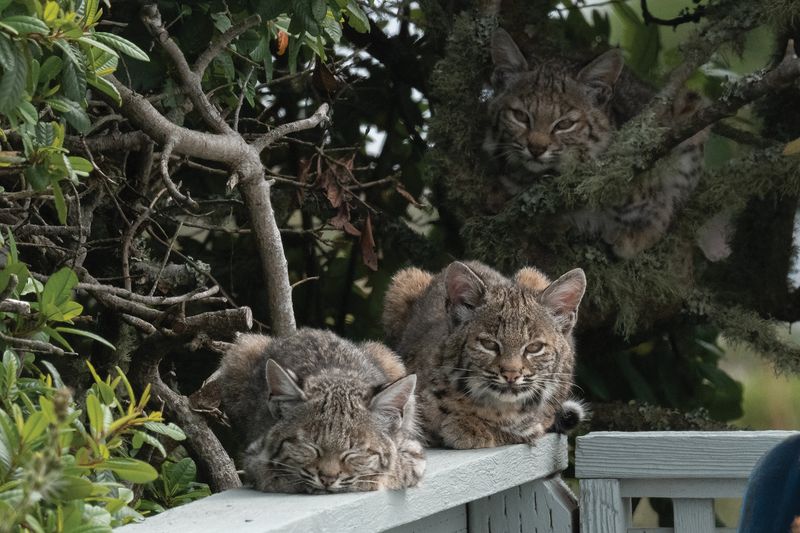
Spotting a bobcat crouched at the edge of your yard can stop you cold, and the first instinct for most California homeowners is to wonder whether something has gone seriously wrong. The truth is far less dramatic than that first surge of alarm suggests.
Bobcats are native California wildlife that move through suburban neighborhoods more often than most people realize, and knowing what that sighting actually signals, and what to do next, makes all the difference between a panicked reaction and a smart one.
A bobcat in the yard usually means opportunity, not pursuit
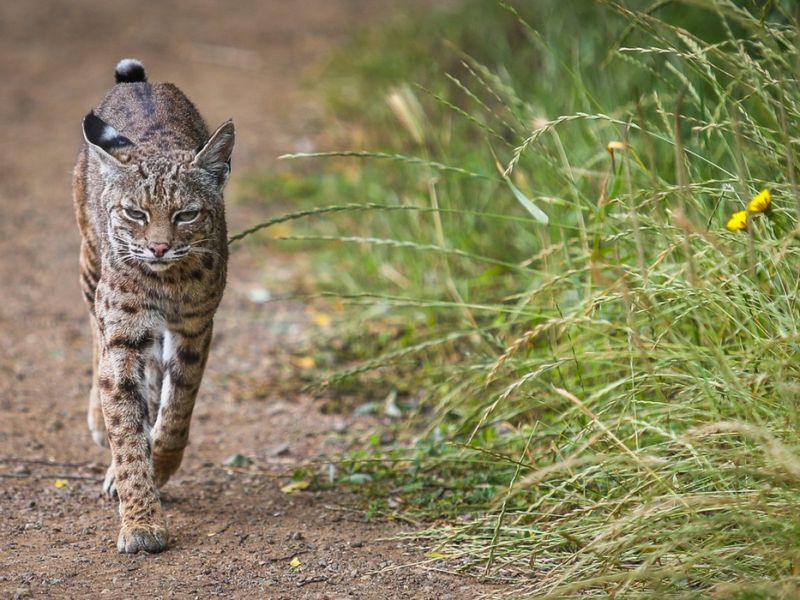
Seeing a bobcat pause near your back fence is unsettling, and that reaction makes complete sense. A wild predator in a residential yard commands attention.
Before that alarm turns into a hasty decision, though, it helps to understand what the sighting most likely signals, because the explanation is almost always more ordinary than the fear.
According to the California Department of Fish and Wildlife (CDFW), bobcats are solitary, elusive animals that generally avoid people. When one shows up in a California yard, the most common explanation is access: the property connects to usable habitat, or the yard contains something the bobcat finds worth investigating.
Rabbits, rodents, birds, and other small prey are the primary draw. Cover such as dense shrubs or brush piles, standing water, unsecured garbage, and outdoor pet food can also pull a bobcat closer to a home than it would otherwise venture.
California bobcats occupy an impressive range of environments, from chaparral and oak woodland to riparian corridors and desert edges. Urban and suburban areas are not off-limits.
Research on bobcat behavior in fragmented Southern California habitat found that these cats can persist in suburban landscapes by adjusting their movement patterns around human activity. A bobcat crossing your yard may simply be traveling a corridor it uses regularly, drawn by the prey base your neighborhood sustains.
A single sighting does not establish that the animal has taken up residence on your property, that it is targeting you or your family, or that a mountain lion is somewhere nearby. CDFW’s human-wildlife conflict guidance does not draw any connection between bobcat sightings and mountain lion presence, and the sources reviewed do not support that claim.
The bobcat passed through because your yard offered an opening, a meal, or a route. That is the explanation that should guide your response.
First, make sure the animal is actually a bobcat
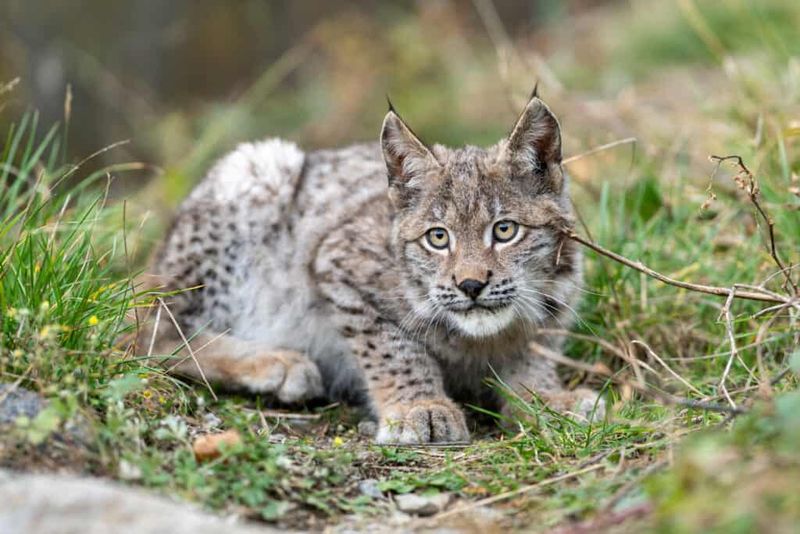
Before deciding how to respond, take a calm look from a safe indoor or sheltered position. Correctly identifying the animal matters, because a bobcat and a mountain lion call for different levels of concern and entirely different agency guidance.
Bobcats are noticeably smaller than mountain lions, typically about two to three times the size of a domestic house cat. CDFW describes the bobcat as having a short “bobbed” tail that measures only a few inches, prominent ear tufts, and a coat that is spotted or barred with brown, tan, and black markings.
Those three features, compact tail, tufted ears, and patterned coat, are the clearest field markers from a distance.
A mountain lion looks fundamentally different. It is substantially larger, carries a long, heavy tail that may reach nearly the length of its body, and displays a uniformly tan or tawny coat without the bold spotting pattern of a bobcat.
CDFW’s bobcat page and California State Parks mountain lion guidance both make clear that these are distinct animals with very different profiles. If the cat in your yard is large, long-tailed, and uniformly colored, treat it as a potential mountain lion and consult the appropriate state resources rather than bobcat guidance.
Observe from inside the house or from behind a closed door or window. Binoculars help if you have them.
The goal is a confident identification from a distance that keeps you, your family, and your pets fully separated from the animal. Do not step outside for a closer look, and do not attempt to photograph it at close range.
A brief, calm observation from safety gives you everything you need to act appropriately.
What should you do while the bobcat is still outside?
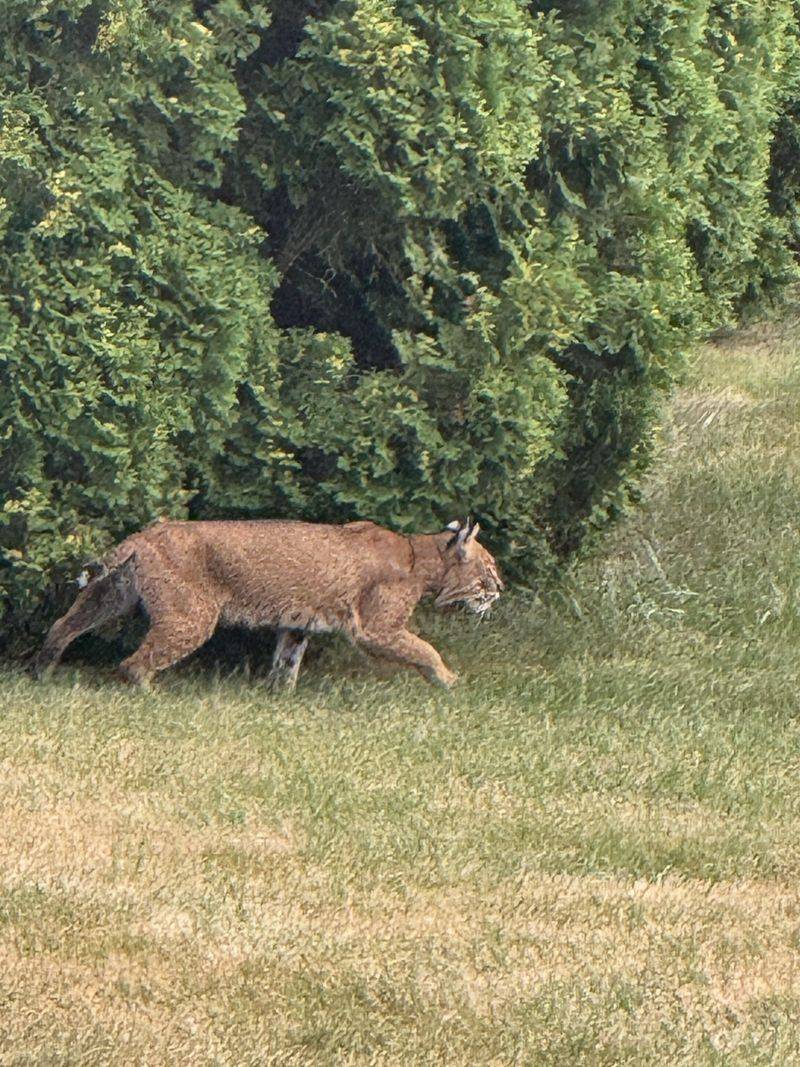
While the bobcat is still in the yard, a calm and deliberate response protects your household without putting anyone at risk. The sequence is straightforward, and the most important step comes first.
Bring children and pets inside immediately, or place them behind a securely closed door or barrier if they are already outdoors. Small dogs and cats are the most vulnerable, and even a few unsupervised minutes outside during a bobcat sighting creates unnecessary risk.
CDC wildlife guidance consistently advises keeping people and domestic animals away from wild animals, and that advice applies here regardless of how calm the bobcat appears.
Once people and pets are secure, give the bobcat room to leave on its own. Do not block the path it used to enter the yard, and avoid positioning yourself or others in a way that cuts off its exit.
A bobcat that feels cornered or trapped is more likely to hold its ground or react defensively. CDFW’s bobcat conflict guidance supports giving the animal a clear escape route rather than attempting to drive it away through pursuit or confrontation.
Stay quiet and avoid shouting, throwing objects, or rushing toward the animal. Do not feed it, touch it, or attempt to photograph it from close range.
If you need to check on something outdoors urgently, wait until the bobcat has moved on. CDFW’s living-with-wildlife resources and CDFW’s rehabilitation guidance both reinforce that capturing or handling a wild animal independently is unsafe and should not be attempted.
Prevention and patience are safer than pursuit, and most healthy bobcats move on without incident when given the space to do so.
The real household risk is an unsecured pet or small animal
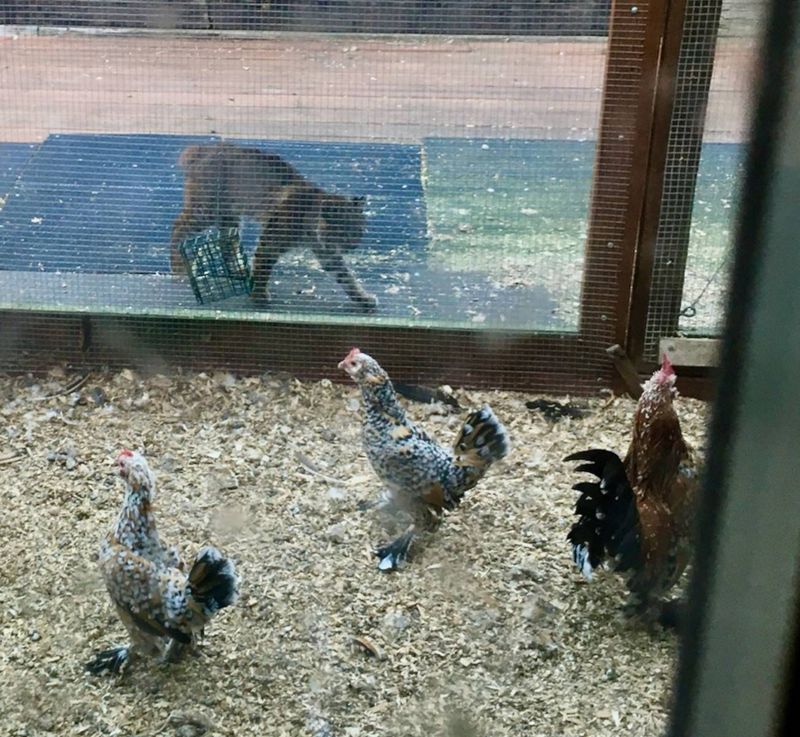
Bobcats are skilled, opportunistic hunters, and their natural diet centers on rabbits, rodents, birds, reptiles, and other small prey. That prey profile overlaps with what many California homeowners keep outside: chickens, ducks, cats, and small dogs.
The risk is real, but it is also largely preventable.
CDFW confirms that bobcats may opportunistically take cats, small dogs, and poultry when those animals are not securely confined. The highest-risk windows are dusk through dawn, when bobcat activity naturally peaks, though daytime encounters are also possible.
Leaving a small pet unattended in a yard during these hours, even briefly, raises the odds of a conflict.
Keeping cats and small dogs indoors is the most reliable protection. For poultry and other small livestock, CDFW’s Living with Bobcats guidance recommends housing them in covered, fully enclosed pens with tightly secured seams.
Bobcats are capable climbers and jumpers, so an open-top enclosure or a pen with loose edges does not provide adequate protection. Hardware cloth or welded wire that is properly secured on all sides and across the top is the standard to aim for.
A bobcat sighting in the neighborhood does not mean every outdoor animal is in immediate danger, and it does not signal that the bobcat is specifically targeting your property. The concern is access.
An animal that can be reached will be more vulnerable than one that cannot. Closing that gap through secure housing and supervised outdoor time for pets is the practical step that matters most, and it remains effective regardless of whether the bobcat ever returns.
Reduce the reasons a bobcat may return
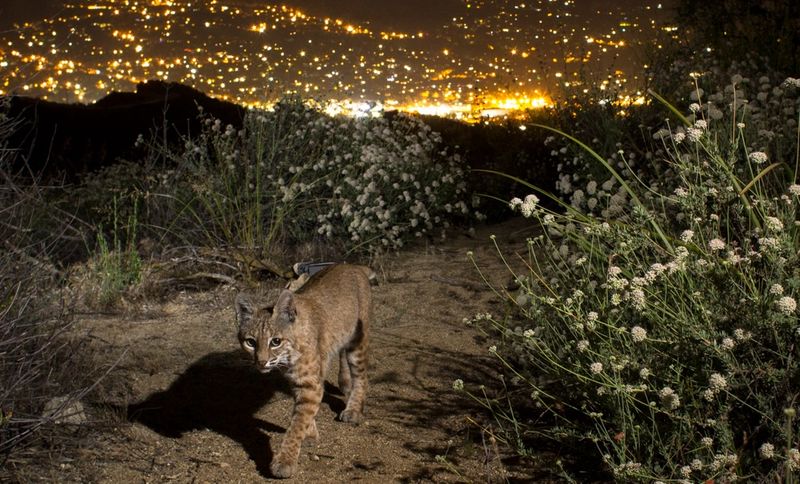
After the immediate situation is handled, the next question most homeowners ask is how to make a repeat visit less likely. Reducing what draws a bobcat to the yard is the most reliable approach, though it helps to be realistic about what you can and cannot control.
Start with the attractants that are easiest to address. Bring pet food and water dishes inside at night, or remove them entirely from outdoor spaces.
Clean up spilled birdseed beneath feeders, since accumulated seed draws rodents and birds, which in turn can attract bobcats. CDFW’s Living with Bobcats fact sheet recommends securing garbage containers and managing pet waste, both of which can draw prey animals that bobcats follow.
California Fish and Game Commission materials have also addressed the role of wildlife feeding in creating indirect attractant chains.
Bird feeders are not automatically the problem, but the conditions around them can be. Spilled seed that builds up beneath a feeder creates a foraging spot for rodents and ground-feeding birds, and that concentration of small prey can attract a hunting bobcat.
If bobcat visits become recurrent, suspending feeding temporarily or switching to a feeder style that minimizes ground spillage is a reasonable step. CDFW notes that feeding wildlife, including birds, can indirectly pull predators into a yard.
Motion-activated lights, sprinklers, or sound devices may briefly discourage a bobcat from approaching a specific area, but their effectiveness tends to decrease as the animal becomes familiar with them. University of Florida IFAS Extension guidance on wildlife deterrents confirms that habituation is a documented limitation of scare devices.
These tools work best as a temporary supplement, not a standalone solution, and they cannot replace removing food sources or securing pets and livestock.
Some factors remain outside a homeowner’s direct control. Natural prey like rabbits and rodents, dense brush or drainage corridors that provide cover, and the fragmented suburban habitat that connects yards to open space can all explain why a bobcat moves through an area.
Reducing obvious attractants is worthwhile and appropriate; expecting complete prevention is not realistic.
Daylight alone is not the warning sign people think it is
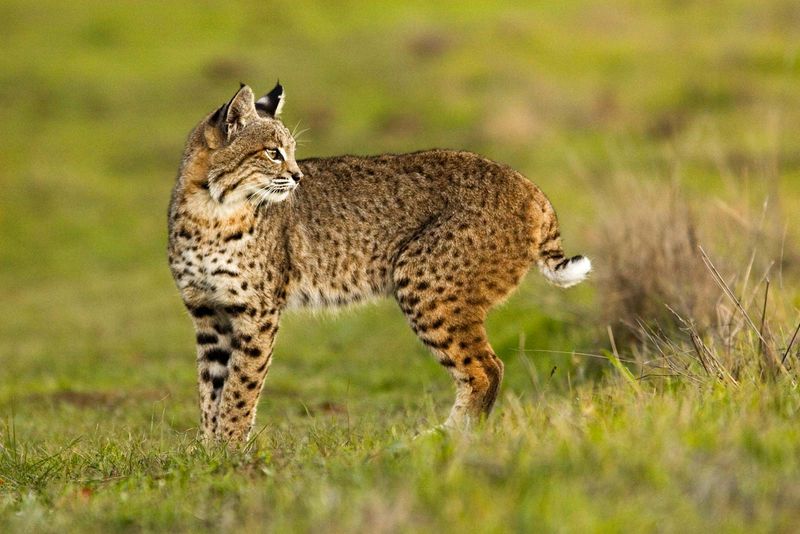
One of the most persistent misconceptions about bobcats is that any daytime appearance signals illness or danger. That assumption can push homeowners toward unnecessary alarm, and it is worth correcting clearly.
CDFW states directly that bobcats are most active at night and during twilight hours but can be seen during the day. A bobcat moving through a yard at midmorning or midafternoon is not automatically sick, rabid, or behaving abnormally.
Mothers with kittens may hunt during daytime hours to meet higher energy demands. A bobcat may also shift its schedule in response to prey availability or disturbance patterns in a neighborhood.
The time of day, by itself, is not a reliable indicator of a problem.
The behaviors and conditions that do justify greater concern are distinct and observable. Watch for staggering or an unsteady gait, apparent paralysis, severe disorientation, an animal that circles repeatedly without a clear direction, unusual tameness or willingness to approach people, persistent aggression without provocation, or a failure to retreat when given space.
These signs, individually or in combination, suggest something may be physically wrong with the animal.
If a bobcat displays any of those characteristics, stay away and do not attempt to handle or capture it. CDFW’s living-with-wildlife resources and CDFW’s sick and injured wildlife guidance both caution against independent handling of wild animals.
Instead, contact your local animal services agency, a CDFW regional office, or a permitted wildlife rehabilitator. These professionals can assess the situation and determine whether intervention is warranted.
Describing what you observed, including the animal’s posture, movement, and reaction to your presence, helps them respond appropriately.
A bite or scratch changes the response

Most bobcat sightings end without any physical contact, but if a person or pet is bitten or scratched, the response needs to shift immediately from observation to action.
For a person who has been bitten or scratched, wash the wound thoroughly with soap and water for at least 15 minutes. Then contact a healthcare provider or your local health department promptly so they can assess the rabies exposure risk and advise on next steps.
CDC rabies prevention guidance identifies prompt wound washing and timely medical evaluation as the essential first responses to a potential exposure. Do not wait to see if symptoms develop before seeking advice.
If a pet was bitten or scratched, contact a veterinarian as soon as possible. CDC wildlife and pet guidance recommends veterinary evaluation after any contact between a domestic animal and a wild animal that could carry rabies.
California has documented rabies in bobcats, and California Department of Public Health records confirm occasional cases in the state. CDPH rabies information makes clear that exposure decisions belong with public-health professionals, not with the homeowner.
The existence of occasional cases does not make an ordinary sighting a likely rabies event, but an actual bite or scratch is a different matter entirely and warrants prompt professional evaluation without delay.
Use California’s conflict process instead of attempting removal
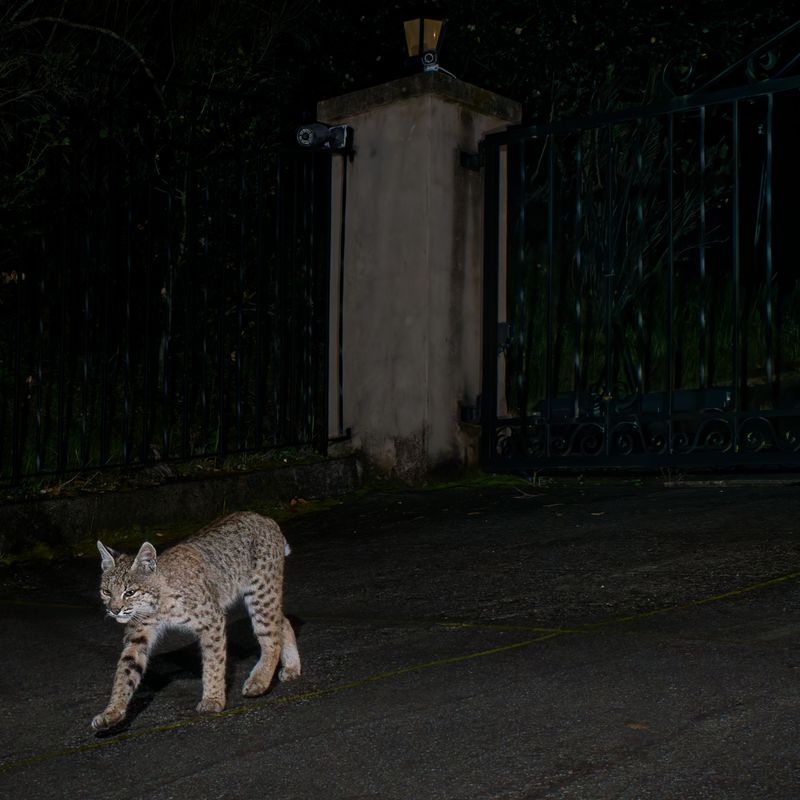
Repeated visits, livestock losses, or a bobcat that has caused property damage are situations where contacting wildlife officials makes sense, even when the animal shows no signs of illness. You do not have to wait for a bite or a confirmed health concern to reach out for guidance.
CDFW’s human-wildlife conflict resources for bobcats and CDFW’s broader living-with-wildlife guidance both support engaging with the appropriate agency when ongoing conflicts arise.
What homeowners should not do is attempt to resolve the situation through trapping, relocation, or chemical deterrents. CDFW’s Living with Bobcats fact sheet states that no chemical repellents, fumigants, or toxicants are currently registered for bobcats in California.
Using poison or improvised chemicals is unsafe and not supported by state guidance. Relocation is also not an option under CDFW’s guidance; damage situations should be directed to the applicable agency reporting and permitting processes rather than handled independently.
The practical path forward follows the same logic throughout: identify the animal from a safe distance, protect pets and livestock through secure housing and supervised outdoor time, remove the preventable attractants you can control, and give a healthy bobcat the space and route it needs to leave. A bobcat slipping through a California yard is not a prediction of danger.
It is a sign that the yard connects to a landscape where wildlife still moves. That connection can be managed thoughtfully, and California’s agencies exist to help when management alone is not enough.