
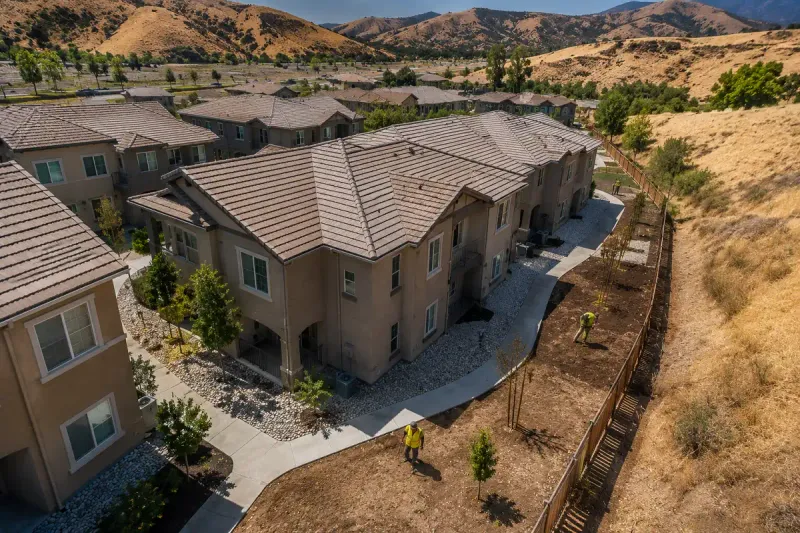
Wildfire smoke, ember showers, and scorched neighborhoods have pushed California to strengthen its fire-safety landscaping rules, and some of those rules now carry enough legal weight to override what a homeowner association demands in the yard. For homeowners living in fire-prone communities governed by an HOA, that creates a real tension: follow the HOA’s landscaping standards or follow the fire code.
The answer depends on which specific law applies to the property, whether it actually conflicts with the HOA rule, and how well the homeowner documents the situation.
An applicable fire rule can control a conflicting HOA demand
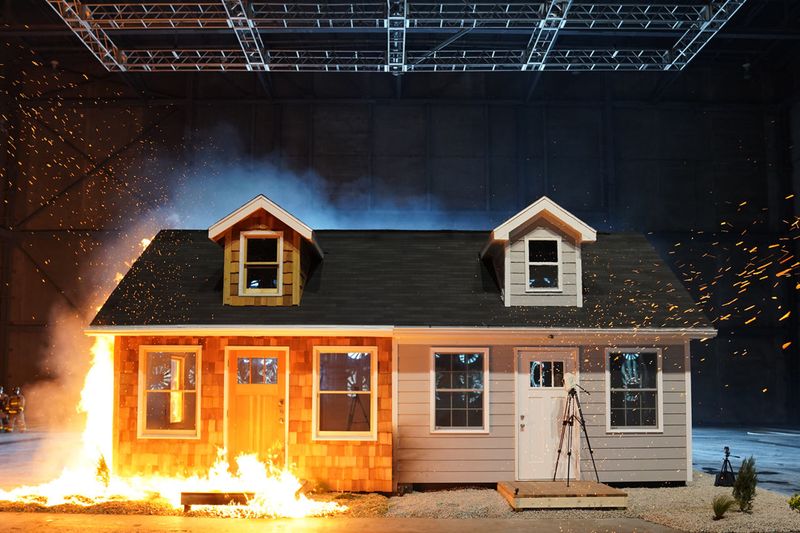
California law puts a clear thumb on the scale when a homeowner association rule runs into a genuine state or local fire-safety requirement. Civil Code § 4205 states that when an HOA’s governing documents conflict with California law, the law wins.
That principle applies to statutes, regulations, and approved local fire-safety requirements, and it means an HOA cannot force a covered homeowner to violate a controlling fire rule.
The critical word is “conflict.” A homeowner who simply prefers a fire-conscious planting style, or who is following general agency guidance rather than a binding legal requirement, does not automatically have a legal trump card over the HOA. The conflict must be real: the HOA rule must directly prohibit or prevent what the applicable fire-safety law actually requires.
A general HOA preference for lush greenery, a particular mulch color, or a formal garden layout is not nullified just because a homeowner finds it inconsistent with good fire-safety practice.
Existing California defensible-space statutes already impose binding requirements on many properties in State Responsibility Areas and Very High Fire Hazard Severity Zones. Those existing requirements are the legal basis most homeowners can rely on today.
Separately, the California Board of Forestry and Fire Protection approved a final draft of statewide Zone 0 regulations in August 2026, but as of September 23, 2026, that package still required review by the Office of Administrative Law and publication by the California Secretary of State before it could take full effect. The Board’s Zone 0 approval announcement confirms that timeline.
This article covers both the existing applicable requirements and the pending Zone 0 rules, and it keeps those two things clearly separate.
Confirm the property’s fire designation before changing the landscape
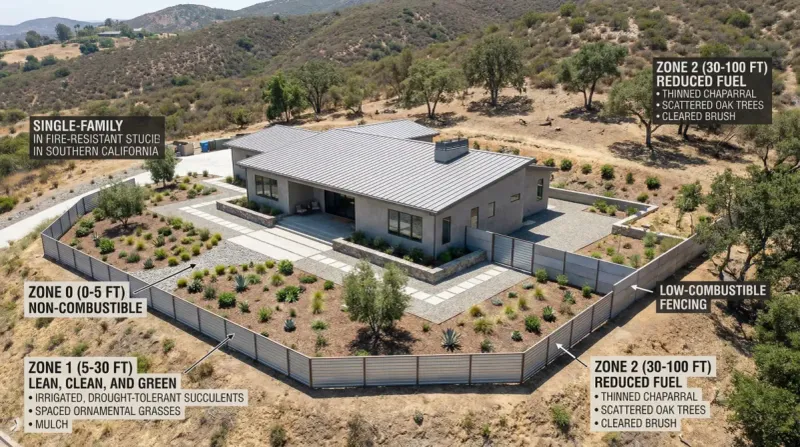
Before pulling a single plant or spreading a single bag of gravel, the most important step is confirming which fire-safety framework actually applies to the property. Two separate California statutes create defensible-space duties, and they cover different kinds of land.
Public Resources Code § 4291 applies to structures located in a State Responsibility Area, which is land where the state bears primary responsibility for wildfire protection. Government Code § 51182 applies to occupied structures in Very High Fire Hazard Severity Zones that have been designated by a local agency within a Local Responsibility Area.
Both statutes establish a general 100-foot defensible-space framework around structures, but they are not interchangeable. A property in a city or county Local Responsibility Area that has not been designated a Very High Fire Hazard Severity Zone may not fall under either statute at all.
The 100-foot number also does not mean 100 feet of identical treatment. Slope, surrounding vegetation, building conditions, and local rules all affect what work is actually required and where.
Property-line limits matter too: the statutes recognize that a homeowner cannot always complete a full 100-foot clearance if the property ends before that distance. CAL FIRE’s defensible space guidance explains the graduated zones and the factors that modify the standard distance.
Local governments may also impose requirements that are stricter than the state baseline, and fire agencies can approve alternative practices that achieve substantially similar fire-safety results. A homeowner relying on state minimums alone could miss a stricter local ordinance or a fire-department inspection requirement.
Verifying the property’s designation and checking with the local fire department or fire protection district is the only reliable way to know which legal requirements actually apply before making any landscape change or HOA request.
Zone 0 has important limits and a defined regulatory timeline
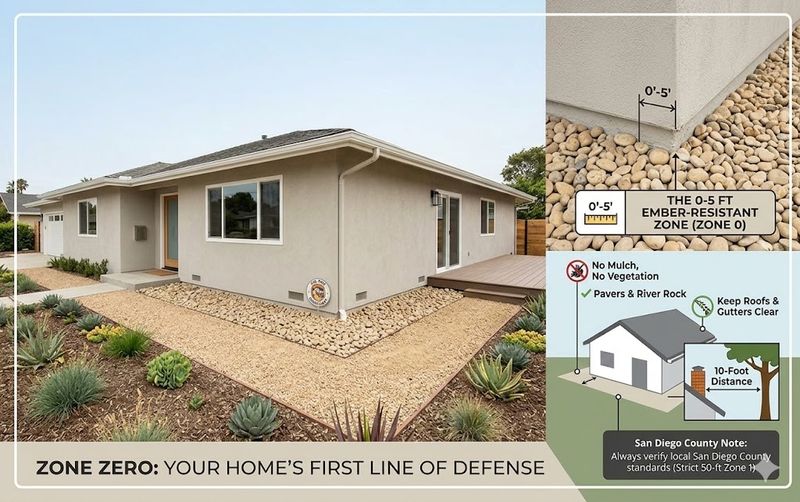
The ember zone closest to a home’s foundation gets the most attention in California’s updated fire-safety framework, and for good reason. Embers carried by wind can land in combustible material right next to the house and start a fire even when flames are still far away.
The first five feet around a structure is where that risk is most concentrated.
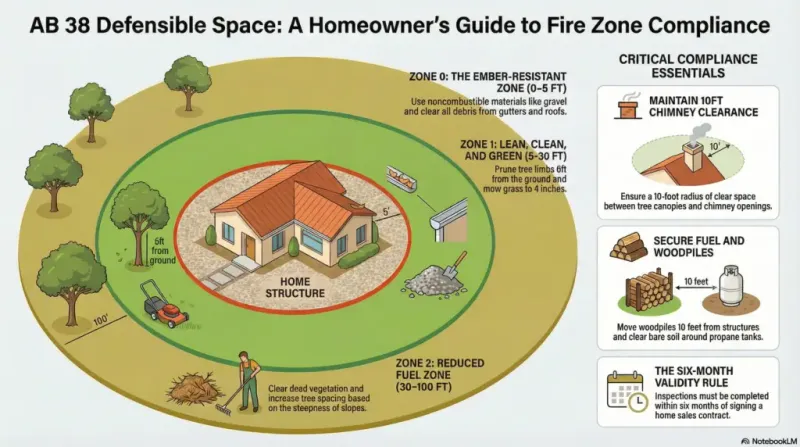
CAL FIRE’s defensible space guidance describes practical steps for this area: use hardscape such as gravel, concrete, or pavers; remove combustible bark and mulch; clear dead vegetation and debris; relocate firewood storage; and limit combustible items placed near the structure. These steps reflect sound fire-safety practice regardless of which specific regulation applies.
The California Board of Forestry’s Zone 0 program page and the Board’s proposed rule packages track the regulatory process. The Board approved a final draft of Zone 0 regulations on August 19, 2026, but as of September 23, 2026, the package still required review by the Office of Administrative Law and publication by the California Secretary of State before becoming fully effective statewide.
That means the new Zone 0 operational rules were not yet enforceable everywhere on that date.
The Board’s August 2026 Zone 0 approval announcement also makes clear that the approved draft is not an absolute ban on every plant within five feet. The draft allows certain well-maintained herbaceous plants, flowers, low ground covers, lawns, and movable plants in specified portions of Zone 0.
What it restricts is combustible materials, dead vegetation, plants placed near openings such as vents and windows, and other hazards that create a direct ember-ignition path. Homeowners planning changes in the first five feet should read the actual approved draft language and check with their local fire agency rather than assuming all vegetation must be removed.
Compare the HOA rule with the exact controlling requirement
Knowing that fire-safety law can control a conflicting HOA rule is only half the job. The other half is doing the comparison carefully enough to know whether a real conflict actually exists.
That process starts with two specific documents: the exact HOA provision being enforced and the exact legal requirement that applies to the property.
Ask the HOA in writing to identify the specific CC&R section, architectural guideline, or landscaping policy it is relying on. Then identify the applicable statute, regulation, local ordinance, fire-agency requirement, or inspection notice on the fire-safety side.
Civil Code § 4205 establishes the hierarchy, but it only resolves the dispute when there is a genuine conflict between a specific HOA demand and an applicable law. A general claim that fire safety matters more than HOA preferences is not enough.
Read both documents side by side. The HOA rule might require a specific plant type, a minimum lawn area, a particular mulch material, or a design style.
The fire-safety requirement might prohibit combustible mulch, require clearance near openings, or mandate spacing between plants. If the HOA rule directly prevents compliance with the fire requirement, a conflict exists.
If the HOA rule is silent on the specific point, or if both requirements can be satisfied at the same time, there is no conflict to resolve through the legal hierarchy.
Local standards add another layer. Government Code § 51182 allows local fire agencies to adopt alternative practices or more stringent requirements than the state baseline.
CAL FIRE also notes that local governments may impose stricter standards. A homeowner should check local fire-department requirements before finalizing any written proposal to the HOA, and should document the proposed landscape changes in enough detail to show how they satisfy the controlling fire requirement without abandoning every compatible HOA standard.
Defensible space manages fuel instead of erasing vegetation
Stripping a yard down to bare dirt is not what California’s defensible-space requirements call for, and it can actually create new problems like erosion and dust. The goal is managed fuel, not the elimination of every living thing.
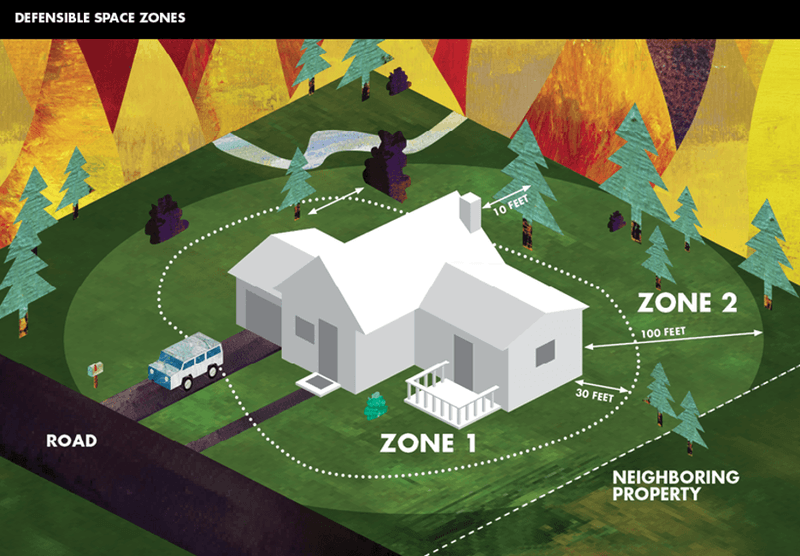
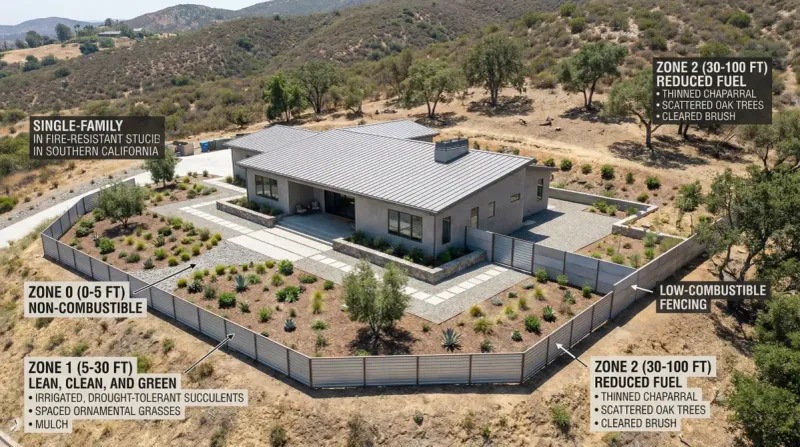
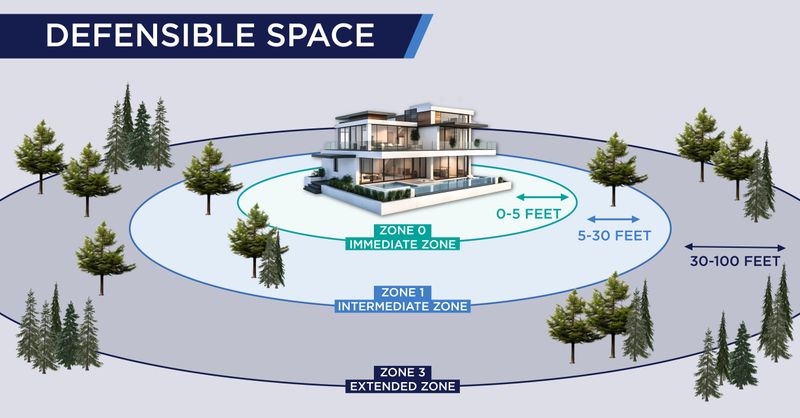
CAL FIRE’s defensible space program describes three graduated areas that each carry different expectations.
From zero to five feet, hardscape, gravel, or concrete is generally preferred, combustible mulch and bark should be removed or replaced, and debris and dead plant material should be cleared regularly. From five to thirty feet, the focus shifts to spacing, pruning, and fuel-ladder prevention.
Shrubs should be separated so fire cannot move continuously from one to the next, lower branches on trees should be pruned up, and dead material should be removed promptly. UC IPM’s fire-hazard landscaping guidance reinforces that maintenance and placement decisions matter far more than plant labels alone.
From thirty to one hundred feet, the work is about breaking up continuous fuel. Trees and large shrubs can remain when they are appropriately spaced, irrigated, and maintained.
UC ANR’s Fire Network defensible-space resources and UC Marin Master Gardeners’ fire-smart tips both support retaining native, drought-tolerant, and wildlife-supporting plants in appropriate locations when they are managed correctly.
Plant labels, including “fire-resistant,” “native,” or “drought-tolerant,” do not make a plant safe by themselves. UC ANR’s home landscaping for fire preparation guide notes that all plants can burn under the right conditions.
Irrigation, pruning, dead-material removal, and thoughtful spacing are what actually reduce risk. A well-maintained native plant in the right location is a sound choice; the same plant left dry, unpruned, and crowded against the house is a hazard regardless of its species name.
Property control determines what the homeowner may change
One of the most practical limits on a homeowner’s ability to create defensible space is something that has nothing to do with fire law: who actually controls the land. A homeowner cannot unilaterally remove trees, shrubs, fences, or other vegetation on property they do not legally manage, regardless of how close that vegetation is to their structure.
Public Resources Code § 4291 expressly recognizes this limit, acknowledging that a property owner cannot be required to manage fuel on land they have no legal right to manage. Government Code § 51182 carries a similar framework.
In an HOA community, this becomes especially relevant because the landscaping near a home may include common areas controlled by the association, limited common areas with shared maintenance duties, attached structures, fences, or neighboring parcels.
When vegetation on HOA common areas or a neighbor’s property creates a hazard within the defensible-space distance, the homeowner’s correct step is documentation, not unilateral removal. Write to the HOA explaining the fire-safety concern, identify who is responsible for maintaining the area in question, and ask the association or other responsible party to take action.
If a fire-agency inspection has identified the vegetation as a hazard, include that notice in the written request. Removing common-area plants, shared fences, or a neighbor’s shrubs without authorization exposes the homeowner to legal liability separate from any fire-safety dispute, and it does not resolve the underlying question of who holds the maintenance obligation.
Water-wise and habitat-friendly goals must fit the fire requirement

Many California homeowners want a yard that is water-efficient, pollinator-friendly, and supportive of local wildlife, and they may run into HOA resistance when they try to get there. A separate statute addresses some of that tension.
Civil Code § 4735 makes HOA rules void and unenforceable if they prohibit low-water plants, artificial turf, or compliance with qualifying water-efficiency requirements. That protection is real and useful for homeowners facing HOA pushback on water-wise choices.
What § 4735 does not do is automatically resolve an ember-zone dispute or override a valid fire-safety restriction. A low-water plant placed directly against a vent screen in a combustible mulch bed is still a fire hazard, regardless of its water use.
Conversely, an HOA cannot use a general landscaping preference to block a homeowner from complying with an applicable fire-safety requirement. The two statutes address different problems and neither one cancels the other.
The practical path is to align water-wise and wildlife-friendly choices with the fire-safety framework rather than treating them as competing priorities. Public Resources Code § 4291 itself directs agencies to preserve or restore native species where feasible, minimize erosion and water use, and allow trees and shrubs for shade, aesthetics, and habitat when managed safely.
UC Marin Master Gardeners’ fire-smart landscaping tips show how native, drought-tolerant plants can support pollinators and birds while fitting within a defensible-space plan, as long as they are appropriately placed, spaced, irrigated, pruned, and maintained. The goal is a yard that satisfies both frameworks, and in most cases that is achievable with careful planning rather than a choice between one set of values and the other.
Use a written request to resolve the landscaping conflict
Verbal conversations with HOA board members rarely produce durable results when landscaping and fire safety are in conflict. A written modification request, backed by specific documents, gives the homeowner a clear record and gives the HOA a concrete proposal to evaluate rather than a general complaint.
Start by verifying the property’s fire designation through CAL FIRE’s maps or the local fire department. Identify the controlling requirement by name and section number, whether that is Public Resources Code § 4291, Government Code § 51182, a local ordinance, or a fire-agency inspection notice.
Obtain the specific HOA rule in writing and map the actual conflict between the two. Check local fire-department standards for any stricter requirements that apply to the specific property.
Confirm who controls each portion of the affected land before proposing any change that touches common areas or structures outside the homeowner’s individual lot.
The written request should describe the proposed landscape in enough detail to show how it satisfies the controlling fire requirement while preserving every compatible HOA standard. Civil Code § 4205 supports the homeowner’s position when a genuine conflict exists, but a well-documented proposal often resolves the dispute before it reaches that legal threshold.
Consulting the local fire department or fire protection district for site-specific guidance strengthens the request and may surface local requirements that the homeowner had not yet identified. CAL FIRE’s defensible space resources are a practical starting point for building that documentation.
A yard that satisfies the applicable fire requirement, respects compatible HOA standards, and is supported by a clear written record is the most defensible outcome in every sense of the word.