
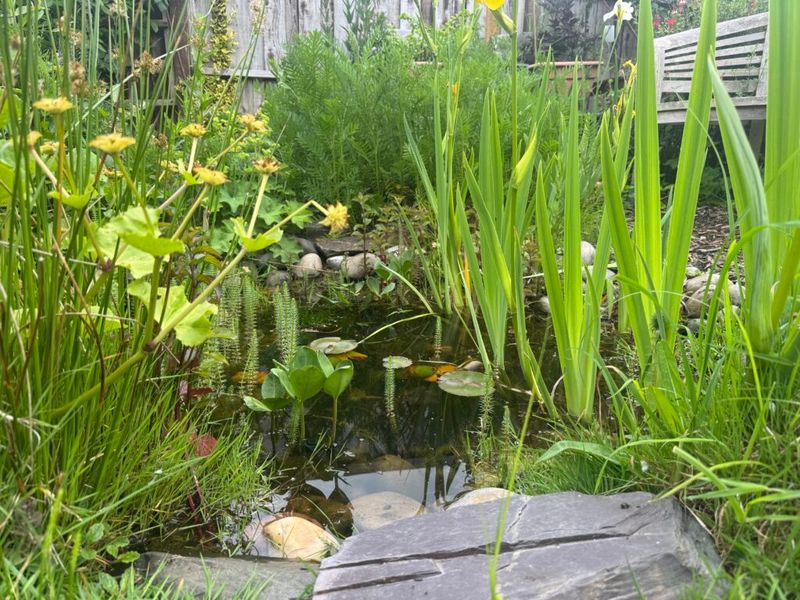
Dragonflies are some of the most capable hunters in your yard, and they spend the earliest part of their lives underwater hunting mosquito larvae before they ever take to the air. Building a pond that supports their full life cycle is one of the most wildlife-friendly improvements a California homeowner can make.
The catch is that a poorly designed water feature can actually become a mosquito nursery instead of a solution. Get the setup right, and you add real predators to your yard’s natural mosquito-management toolkit.
A breeding pond can support predators without guaranteeing fewer bites
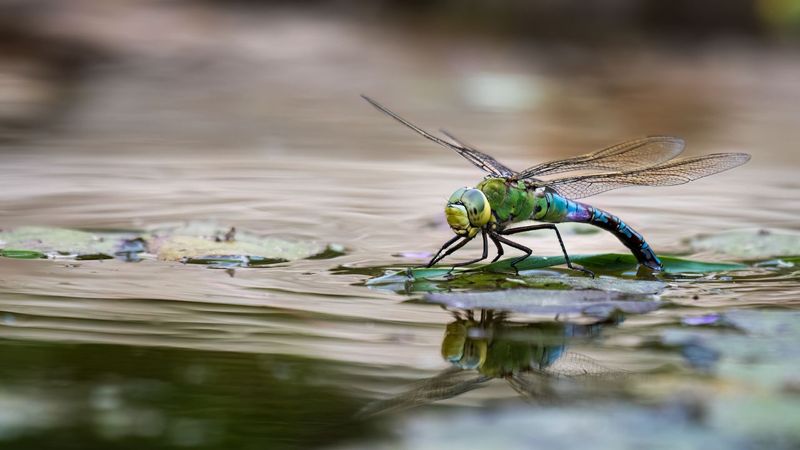
Adult dragonflies visiting your yard are a welcome sight, but a perch on a fence post or a lap around the patio does not mean your yard is doing anything for dragonfly reproduction. NPS documentation on the common green darner makes clear that dragonflies need water to complete their life cycle: females lay eggs in or near aquatic habitat, and nymphs spend most of their development submerged, hunting other aquatic organisms including mosquito larvae.
Flowers, open lawn, and garden perches may attract adults passing through, but none of those features support reproduction on their own.
The two life stages also control mosquitoes through completely different mechanisms. Nymphs are underwater ambush predators that consume mosquito larvae directly.
Adults are aerial hunters that capture flying insects, which can include adult mosquitoes, but also midges, flies, and other insects they encounter while patrolling. A pond that supports nymph development adds a predator where mosquitoes are most vulnerable, in the water, before they can emerge and bite.
What a well-designed pond cannot do is guarantee a measurable reduction in biting pressure across your property. A 2023 meta-analysis in the Journal of Animal Ecology found strong evidence that dragonfly and damselfly nymphs can suppress mosquito larvae under controlled experimental conditions.
Those results came from contained studies, not typical California backyards, and they do not translate directly into a predictable bite-reduction figure for a homeowner.
UC IPM notes specifically that even effective larval control on a property may not reduce local adult mosquito numbers or biting activity, because mosquitoes can develop elsewhere and travel to your yard. The realistic and defensible goal is to build habitat that may support natural mosquito control as one part of a broader integrated approach, not to replace source reduction, screens, or repellents with a pond.
Choose a site with usable sun, intermittent shade, and inspection access
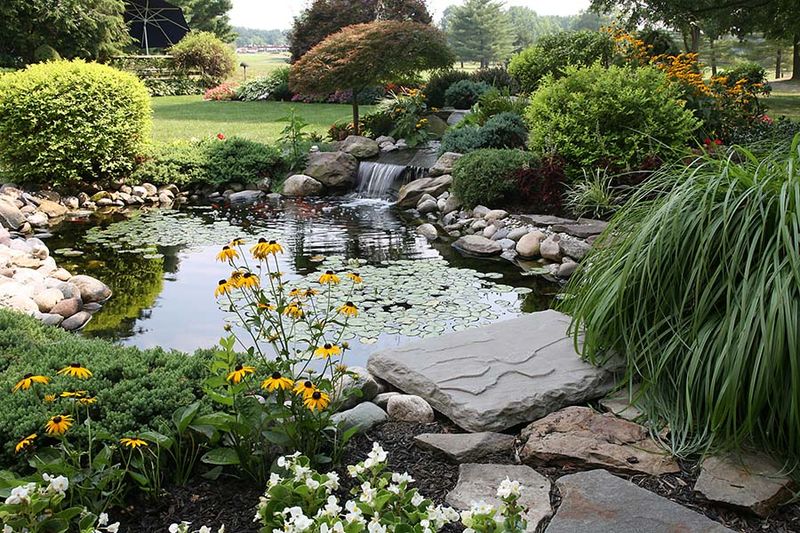
Placement shapes everything about how well a pond functions for dragonflies. Most dragonfly species are sun-dependent: they bask on rocks and stems to regulate their body temperature, and adults are most active in open, warm conditions.
Penn State Extension guidance on backyard pond design recommends a location that receives several hours of direct sun each day, while also noting that some intermittent shade helps moderate water temperature and slows excessive algae growth, particularly in smaller ponds. Full shade is not suitable, but a mix of sun and occasional shade is more practical than insisting on full sun in California’s inland valleys and hotter microclimates.
Access matters as much as light. Leave a clear path around at least part of the pond so you can inspect the water surface, remove debris, and check for mosquito larvae weekly without trampling plants or disturbing the margins.
A pond tucked into a dense corner of the yard becomes difficult to monitor and easy to neglect, which is exactly the condition that can turn a wildlife feature into a mosquito problem.
Before breaking ground, check with your local water agency, city planning department, and fire district. Water use, pond construction, drainage connections, and defensible-space setbacks vary significantly across California communities.
Some water districts offer rebates for wildlife-friendly water features, while fire-prone areas may have specific rules about vegetation and water storage near structures. There is no single pond size, depth, or orientation that works for every California climate zone or species, so treat local guidance as part of the design process rather than an afterthought.
Layer the pond with plants and emergence structures
A pond that looks like a bathtub with water in it will not support dragonfly breeding. What nymphs actually need is structural complexity: submerged vegetation where they can hunt and shelter, emergent stems along the margins where females deposit eggs and nymphs eventually climb out, and floating leaves that break up the surface and shade the water.
Penn State Extension’s pond design resource recommends including all three plant layers to create the range of microhabitats that different dragonfly and damselfly species use at different life stages.
For California yards, native and regionally appropriate plants are the safest choices. Good candidates for emergent zones include native bulrush (Schoenoplectus species), sedges (Carex species suited to your region), and native rushes.
Submerged plants such as native pondweed (Potamogeton species) provide underwater structure and oxygenation. Floating plants like native yellow pond lily (Nuphar polysepala) where appropriate can provide surface shade and egg-laying sites.
Check with your local native plant society or UC Cooperative Extension office for species that match your specific California climate zone.
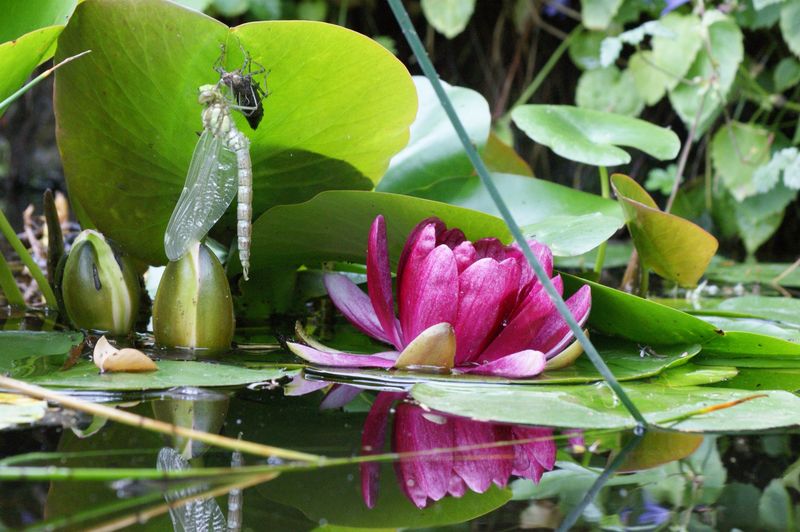
Emergence structures are non-negotiable for successful dragonfly reproduction. When a nymph is ready to transform into an adult, it climbs out of the water and clings to a vertical surface while its exoskeleton splits and the adult unfolds.
Without something to climb, that transformation fails. Push bamboo stakes, sturdy twigs, or smooth-barked branches into the pond margins so they rise several inches above the waterline.
Flat rocks placed partly in and partly out of the water give adults a place to bask after emergence and give you a visual cue: a dragonfly resting on a warm rock near your pond is a sign the habitat is working.
Keep plant coverage to roughly one-third to one-half of the water surface. Dense mats that cover the entire pond block light, reduce oxygen, and create the sheltered, stagnant pockets that mosquito larvae prefer.
Thin plants when they become overcrowded, and remove clippings from the water immediately.
Maintain functioning water instead of neglected stagnation
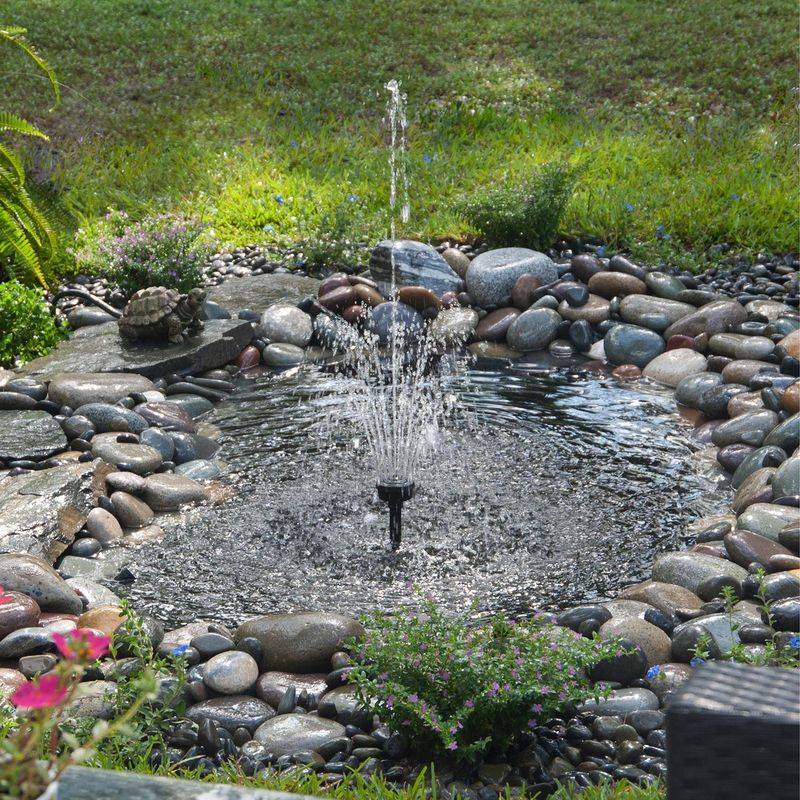
Calm water and stagnant water are not the same thing, and that difference matters for both dragonflies and mosquitoes. Dragonflies do use still or slow-moving water, and a rushing stream is not what you are building.
What you want is water that has functioning ecology: oxygen, circulation, and regular maintenance. UC ANR guidance on pond and water garden management recommends adding a fountain, small waterfall, or submersible pump to reduce stagnation, and CDC guidance similarly advises installing a pump where feasible in standing-water features.
Circulation helps, but it does not make a pond automatically mosquito-proof, especially in shallow pockets near the margins where flow does not reach.
Vegetation management is the maintenance task most homeowners underestimate. UC IPM recommends removing excess vegetation from ponds because dense plant growth provides food, shelter, and physical protection for mosquito larvae developing near the surface.
That means thinning emergent plants when they spread beyond their zone, pulling out floating mats that have grown solid, and raking out leaf litter before it settles into the sediment. Decomposing organic matter at the bottom of a pond reduces oxygen and creates nutrient-rich conditions that favor algae and can benefit mosquito larvae.
Set a weekly inspection habit rather than waiting until you notice a problem. Walk the perimeter, check the water surface for mosquito larvae (they look like tiny wriggling threads near the surface), clear any debris that has blown in, and confirm that your pump or fountain is still running.
A pump that has clogged and stopped creates a stagnant pocket quickly, particularly in the warm months when mosquitoes are most active in California.
Shallow isolated areas along the pond edge deserve specific attention. If the liner has created a separate puddle disconnected from the main water body, fill or level it.
Those pockets do not benefit from your pump, do not support the depth that dragonfly nymphs need, and can produce mosquitoes even when the rest of the pond is well-maintained.
Control mosquito habitat across the entire property
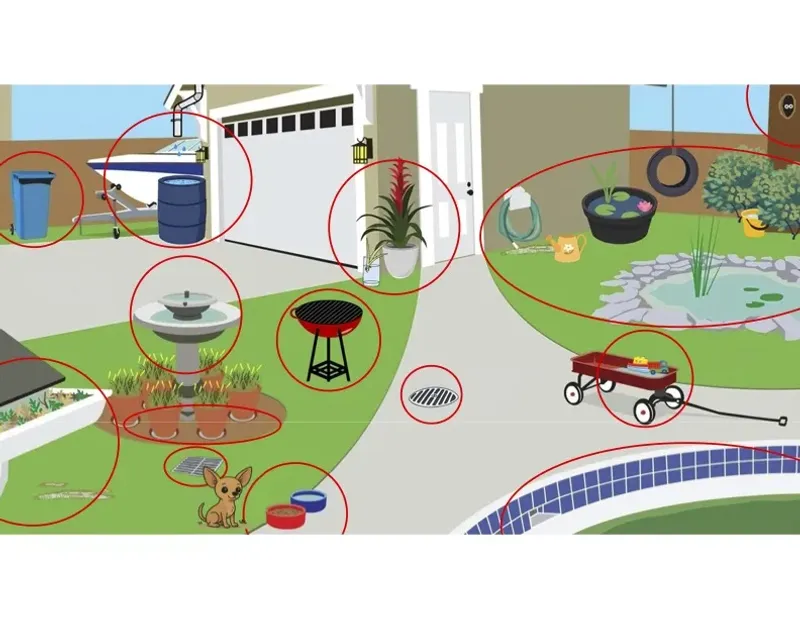
Your pond is one water feature on a property that likely holds a dozen others, and California’s most aggressive mosquito species do not need much to breed. UC IPM’s mosquito management guide identifies plant saucers, buckets, children’s toys, tarps with pooled water, clogged gutters, low spots in lawns, and even bottle caps as potential breeding sites for invasive Aedes mosquitoes that have established in many California communities.
These species can complete a generation in less than a week, so a container you checked last month can be producing adults by the time you notice.
Walk the entire property once a week with source reduction in mind. Tip over anything that holds water and does not need to.
Store containers upside down or in a covered area. Clean gutters before the rainy season and after major debris events.
Change water in bird baths every few days. Cover rain barrels with tight-fitting screens.
Adult mosquitoes can travel significant distances, so even if your pond is perfectly maintained, mosquitoes developing in a neighbor’s yard or a nearby neglected lot can still reach your patio. Controlling what you can on your own property reduces the local contribution to that pressure.
When standing water is unavoidable and you find larvae, a label-directed Bti product is a reasonable backup within an integrated management approach. Bti (Bacillus thuringiensis israelensis) is a naturally occurring soil bacterium whose toxic proteins target the larvae of mosquitoes, blackflies, and fungus gnats.
CDC guidance on larvicides explains that Bti works against larvae in the water, not against adult mosquitoes that are already flying and biting. EPA’s Bti overview describes it as low-risk when used according to label directions, but ecological research indicates that repeated use can reduce other larval insects in the water column that dragonfly nymphs also eat.
Use it as directed, where larvae are present, and treat it as a backup rather than a routine substitute for eliminating unnecessary standing water.
Avoid shortcuts that damage the pond’s food web
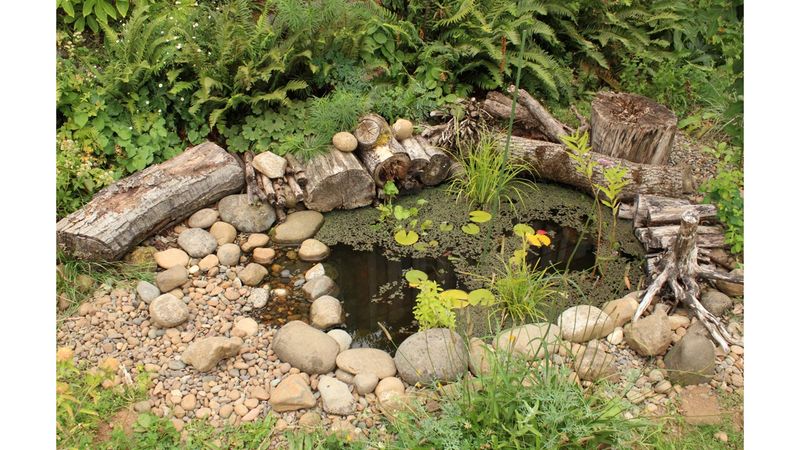
A few common shortcuts can quietly dismantle the habitat you spent time and money building. The first is invasive aquatic plants.
Water hyacinth, hydrilla, Brazilian waterweed, giant salvinia, and waterprimrose are popular in water gardens but are identified by Cal-IPC’s Don’t Plant a Pest aquatic plant list as invasive or ecologically problematic in California. These species can escape into natural waterways through drainage, flooding, or improper disposal.
Never dump aquatic plant trimmings, water, or sediment into a storm drain, creek, or any natural waterway. Dispose of unwanted aquatic plant material in sealed bags in the trash.
Dense planting of even native or non-invasive species can work against you. Thick stands of reeds or rushes that cover most of the water surface reduce light penetration, lower dissolved oxygen, and create the sheltered, slow-water pockets that mosquito larvae use as refuges.
Keep margins productive but open enough to allow inspection and water movement.
Fish are sometimes suggested as a mosquito control shortcut, and they can reduce larvae in some situations. The problem is that fish also eat dragonfly nymphs, amphibian eggs, and other aquatic invertebrates that form the food web your pond depends on.
UC IPM’s mosquito guidance warns against releasing mosquitofish into natural California waters, where such introductions can be illegal and ecologically damaging. If you use mosquitofish in a closed artificial pond, do so under guidance from your local vector control district and keep the pond completely isolated from any drainage that reaches natural water bodies.
Broad-spectrum insecticides and residential mosquito-misting systems are two more shortcuts that undermine the habitat. UC ANR advises protecting dragonflies and other natural predators by avoiding broad-spectrum sprays near the pond.
CDC guidance on residential misting systems notes that these systems can harm beneficial insects and are not recommended for homeowners. If you are treating your yard with a broad-spectrum product or running an automated misting system, you are likely reducing the very predator populations the pond is designed to support.
Measure success by habitat quality, not a mosquito-free patio
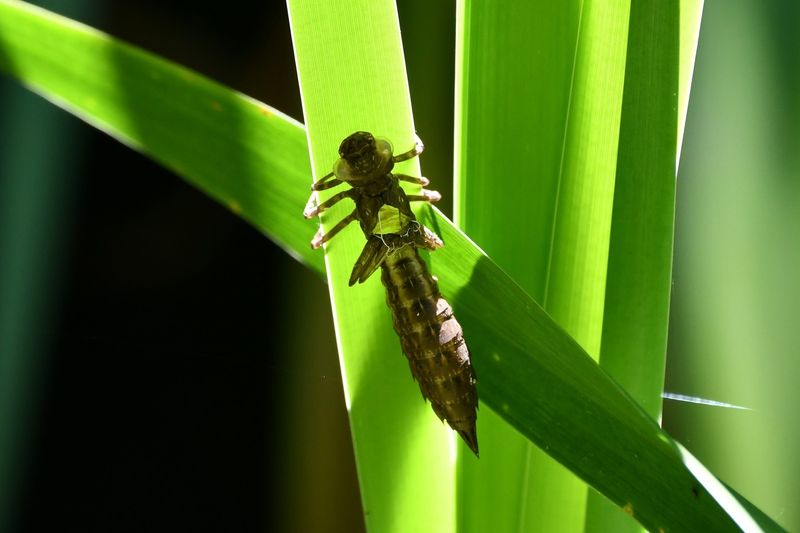
A realistic measure of success for a dragonfly breeding pond is not a bite-free summer. Look instead for signs of a functioning aquatic habitat: clear or lightly tinted water with no persistent surface scum, a mix of plant layers that stays manageable, emergence structures with the occasional shed nymph skin (called an exuvia) clinging to a stem, and adult dragonflies or damselflies spending time near the water rather than just passing through.
Those signs indicate the pond is supporting the life cycle, which is the actual goal.
Keep expectations grounded in what the research supports. The 2023 meta-analysis confirms that nymphs can suppress mosquito larvae under controlled conditions.
What it does not show is a predictable reduction in biting pressure for residential yards, where mosquitoes arrive from multiple sources and dragonflies are, as NPS documentation on dragonfly ecology notes, generalist predators that eat a wide range of flying and aquatic insects rather than focusing exclusively on mosquitoes.
Local results will vary based on which dragonfly species are present in your area, your water quality, how well your pond connects to other habitat, your California climate zone, and how consistently you maintain the feature. A pond in a Sacramento Valley suburb will behave differently from one on the San Diego coast or in a Bay Area hillside yard.
The action sequence that gives you the best shot: site the pond where it gets real sun with some shade relief, build in all three plant layers plus emergence structures, add circulation, inspect weekly, remove standing water elsewhere on the property, and use other mosquito-control measures when needed. A yard that supports a working dragonfly pond is doing more for local aquatic biodiversity than most neighbors, and that is worth building for its own sake.