
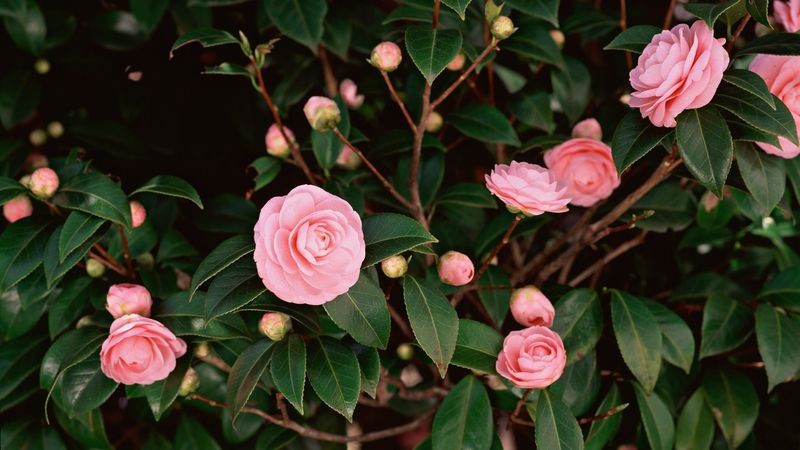
Fall is a quiet but important season for camellias in North Carolina. While the plants look settled and calm on the outside, developing flower buds are working hard underground, drawing on stored moisture and nutrients to finish forming.
If the soil around your camellia dries out during this window, those buds can suffer before you ever see a bloom. Checking the root zone now and watering slowly when the soil is dry can help protect what your plant has already been building.
When fall soil is dry, watering can protect developing flower buds
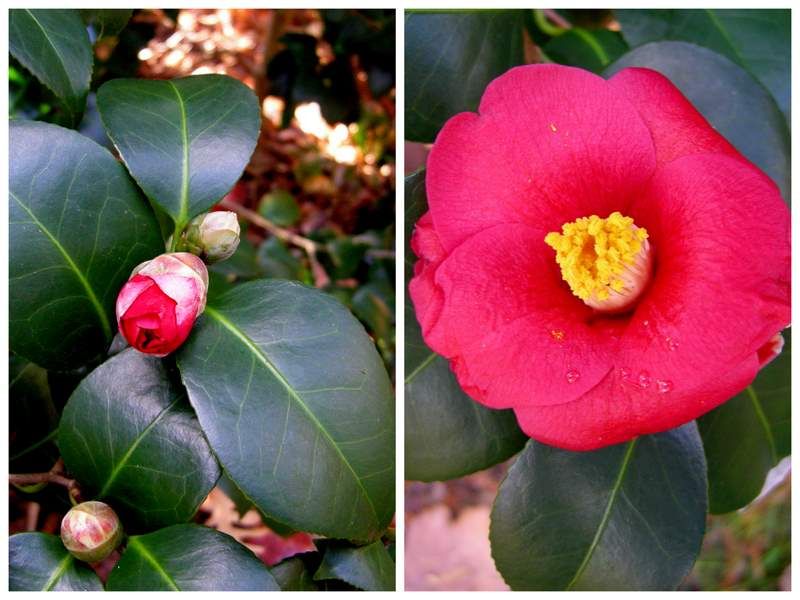
Camellias carry their flower buds through fall in a vulnerable state. The buds that will eventually open were initiated earlier in the season, and as autumn progresses, they continue to develop and fill out.
NC State Extension guidance on nursery plants and winter preparation notes that severe fall dryness can reduce the stored carbohydrates and nutrients that plants need for bud break and new growth, which means a dry root zone is not just a short-term stress but a setback that can carry forward into the bloom season.
The practical takeaway is straightforward: when the soil in your camellia’s root zone becomes dry during a fall dry spell, water it slowly and thoroughly. This supports the quality of buds already forming and can reduce the likelihood of drought-related bud drop.
The American Camellia Society points out that water stress during flower-bud formation can affect bud quality, and Clemson Extension identifies under-watering as a contributing cause of camellia bud drop.
What fall watering cannot do is equally worth understanding. Once a bud has dried out, dropped, or been damaged by cold, disease, or pests, later irrigation will not restore it.
Watering also does not reliably increase the total number of buds your plant initiates; that count is shaped by cultivar, light, nutrition, and conditions earlier in the season. Think of fall moisture as preserving flowering potential that already exists, not as a way to manufacture more of it.
Check the root-zone soil before you water
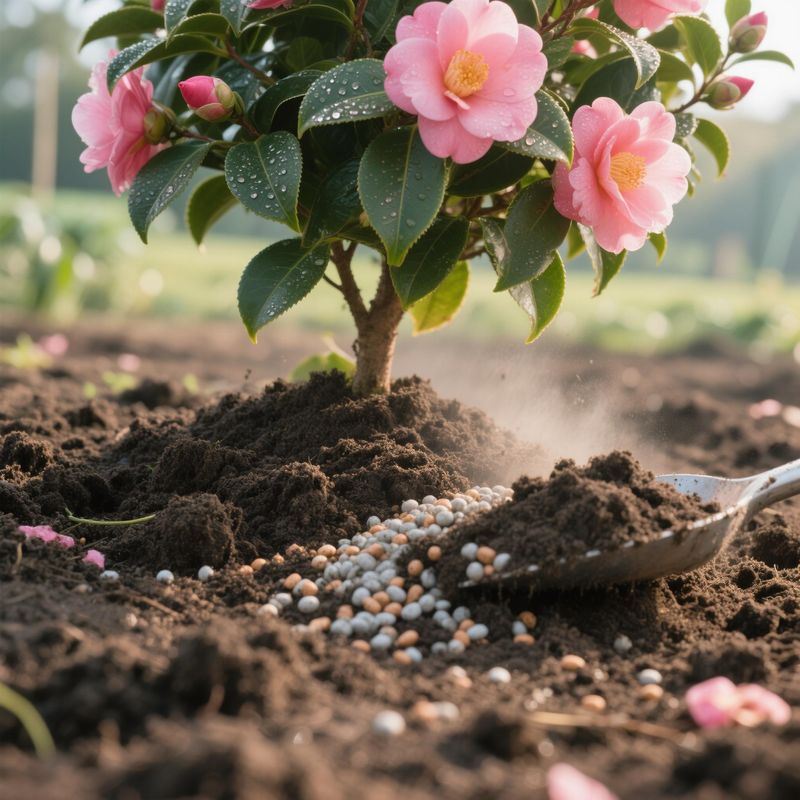
A calendar schedule is a poor guide for camellia watering. Soil conditions in North Carolina vary enormously from the Coastal Plain’s sandy loam to the Piedmont’s clay-heavy ground to the rocky, well-drained soils of the mountains, and rainfall patterns shift week to week.
University of Minnesota Extension guidance on established trees and shrubs recommends checking moisture approximately 6 to 9 inches below the surface for established shrubs and watering only when that zone is becoming dry rather than following a fixed interval.
Doing this check takes about thirty seconds. Push a screwdriver, wooden dowel, or your fingers down several inches into the soil near the outer edge of the canopy.
If the soil feels damp and cool, the plant is fine for now. If it feels dry or crumbly at that depth, a slow soaking is warranted.
Sandy soils drain faster and may need more frequent checks, while clay soils hold moisture longer but can become waterlogged if overwatered.
Several local factors can shift the answer on any given week. Recent rainfall, a heavy mulch layer, shade from overhead trees, and competition from surface roots of nearby large trees all change how quickly the root zone dries.
NC State Extension cautions that fall irrigation should be moderate, since encouraging late-season growth flushes can reduce a plant’s hardiness heading into winter. Cool, rainy stretches may mean your camellia needs no supplemental water for weeks at a time.
Use a slow soaking method that penetrates the root zone
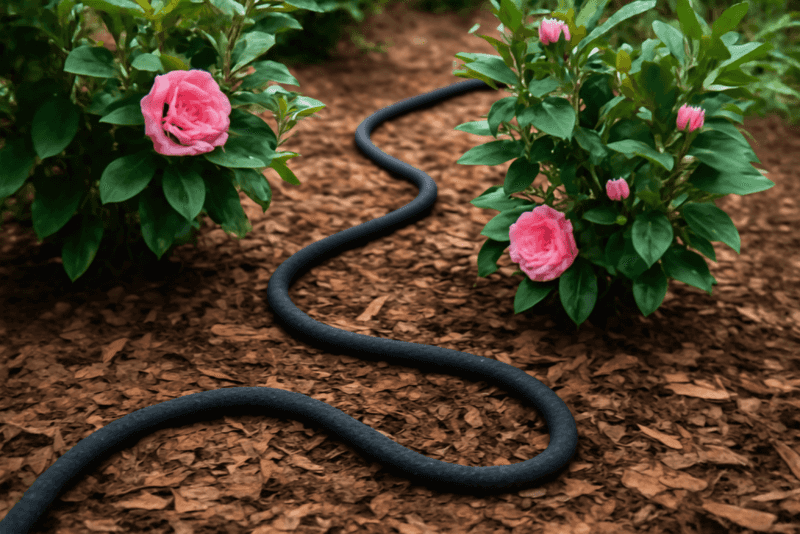
Getting water to the roots of a camellia is not the same as getting water onto the ground near a camellia. A brief blast from a garden hose on compacted or sloping soil often creates fast runoff rather than deep penetration, leaving the root zone nearly as dry as before.
UGA Extension’s best management practices for landscape irrigation recommend applying water slowly enough to wet the soil 8 to 10 inches deep, and caution against light, frequent irrigation that never reaches the root zone at all.
A soaker hose, drip line, or slow trickle from a hose laid on the soil surface are all practical options. The goal is a slow, steady delivery that gives the soil time to absorb water rather than shedding it.
On clay soil, even a slow application may need to be paused and restarted to avoid puddling. On a slope, directing the hose toward the uphill side of the root zone gives water more time to sink in before gravity moves it away.
How long to run the water depends entirely on your soil type, compaction level, mulch depth, and how dry the root zone already is. NC State Extension’s woody ornamentals guidance notes that wetting soil to 12 inches may require roughly 3 inches of surface water, but that figure shifts substantially with soil texture and compaction.
The more useful check is to probe the soil after watering to confirm that moisture has actually reached the intended depth rather than relying on elapsed time or a fixed gallon count. The American Camellia Society recommends wetting the root zone to roughly 14 to 18 inches for a thorough soaking, which reinforces why speed matters less than depth.
Spread water across the canopy’s root area
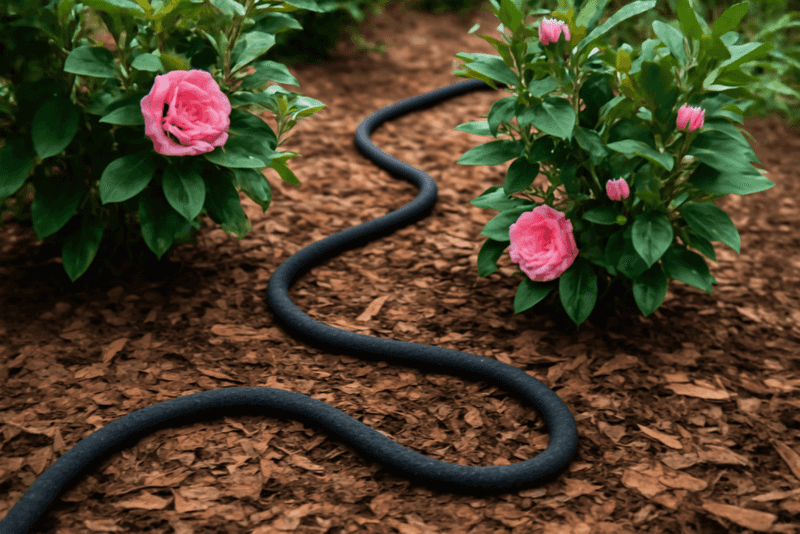
Pouring all your water directly at the trunk is one of the most common watering mistakes with established shrubs. Camellia roots are relatively shallow and spread outward, not straight down from the base, and the active root zone where water uptake actually happens extends beneath and often well beyond the canopy edge.
NC State Extension notes that woody-plant roots can extend two to three times the distance from trunk to canopy edge, which means the outermost root zone may be much farther out than most gardeners expect.
A practical approach is to move the hose or soaker around the perimeter beneath the canopy, pausing in several spots to let water soak in rather than concentrating it in one location. Clemson Extension’s camellia care guidance also underscores the importance of distributing water broadly across the root zone rather than creating a single saturated spot near the crown.
Newly planted camellias follow different rules. A shrub planted within the last year or two has not yet established a wide root system, so its effective root zone is much closer to the planting hole.
UGA Extension guidance on camellia establishment recommends regular watering during the first growing season, with closer monitoring than an established plant would need. Young plants are also more vulnerable to competition from nearby tree roots, so checking the soil around a new camellia more frequently than you would an older, well-rooted shrub makes good sense.
Use mulch to moderate moisture without trapping water
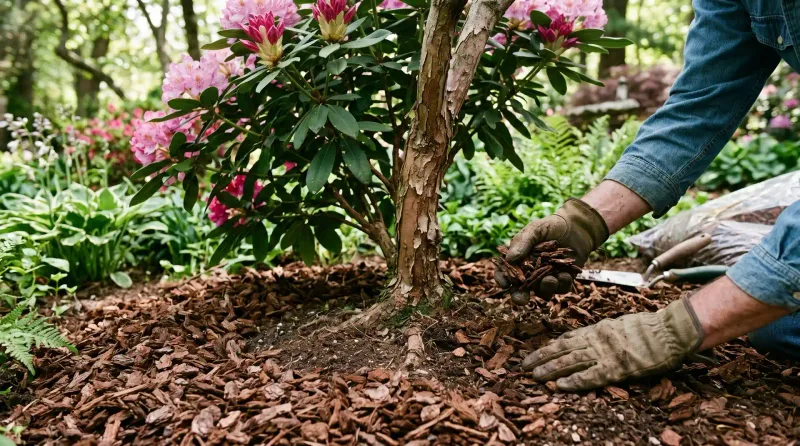
Mulch does quiet but meaningful work between waterings. A 2 to 3-inch layer of organic mulch, such as pine bark, shredded leaves, or wood chips, slows evaporation from the soil surface, moderates temperature swings, and helps the root zone stay more evenly moist between rain events and supplemental irrigation.
Clemson Extension recommends a 2 to 3-inch mulch layer for camellias, while the American Camellia Society generally suggests 2 to 4 inches depending on site conditions.
One consistent rule applies regardless of mulch depth: keep it pulled back from the trunk and crown. Mulch piled against the stem traps moisture against the bark, which can invite decay and disease at the base of the plant.
A few inches of clear space around the trunk is enough. The American Camellia Society’s watering and mulching guidance reinforces this point, noting that mulch should support healthy root conditions rather than create new problems at the crown.
Mulch supports good moisture management, but it does not replace the need to check the soil and water when the root zone is actually dry. Even under a thick mulch layer, the soil beneath can dry out during a prolonged dry spell.
NC State Extension emphasizes that the goal for woody ornamentals is evenly moist soil with adequate air around the roots, not a permanently wet environment. Deep watering means thorough penetration, not saturation that lingers for days.
Avoid repeated overhead irrigation while supplying the roots
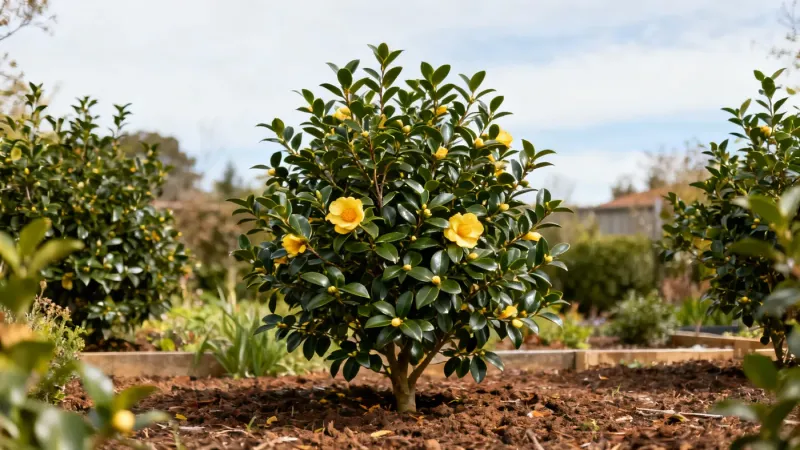
Where the water lands matters as much as how much you apply. Directing water onto the soil surface rather than spraying it over the foliage is the better habit for fall camellia care.
Frequent or prolonged wetting of leaves and buds under cool, moist autumn conditions can raise the risk of certain fungal problems. UGA Extension’s guidance on Exobasidium leaf and flower gall identifies cool, moist conditions as a factor in the development of this fungal disease, which affects camellias and related plants.
NC State Extension’s plant disease and disorder handbook similarly notes that extended leaf wetness supports many fungal pathogens.
This does not mean that rainfall is harmful or that wet foliage after a storm is a cause for concern. Natural rain events are a normal part of the environment your camellia already grows in, and a single overhead watering in a dry stretch is unlikely to cause problems.
The issue is a routine of repeatedly spraying the canopy when soil-level irrigation would deliver the same moisture more efficiently and with less foliar wetness. If you do water overhead, doing so in the morning gives foliage time to dry before temperatures drop in the evening.
The opposite mistake carries its own risks. Soggy soil reduces the oxygen available to roots, and the American Camellia Society warns that waterlogged conditions can promote serious root problems.
Replacing drought stress with chronic overwatering trades one set of problems for another; the target remains evenly moist soil that drains well between waterings.
Set expectations by camellia type, bloom timing, and site
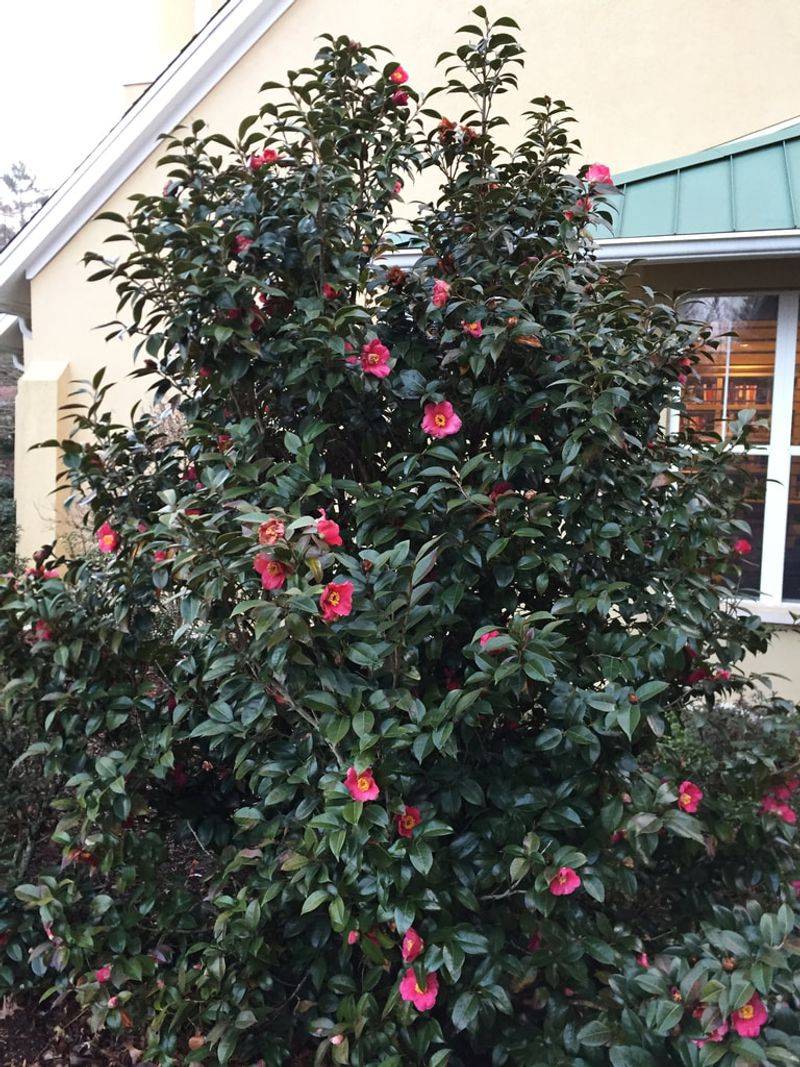
Fall moisture can support bud retention, but it works within limits set by factors that irrigation alone cannot fix. Clemson Extension’s camellia disease and pest guide lists irregular moisture, freezing temperatures, hot weather, poor drainage, nutrient problems, bud mites, and cultivar sensitivity as separate causes of bud drop, each capable of affecting flowering independently of whether you watered well in fall.
Cold injury from early freezes, heat stress during bud formation, and inadequate light are additional variables that watering cannot address.
The timing of any benefit also depends on which camellia you have. NC State Extension’s pruning guide describes sasanqua camellias as generally blooming from fall into early winter, while japonicas typically bloom from early winter into spring.
A fall watering effort aimed at protecting buds for a spring display is therefore more directly relevant to later-blooming japonicas and some hybrid cultivars than to sasanquas, which may already be opening flowers before winter sets in. Clemson Extension also notes that sasanquas tend to be more drought- and sun-tolerant than japonicas once established, so their watering needs in a dry fall may differ.
Site differences across North Carolina add another layer. A camellia in a shaded Piedmont bed with clay soil holds moisture differently than one on a sunny Coastal Plain slope with sandy soil, and mountain camellias face harder frost risk that can override any moisture advantage.
The action sequence stays the same wherever you garden: probe the soil at root depth, soak the root zone slowly if it is dry, maintain a suitable mulch layer, and recheck after rain or a weather change. Good fall moisture care gives your camellia the best conditions to carry its buds through to bloom, and that quiet consistency is what the plant needs most.