
Your backyard orange tree can send confusing signals in summer, looking thirsty and pale even when the soil around it is soaking wet. That contradiction is one of the first hints that summer watering may have crossed from helpful to harmful, stressing the very roots that keep the tree productive.
Learning to read the full picture, not just a yellow leaf or a drooping branch, is what separates a quick fix from a real diagnosis.
The warning pattern begins with soil that stays wet
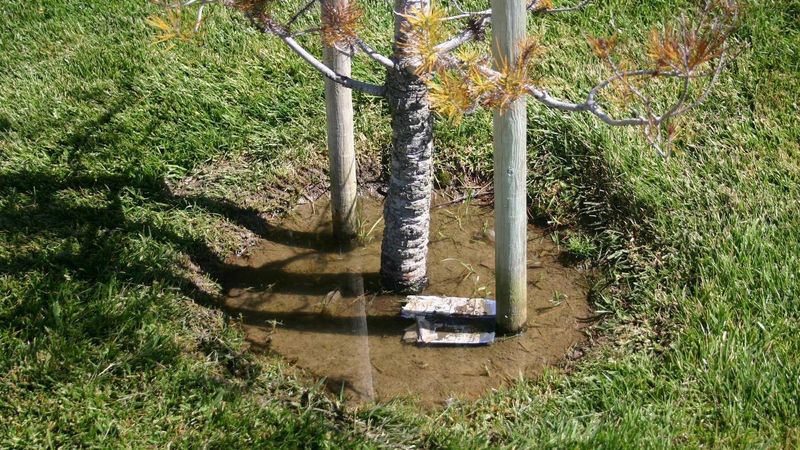
Soil that never quite dries between waterings is often the first clue that something is off with a backyard orange tree. The surface may feel cool and damp to the touch for days after an irrigation cycle, and when you press your fingers a few inches in, the soil comes up dark, heavy, and almost muddy.
That persistent saturation, rather than any single leaf symptom, is the starting point for a root-stress diagnosis.
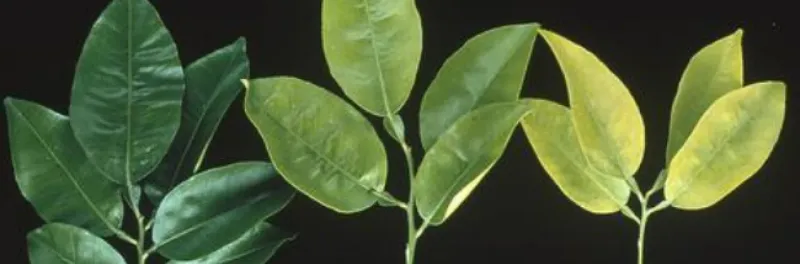
Alongside the wet soil, a stressed tree typically shows a cluster of changes: foliage that looks pale or washed out, leaves turning yellow across multiple branches, a canopy that seems thinner than it did earlier in the season, or shoots that are noticeably short and small. Some trees drop leaves steadily without an obvious cause, while others wilt at midday even though the ground around them is clearly moist.
UC IPM guidance on aeration deficits notes that these above-ground changes often reflect what is happening underground when oxygen is crowded out of the root zone.
No single symptom on this list proves overwatering. A few yellow leaves in summer can be perfectly normal, and wilting on a hot afternoon does not automatically mean the tree needs water.
What raises concern is the combination: persistently saturated soil paired with a visible pattern of pale foliage, leaf loss, slow growth, or canopy thinning that does not improve after several days.
The central diagnostic question to carry into the rest of your inspection is straightforward: is the root zone staying saturated between irrigation cycles? UC IPM’s overview of water deficit and excess identifies frequent irrigation, excessive irrigation amounts, and poor drainage as common contributors to this problem.
Before adjusting any schedule or adding any inputs, spend time observing what the soil and canopy are actually telling you.
Why an overwatered tree can look thirsty
Roots need two things to function: water and oxygen. Soil is made up of solid particles, water, and air-filled pore spaces, and healthy roots draw on all three.
When irrigation fills those pore spaces completely and keeps them full, the oxygen supply drops sharply. Prolonged oxygen shortage, sometimes called an aeration deficit, can begin to damage feeder roots within a day or two in warm soil, and the finer absorbing roots are often the first to die.
Here is where the apparent contradiction appears. UC IPM’s aeration deficit resource explains that once feeder roots lose their ability to absorb water and nutrients, the tree can display the same outward signs as a drought-stressed tree: wilting, yellowing leaves, leaf drop, and dieback.
The soil is wet, but the tree cannot use that water because the roots responsible for uptake are impaired or gone. This is why checking soil moisture alone is not enough to confirm the cause of the symptoms.
The mechanism also explains why an overwatered tree may look worse during hot weather. Heat increases the tree’s demand for water and nutrients at the same time that damaged roots are least able to deliver them.
UC IPM’s water deficit and excess page reinforces that both too much and too little water can produce overlapping visual symptoms, which is exactly why the soil and root zone need to be checked before any corrective step is taken.
Saturated conditions also create an environment where certain root-decay organisms can gain a foothold more easily. Roots that are already weakened by oxygen deprivation become more vulnerable to infection.
That connection between wet soil and root disease is real, but it is worth being clear: waterlogged soil does not conjure pathogens out of nothing. UC garden notes on summer watering caution that the interaction between moisture, root health, and disease is complex, and symptoms that look like simple overwatering sometimes point to something that requires a closer look.
Yellow leaves are a clue, not a verdict
Yellow leaves on an orange tree get noticed fast, and the instinct is often to blame the hose. Before acting on that assumption, consider how many different conditions can produce the same color change.
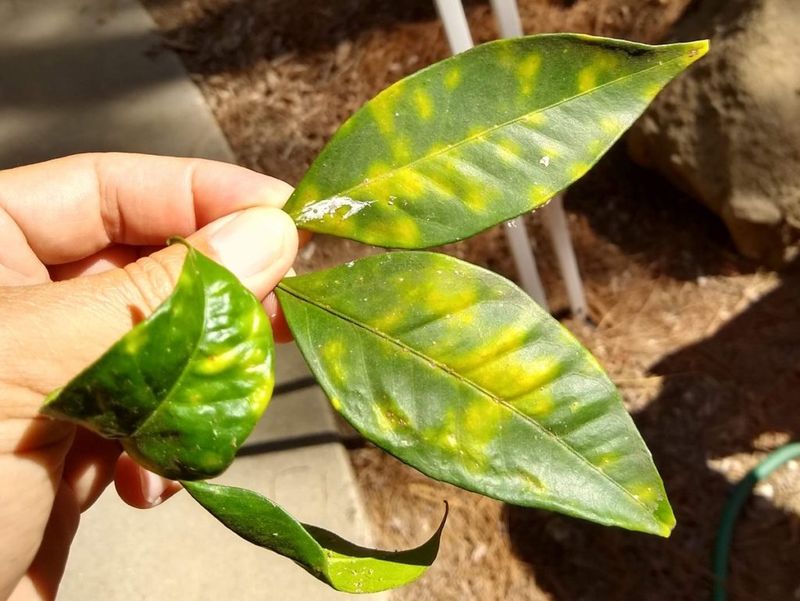
UC Master Gardener guidance on yellow citrus leaves lists excessive moisture, insufficient water, nutrient deficiencies, salt injury, pests, root disease, seasonal root dysfunction, cold wet soil, and viral disorders as possible causes, many of which can look nearly identical at first glance.
A useful inspection sequence starts with pattern and distribution. Yellowing that appears uniformly across the canopy reads differently than yellowing concentrated on older interior leaves, which is common with certain nutrient deficiencies.
New growth that yellows between the veins while the veins stay green can suggest iron or manganese issues tied to soil pH or waterlogged roots rather than irrigation frequency alone. Yellowing that marches from older to newer growth, combined with brown leaf margins, may point toward salt accumulation.
UC IPM’s citrus leaf and twig disorder guide provides detailed visual distinctions that can help narrow the field.
After noting the pattern, inspect leaves, twigs, and fruit surfaces closely. California red scale and other pests can cause yellowing, leaf drop, and twig dieback that mimics irrigation stress, especially in late summer.
Tiny, round, gray-brown covers on leaves or stems are a sign worth investigating before adjusting the irrigation timer.
Fruit drop adds another layer of confusion. UC IPM’s citrus fruit drop resource notes that small-fruit drop shortly after bloom is a normal thinning process, while larger-fruit drop later in the season can result from drought, heat, temperature swings, wind, pests, nutrition problems, or disease.
Attributing fruit drop to overwatering without ruling out these other factors can send a homeowner in the wrong direction. Check soil moisture below the surface and observe the full symptom pattern before reaching for fertilizer or adjusting the schedule.
UC IPM’s California red scale guide is a practical reference for identifying scale covers and distinguishing pest-related decline from moisture-related decline before committing to any treatment.
Gumming and dieback signal a more serious decline
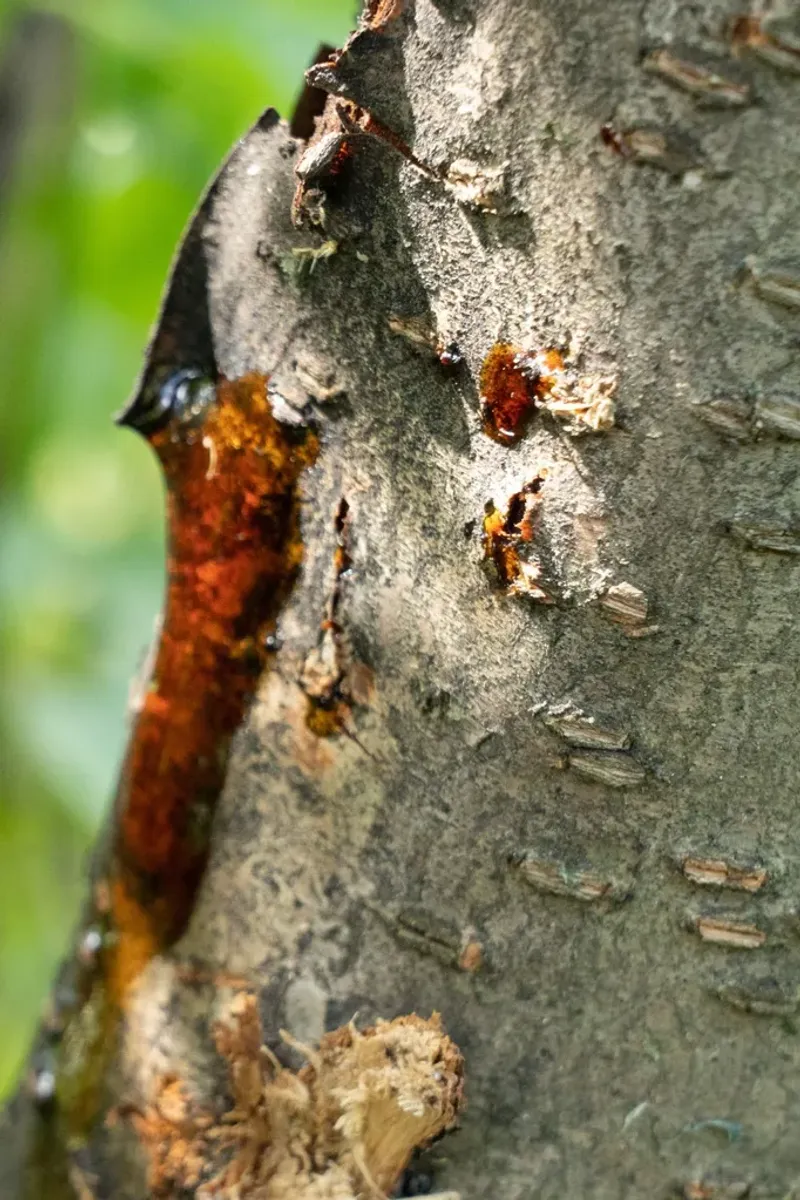
A few pale leaves or a brief wilting episode in summer heat is one thing. A thinning canopy that keeps thinning, significant leaf loss that does not reverse, poor new growth, and dead or dying twigs and branches are something else entirely.
These symptoms together suggest the tree is losing ground rather than cycling through normal stress, and they call for a closer investigation rather than a simple watering adjustment.
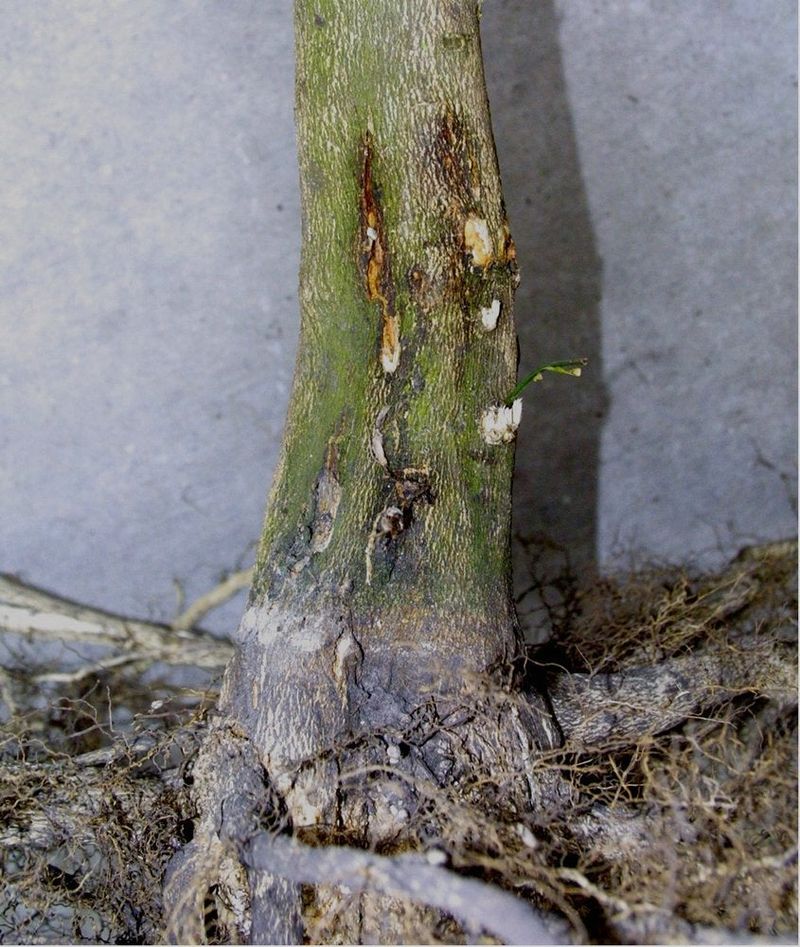
The detail that most clearly raises the stakes is gumming or oozing sap near the lower trunk, particularly at or below the soil line. Amber-colored resin seeping from the bark in that zone is associated with Phytophthora crown and root rots in citrus.
UC IPM’s Phytophthora root rot resource explains that this pathogen is favored by saturated soil, poor drainage, and water or soil held against the trunk, but the organism may already be present in the soil before overwatering begins. Saturated conditions provide the environment it needs to spread and infect, not a starting point from scratch.
Symptoms are not self-diagnostic. UC IPM’s citrus trunk and root disease guide notes that gumming can result from other causes, including physical injury and other fungal pathogens.
Seeing sap at the trunk base is a reason to investigate carefully, not an automatic confirmation of Phytophthora.
When symptoms have progressed to dieback, trunk gumming, or a steady decline despite reasonable care, the practical steps are: inspect the trunk base for discolored bark or ooze, check drainage in the root zone for ponding or slow percolation, review whether irrigation water is reaching the trunk, and confirm the graft union is above the soil. UC IPM’s citrus cultural tips recommend keeping irrigation off the trunk and the graft union exposed.
For progressive or advanced decline, reaching out to a UC Cooperative Extension advisor or certified arborist is a reasonable next step.
Check the root zone before you change the timer
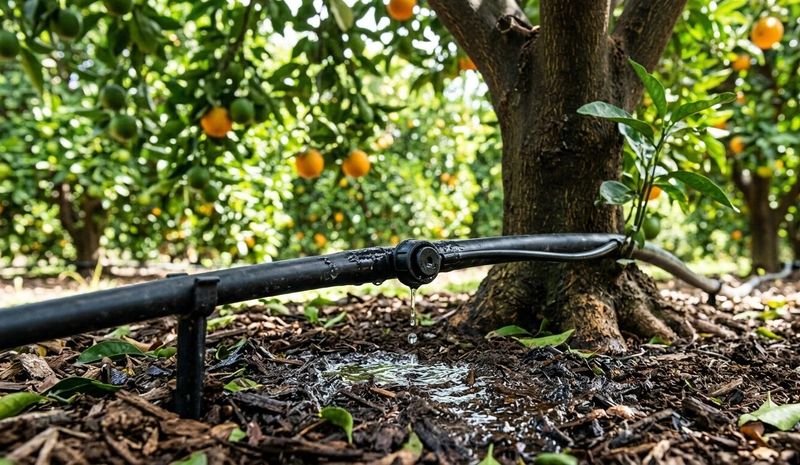
Adjusting a watering schedule based on how the soil surface looks is one of the most common mistakes in backyard citrus care. A dry crust on top can hide significant moisture a few inches down, especially in clay soils or under a mulch layer.
Conversely, a surface that feels damp after a light irrigation event may not reflect what is happening at the depth where feeder roots actually live, typically in the top 18 to 24 inches of soil.
A more reliable check involves probing or digging. Push a long screwdriver or a soil probe into the ground at several points across the area beneath the canopy, not just near the trunk.
If the probe slides in easily and comes out with moist soil clinging to it, the root zone still has water. If it meets resistance or comes out dry, the deeper roots may be drying out even while the surface looks fine.
UC Master Gardener citrus cultural practices guidance recommends checking moisture below the surface and across the wetted area rather than relying on the top inch alone.
A moisture meter can add another data point, but treat it as a supporting tool rather than a definitive answer. Readings vary with soil texture, probe placement, and the wetted pattern, so a single reading in one spot may not represent the full root zone.
UC Master Gardener soil tips from Santa Clara County suggest combining probe readings with direct observation and drainage checks for a more complete picture.
While you are out there, look for signs of drainage trouble. Does water pool near the tree after irrigation or rain?
Does it disappear within a few hours, or does it sit for a day or more? Probe a few spots at the edge of the wetted zone to check for compaction or hardpan that might be trapping water.
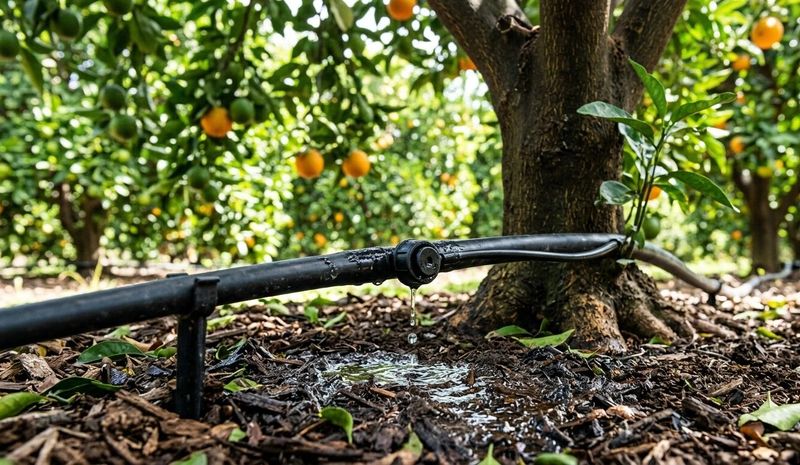
Also note whether emitters are clustered near the trunk rather than spread across the root area. UC IPM’s aeration deficit guidance identifies concentrated irrigation near the trunk and poor drainage as conditions that increase the risk of prolonged oxygen shortage in the root zone.
Reset summer irrigation around the active roots
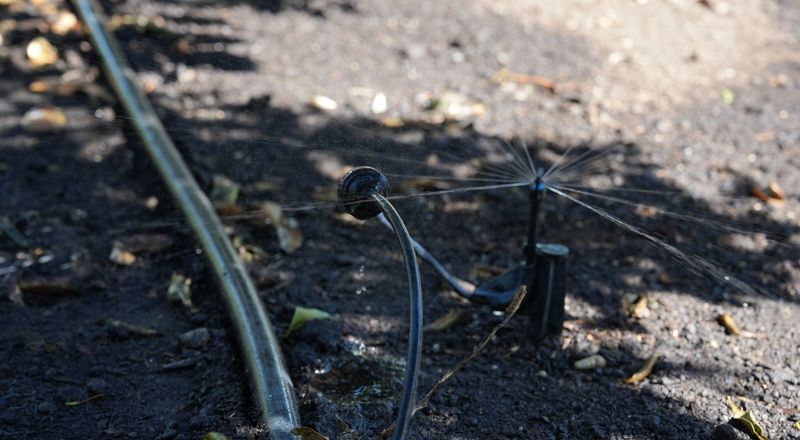
Once you have confirmed that the root zone is staying too wet between cycles, the correction is not to stop watering but to change how and where the water is applied. California orange trees need supplemental irrigation through summer, especially during fruit development and heat events.
The goal is to supply enough water to wet the active root area fully, then allow the soil to partially dry before the next cycle, rather than keeping it perpetually moist.
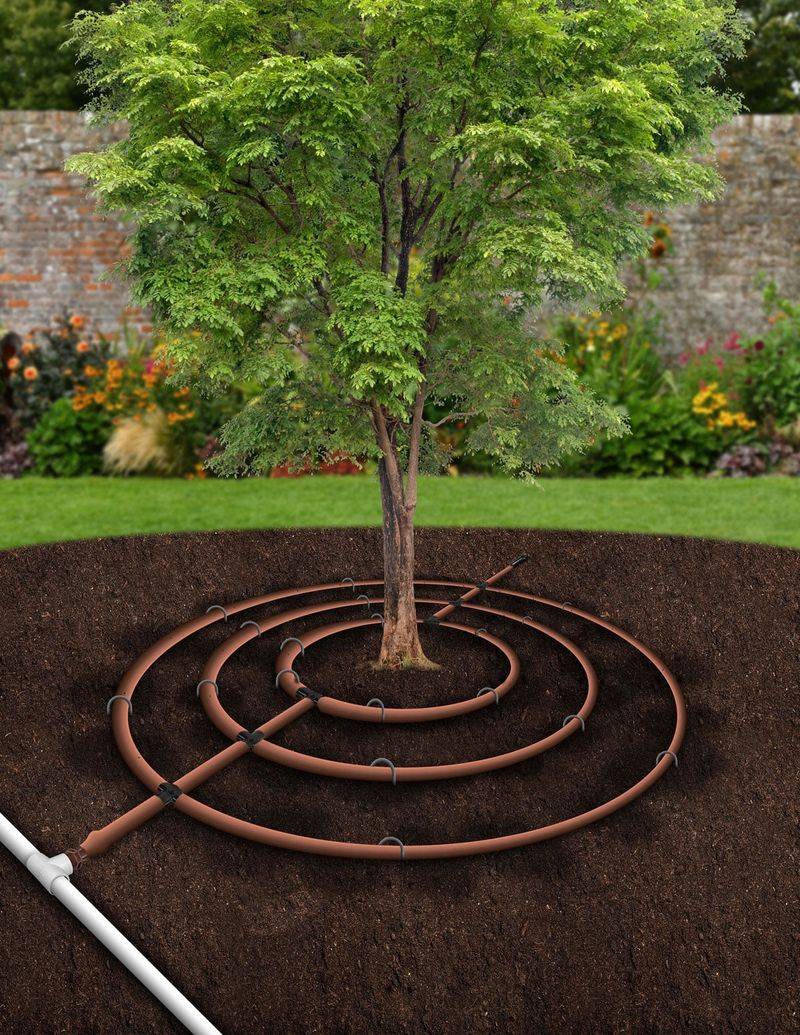
Start by moving emitters away from the trunk if they are currently concentrated there. For an established tree, the active feeder roots spread outward well beyond the drip line, and irrigation should cover that broader zone.
UC IPM’s citrus cultural tips recommend keeping water off the trunk entirely and ensuring the graft union stays above the soil line. As a tree matures, emitter positions should shift outward to follow root expansion rather than remaining fixed near the base.
UC IPM’s citrus watering guide offers a broad summer reference of approximately 4 to 6 inches of water per month for established citrus, often split into several applications, with intervals of roughly 7 to 10 days in hot inland climates. These are starting points, not universal rules.
Sandy soils drain faster and may need shorter intervals; clay soils hold water longer and can become saturated with the same schedule that works fine in loam. Canopy size, rootstock, local heat load, wind, and your irrigation system’s output rate all factor in.
UC Master Gardener citrus cultural practices guidance reinforces moisture-based irrigation over fixed scheduling: check the root zone, water when the upper several inches have begun to dry, and apply water slowly enough that it soaks in rather than runs off.
During heat waves, increase monitoring frequency rather than automatically increasing run time. UC guidance on summer heat spikes recommends checking root-zone moisture and irrigating when needed rather than following a rigid calendar.
Newly planted trees are a separate case: their root balls can dry out quickly and may need more frequent checks, but emitters should be placed near, not against, the root ball, and the wetted area should expand as roots establish. CIMIS drought irrigation guidance also notes that matching application volume to actual soil and drainage conditions is more effective than applying a fixed amount on a fixed schedule.
When watering is only part of the diagnosis
Correcting irrigation frequency is the right first move when soil stays saturated and the symptoms fit. But some trees keep declining after the schedule is adjusted, and others show the same pattern without any real overwatering involved.
At that point, the investigation needs to go further than the timer.
Salt injury is a frequent look-alike. Where water is moderately saline or irrigation has been frequent and shallow, salts can accumulate in the root zone and produce yellow leaves, brown leaf tips, and marginal burn that resembles both overwatering and nutrient deficiency.
UC Master Gardener guidance on yellow citrus leaves identifies salt injury as a distinct cause that requires different management than adjusting irrigation frequency alone.
Nutrient deficiency is another common mimic, but adding iron or nitrogen to a tree with waterlogged or diseased roots is not a reliable fix. When roots are impaired, they may be unable to take up nutrients regardless of what is applied to the soil.
Diagnose irrigation, drainage, and root condition before introducing any fertilizer inputs, since unnecessary applications can worsen salt stress.
UC IPM’s California red scale guide details how scale infestations can cause yellowing, leaf drop, twig dieback, and general decline that is easily mistaken for a root or water problem. Check leaf undersides, twigs, and fruit for the small, round, grayish covers before concluding that irrigation is the culprit.
Broad-spectrum insecticides are not an appropriate first response, since they can harm beneficial insects that naturally keep pest populations in check.
For trees showing progressive decline, significant dieback, or symptoms that do not improve after irrigation and drainage are corrected, viral disease and other pathogens deserve consideration. CDFA information on citrus tristeza and UC IPM’s tristeza disease complex resource explain that some viral disorders can resemble root problems closely enough that visual diagnosis alone is inconclusive.
In those cases, laboratory testing or assistance from a county agricultural commissioner or UC Cooperative Extension advisor provides a clearer path forward than continued trial-and-error adjustments.
The right response is measured, not waterless
The clearest takeaway from this diagnostic process is also the most practical: root stress from summer irrigation is not fixed by stopping irrigation. California orange trees need water through the warm months, and pulling it back too sharply during fruit development or a heat event can cause its own set of problems, including tip dieback, fruit drop, and sunburn.
The correction targets frequency and placement, not the water itself.
Read the symptom pattern as a whole, check moisture several inches below the surface across the wetted zone, and look for drainage problems, pest activity, trunk symptoms, or other contributors before settling on a diagnosis. UC IPM’s water deficit and excess guidance makes clear that both overwatering and underwatering can produce similar visible symptoms, which is why soil observation and the full symptom picture matter more than any single sign.
When irrigation does need to change, shift to moisture-based watering: allow partial drying between cycles, spread water across the active root zone rather than near the trunk, and monitor more closely during heat. UC IPM’s citrus watering resource and UC IPM’s Phytophthora root rot guidance both support the conclusion that correcting drainage and irrigation practices can reduce ongoing risk, but advanced root loss or trunk infection may already be beyond what a schedule change can reverse.
A well-timed, well-placed irrigation is the tree’s best summer ally, not its enemy.