
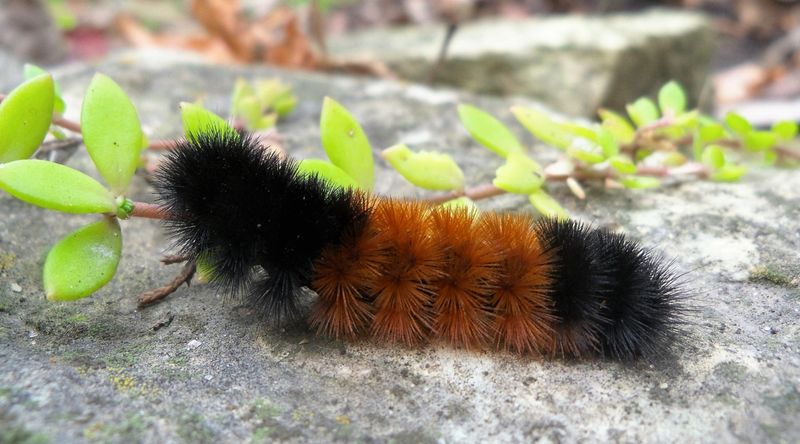
Walk across a North Carolina yard in October and you may spot a small fuzzy caterpillar hurrying over the grass or driveway. It is easy to wonder if your yard has a bumper crop of them, or if they are hinting at the winter ahead.
The real story is simpler and more interesting than either idea. Here is what those little travelers are doing, what they cannot tell you, and how to treat them well.
Fall crossings usually signal a search for shelter
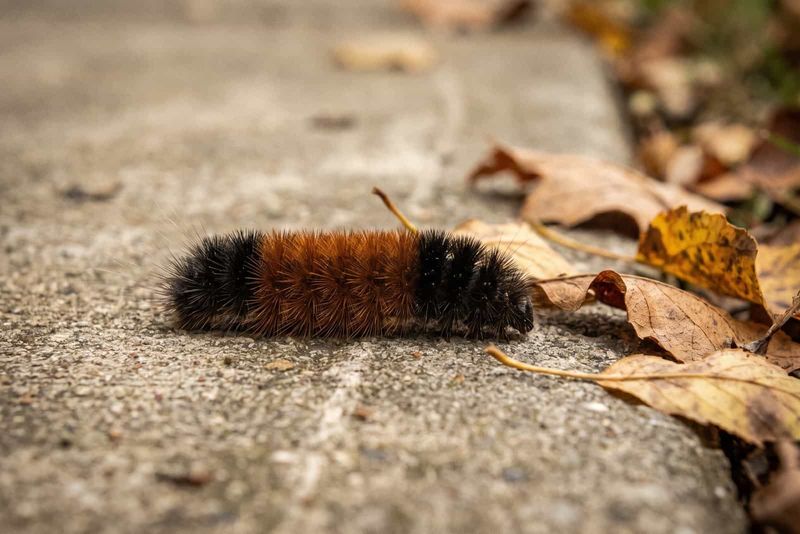
By the time autumn arrives, most banded woolly bears have finished eating for the year. NC State Extension explains that the caterpillars people notice in fall have wrapped up feeding and are looking for a place to spend the winter.
That is why you see them on the move across lawns, sidewalks, and driveways.
The Missouri Department of Conservation describes the same autumn habit, noting that these caterpillars are often seen crossing roads as they look for shelter. In other words, a woolly bear on the march is doing seasonal homework, not wandering at random.
Think of it as a traveler heading toward a cozy winter spot.
Shelter-seeking is the most likely explanation, but it is not a guarantee for every single caterpillar. Some may simply be wandering, and you cannot read one individual’s mind from the way it crosses your patio.
Treat the shelter idea as a good general rule rather than a promise about each fuzzy visitor.
Here is the part that surprises many homeowners. Movement is not the same as a boom in numbers.
Caterpillars on the go are simply easier to see than caterpillars tucked into leaves or grass, so a few crossings can feel like a parade even when nobody knows how many live nearby.
A practical way to use this: note the date and spot where you see one, enjoy the moment, and let it keep going. That small habit turns a surprise sighting into a seasonal wildlife observation you can compare from year to year, without drawing big conclusions from a single afternoon.
A visible parade is not a population count
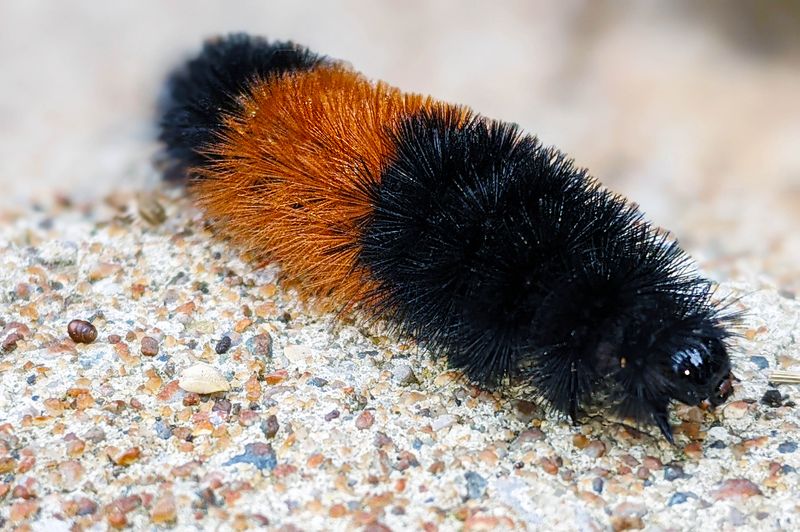
Picture a crowded sidewalk at a festival, then the same sidewalk at midnight. The people did not vanish, they just stopped moving around in plain view.
Woolly bears work much the same way, becoming conspicuous when they travel in fall.
That means a handful of crossings, or even a dozen on a good afternoon, cannot tell you how many caterpillars live in your yard. It cannot show that numbers have surged, and it cannot prove your property is unusually welcoming.
No local count or baseline exists that would let a homeowner turn a few sightings into a trend, so any number you come up with is just an observation.
Timing also matters. NC State Extension reports one or two generations per year in North Carolina, so seeing caterpillars in fall does not by itself point to an exceptional brood.
Fall is simply when this stage is out and about.
The Missouri Department of Conservation likewise frames autumn crossings as seasonal behavior rather than a sign of abundance. Where you walk matters too.
A caterpillar near a busy road, a street light, or a path gets noticed far more than one in a thick patch of lawn.
If you want to keep tabs, jot down what you see over several autumns and treat it as a casual diary. Even then, it records what you noticed, not what is truly there, and that is a perfectly fine way to enjoy the season.
Host plants can be nearby without being in your yard
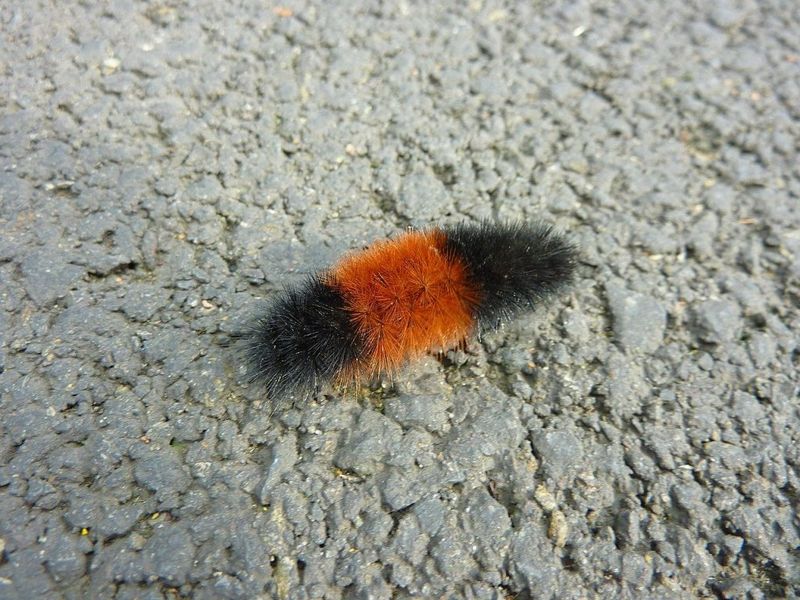
Woolly bears are not picky in the way some caterpillars are. In North Carolina, NC State Extension lists plantain, dandelion, dock, aster, goldenrod, and some grasses among the plants the larvae feed on.
Many of these are the so-called weeds that pop up in lawn edges, ditches, and old fields.
So a caterpillar on your walkway fits with food plants being somewhere in the area. It does not prove those plants are growing in your yard, and it does not show that the caterpillar fed there.
It may have come from a neighbor’s overgrown corner, a power line cut, or a field down the road.
The same caution applies to your plantings. A bed of native asters or goldenrod might be a fine place for a caterpillar to eat, but a sighting cannot show that your plants caused it.
If you like the idea of feeding wildlife, a few easy steps can help. Leave a small patch of plantain or dandelion unmowed in a back corner, and let native asters and goldenrod fill a sunny border.
Skip the urge to score your yard based on who walks across it. A single caterpillar is a clue about the neighborhood, not a grade for your garden.
Leaf litter and logs may offer overwintering shelter
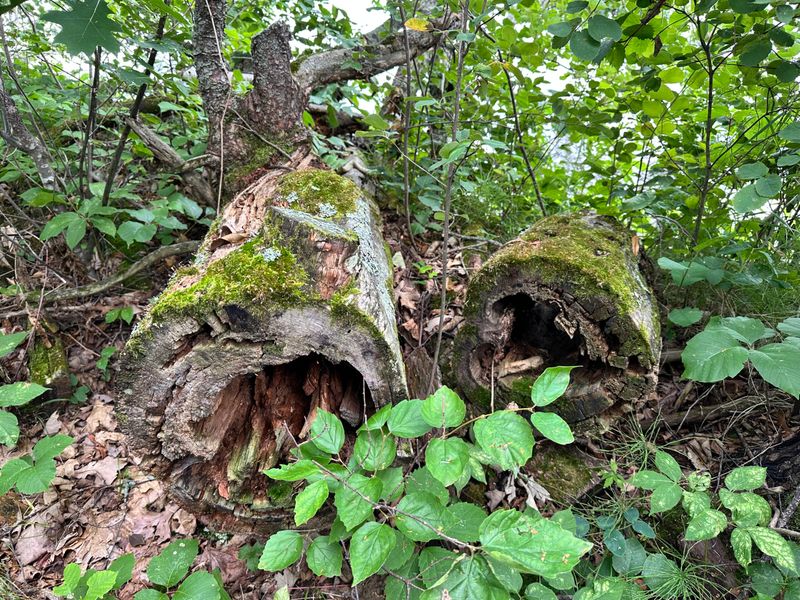
Rather than tidying every leaf away, consider what a fallen leaf really is: a blanket. Illinois Pollinators notes that woolly bears overwinter in places such as leaf litter, bark, and logs.
Those materials can offer protection from cold and wind through the winter months.
If you want to support wildlife, you can keep some of that cover in a spot where it will not cause trouble. A strip of leaves under shrubs, a layer in a back bed, or a small log pile at the edge of the property are all low-effort choices.
Many other small creatures use the same spots, so the benefit stretches beyond a single caterpillar.
Be realistic about what this does. Keeping leaf litter provides possible shelter, but it will not guarantee more woolly bears, and it cannot make caterpillars show up.
A crossing also does not prove that your yard supplied the shelter the caterpillar was seeking, since it may be passing through to somewhere else.
Choose the spot with care. Keep leaves off lawn grass, where a thick mat can smother it, and away from foundations, vents, and walkways.
Raking leaves into beds or mowing them into small pieces are both tidy compromises that still leave something behind.
Can their bands tell you what winter will bring?
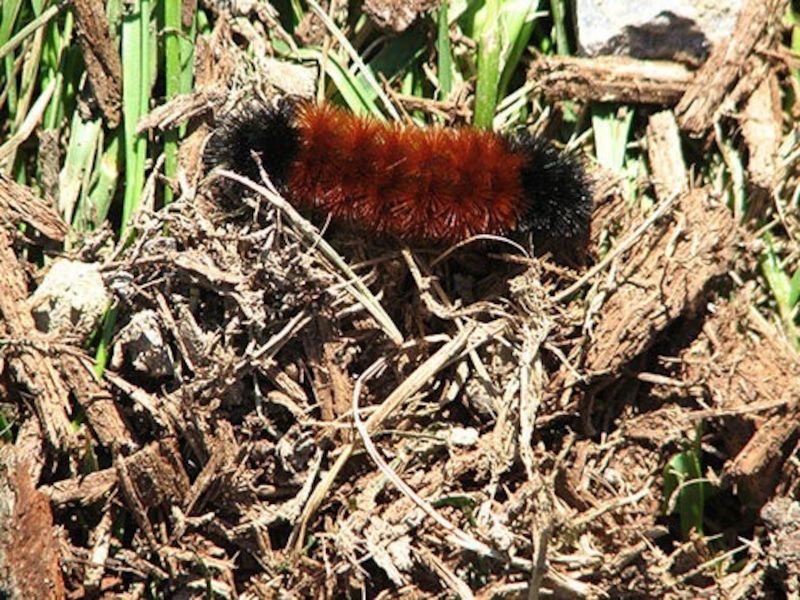
Short answer: no. The old tale says the width of the rusty band predicts how harsh winter will be, but it is folklore, not a reliable forecast of severity, timing, or direction. University of Missouri IPM treats it as weather folklore, and the banding is shaped by other things, including the caterpillar’s age and the weather it grew up in, as UMass Extension explains.
The band is not a neat age test either. A wide brown stripe does not prove an older caterpillar, so skip any simple rule of thumb.
The familiar banded caterpillar with black ends is the larva of the Isabella tiger moth, as the Missouri Department of Conservation describes. Even so, do not assume every fuzzy caterpillar is one.
Plenty of hairy species look alike at a glance, and color alone is not enough for a confident ID.
Winter plans vary too. Some sources describe full-grown caterpillars overwintering, but NC State Extension notes that in North Carolina individuals may overwinter as caterpillars or as pupae.
No single route fits every one you meet.
If you want a winter forecast, check the local weather service. The caterpillar is better enjoyed as a small fall visitor.
Let crossing caterpillars pass; skip the spray
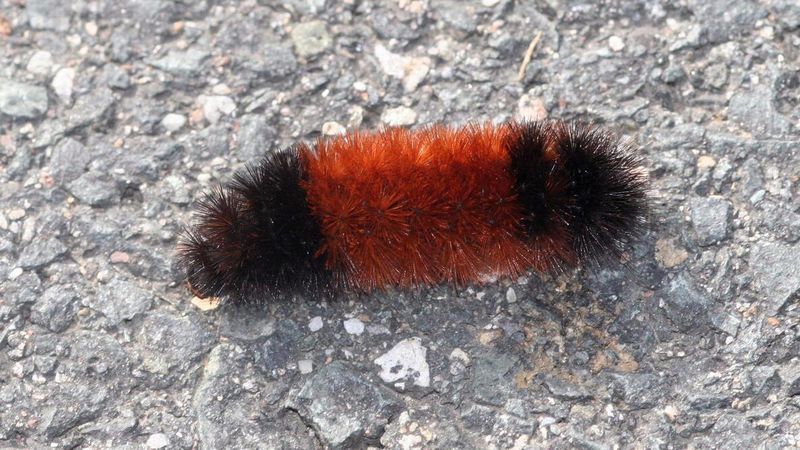
When one turns up on your path, the best move is the easiest one: step around it and let it go. That fits its seasonal behavior, as the Missouri Department of Conservation describes for autumn travelers.
Keep dogs and toddlers from grabbing it.
Skip the insecticide. NC State Extension advises against treating for banded woolly bears, which feed on weeds and are virtually harmless to people.
Hands off unfamiliar fuzzy caterpillars, though. Some people react to woolly bear hairs, and other hairy species can be more hazardous.
If you must move one, use a leaf or stick.
A fall crossing is a small seasonal sighting, not a yard census or a winter forecast. Let it pass, and it will get on with its journey.