
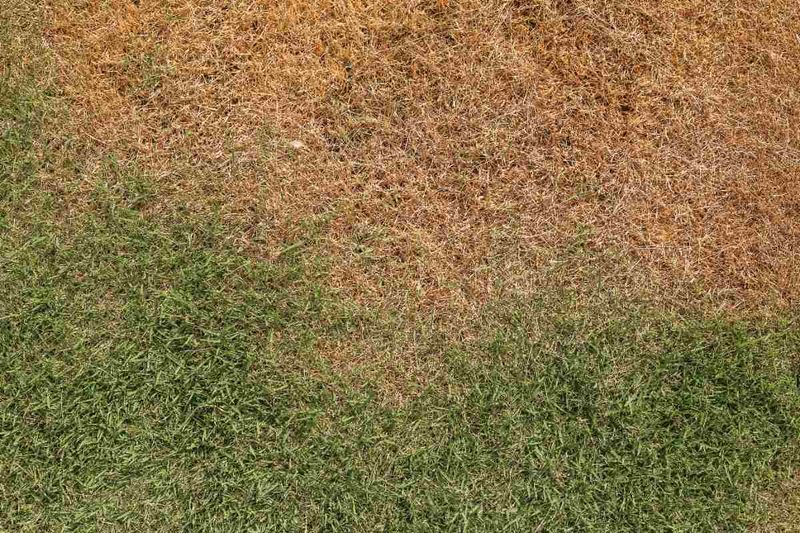
You mowed all summer, the heat finally eased, and the grass still looks tan. Before you buy a bag of anything, it helps to know that a brown lawn in October can mean very different things.
Sometimes it is just the season, and sometimes it is a sign of real trouble. A few simple checks can tell you which one you are dealing with.
Warm-season grass may be entering dormancy, not failing
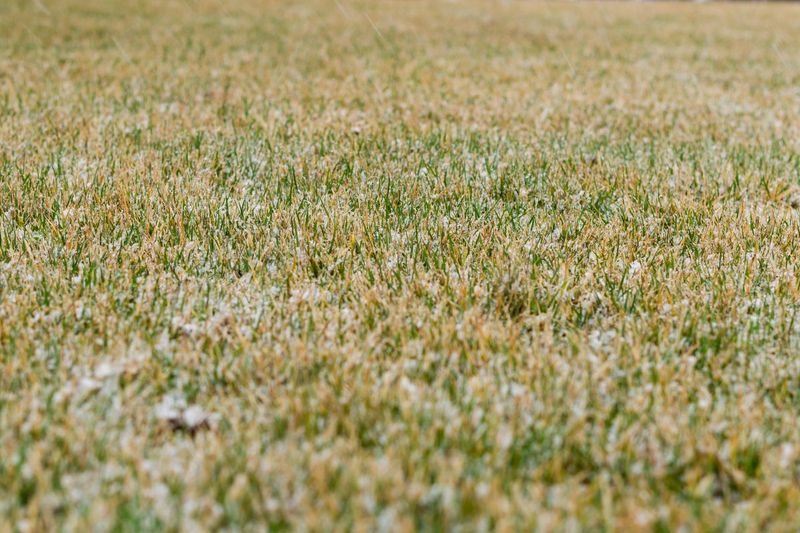
Cooler weather does not turn every lawn green. Bermudagrass, zoysia, centipedegrass, and St. Augustinegrass are warm-season grasses, and UGA Extension fall lawn guidance explains that they slow down and begin to brown as days shorten and temperatures drop.
In Georgia, that change commonly starts in October or November. Timing shifts across the South, so a lawn in South Florida or the Texas Gulf Coast may stay green longer than one in north Georgia or the Texas Panhandle.
Grass type matters a lot here. Tall fescue is a cool-season grass that generally grows in fall, so a brown fescue lawn tells a very different story than a brown bermudagrass lawn, as noted in UGA’s guide to Georgia lawn species.
So the first question is not why the grass has not greened up. It is what kind of grass you have, and what it normally does in your area this time of year.
Is the browning uniform or spreading in patches?
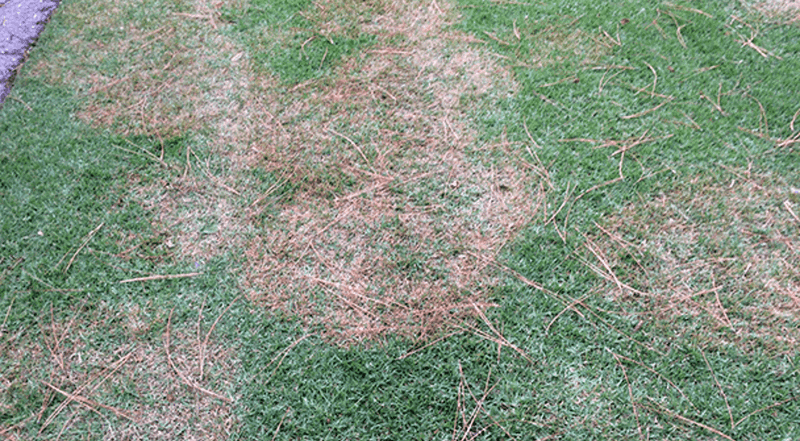
Walk the whole yard and look at the pattern. A broad, fairly even color change across the lawn fits seasonal slowdown.
Isolated spots that are growing, coming back in the same places, or looking thin deserve a closer look.
Pattern alone will not name the cause, though. It only tells you what to inspect next.
Several things can produce local damage in fall. Drought injury can linger, and some stressed zoysia recovers slowly, as UGA Extension’s drought recovery article describes.
Caterpillars are another suspect. UGA reports that sod webworm activity in Georgia peaks from September through November, and early damage can look like drought stress.
Disease is also possible, and large patch tends to show up in fall. Keep notes or photos of each patch so you can track whether it changes.
Read the blades before changing the watering schedule
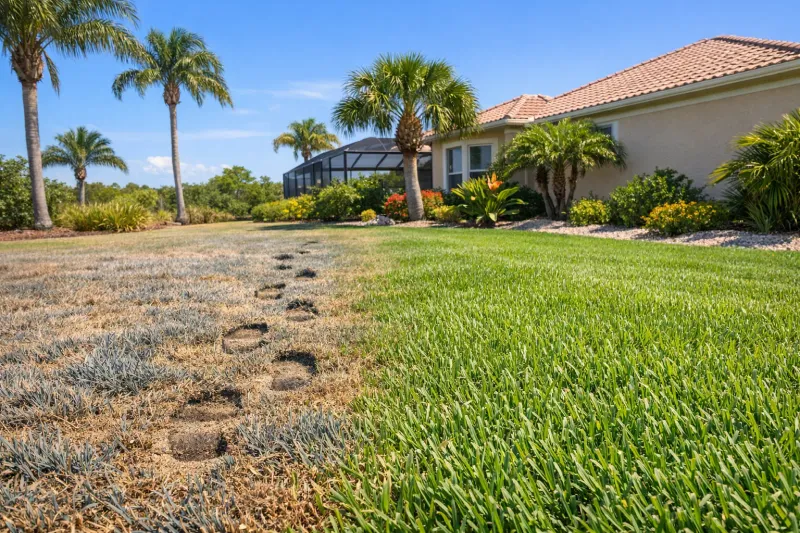
Grass tells you when it is thirsty. Folded or wilted blades, a blue-gray cast, and footprints that stay visible after you walk across the lawn all point to water stress.
If you see those signs, check the soil and the site before turning up the sprinklers. Slopes, sandy spots, and hot edges near pavement dry out faster than the rest of the yard.
For Florida lawns, UF/IFAS best practices advise watering as needed instead of following a fixed daily schedule, and they recommend checking local restrictions first. UF/IFAS watering guidance suggests about half to three-quarters of an inch per watering, adjusted for the site.
That is Florida context, not a rule for every state.
Water can help grass that is dormant from drought. UF/IFAS notes bermudagrass may resume growth after enough irrigation.
It will not bring back turf that is already dead or damaged by something else.
Check for caterpillars above ground and grubs at the roots
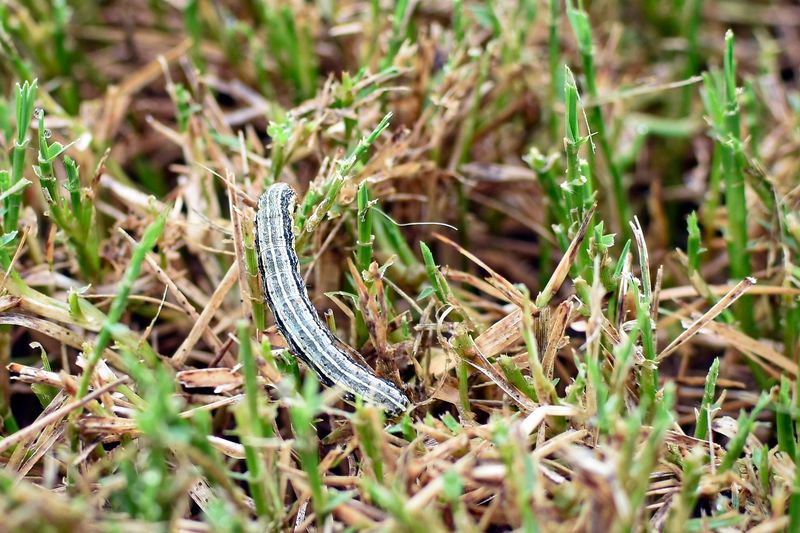
Two different insect checks can help. Start above ground.
Clipped or ragged blades and brown areas that expand quickly can fit caterpillar feeding, including fall armyworms.
A soapy-water flush may bring them to the surface. Follow your local Extension instructions for the mix and the location, since details vary.
Next, check the roots. At the edge of a patch, cut and lift a small section of sod.
Grubs feed on roots, so affected turf may thin, lift easily, and have few roots.
Seeing a grub is not the same as needing insecticide. Texas A&M describes 5 to 10 or more per square foot alongside turf that pulls up readily as a level where treatment may be justified.
Thresholds vary by species and place. UF/IFAS lists eight per square foot for one particular grub species.
A small count in healthy, well-rooted turf may not call for any treatment.
Large patch has clues beyond a brown circle
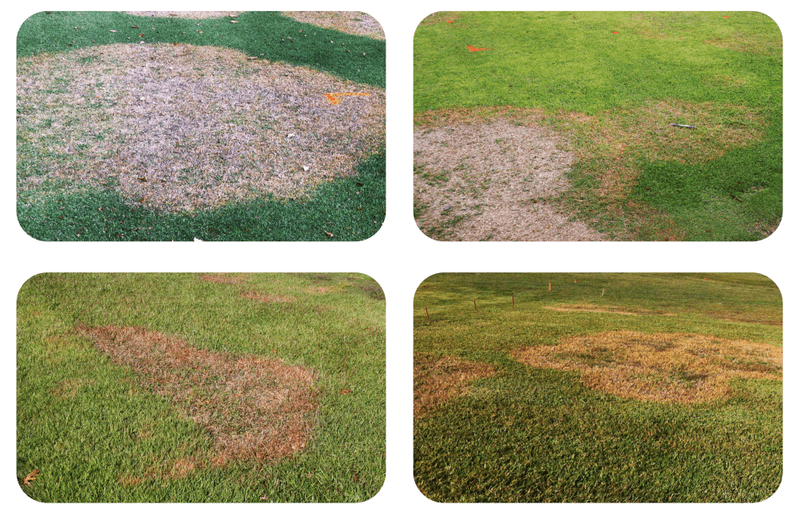
A round brown spot is not enough to call it disease. Large patch, a fungal disease of warm-season turf, deserves consideration when roughly circular areas keep expanding and other clues show up.
Look at the edges of the patch. Possible signs include an orange border and dark, water-soaked lesions near the leaf sheath, as described in UGA’s large patch update.
Conditions matter too. The disease is linked to fall and spring transitions, prolonged moisture, and poor drainage, so a patch in a soggy, shaded low spot is more suspicious than one on a dry, sunny rise.
A UGA Extension article on disease at green-up covers this seasonal timing.
You may also hear the name brown patch. UGA uses that term for the same kind of Rhizoctonia disease on cool-season grasses, while large patch is the name for warm-season lawns.
If you are unsure, your county Extension office can help confirm it.
Compaction and thatch can add stress without proving the cause
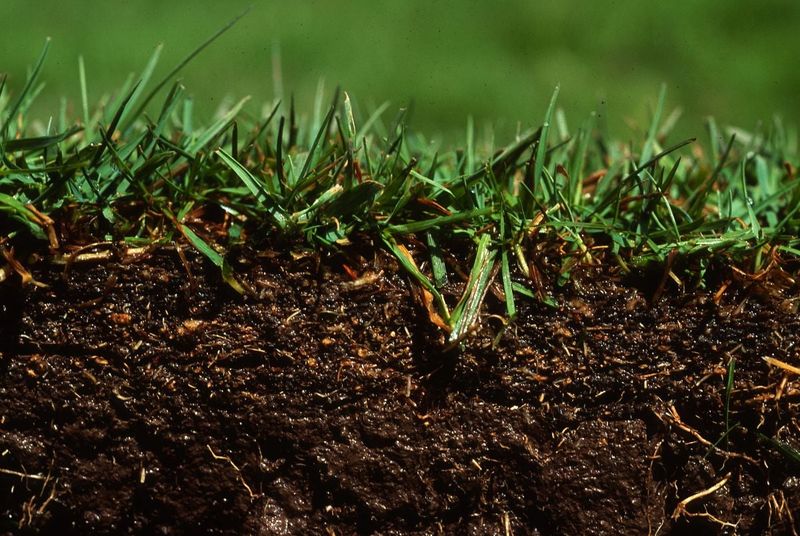
Hard soil and a thick thatch layer can stress turf, but finding one does not prove it caused a particular brown patch. Treat them as clues to check, not default answers.
If damage follows foot traffic or runoff, try a screwdriver test in moist soil. UF/IFAS notes that if you cannot push one in about six inches without significant force, compaction may be affecting the turf.
For thatch, cut out a small plug and look at the spongy layer between green blades and soil. Texas A&M’s take-all root rot factsheet calls more than half an inch excessive.
That number is a source-specific guide, not a diagnosis by itself.
Other causes of dry spots exist too, including sandy soil and buried materials, according to UGA’s turf disorder guide.
Hold off on aeration for now. UGA says warm-season turf should be actively growing, with soil at four inches at least 65°F and rising.
October may be too late in some places.
Match the next step to the evidence
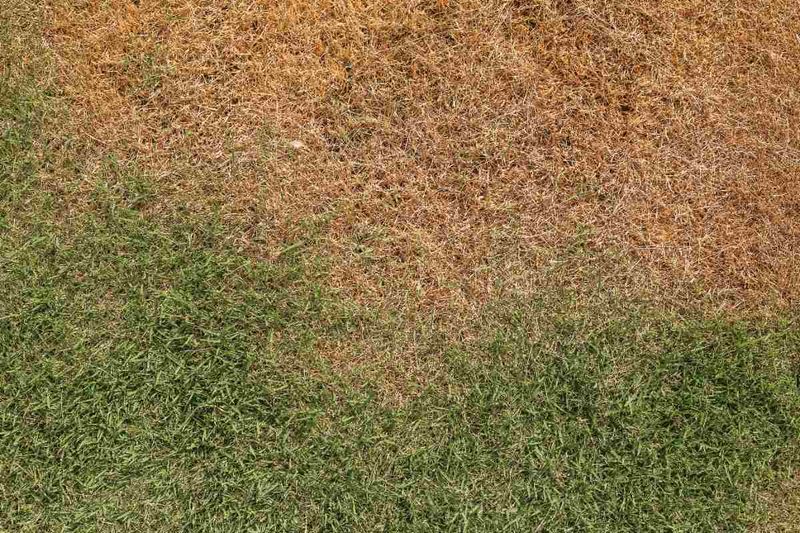
Put your findings together. Confirm the grass type, note the patch pattern, and run the moisture, insect, and root checks that fit what you saw.
If the clues still do not add up, take photos and samples to your local Extension office.
One symptom does not justify a blanket pesticide, fungicide, fertilizer, aeration, or dethatching job. Fungicide choices depend on the correct diagnosis, as UF/IFAS fungicide guidance points out.
Be careful with nitrogen. UGA warns that late fertilizer can interfere with dormancy and raise the risk of winter injury.
Always follow local recommendations and the product label.
A tan lawn in October is often just a grass taking its seasonal rest, and the best treatment is sometimes patience.