
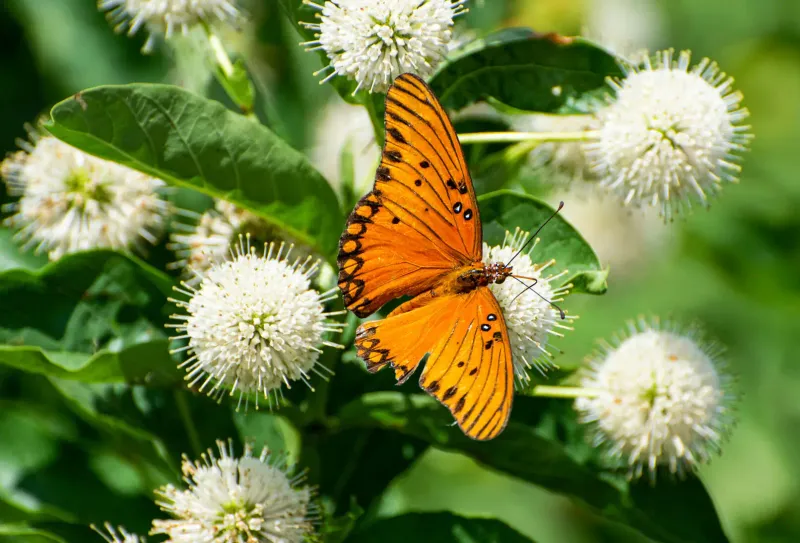
Picture a shrub covered in white golf-ball-sized flowers that look like tiny pincushions stuck full of pins. That is common buttonbush, a Texas native that bees and butterflies visit for nectar.
It does not fit every yard, though, and its bloom time and site needs matter a lot. Here is how to tell whether it belongs in yours.
Meet the Texas native with pincushion-like flowers
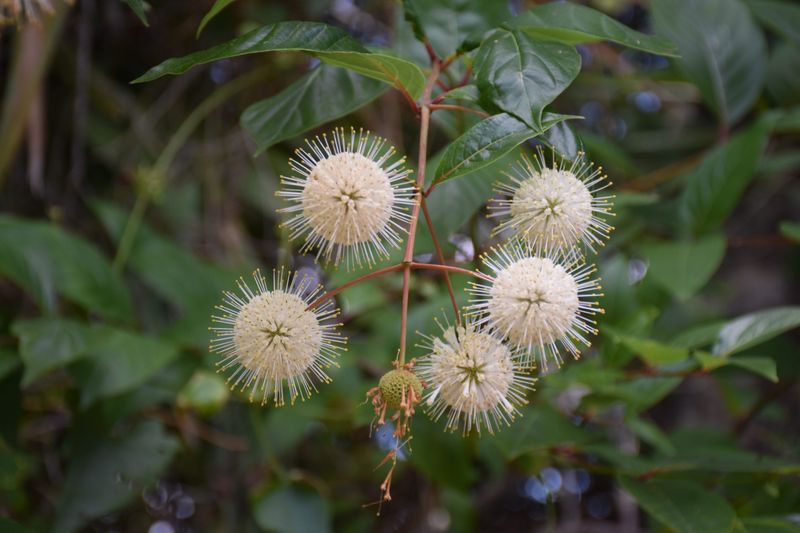
Common buttonbush (Cephalanthus occidentalis) is the plant behind those strange white spheres. It is native to Texas, where it shows up in swamps, moist low areas, and along streams.
Once you spot one in bloom, you will not confuse it with much else.
Each flower head is round and white, and Texas A&M’s rangeland plant profile puts the flowers at about an inch across. Look closely and you will see that every ball is built from many small florets packed tightly together.
Each floret has a long style poking out past the petals.
Those projecting styles create the pincushion look. Imagine a ball of cream-colored foam with hundreds of thin pins pushed in from every direction.
That is the effect, and it gives the shrub a texture unlike most garden flowers.
The glossy green leaves make a good backdrop for the pale globes. Against dark water or wet shade, the flower heads stand out clearly.
For gardeners who like plants with a bit of personality, buttonbush offers something you can describe in a single sentence and recognize from across a pond.
Before you picture one in your yard, though, there are practical questions to answer. Where does the ground stay wet?
How much room is there? And when will the flowers actually open where you live?
The next sections take those up one at a time.
Why bees and butterflies visit buttonbush
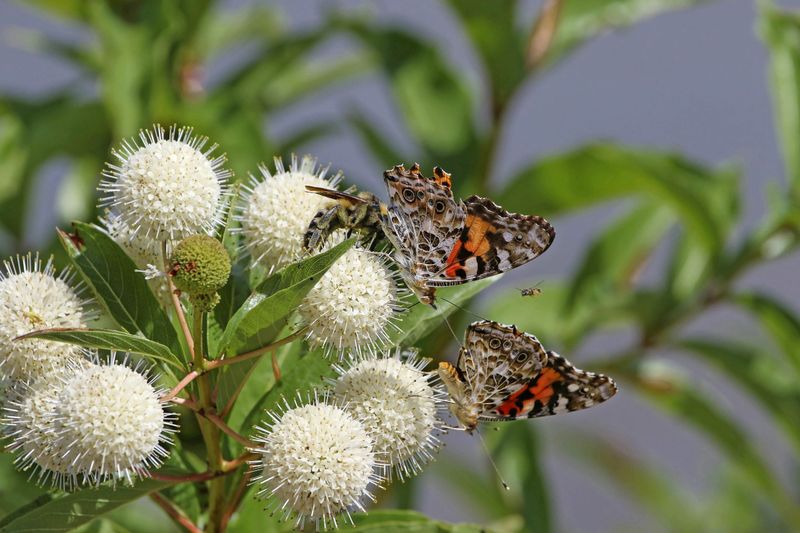
Nectar is the draw. Those packed florets give visiting insects lots of small flowers to work in one spot, and Texas A&M lists buttonbush as a nectar source.
A butterfly can stand on a single ball and sip from floret after floret without flying anywhere.
Other extension sources back up the visits. UF/IFAS reports that the flowers attract bees and butterflies, and NC State Extension says the same.
Texas Parks and Wildlife also includes the plant in its native pollinator guidance.
That is a solid reason to plant it, but it is not a promise of a crowd. No source says how many bees or butterflies a particular yard will get.
Results depend on what else is blooming nearby, how healthy the shrub is, and what pollinators live in your area.
A practical way to improve your odds is to plant buttonbush alongside other native bloomers that flower at different times. Then visitors have reasons to keep coming back to your yard through the season.
Buttonbush becomes one stop on the route instead of the only one.
Also, give the shrub a couple of seasons. A young plant in a wet spot may bloom lightly at first.
Watching which insects show up over time will tell you more than any general claim can.
When can Texas gardeners expect blooms?
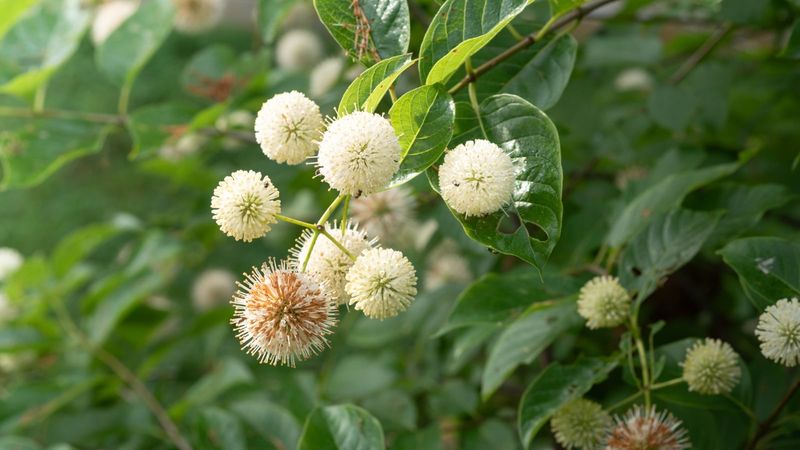
Buttonbush is best thought of as a summer bloomer. Texas A&M reports flowering from June through September.
That window already stretches toward fall, but it ends well short of a guaranteed autumn show.
A regional chart adds some nuance. In its Cross Timbers section, a Texas Parks and Wildlife pollinator guide lists buttonbush for September through October.
So in some parts of Texas, blooms may overlap with early fall.
Timing shifts with location, so a neighbor’s shrub across the state may flower on a different schedule than yours. Weather and moisture likely play a role too.
Treat any single date range as a rough guide rather than a calendar you can set.
As a regional example only, UF/IFAS Lee County describes an earlier March to August season in South Florida. That is not advice for Texas, but it shows how much bloom time can move from place to place.
The practical takeaway: plan on summer flowers and hope for some extension into early fall. If you want pollinator food deep into autumn, pair buttonbush with plants known to bloom later in your region.
Choose a spot that stays moist
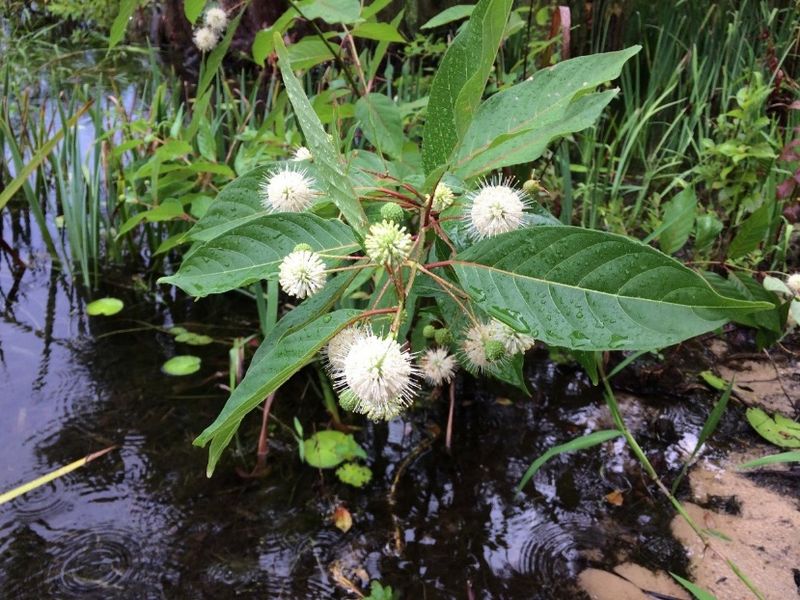
Wet feet are what this shrub wants. Think pond edge, stream margin, rain garden, or a low spot in the yard where water lingers after storms.
Texas A&M notes it grows in swamps, moist low areas, irrigated ground, and along streams, and that it does not tolerate dry soil.
Being a Texas native does not make it right for every Texas yard. A sunny, well-drained slope is a poor match.
Gardeners who bring home a buttonbush for a dry bed often end up with a struggling plant.
NC State Extension gives a similar warning, saying the plant flowers poorly in dry soil. That matters here, because flowers are the whole reason most people plant it for pollinators.
A simple test can help. After a good rain, watch the spot for a few days.
If water drains within hours and the soil is crumbly again by the next day, it is probably too dry. If the ground stays damp or soggy for long stretches, buttonbush has a better chance.
Hauling water to a dry site is not a reliable fix. Extra watering may not match the steady moisture the plant gets in a true wet spot, and nothing guarantees it will thrive.
Match the plant to the site instead of the other way around.
Make room for a substantial shrub
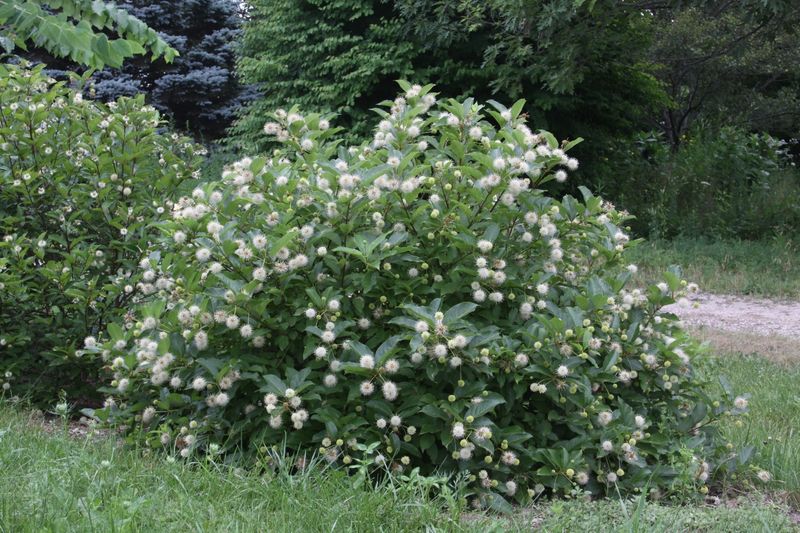
Size catches many gardeners off guard. Texas A&M reports a typical height around 10 feet, with plants ranging from 3 to 20 feet.
That is a wide spread, and the upper end is tree-like.
For landscape planning, UF/IFAS gives a common range of 6 to 12 feet tall and 6 to 10 feet wide. In practice, picture a shrub roughly as wide as a small car and as tall as a single-story roofline.
So skip the foundation bed by the front door. Buttonbush works better along a roomy pond margin, at the back of a rain garden, or in a naturalized wet area where it can spread without crowding paths or windows.
Pruning is possible. Early spring is the time to cut it back if the shrub gets bigger than you want.
Even so, pruning will not turn it into a naturally small, tidy plant, and you will be trimming each year to hold it in check.
Before planting, mark out a circle about ten feet across with a hose or stakes. If that space feels too tight for the spot, consider a different plant or a different location.
Fruit offers a later benefit for birds
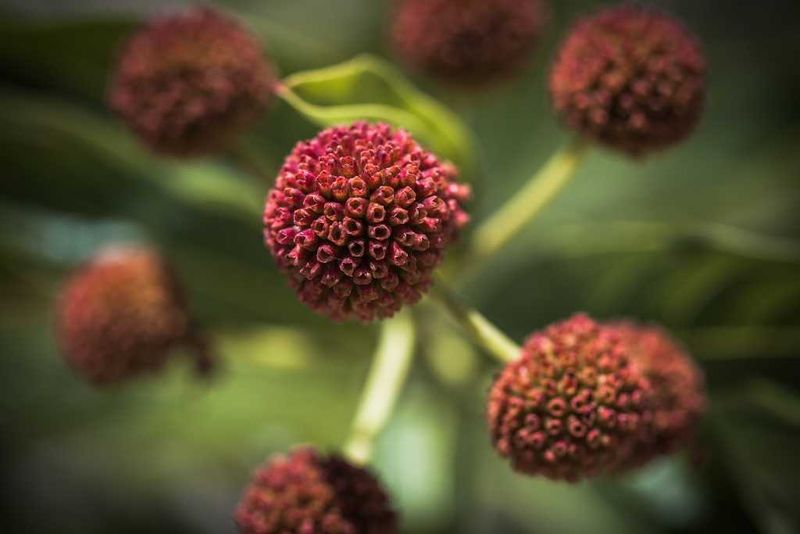
Once the flowers fade, the shrub has a second act. Small round fruit heads form and darken, and they are a different feature from the blooms that bring in bees and butterflies.
Keeping the two separate helps you set realistic expectations.
According to Texas A&M, the fruits mature around September and October and persist into winter. Each one holds small nutlets, and birds eat them.
That makes the shrub a modest food source when many plants have already dropped their seeds.
Think of this as a bonus rather than the main event. Pollinators visit for nectar earlier in the season, while birds come for the nutlets later.
The two groups use different parts of the plant at different times.
The persistent fruit heads also give the shrub some winter interest. The rounded brown balls hang on bare stems and echo the shape of the summer flowers.
If you want to see who stops by, set up a chair with a view of the shrub on a calm cold morning. Waterside spots can attract plenty of bird activity, though what shows up will depend on your area.
Use a simple site-and-safety check before planting
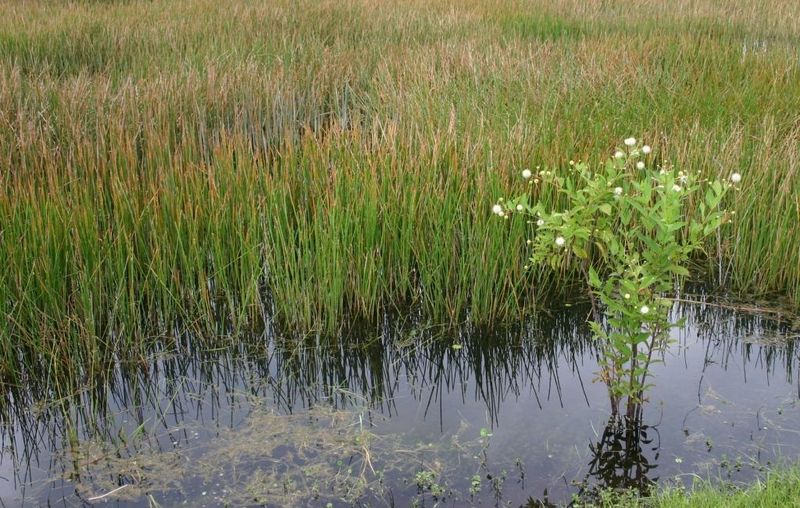
Two questions settle most of the decision. Does the ground stay moist or wet?
And is there room for a large shrub? If both answers are yes, buttonbush deserves a spot on your list.
If your yard is dry, cramped, or both, look at other natives instead. Buttonbush is not a default pick for a tight bed or a sun-baked slope, no matter how interesting the flowers look.
Safety is simple. Do not eat any part of the plant, and do not let livestock browse it.
Texas A&M says the toxic agent is not established, with cattle the main concern, and the NC State Herbarium lists it among plants poisonous to livestock. Neither source shows ordinary garden contact to be a hazard.
A wet corner and a roomy edge are all this shrub asks for. Give it those, and it will do the rest.