

The last iris blossom drops, and the garden bed suddenly looks like the party has ended. But a few quick jobs now can keep your bearded irises tidy and healthy for next spring.
Some of those jobs happen every year, and one only happens every few years. Here is how to tell them apart in a North Carolina yard.
Cut the spent stalk after its last flower fades
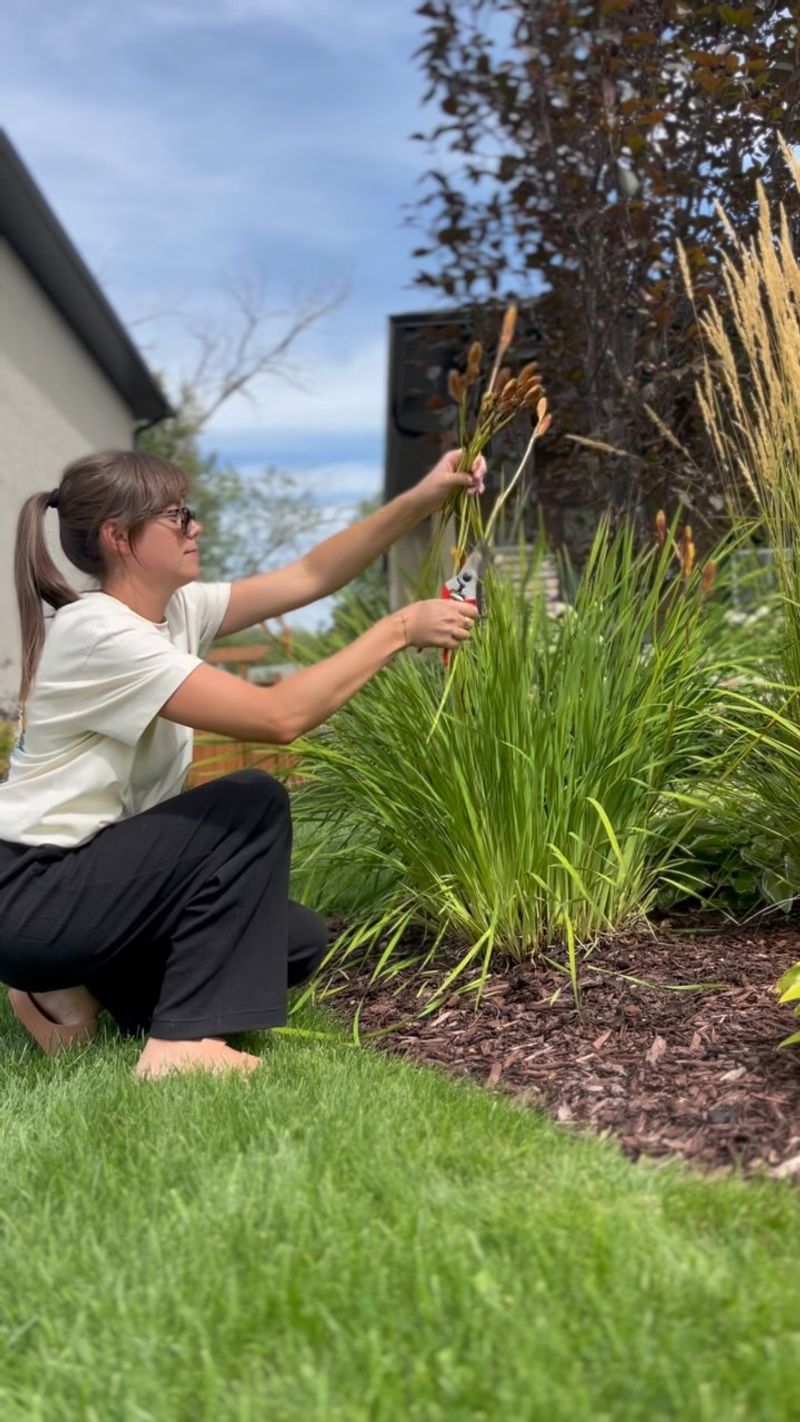
Keep an eye on each flower stalk rather than the whole clump. A single stalk carries several buds that open one after another, so wait until every flower on that stalk has faded.
Then cut the stalk off near the base of the plant with clean pruners or scissors.
The reason is simple. If old blooms stay put, they can turn into seedpods, and the plant spends energy on seeds you probably do not want.
Iowa State Extension deadheading guidance describes how removing spent flowers prevents seed formation and keeps plants looking neater. A bed full of bare, brown stalks looks messy, so this job is as much about appearance as plant care.
Be realistic about what to expect. Cutting the stalk does not guarantee a second round of flowers, and most bearded irises will not rebloom just because you deadheaded.
It also will not stop a crowded clump from slowly flowering less. Think of it as a tidy-up and a seed-prevention step, nothing more and nothing less.
If some stalks still have unopened buds, leave them alone for now. Come back in a few days and snip each one as it finishes.
Cut close to the base so no ugly stubs poke up through the leaves.
Leave the green foliage in place
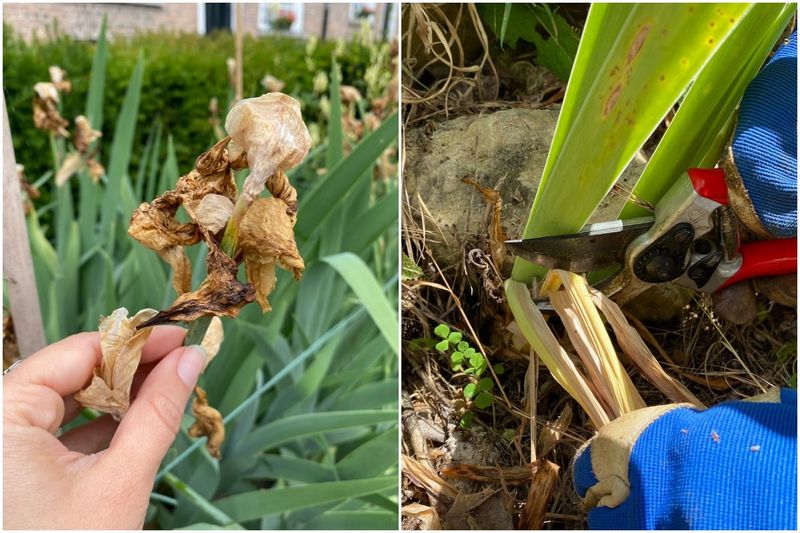
Once the stalks are gone, the leaves have an important summer job. They soak up sunlight and turn it into food, and the thick rhizome underground stores that food for next year’s flowers.
Cutting the fans off early means a smaller pantry when the plant needs it most.
That is why healthy green foliage should stay put after flowering. Utah State Extension notes that iris leaves feed the rhizome, which is a good reason to skip a routine buzz cut.
Routine post-bloom care means removing flower stalks only.
You may have heard about trimming iris leaves to about half their height. That tip belongs to a different situation.
It applies to divisions being replanted, where trimming helps the fans stay steady while new roots form. It is not a yearly haircut for an established clump.
Do pull off any leaves that are brown, mushy, or clearly diseased, since those no longer feed anything. Healthy leaves with a few ragged tips can stay.
Let the fans do their work through summer, and tidy them only if they turn fully yellow or spotted.
Deadheading and division do different jobs
The idea that one quick chore decides whether your clumps fade each year gets the story tangled. Two separate tasks are at work here, and they solve different problems.
Mixing them up can leave a gardener disappointed after doing everything “right.”
Deadheading stops seedpods from forming. Iowa State describes a vigor benefit from avoiding seed production, and it also makes the plant look better.
That is a real, modest payoff, and it is worth the two minutes per stalk.
Division deals with crowding. Bearded irises spread by rhizomes, and over time the clump gets packed, with older growth in the middle and rhizomes piled on top of each other.
Iowa State’s iris guidance points to dividing as the way to refresh mature clumps that bloom less.
So removing spent stalks is not a substitute for dividing an overcrowded clump. It will not, by itself, stop a clump from declining over the years.
If your irises are packed and sparse with flowers, deadheading alone will not fix it.
The reverse also holds. Dividing does not replace deadheading, because seedpods can still form on a newly divided plant.
Treat deadheading as a yearly habit and division as an occasional repair job.
Divide when the clump’s condition calls for it
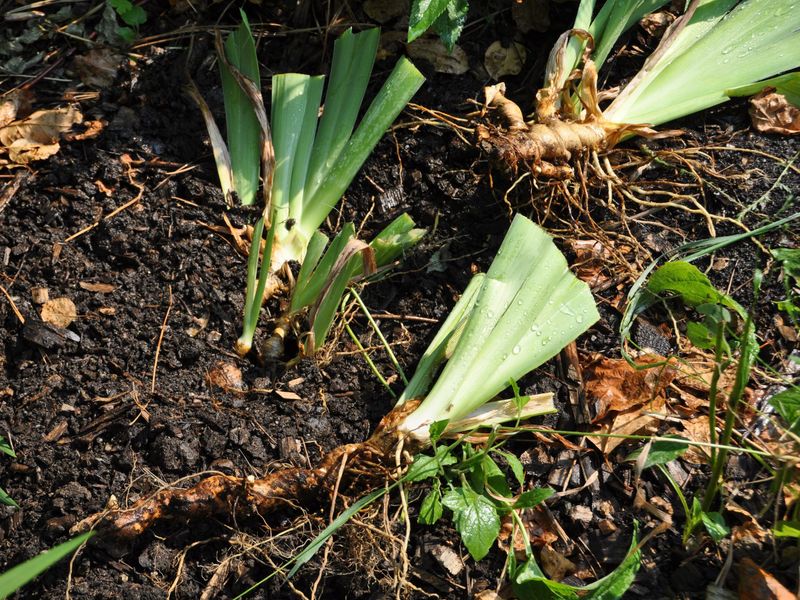
Start by looking at the clump rather than the calendar. Are the rhizomes stacked up and shoving each other out of the soil?
Is the center bare or leafy but flowerless while the edges still send up fans? Those are signs the plant has run out of room.
A common rule of thumb is every three to five years. Clemson Extension recommends dividing bearded iris on roughly that schedule.
Treat it as a typical range, not a deadline. Some clumps stay productive longer, and others crowd up sooner in rich soil.
Dividing after every bloom, or every single year, is unnecessary. It disturbs plants that are doing fine and sets them back.
A healthy clump with plenty of flowers can simply be left alone.
Iowa State’s guidance also reminds gardeners that a newly divided clump may flower sparsely the first spring. So do not plan a big display from fresh divisions.
If a clump is flowering well, wait.
A quick check helps. Note how many stalks the clump produced this spring compared with a couple of years ago.
If the number has dropped and the rhizomes look piled together, division is a sensible next step.
Use a flexible post-bloom window in North Carolina
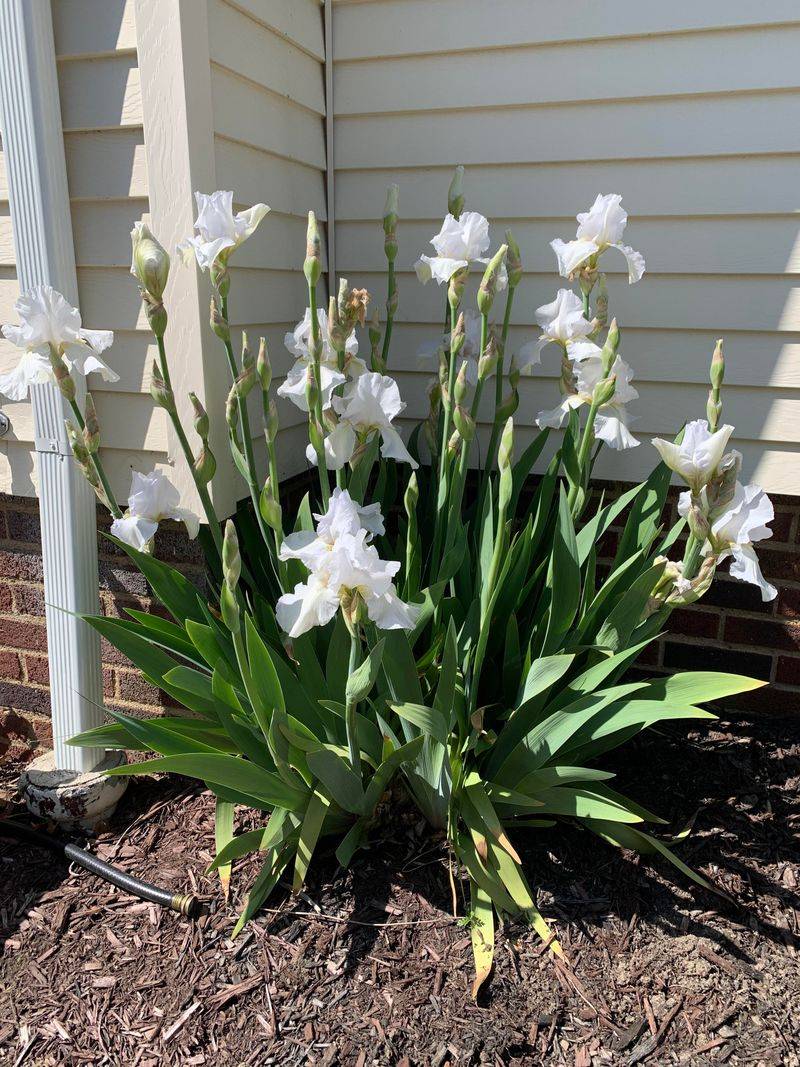
North Carolina stretches from the mountains to the coast, so one date cannot fit every yard. Irises in Wilmington bloom well before those in the high country, and a wet spring can shift everything again.
That is why the best cue is the plant itself.
NC State Extension says bearded iris can be divided after flowering, including in summer. Notice that no single statewide date is given.
Once your clump has finished blooming, the window is open.
Pick a day when the soil is workable and you can water the new plantings afterward. A scorching afternoon with a dry forecast is a poor choice.
Cooler mornings or a stretch of milder weather make the job easier on both you and the plants.
One more caution: these tips are for bearded iris. Other iris types can follow different schedules.
Iowa State’s guidance notes, for example, that Siberian iris is divided less often and at different times.
Check the flower before you act. Bearded iris has fuzzy “beards” on the lower petals and thick rhizomes that sit near the soil surface.
If yours looks different, look up its own care before reaching for the shovel.
Keep vigorous outer rhizomes and replant them shallowly
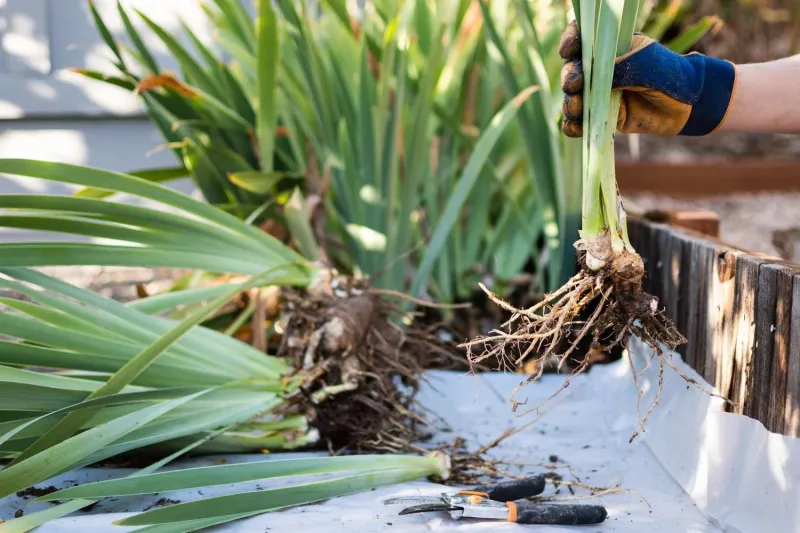
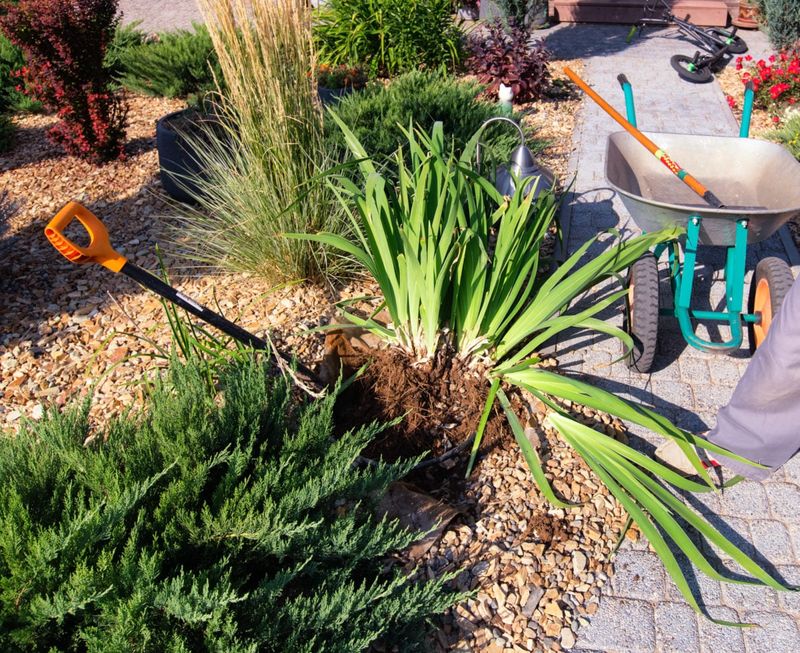
Lift the whole clump with a garden fork, working outside the leaves so you do not spear the rhizomes. Shake off loose soil and look at what you have.
The best pieces are usually on the outside, where the newest growth is.
NC State Extension advises keeping vigorous outer sections instead of weak growth from the center. Keep healthy rhizomes that have roots and a fan of leaves.
Discard pieces that are weak, old, diseased, or damaged, including any that are soft or have insect holes.
University of Wisconsin Extension describes disinfecting cutting tools between cuts when disease is present or suspected. A quick wipe with a household disinfectant can help avoid spreading problems from one rhizome to the next.
For replanting, dig a shallow hole in a sunny spot and set the rhizome at or just above the soil surface. Spread the roots out, firm the soil, and water well.
Burying the rhizome deeply is a common mistake. If you are trimming the leaves on these divisions, that is a replanting step, not routine care.
Iowa State’s guidance cautions that a newly divided clump may flower sparsely the next spring. Give it time to settle in.
Check other causes of poor flowering
If your irises bloomed poorly this year, resist blaming yourself right away. Fewer flowers do not prove you missed deadheading, and dividing will not automatically fix things either.
Several other problems can produce the same sparse display.
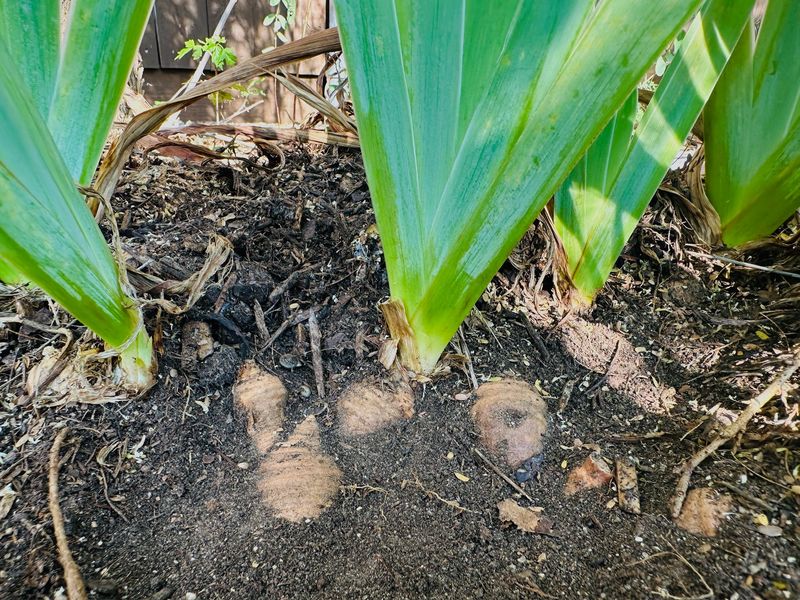
Crowding is one cause, as covered above. Planting too deeply is another, since bearded iris rhizomes want to sit at or just above the soil surface.
Shade is the third, and it is easy to overlook as trees and shrubs grow larger each year.
Iowa State Extension recommends at least six hours of direct sun for best flowering. Spend a sunny day noting how long the bed is actually lit.
If a maple’s canopy now blocks the afternoon light, moving the irises may help more than any amount of trimming.
Walk through a simple diagnosis. Look at the rhizomes: are they buried or stacked?
Look at the light: is it six hours or less? Then look at the clump’s age and density.
The routine stays simple. Remove spent stalks, keep the healthy leaves, and divide only when the clump’s condition calls for it.
A bed that looks finished in June is often just resting up for next April.