
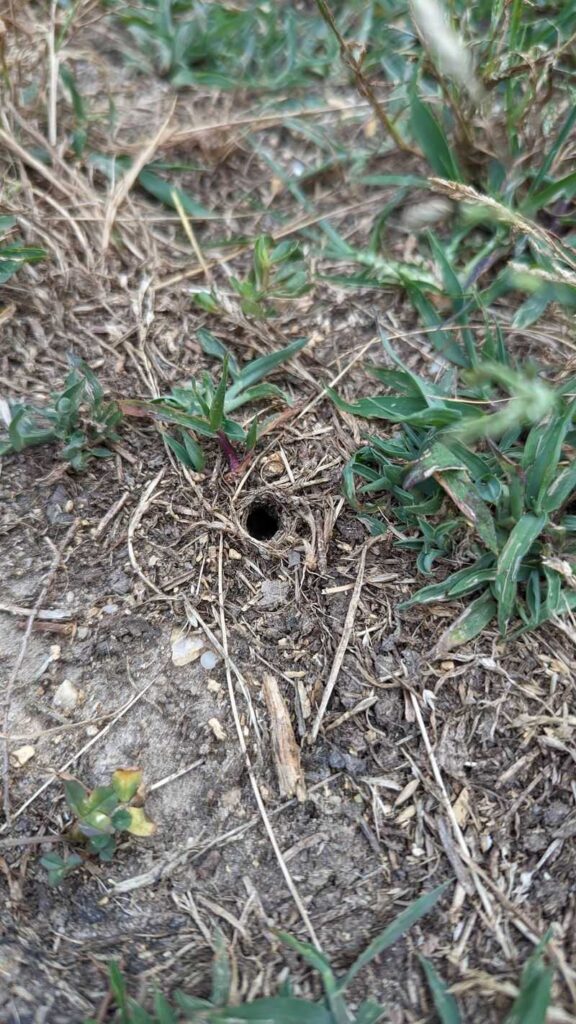
Big wasps cruising low over your Central Texas lawn can make anyone nervous, especially when fresh holes show up in the grass. Two different kinds of wasps may be behind the scene, and only one of them has anything to do with lawn grubs.
Knowing which is which can save you money, protect your turf, and keep you from spraying for no reason. Here is how to sort out what you are seeing and what to do next.
A lawn hole does not identify its cause
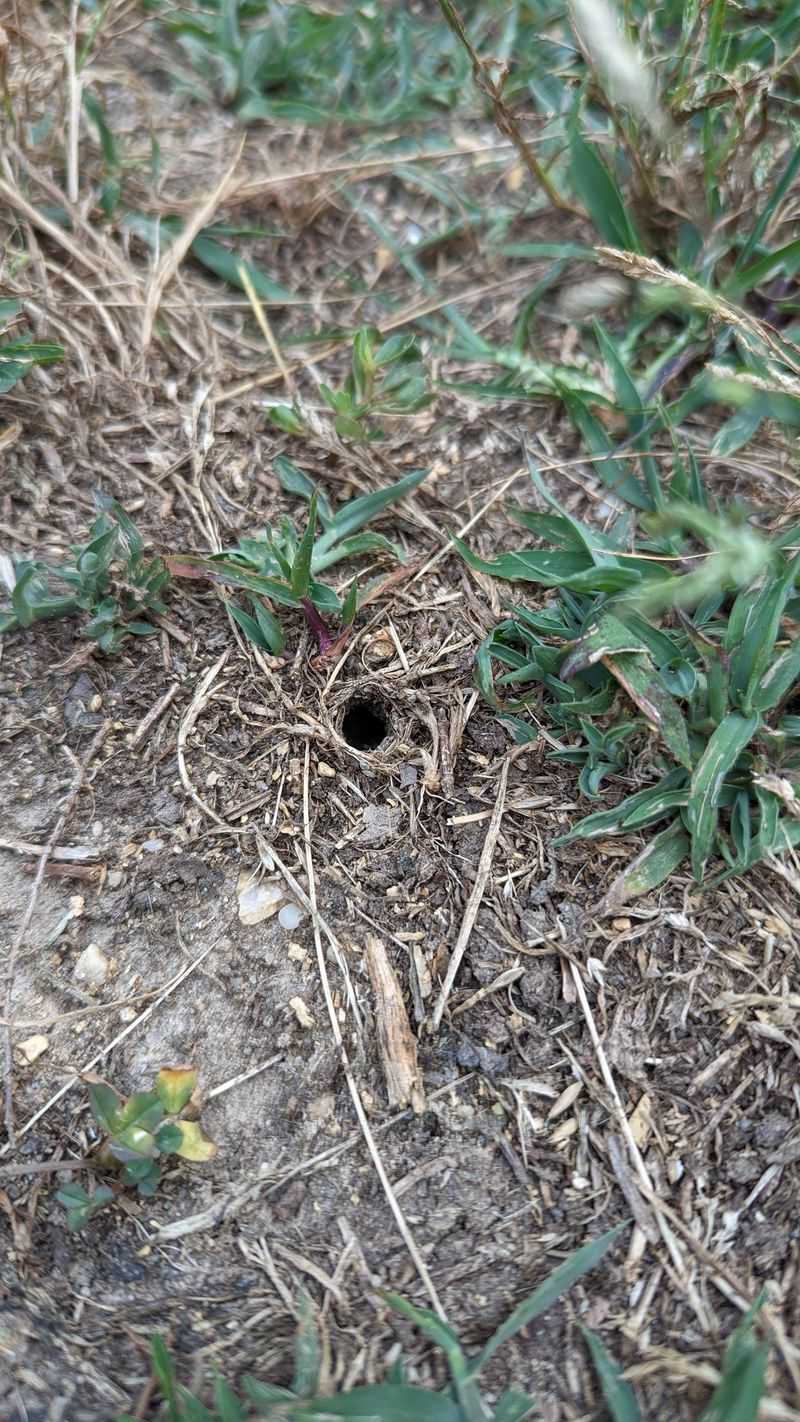
Spot a neat round hole in the grass and the mind jumps straight to wasps. That jump is understandable, but it is a guess.
Texas A&M turf damage guidance lists round holes in turf as something digger wasps or emerging cicadas can cause, and other insects and animals disturb lawns too.
Cicadas are a good example. When the nymphs crawl up out of the soil, they leave small exit holes behind, and no wasp is involved at all.
A hole by itself tells you something moved through the dirt, not who did it.
The better clue is what you see happening around the hole. Spend ten minutes watching on a sunny afternoon.
Is a large wasp flying in and out of it? Is she carrying something heavy?
Or is the area quiet, with no insect traffic at all?
Activity matters because two very different wasps get lumped together in Central Texas yards. Cicada killers are big, loud, and dig burrows in bare, sunny ground.
They hunt cicadas, as described in Texas A&M AgriLife’s Central Texas report. Scoliid wasps, on the other hand, search turf for beetle grubs.
Both can look intimidating, and both are often blamed for damage they did not cause. Before you decide anything about your lawn, figure out which insect, if either, is actually there.
The next sections walk through each one.
Cicada killers provision their young with cicadas
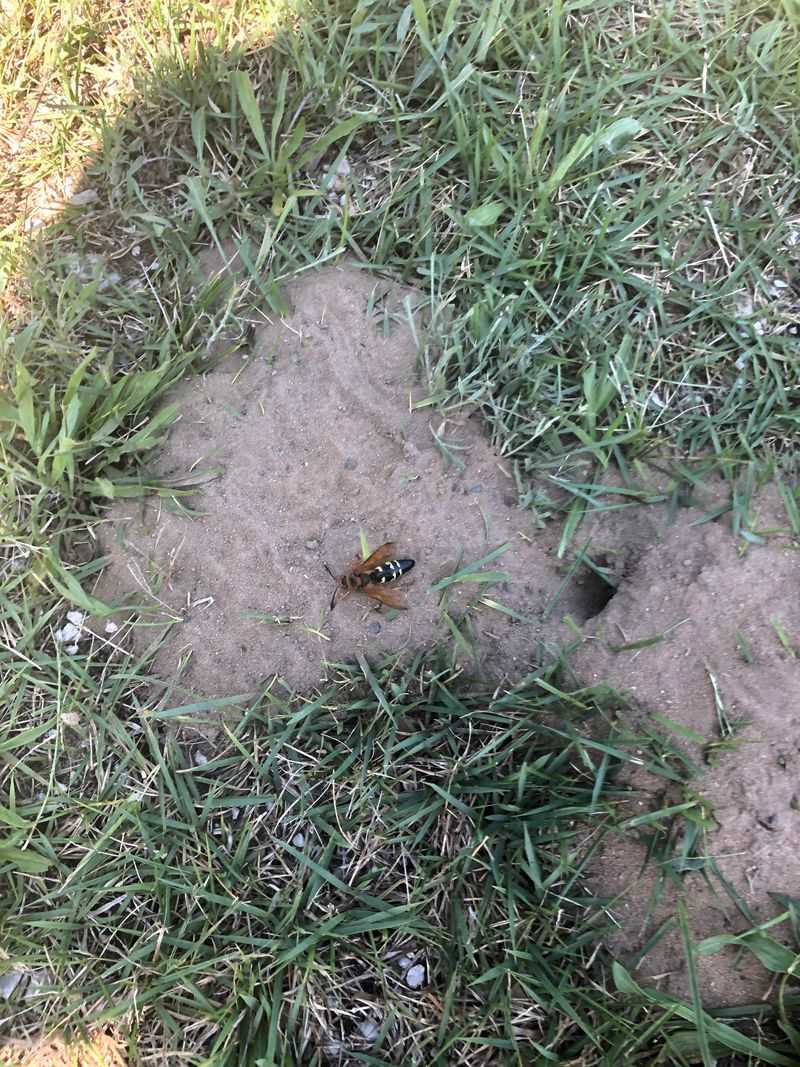
Few insects look as dramatic as a cicada killer hauling a limp cicada across the yard. Each female digs her own burrow, stocks it with paralyzed cicadas, and lays an egg on them so her young have food.
The wasps do not eat your grass, and they are not hunting lawn grubs.
That last point trips up a lot of homeowners. Cicada killer burrows do not signal grubs below the surface.
Their prey is cicadas, so a burrow tells you nothing about grub numbers.
Where they nest says a lot about whether you will see them. Oklahoma State Extension notes they favor exposed, well-drained or sandy soil with sparse vegetation.
Thick, vigorous turf is rarely their pick, so burrows often turn up along bare edges, thin spots, flower beds, and dry slopes.
The mounds of loose soil at the burrow mouth can smother small patches of grass. That is usually a cosmetic issue, limited to a spot the size of your hand or a bit larger.
The wasps themselves do not feed on the lawn.
Expect them in summer, when cicadas are singing in Central Texas trees, as Texas A&M AgriLife describes. The season is fairly short, and the activity fades on its own.
Scoliid wasps parasitize beetle grubs
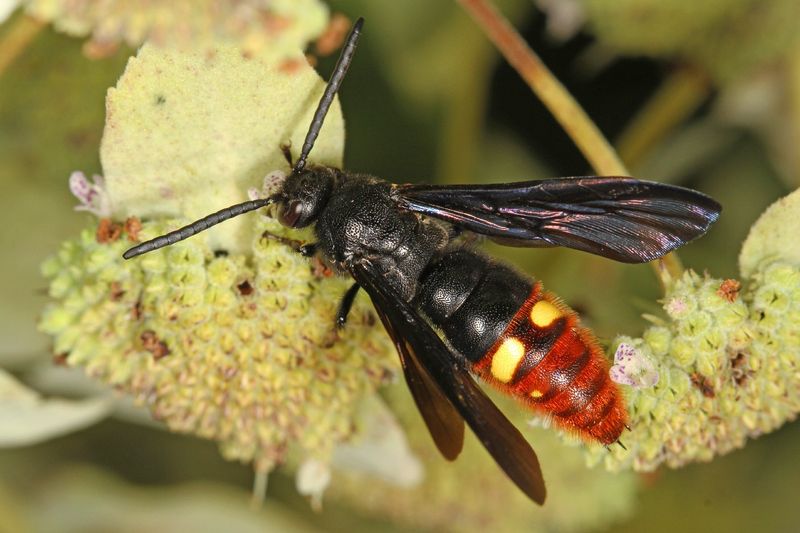
Scoliid wasps work quietly compared with the noisy cicada killers. Species such as Scolia dubia parasitize beetle grubs, including green June beetle grubs.
The female finds a grub in the soil, paralyzes it, and lays an egg on it, and the developing wasp larva feeds on the grub.
Homeowners usually notice them flying low over turf in a slow, sweeping pattern. That is host-searching behavior, as the NC State Extension digger wasp page explains, and NC State describes them as useful natural control of lawn grubs.
So the claim that some lawn wasps do you a favor fits scoliids best. They can chip away at grub numbers without any effort or cost from you.
Still, a wasp in the yard is not a lab report. Their activity can hint that host grubs are somewhere nearby, as NC State TurfFiles discusses, but it does not tell you how many grubs there are or whether they are damaging the lawn.
Think of scoliids as a helpful bonus. They are not a warning alarm, and they are not a reason to reach for treatment.
These wasps are usually docile, but females can sting
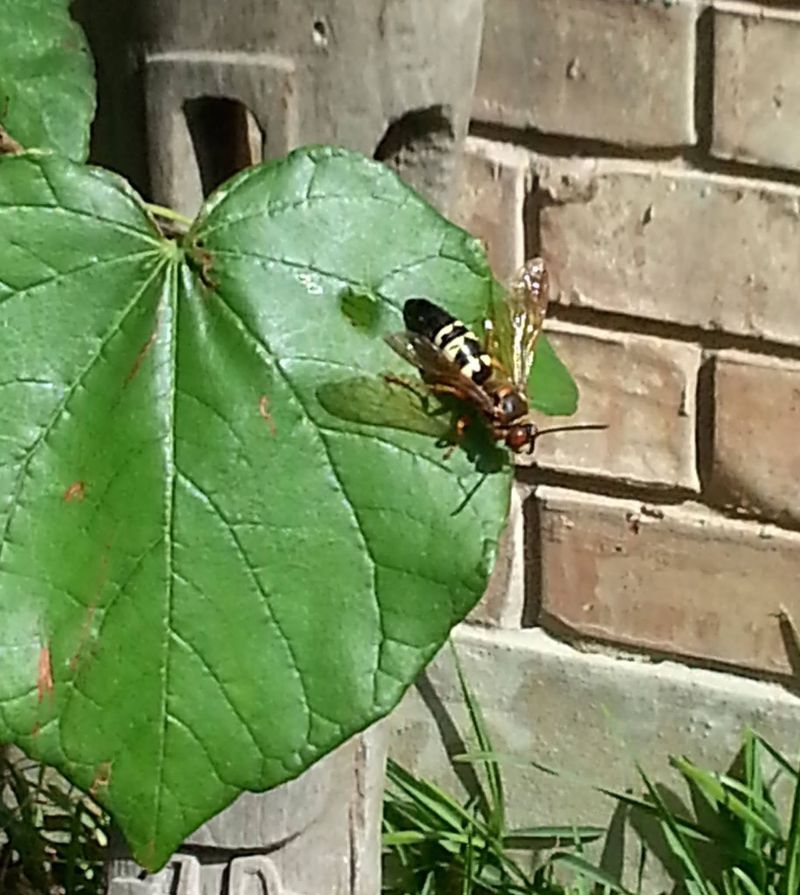
Size makes a bad first impression. Cicada killers are among the largest wasps in Texas, and the males love to hover and dart at anything that moves near their territory.
Those males are all show, because they cannot sting.
Females are a different story. Texas A&M Apiary Inspection Service says females can sting, especially if handled or stepped on, though they are generally not aggressive and stings are uncommon.
The same holds for scoliids, according to NC State.
Cicada killers may gather where the soil suits them, so a patch can hold many burrows. They are still not a social colony like yellowjackets or paper wasps.
Each female digs and guards only her own burrow, a pattern covered in Texas A&M’s guide to solitary wasps.
Calling them harmless goes too far, but treating them like a hornet nest does too. Common sense covers most of it.
Do not grab or swat at them. Keep bare feet, kids’ play, and rough activity such as wrestling or digging away from active burrows.
Mow and walk elsewhere for a few weeks, and the wasps will mostly ignore you.
Inspect damaged turf before treating for grubs

Seeing wasps or holes is no reason to buy grub killer. Neither one proves your lawn has a grub problem, so the decision should rest on how the grass looks and what is in the soil.
Start with the turf itself. Browning patches, or grass that pulls up easily like a loose carpet, are your cue to look underneath.
Healthy, green grass does not need digging up.
Use a shovel to cut and fold back a square foot of sod, then sift through the soil and roots. Texas A&M’s white grub guide advises sampling several spots, including the edge of the damaged area where grubs are often active.
Then count. Texas A&M treats more than five grubs per square foot as a point where treatment can be justified.
That number is a guide, not a universal damage line, and some lawns show no damage even above it.
Say you find two grubs in one spot and eight in another, but the grass is thick and green. Weigh the whole picture before acting.
Next, rule out other causes of brown turf, such as drought stress, heat, disease, or irrigation problems, which look similar and are common in Texas summers.
Confirm the cause first. Treating without that step can waste money and hit insects you did not intend to.
Leave them alone unless they create a problem

For most yards, the best move is no move. Once you have identified cicada killers or scoliids, leave them be if they are not blocking a path, a play area, or an entrance.
Their season is short, and they are not feeding on your lawn.
High-use spots call for a bit more thought. If burrows keep appearing beside a patio or a kids’ play area, Oklahoma State Extension points to reducing exposed bare soil and improving turf or groundcover so the spot is less appealing for nesting.
Since cicada killers prefer sparse, sunny ground, patching thin areas in fall or spring can help next summer.
If you are weighing a pesticide, identify the insect first and follow the product’s current label. Broad lawn treatment is not warranted just because wasps are present, and it will not fix a problem you have not confirmed.
Grub products belong only after you have inspected damaged turf, using the sampling approach in Texas A&M’s grub guide.
The order is simple: identify the insect, inspect any damaged turf, and act only when the findings call for it.
A big wasp over the grass looks like trouble, but it is often just a neighbor with a job to do.