
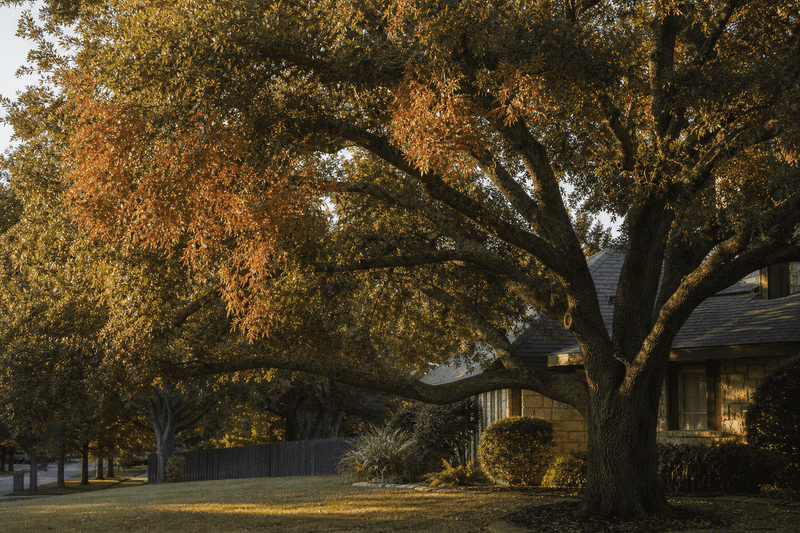
You walk outside and find your live oak’s leaves piled across the yard, months before you expected any mess. Texas live oaks are famous for staying green through winter, so sudden leaf loss can feel like a warning sign.
Sometimes the tree is simply reacting to a rough, dry year, and sometimes it deserves a closer look. Here is how to tell the difference and what to do next.
November leaf drop is outside the usual live-oak exchange
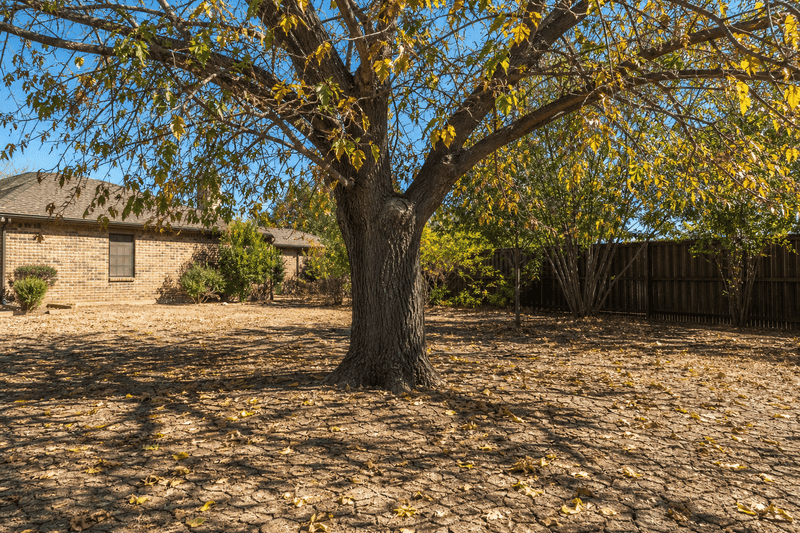
Texas live oaks have a reputation for holding green leaves all winter, and there is a reason. According to Texas A&M AgriLife Extension, live oaks normally drop old leaves in late winter or spring, right as new growth pushes out.
That timing means a heavy leaf fall in November is not the tree’s usual seasonal exchange.
So what is going on? Trees can shed leaves in autumn when they are under stress.
Texas A&M Forest Service notes that drought and heat can push some trees into early dormancy, which can look like fall color and leaf drop.
Still, the calendar alone cannot name the cause. Falling leaves in November do not prove drought, and they do not prove disease.
They simply tell you the tree is reacting to something, and your job is to gather clues.
The rest of this guide separates two main possibilities Texas homeowners hear about most: drought stress and oak wilt. Both can leave a canopy thin, and a few simple observations will show whether you can keep watching, adjust care, or call in help.
Drought can push a live oak into early dormancy
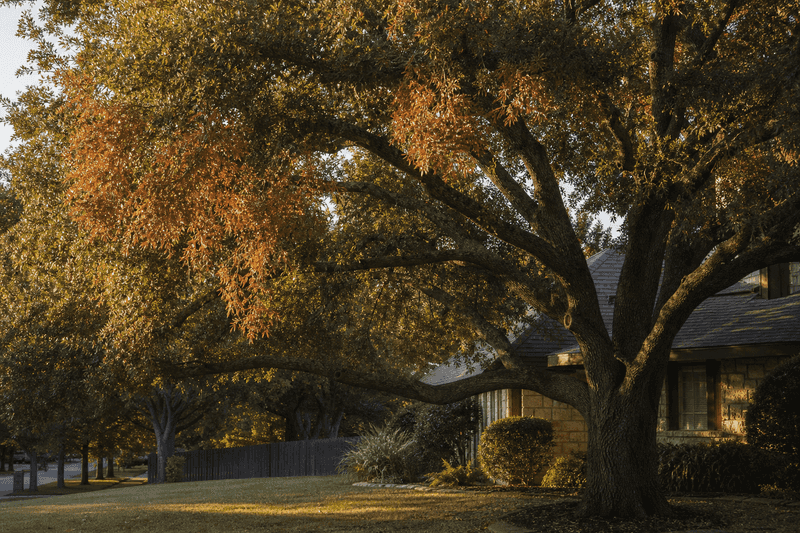
Long stretches of triple-digit heat and little rain take a toll, even on a tough tree like the live oak. Drought-stressed trees may show wilting, yellowing, scorched leaf edges, early leaf drop, and sometimes twig or branch dieback.
Not every tree shows all of these signs, and symptoms vary from one tree to the next.
Some stressed trees respond by shutting down early. Texas A&M Forest Service reported in September 2026 that oaks across parts of East and Central Texas were showing premature fall-like color and leaf drop.
That report covers a specific time and region, so it does not automatically explain every tree in every Texas yard this November.
Other trees are not so lucky and suffer more serious damage. That is why a thin canopy is worth taking seriously without jumping to the worst conclusion.
Here is the reassuring part. A tree that has lost many leaves is not necessarily dead, and Forest Service guidance points out that a leafless hardwood can still be alive.
Drought stress is a plausible explanation for what you see, but it is a possibility, not a diagnosis. Your next step is to look at the whole picture, including how your neighbors’ oaks are doing.
Oak wilt clues matter as a pattern, not a single leaf
Oak wilt is a serious disease of Texas oaks, and it is the reason many homeowners get nervous when leaves fall at the wrong time. It should be treated as one possibility to rule in or out, not as the default answer.
Plenty of drought-stressed oaks never have it.
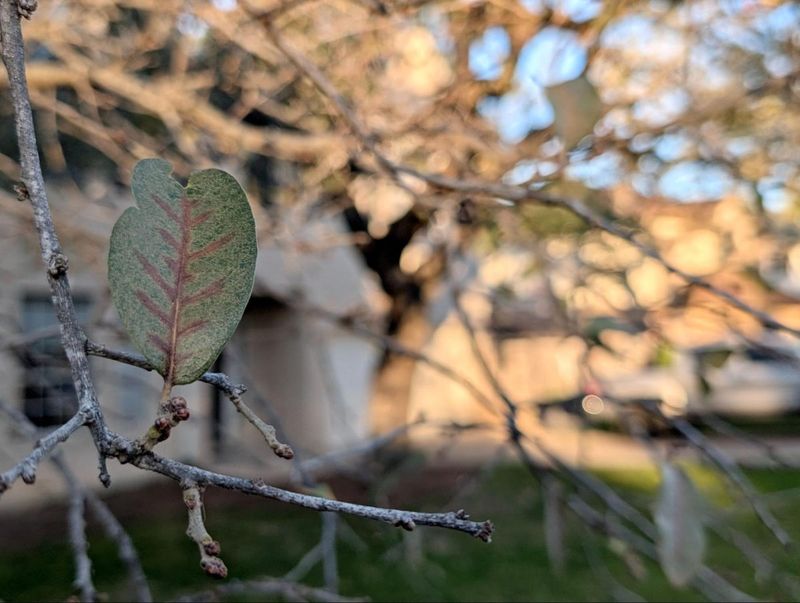
Certain clues deserve attention. Texas Oak Wilt identification guidance lists rapid leaf loss and live-oak leaves with yellow veins that turn brown, a symptom called veinal necrosis.
These clues call for investigation, but they do not let a homeowner confirm the disease.
Location matters too. Oak wilt can spread between live oaks through connected roots, so several nearby oaks declining together is a pattern worth noting.
Here is the tricky part. Drought can cause leaf drop, brown tissue, and some vein symptoms, so the two problems overlap.
Texas Oak Wilt guidance on drought versus oak wilt says an assessment should weigh the whole canopy, the symptoms on the individual tree, and the pattern of decline around it. Laboratory confirmation may be needed.
Try a quick neighborhood walk. Note whether one tree or many are affected, how fast the change happened, and what the leaves look like up close.
Those notes will help an expert far more than a single odd leaf.
At-home checks can show vitality, not the cause
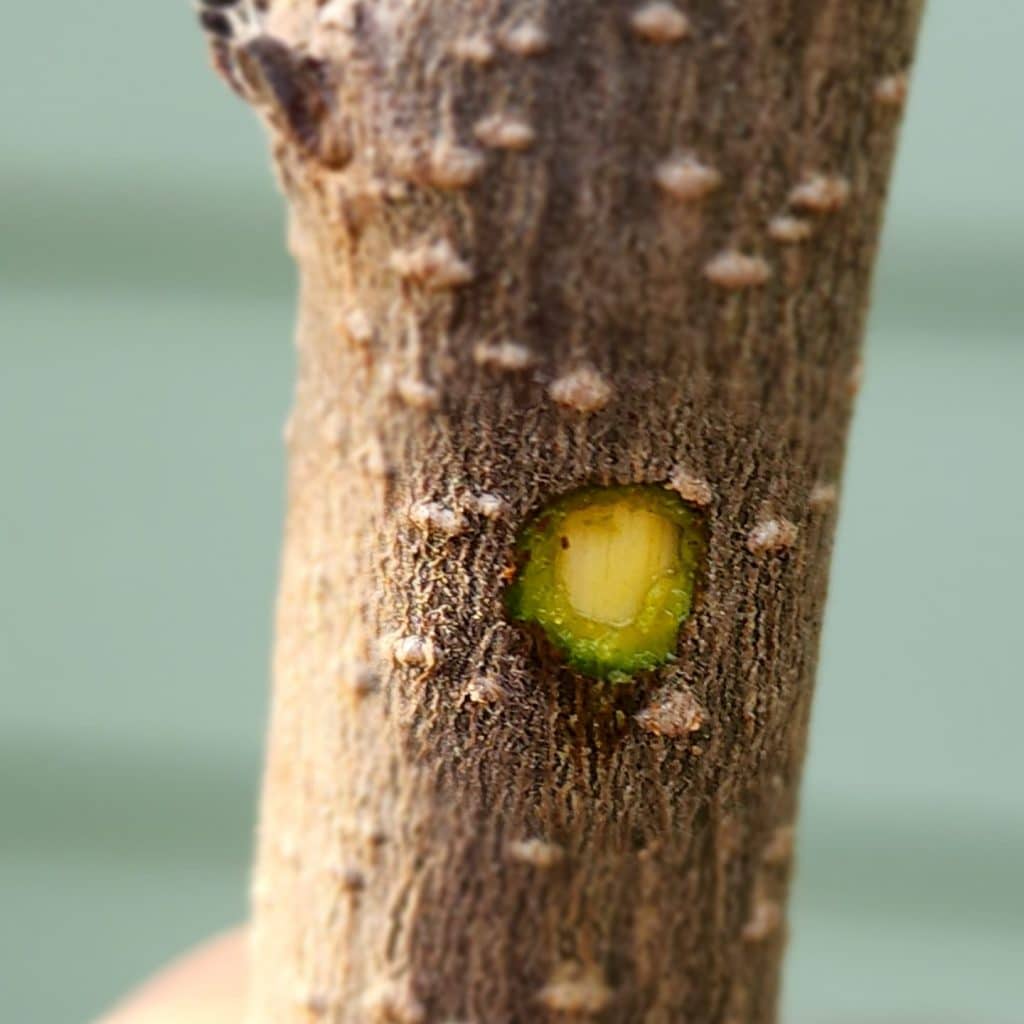
A couple of gentle checks can tell you whether tissue is still alive. Pick a small twig from a branch and bend it.
A flexible twig suggests living tissue, while one that snaps easily may be a concern.
Next, use a thumbnail or pocketknife to lightly scratch a tiny patch of bark on a small branch. Texas A&M Forest Service says green, moist tissue underneath suggests the branch is alive, while brown, dry tissue in multiple spots deserves further inspection.
Keep the limits in mind. Passing these checks does not mean the tree is healthy, and failing them does not tell you why it is struggling.
They cannot diagnose oak wilt or explain the leaf drop.
Go easy, too. Scratch only a small spot, try a few branches once, and skip repeated tests, since every scrape is a small wound on a tree that is already under pressure.
Jot down what you find, snap a few photos, and move on to the next step.
Care for dry soil without adding stress
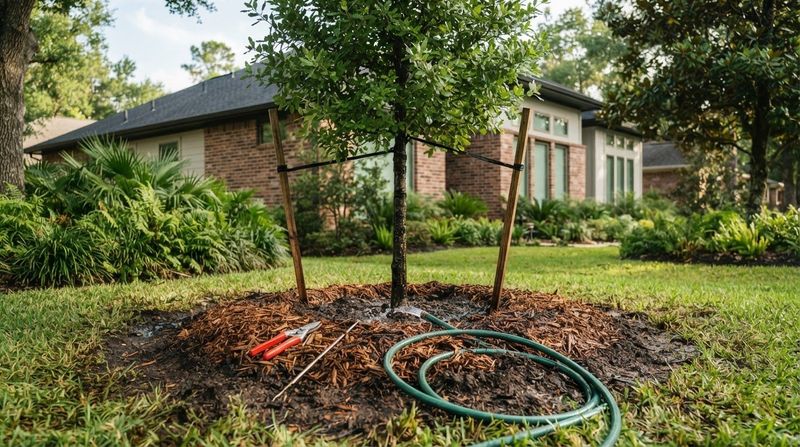
Before you reach for the hose, check the soil. Texas A&M Forest Service suggests pushing a screwdriver into the ground under the canopy.
If it will not slide in 6 to 8 inches, the root zone is likely dry.
When soil is dry, water slowly and thoroughly across the root zone, not just at the trunk, and follow your city’s watering restrictions. A soaker hose or slow trickle lets water soak down instead of running off.
Skip the watering if the screwdriver goes in easily, because too much water is a stress of its own.
Mulch helps. Spread a 2 to 3 inch layer under the canopy to hold moisture, and keep it off the trunk.
Some well-meant fixes backfire. Forest Service guidance for drought-stressed trees advises against fertilizer, unnecessary pruning, and soil disturbance.
Set realistic expectations as well. Water will not turn damaged leaves green again, and a stressed tree may not show whether it recovered until the following spring.
Rapid decline or several affected oaks calls for expert help
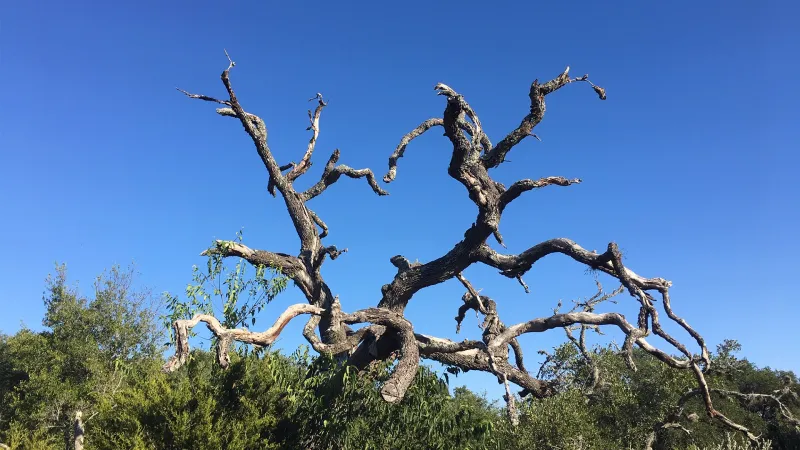
Some situations call for a professional rather than more waiting. Reach out if the decline is rapid, if more than one oak is affected, or if you simply cannot tell what is going on.
Good contacts include Texas A&M Forest Service, your county AgriLife Extension agent, or a Texas Oak Wilt Qualified Arborist.
An expert can look at the canopy, the symptoms, and the pattern around your property. If testing makes sense, the Texas Plant Disease Diagnostic Lab can test suitable samples, and its guidance says oak-wilt testing takes at least three weeks.
Plan for that wait instead of expecting an instant answer.
In the meantime, hold off on invasive treatments. Fungicide injections, root barriers, and heavy pruning are not first moves for a tree that has not been diagnosed.
If pruning ever comes up, Texas Oak Wilt pruning guidance advises avoiding pruning or wounding oaks from February through June, and painting fresh wounds immediately, all year round. For a broader view of management, see the integrated approach to oak wilt.
A live oak can outlast generations of Texans, so one dropped-leaf season is worth a careful look, not a panic.