
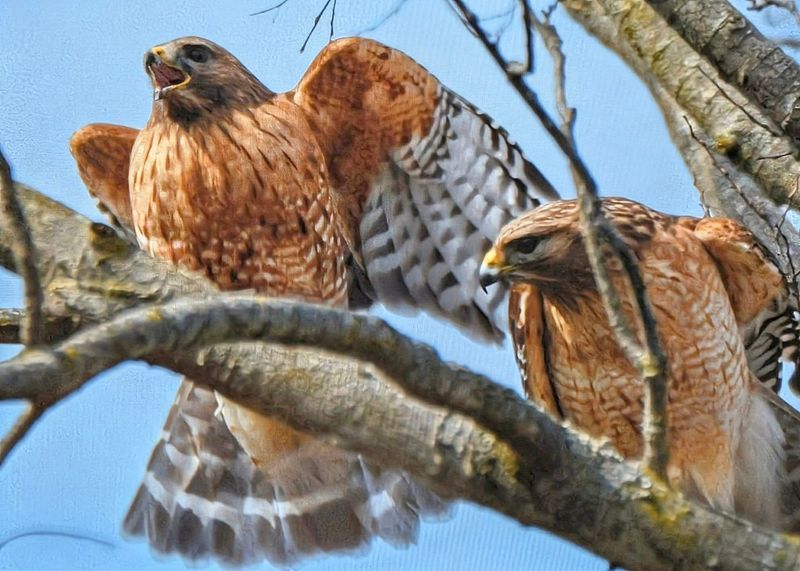
A loud, piercing scream rings out over your Florida yard, and you look up to find a hawk on a branch or fence post. Many people assume the bird has spotted a rat or a snake nearby.
The real story is more interesting and a lot more useful. Here is what the call can tell you, what it cannot, and what to do around your home.
A matching scream does not prove a hawk is overhead
Hear a hawk-like scream and your first thought is probably a hawk. Hold that thought for a moment.
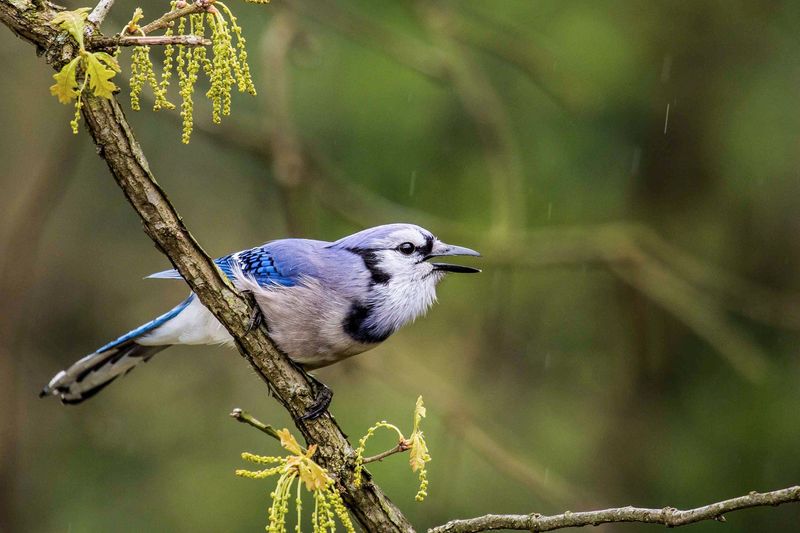
Blue Jays are skilled mimics, and Cornell Lab of Ornithology notes that some birds copy the sounds of other species, including hawks.
That means a matching call alone does not confirm a red-shouldered hawk. A jay hiding in the oaks can fool you, especially when the sound drifts in from a distance.
The fix is simple: find the caller before you decide who is talking.
Step outside and scan the treetops, utility wires, and fence posts. A red-shouldered hawk is a medium-sized hawk, and when you see one calling, you can feel confident about the source.
If you can only hear the sound, listen for a pattern. Cornell describes the real call as a repeated scream with a descending second note, so compare what you hear with a recording.
A jay will often give itself away by switching to its other sounds, or by flitting around in plain view. If the screaming comes from a bird you never spot, treat the identification as unconfirmed.
That small bit of patience keeps you from drawing big conclusions about your yard from a bird that might have been a jay all along.
The call can signal territory or alarm, not a prey sighting
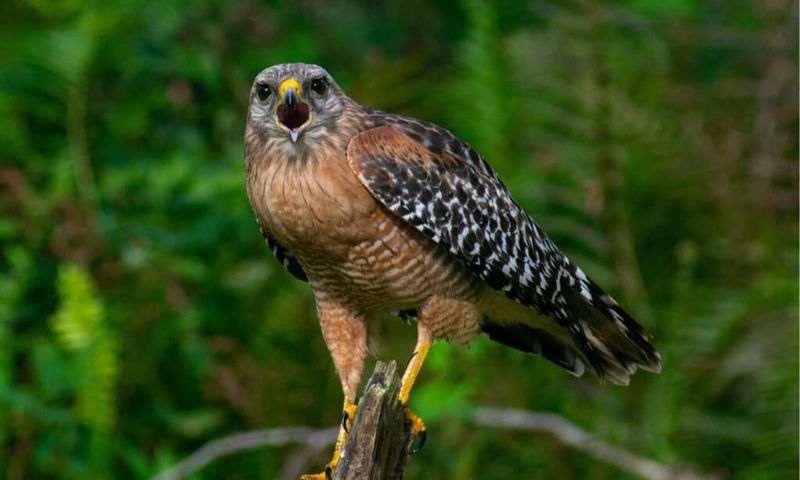
Picture the hawk as a neighbor announcing itself. The loud, piercing call is tied to a few documented situations, and none of them is spotting a snack for the yard.
Cornell adds more detail. Its sound guide describes a repeated call with a descending second note that is used to claim territory and when the bird is alarmed.
So when a hawk screams over your yard, the likely meanings are things like: this is my area, I am showing off for a mate, or something is bothering me or my nest. A crow harassing it, a person walking too close to a nest tree, or another hawk passing through could all set it off.
What the call does not do is name a particular animal. No source describes it as a signal for a rodent, a snake, or any other prey.
The scream tells you about the hawk’s behavior at that moment, not about what is crawling through your mulch.
If the calling comes day after day from the same tree, pay attention to the timing. Spring is nesting season, and a bird that is calling often and watching you closely may be guarding something close by.
What makes a Florida yard useful to a hunting hawk?
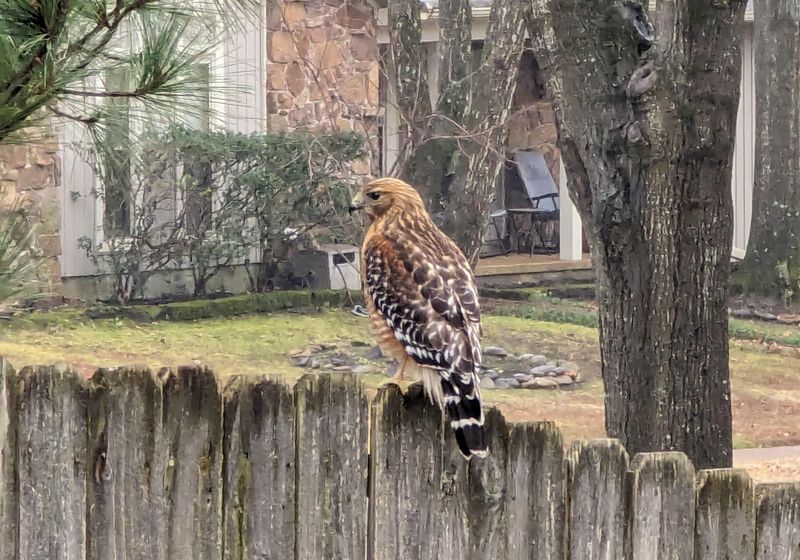
Hawks are sit-and-watch hunters, so a good perch matters. FWC explains that red-shouldered hawks hunt by watching for prey from perches, and that they use pine, oak, and cypress forests near water.
They will also sit in neighborhood trees and on fence posts.
Canopy shape counts too. FWC says partially open canopies make hunting easier, because the bird can see the ground below.
A yard with a few mature trees, some open lawn, and a nearby wet area can give a hawk a place to wait and room to drop down.
The species is not limited to deep woods. Cornell’s life history page describes it using natural wooded habitats as well as some suburban settings, which fits what many Floridians see in their own neighborhoods.
Think of these features as possible reasons a hawk visits, not as a grade for your property. A hawk on your fence post does not mean your yard is untouched, wild, or packed with wildlife.
It means the spot offers a lookout and some hunting space, and that the bird found it useful.
If you want to notice more, walk your yard at different times of day. Look at which trees have clear views below, where the lawn opens up, and whether a pond, ditch, or wet corner sits nearby.
Those are the kinds of places hawks tend to use.
Rodents and snakes are only part of the menu
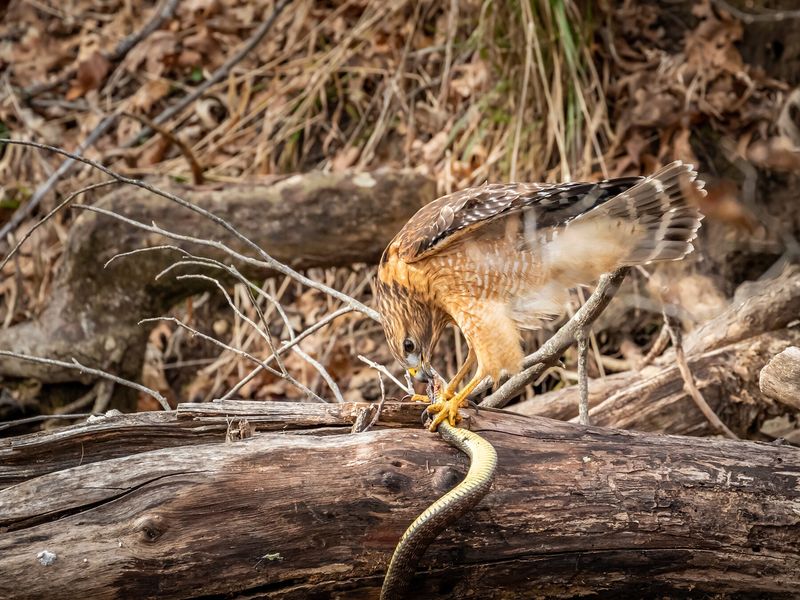
Ask what a red-shouldered hawk eats and the honest answer is a long list. FWC lists small mammals, lizards, snakes, and amphibians, and says the birds may also take crawfish and other birds.
One southern Florida study gives a closer look. Researchers recorded prey delivered to nestlings at six nests in spring 2018 and 2019, and reptiles and amphibians were the most frequently consumed prey classes.
That is a small sample of nestling meals at a handful of nests, so it does not rank the diet of every Florida hawk in every season.
Diet also shifts from place to place. A USGS-hosted study comparing breeding-season diets, including in south Texas, found substantial regional variation and a flexible approach to food.
Hawks tend to take what is available where they live.
So the idea that these hawks mainly eat rodents does not hold up as a Florida-wide statement. A hawk that visits your yard could be after a lizard near the patio, a frog by the pond, or a small mammal in the grass.
For a homeowner, the takeaway is that the menu is wide and changes with local conditions. Seeing a hawk does not tell you which item is on it today.
A hawk is not a pest survey
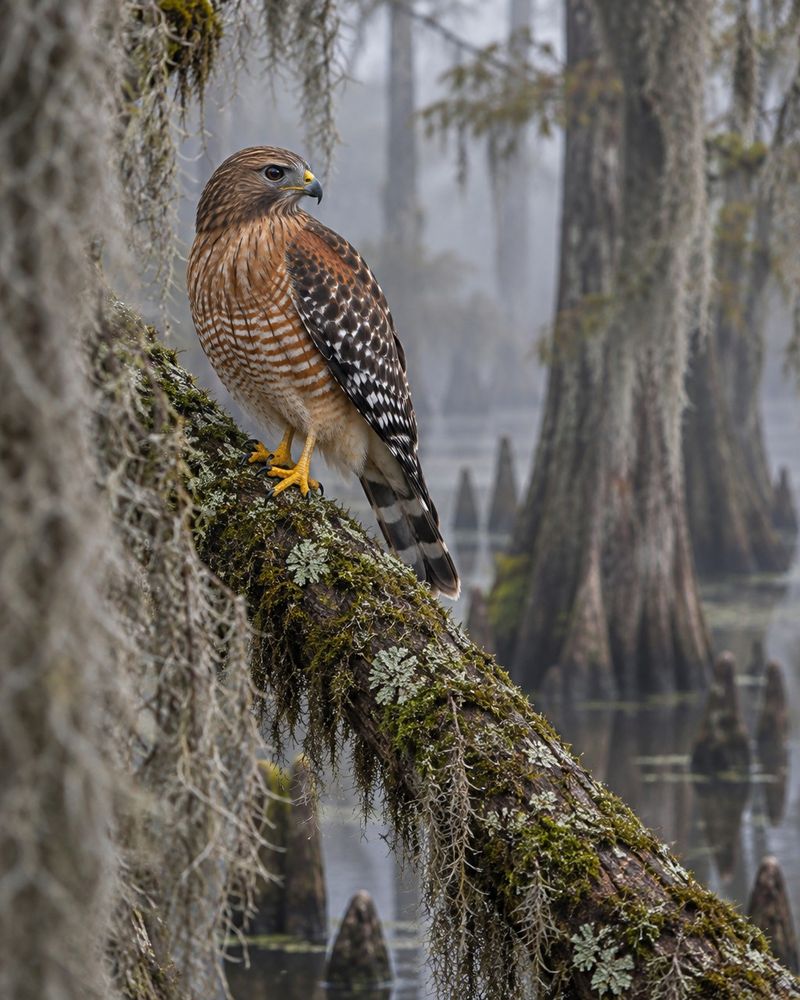
Here is the answer to the question that likely brought you here. A confirmed red-shouldered hawk shows that the bird is using your area.
That is all. Neither its presence nor its scream reveals which prey is nearby or how many rodents or snakes live around your home.
Consider how widely the bird ranges. FWC describes it as a year-round Florida resident, so a hawk in the neighborhood is a normal sight in any month.
Cornell notes it uses both wooded areas and some suburban settings, so its visit does not diagnose the condition of any single yard.
Hawks also adjust to what is around. The USGS-hosted diet comparison shows a flexible feeder, which makes it a poor measuring stick for any one kind of prey.
That means a hawk is not proof of an infestation, and it is not a sign of pristine habitat or effective pest control either. It is one bird making use of a perch and some open space.
If you suspect rodents, look for direct clues instead: droppings, gnaw marks, greasy rub marks along walls, or noises in the attic. Those tell you far more than any bird overhead.
Reduce rodent attractants without managing the wild food web
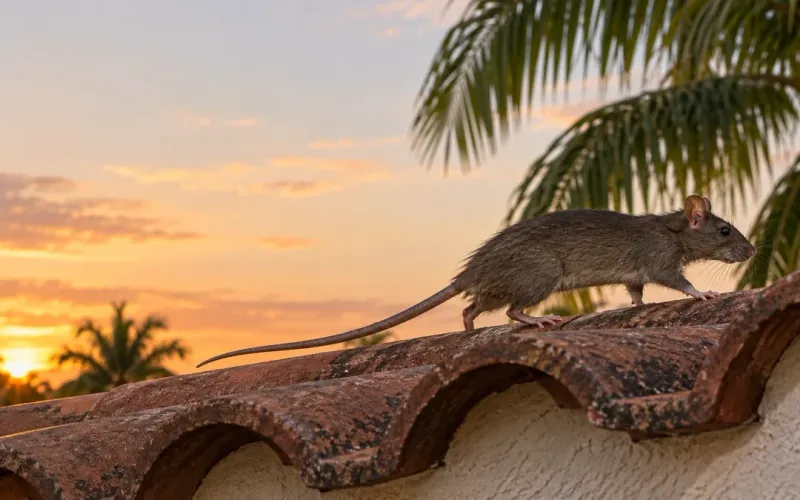
If rodents worry you, start with what you control at home. FWC recommends cleaning up spilled birdseed and securing household attractants such as pet food and garbage.
It also notes that feeder spillage can attract rodents, which can bring larger predators closer to people and pets.
Here are some easy habits to build into your week:
Sweep or rake seed hulls under feeders every few days. Feed pets indoors, or pick up bowls when mealtime ends.
Keep garbage in containers with tight lids, and store bulk birdseed and pet food in sealed bins rather than open bags in the garage.
These steps are about household attractants, and that is where they stop. They will not remove every mouse or lizard from the wider landscape, and they will not keep hawks out of the neighborhood.
Red-shouldered hawks live in Florida year-round, so they will keep passing through regardless of your feeder habits.
Think of it as tidying your own doorstep. You can make your home less inviting to rodents without trying to rearrange the food web beyond your fence line.
Give a nesting hawk space

Nesting season can turn a calm bird into a defensive one. If a hawk keeps diving near people, the kindest and safest move is to avoid the area around its nest when you can.
Walk a different route, move activities to another part of the yard, and give the bird room to raise its young.
Sometimes you cannot avoid the spot. FWC suggests carrying an open umbrella or wearing a hard hat if someone must pass close, and it recommends contacting FWC for help with conflicts.
Resist any urge to take matters into your own hands. FWC says red-shouldered hawks and their active nests are protected, and that a federal permit is required to remove an active nest.
Do not knock down, trim around, or otherwise disturb a nest that has eggs or chicks.
The U.S. Fish and Wildlife Service nest guidance is another place to check the rules.
For a real problem, such as a nest right beside a doorway, call FWC and let the agency walk you through your options.
Most of the tension passes within weeks, once the young are out of the nest.
The scream tells you the hawk is using the neighborhood
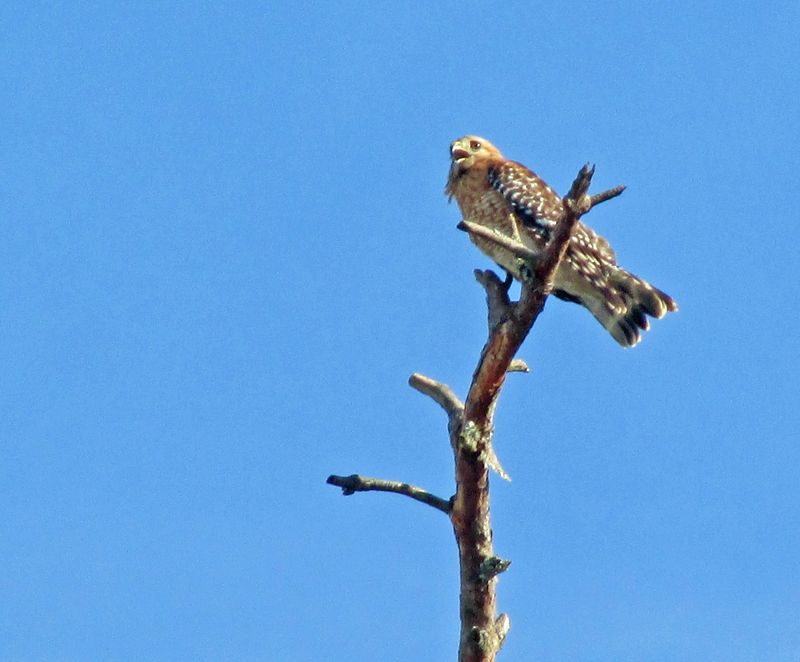
Look first, then listen: the call can mean territory or alarm, and a Blue Jay may be the one doing it. Once you have confirmed a hawk, treat it as proof that the bird is using your area, nothing more.
Keep your own spaces tidy by following FWC feeder advice, and give protected nesting hawks plenty of room.
The scream is a hawk saying it lives here too, and that is a fine thing to hear.