
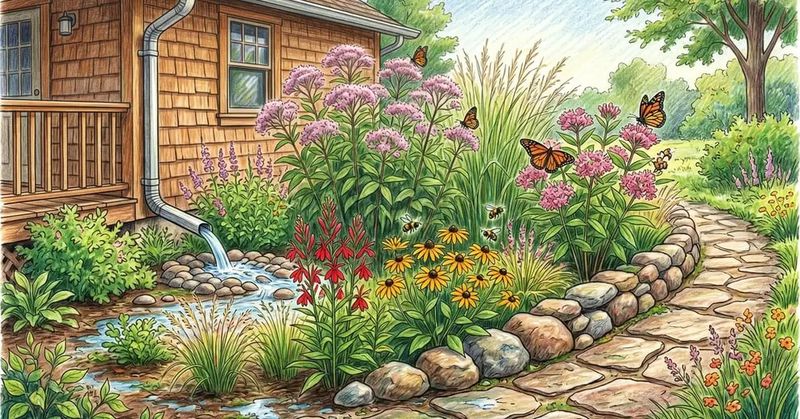
Every winter storm sends a rush of water off your roof and out of a single pipe. Instead of letting it wash across the patio or down the driveway, you can guide it into a shallow planting bed.
With the right size, a safe exit for extra water, and the right plants, that bed can soak up some runoff and offer spring flowers hummingbirds may use. Here is how to plan one that fits your roof, your soil, and your California yard.
A one-downspout bed still needs a roof-area calculation
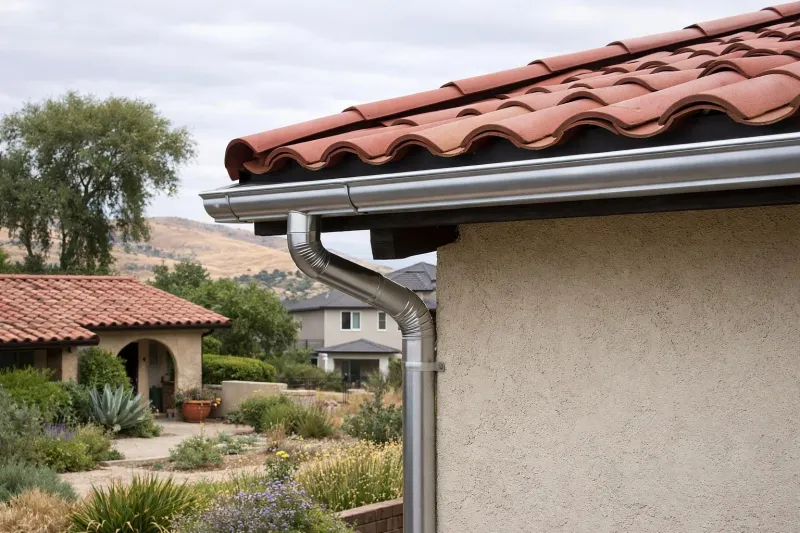
Nothing about a downspout tells you how big a rain garden should be. The pipe is just the delivery point.
What matters is the roof area that drains to it, because a long roof section sends far more water into that pipe during a storm than a small porch roof does.
Start by estimating that roof section. Measure the length and width of the part of the roof that slopes toward the gutter feeding your downspout, then multiply to get square feet.
Gutters that split or share downspouts will change your numbers, so trace where the water actually goes.
Next, match the bed to your soil. UC ANR’s coastal California rain garden guide gives starting guidance of at least 20 percent of the contributing area for sandy soil, 30 percent for loam, and up to 60 percent for clay.
For example, a 400 square foot roof section would suggest a bed of roughly 80 square feet in sandy soil, 120 in loam, and as much as 240 in clay. These percentages come from a coastal guide, so treat them as a starting point rather than a statewide rule or a universal formula.
Size is only part of the picture. Soil, slope, and the size of the storm all affect how much water the bed can hold.
The same guide advises planning for at least 1 inch of rain and including a safe overflow route. Think of the bed as a sponge with a spillway, not a tank that catches every drop.
Bigger storms will send extra water past it, and your design should decide where that water goes.
Will your yard absorb the runoff?
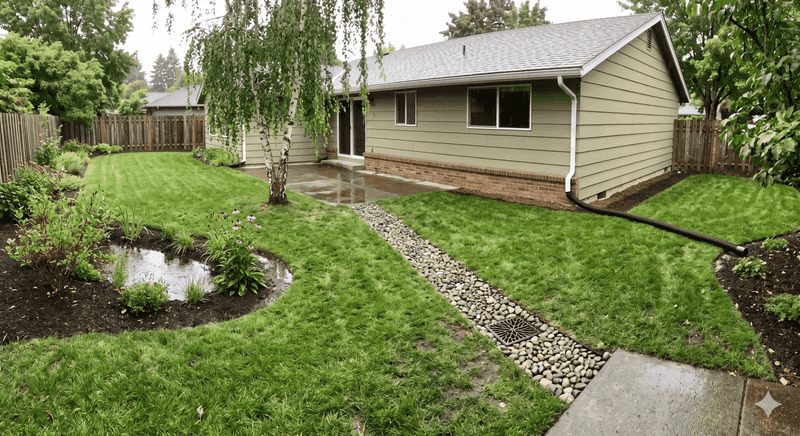
Before you dig, spend an afternoon screening the site. The bed belongs downslope from the downspout, ideally on flat ground or in a natural low spot where water already wants to go.
Pushing water uphill or toward the house defeats the purpose.
Then test how fast the ground drains. UC ANR’s guide suggests digging a test hole about 6 inches deep and filling it with water.
If water is still standing after 24 hours, infiltration is slow. Clay yards often fail this test, which is a cue to plan a larger bed and a solid drainage plan rather than hoping plants will fix it.
Distance matters too. The coastal guide recommends at least 5 feet from structures without a basement and 10 feet from structures with a basement.
It also warns against already soggy spots, areas with a high water table, septic systems, large tree roots, and underground utilities. Call your local utility locator service before digging, and check local requirements, since these distances are recommendations from a coastal guide and not rules everywhere.
Fire-prone neighborhoods add one more filter. Where CAL FIRE defensible-space guidance applies, the first 5 feet around a home should stay clear of vegetation and combustible mulch.
If your downspout sits right at the wall, use a pipe extension or buried drain line to carry water out to a bed beyond that zone, and confirm current local requirements first.
Shape a shallow basin and give excess water an exit
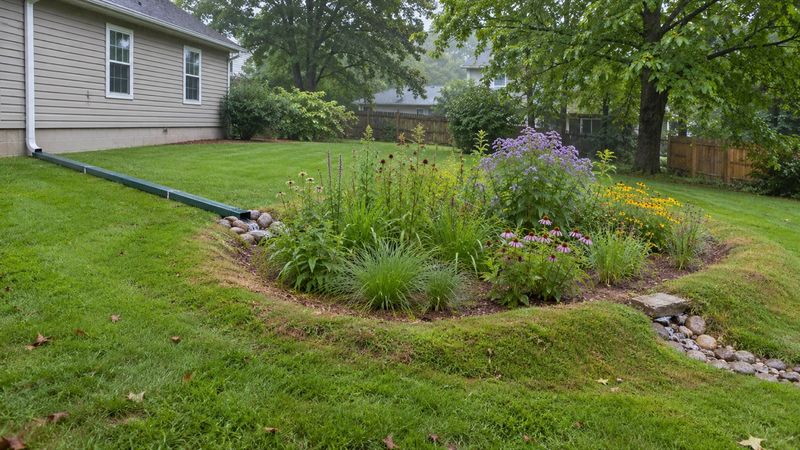
A good rain garden is more of a gentle dish than a pit. The UC ANR guide describes a center about 6 to 12 inches deep, with sloping sides and a level bottom so water spreads out and soaks in evenly.
Deeper is not better, since a deep hole can hold water too long.
Where the downspout water enters, line the inlet with stones. Roof water can arrive fast, and bare soil at the pipe’s mouth will gouge out quickly.
Stone slows the flow, spreads it, and protects the bed’s shape through the winter.
Now plan the exit. During a storm bigger than the bed was designed for, water will fill the basin and need somewhere to go.
Cut a low, stabilized notch or channel on the downhill side, leading to a lawn, a planted area, or another safe spot away from the house and your neighbor’s property. When water uses that overflow in a heavy storm, the design is working as planned.
It is not a failure.
Watch out for the opposite problem, which is water that lingers in the basin for days. Slow drainage is a site or design issue.
Adding plants or compost will not solve it alone, so you may need a larger bed, a different location, or professional advice.
Put spring flowers on the bed’s upper edge
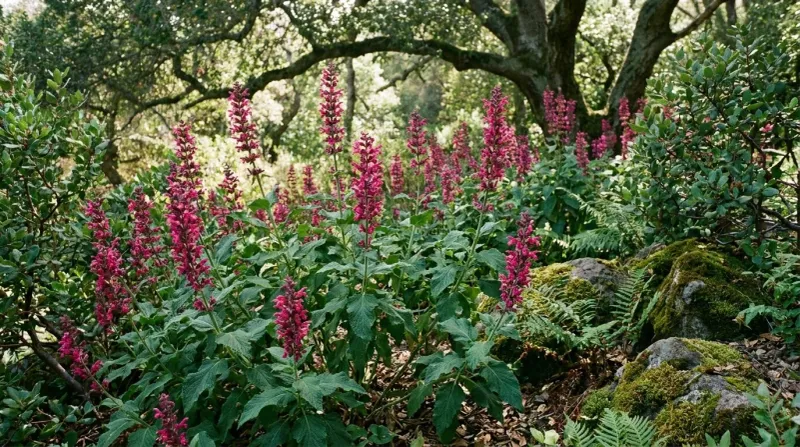
Think of your bed as two zones. The bottom and lower slope get temporarily wet after storms, so they need plants that tolerate occasional soaking.
The upper edge, or berm, stays drier, and that is where spring bloomers for hummingbirds belong.
Hummingbird sage, also called pitcher sage (Salvia spathacea), is a documented option. UC ANR lists it for the rain garden’s berm, and the California Native Plant Society includes it among spring hummingbird plants.
Its size, spread, and light needs vary, so check how it fits your region and whether your spot is sunny or shaded.
Keep expectations realistic. Hummingbird sage can offer potential spring forage, but it does not guarantee visits, and no plant blooms nonstop all season.
Bloom timing shifts by region and site.
A single flower bed also supplies only part of what these birds need. UC Master Gardeners note that hummingbirds also rely on insects and spiders, fresh water, and cover.
If you have a shrub or small tree nearby for perching and shelter, your new bed becomes one useful piece of a bigger habitat.
Choose plants for winter saturation and summer drought
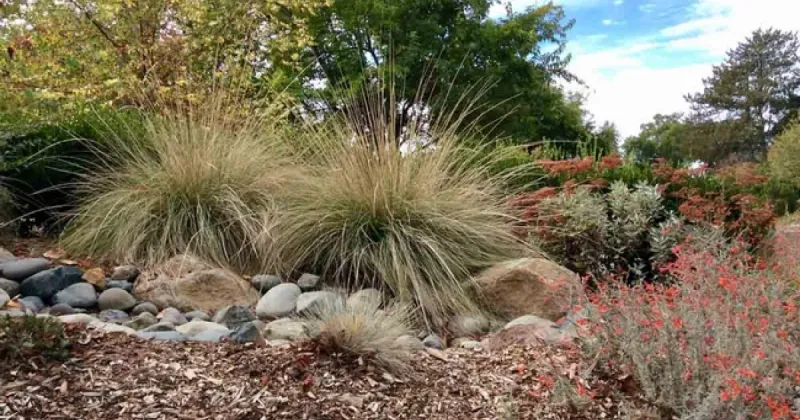
California gives rain garden plants a tough assignment: wet feet in winter, then months without rain. Calling a plant native does not mean it can handle both.
Plenty of natives hate soggy roots, and not all are drought-proof in every place.
The California Native Plant Society advises choosing plants for your actual site, including climate, soil, drainage, elevation, and light. A local native nursery can tell you which species handle temporary inundation in your area.
For the basin and lower slope, pick plants that tolerate both brief flooding and summer dryness.
Timing helps. UC ANR recommends planting when soil is dry, preferably in fall, so roots can settle in before winter rains.
The same guide says newly planted rain garden plants need watering during their first year while they establish.
That is why “rain-fed” is not the same as irrigation-free. Storm runoff feeds the bed in winter, but after the first year, water needs vary by plant and location, and some may still want a summer drink.
One more caution: treat roof runoff as ornamental irrigation. UC ANR warns that collected roof water may carry contaminants and should not be used for overhead watering of food crops.
Watch the first storms for ponding and erosion
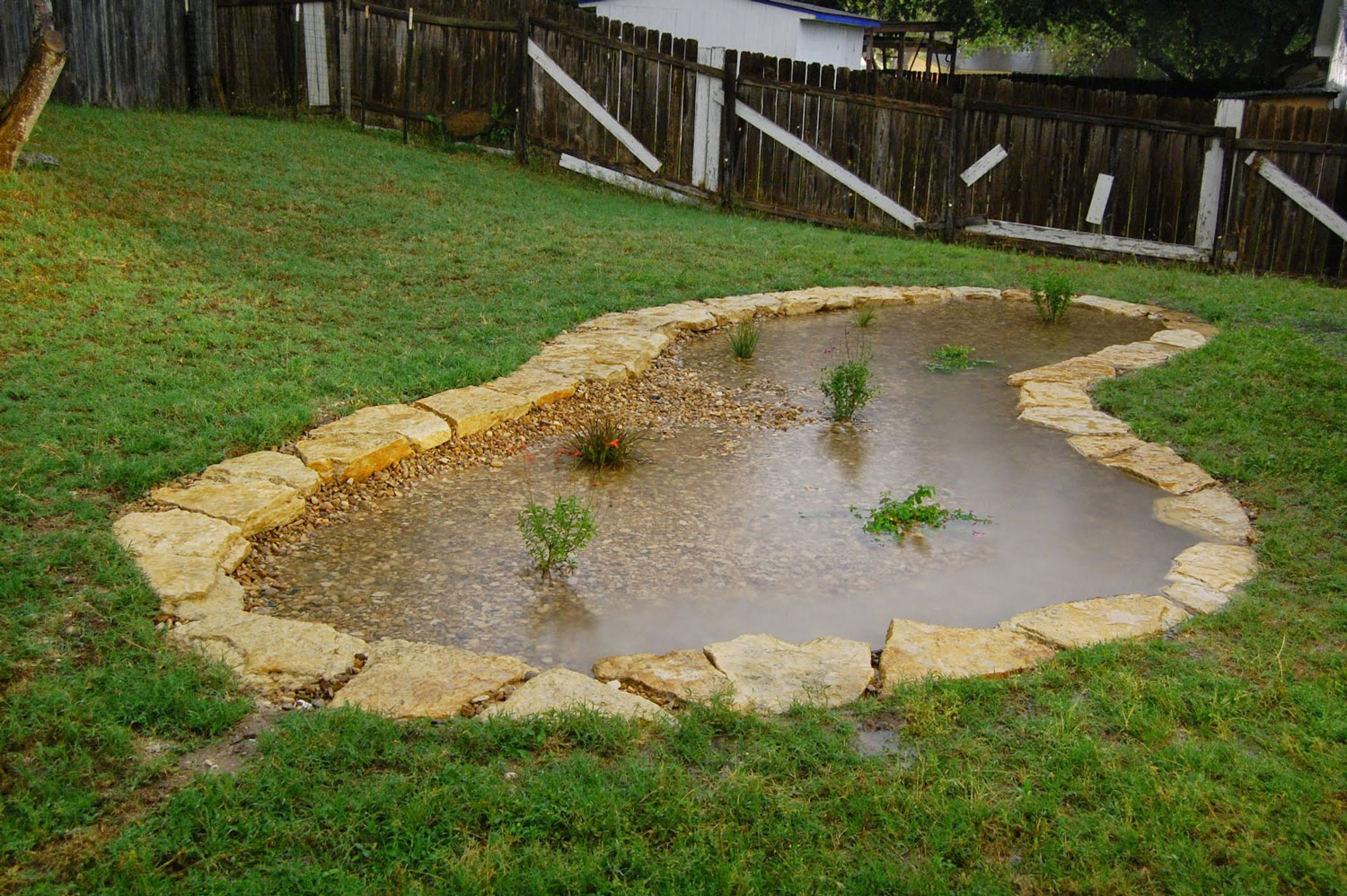
Your best design review happens in the rain. Put on a jacket and watch the first few storms.
See where water enters, how it spreads across the basin, and whether it heads for the overflow route when the bed fills.
Afterward, do a quick maintenance round. Clear leaves and debris from the inlet, overflow, and any channels.
Look for gullies, bare patches, or stones that have shifted, and fix erosion early before it grows.
Then check how long water stays. Some ponding right after a storm is normal, since that is the bed doing its job.
Persistent ponding is different. UC ANR flags ponding beyond 72 hours, while EPA describes properly designed and maintained rain gardens as generally draining in about a day, except in very large storms.
If water hangs around longer than that, reassess drainage, design, and maintenance. The inlet may be clogged, the basin may be too deep or too small, or the soil may drain slower than you thought.
A well-drained bed is unlikely to sustain mosquitoes, but no garden can be called mosquito-proof.
Match the bed’s scale to the site
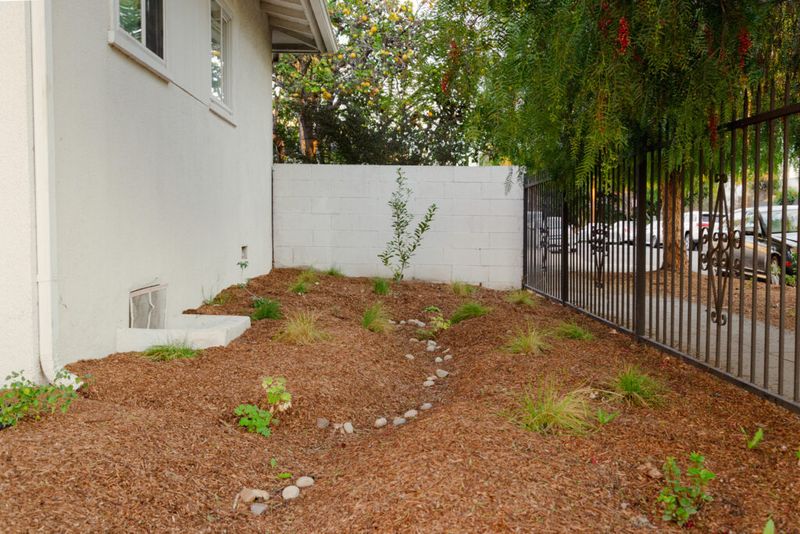
The decision rule is simple. Size the bed from the roof area draining to your downspout and your soil type, using UC ANR’s starting percentages.
Confirm the site drains safely, build in an overflow, and keep spring bloomers above the wet zone.
Done well, you get a manageable way to route some roof runoff and offer potential forage like the spring plants CNPS lists for hummingbirds. Some storms will still overflow, and the birds will decide for themselves.