
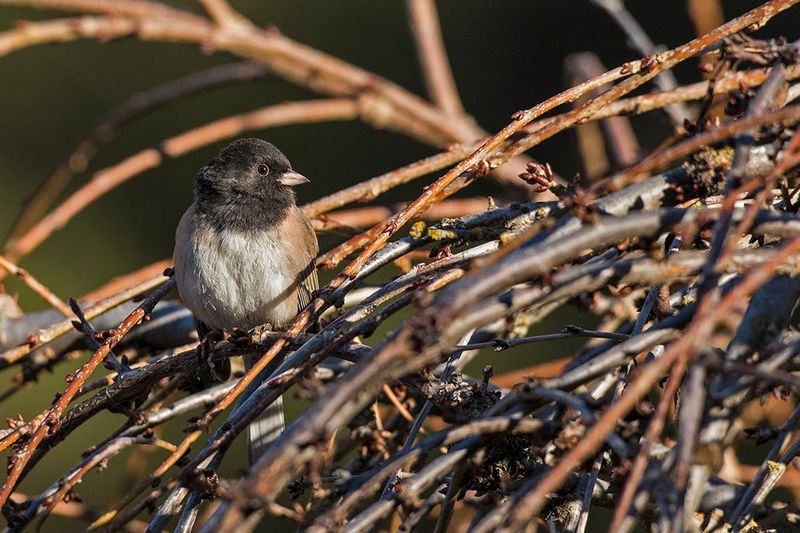
Walk out your back door on a sleety January morning and the yard can look empty. Juncos, sparrows, towhees and cardinals are still around, though, and they need places to duck out of the weather and out of sight.
A pile of branches you already have on hand may add one of those places. Here is how to build one, where to put it, and what it can and cannot do.
A brush pile offers supplemental cover, not storm safety
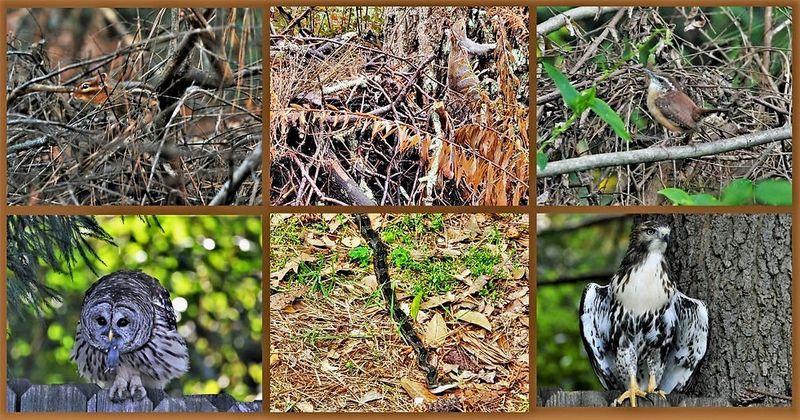
Think of a brush pile as a hiding spot with a roof of sticks. Cornell Lab guidance recommends brush piles for ground-dwelling birds such as sparrows and towhees, noting that they offer hiding places and some protection from rain, snow, and wind.
That is a modest promise, and it is a useful one. A pile can give a small bird a quick place to disappear when a hawk swoops over the yard or when sleet starts to fall.
It cannot keep a bird safe through a storm, and it cannot promise that any bird will survive one.
North Carolina has plenty of birds that could use it. NC State Extension lists cardinals, juncos, and sparrows among the state’s winter-resident birds, and Audubon North Carolina describes juncos as common in winter yards and along woodland edges.
Still, living in the same state is not the same as visiting your pile. Some yards will see regular traffic, and others will see none.
Birds choose based on what grows nearby, what predators are around, and what else the yard offers.
The research is thin, too. A 2010 study of brush piles notes limited data on how well they work.
Its first-year pilot comparison found similar bird nest success in areas with and without piles, and the authors cautioned against broad conclusions from such a short period. So treat the pile as a low-cost experiment, not a guaranteed fix.
Birds shelter in different ways during storms
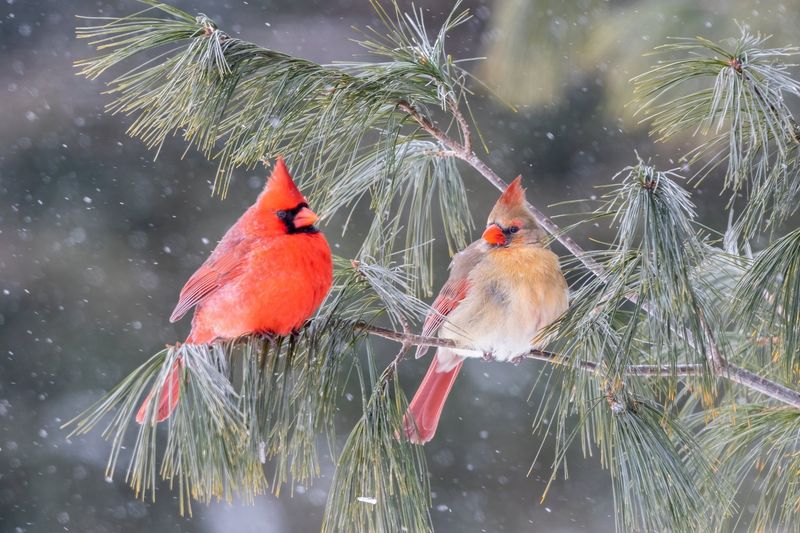
Ask a cardinal where it waits out a sleet storm, and the answer may not be a pile of sticks. Cornell’s storm guidance says sparrows and cardinals may shelter on thick branches, on the side protected from wind and rain.
That detail matters for setting expectations. Birds use different strategies depending on the species, the weather, and what is available.
A dense evergreen, a tangle of shrubs, or a sturdy tree limb on the lee side of the trunk may do the job for some birds.
A brush pile is a different kind of cover. It works best as a low hiding place, especially for birds that spend much of their time on or near the ground.
Cornell’s backyard advice points to sparrows and towhees as the likely users.
Do not picture a crowd of birds tucked inside the pile every time the forecast turns ugly. Some may duck in briefly.
Others may never touch it. Nothing in the guidance says birds sleep inside a pile or gather there during every storm.
The practical takeaway is to add the pile to a yard that already has other shelter, not to replace it. If you have thick shrubs or evergreens, keep them.
The pile becomes one more option on the map, and the birds decide which one to use.
A loose, layered structure is one recommended approach
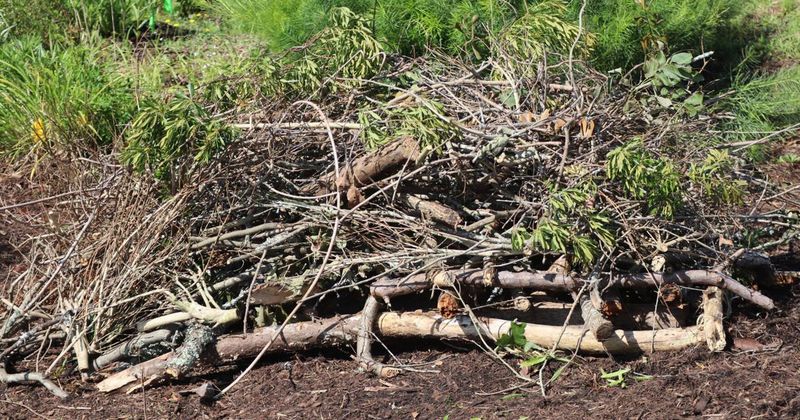
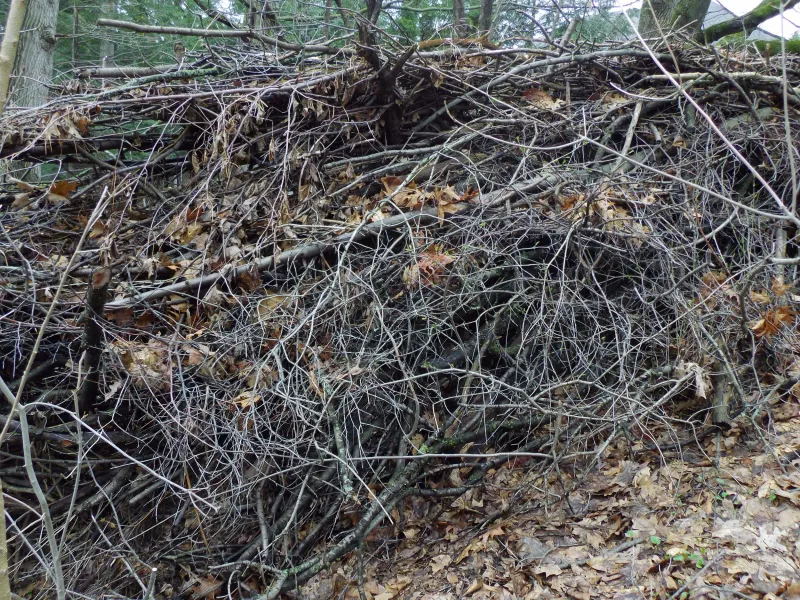
Building a brush pile takes more stacking than skill. Start with natural branches and logs, the kind that come from pruning, storm cleanup, or a fallen limb.
Put the larger pieces on the bottom and lay smaller brush on top, leaving gaps instead of packing everything tight.
This layered approach matches Cornell’s backyard advice and the layered-base idea in NC State Extension’s low-cost habitat tips. Think of it as a recommended approach, not a proven best design.
The goal is open space where a small bird can slip in and out.
You may see bigger numbers in some guidance. NC State’s figures of 4 to 8 feet tall and 10 to 20 feet across are meant for habitat improvements at land-management scale.
They are not a minimum for a suburban lot.
A smaller pile can still help. Maryland’s Department of Natural Resources notes that smaller piles can benefit birds and other small wildlife, so build what your space and your back allow.
A few practical habits help. Use untreated wood and avoid anything painted or chemically treated.
Add fresh branches on top over time as the lower layers settle. And keep the shape rough, because tidy and tight is the opposite of what you want here.
Where should the pile go?
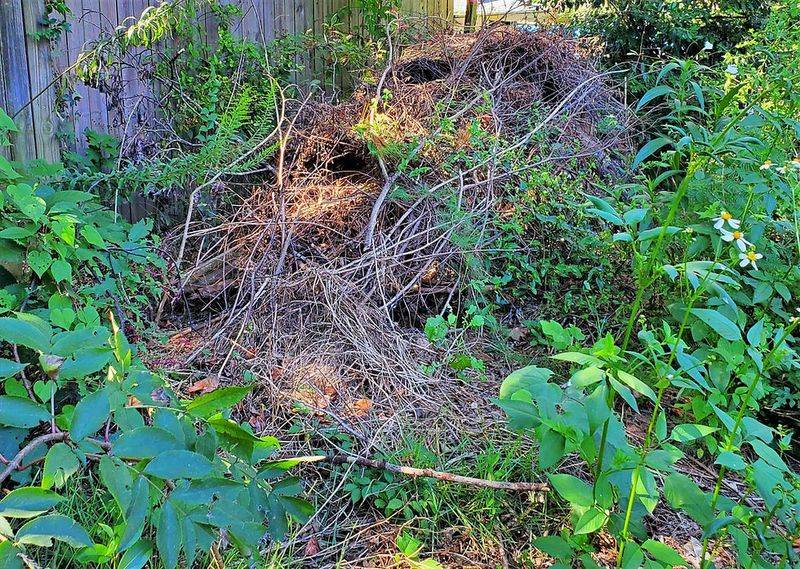
Location may matter more than size. According to NC State Extension, a pile placed near existing cover or food is more useful than one sitting alone, and isolated piles may receive little use.
Look for a wooded edge, a hedgerow, a shrub border, or a corner where native plants already grow. Birds tend to move along protected routes, so a pile that connects to those routes gives them a short, covered dash instead of an open sprint across the lawn.
Now think about your own household. Maryland DNR recommends keeping piles away from the house and away from ground-level feeders.
Piles can attract animals that may turn into household pests, and you do not want them next to your siding or your seed.
There is no single magic distance. A quarter-acre lot in Raleigh, a wooded acre in the mountains, and a coastal plain yard in Wilmington all work differently.
Pick a spot that sits comfortably back from the home while still touching other vegetation.
Before you stack anything, check your local ordinances. Some towns and homeowner associations have rules about debris piles, and a quick call to the town office can save you from having to move the whole thing later.
Winter cover works alongside food
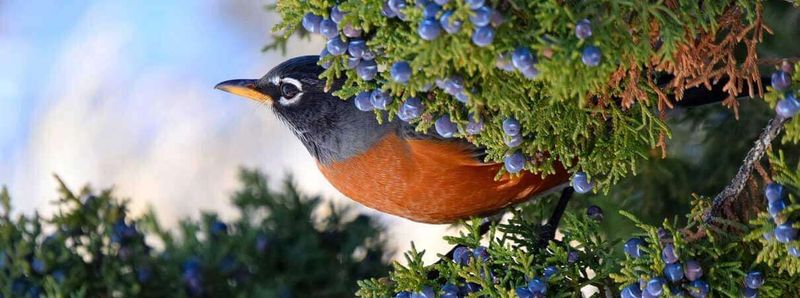
Cover is only half of a winter yard. Birds also need something to eat, and a pile of sticks does not supply it.
NC State Extension points to winter food sources such as persistent fruits and seeds, and recommends keeping natural vegetation and cover.
In practice, that means resisting the urge to clean everything up. Leave seed heads standing through the cold months.
Keep the shrubs that hold berries into winter. Let some of the yard stay a little wild.
A pile next to that kind of planting gives birds a place to feed and a place to duck out of sight, all within a few hops. The low-cost habitat improvements guidance makes the same point, linking cover to nearby food.
A pile alone leaves gaps. It does not offer berries, seeds, or water, and it will not make a bare, mowed yard feel like habitat.
Think of it as one piece of a larger set.
If you want a simple next step, walk the yard this weekend and note what already feeds and shelters birds. Then place the pile where it joins those features instead of standing apart from them.
The pile can shelter more than birds
A brush pile does not check who walks in. Small mammals, reptiles, and other wildlife may use it too.
The U.S. Fish and Wildlife Service notes that hawks and foxes use piles as hunting grounds, so the pile is not predator-proof.
That is a trade-off worth accepting with open eyes. The same tangle that hides a sparrow can hide something hunting it.
For many homeowners, seeing a food web at work is part of the appeal, but it is not the same as a safe refuge.
Maryland DNR warns that piles can conceal predators and may attract animals that become household pests. That is why placement matters.
Keep the pile away from the house and away from ground-level feeders.
If you reuse invasive plant material, be careful not to spread seeds. The Fish and Wildlife Service advises placing such material where it was cut, which helps reduce spread to other sites.
Skip any branches loaded with seeds if you cannot do that.
When the pile gets old, do not reach for a match as routine upkeep. North Carolina DEQ says open-burning rules, local ordinances, burn bans, and permit requirements may apply.
Check them first, and remember that burning removes the habitat.
A small habitat upgrade has a modest, useful job
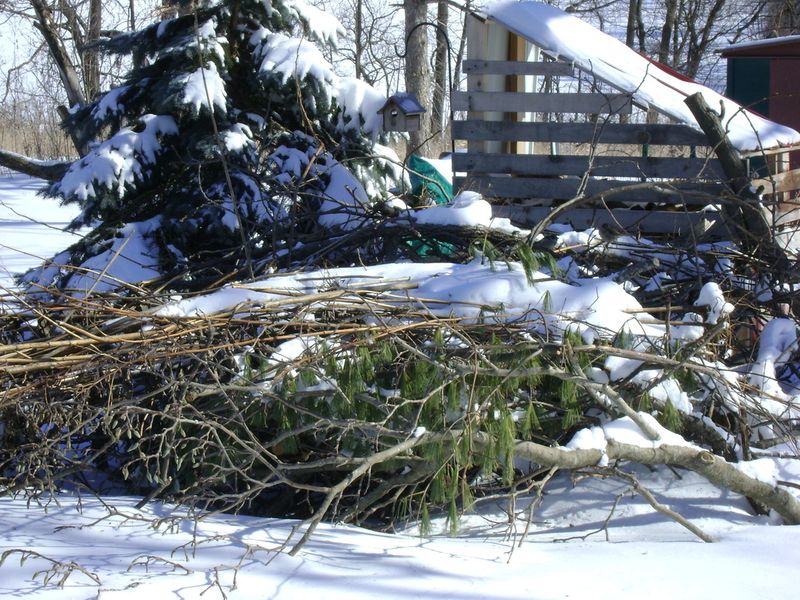
Stack branches loosely, set the pile near existing cover, and keep it part of a yard with berries, seeds, and native plants. That matches the Cornell Lab’s backyard advice for offering shelter.
Some birds will use it a lot, some a little, and some not at all. Either way, it costs almost nothing and gives your winter yard one more place to hide.
A pile of sticks will not promise safety, but it might give a junco a better option.