
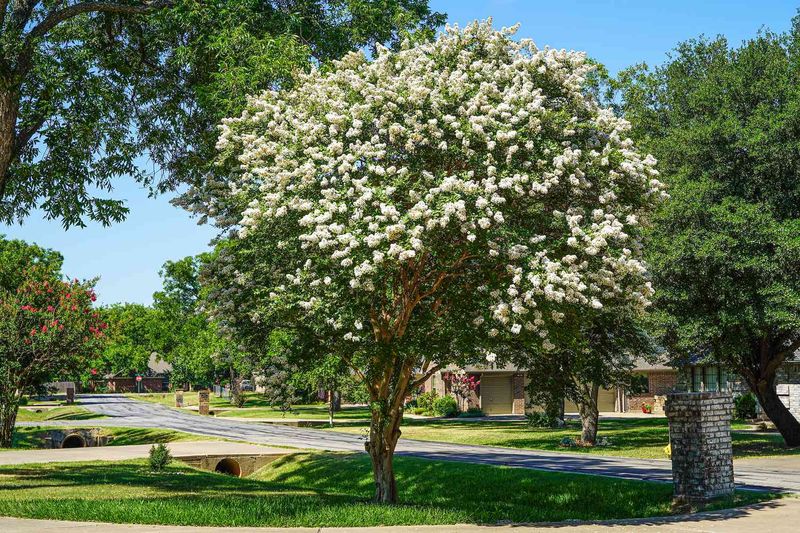
Crape myrtles are everywhere in North Carolina yards, and many of them stand close to a driveway. When pavement cracks or rises nearby, it is easy to point at the tree.
Sometimes roots play a part, but sometimes they do not. Here is how to tell the difference, plant wisely, and avoid fixes that could hurt the tree.
A crack alone does not show that a crape myrtle caused damage
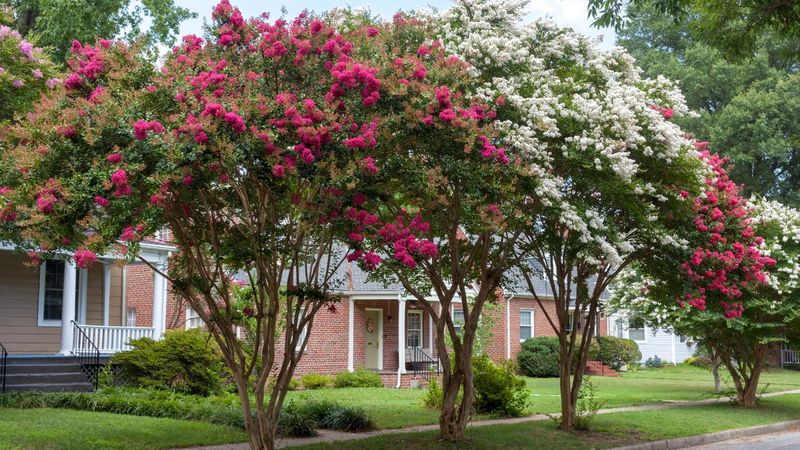
A crack beside a crape myrtle can feel like a smoking gun. It is not one.
Roots can play a role at some sites, but a nearby tree and a damaged slab do not prove the tree is the cause.
There is a real example of the possibility. In a Texas A&M AgriLife Extension response, a homeowner described a crape myrtle root that had lifted a driveway.
That case shows a conflict can happen at an individual property. It says nothing about how often it happens in North Carolina, and it does not make crape myrtles a known driveway threat.
Pavement also cracks for reasons that have nothing to do with trees. University of Florida horticulture guidance notes that sidewalks can crack where no tree is nearby, and that roots are not necessarily the cause of a crack.
Age, thin or poorly prepared base material, drainage, heavy loads, and shifting soil can all break up a slab.
So the useful question is not whether your crape myrtle is guilty. It is whether anything at your particular site points to the roots, and the next sections show how to look at that calmly.
Roots can lift pavement without starting its first crack
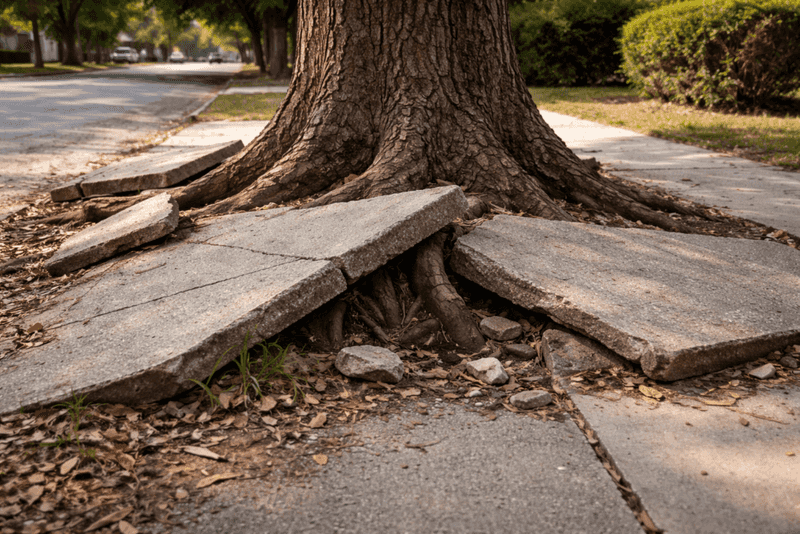
Picture a slab with a small gap in it. Roots under pavement can thicken as they age, and that growth may push a slab upward or widen a crack.
A technical report hosted by Iowa State Extension explains how small roots beneath pavement can enlarge and lead to lifting or cracking.
Lifting a slab is not the same as breaking it in the first place. Pavement may crack from settling, moisture, or poor base material, and roots can then grow toward or through the opening.
Researchers still disagree about which usually comes first. University of Florida guidance describes this debate.
Newer work adds a wrinkle. An University of Florida Extension account of sidewalk research suggests root pressure may be better at lifting a slab that is already cracked than at cracking one on its own.
Keep the limits in mind. These sources deal with sidewalks and pavement in general, and some findings come from simulations.
None is a definitive study of crape myrtles beside residential driveways, and none gives a timeline you can count on.
Crape myrtles vary widely in mature size
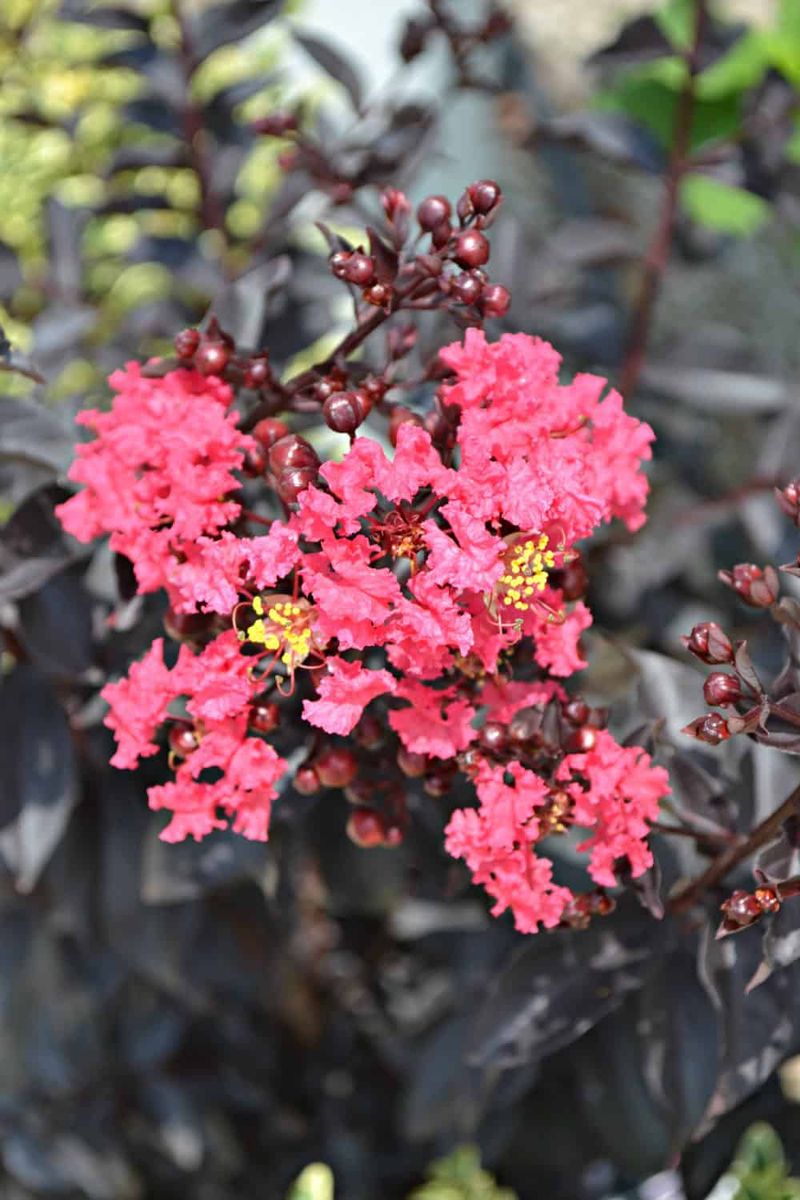
Not every crape myrtle grows into the same tree. NC State Extension’s plant database gives a broad range of roughly 6 to 30 feet in both height and width, depending on the variety.
A compact selection and a large one behave very differently beside pavement.
‘Catawba’ is a useful example. NC State’s page for it lists about 12 to 15 feet tall and 8 to 10 feet wide, and advises against planting it near a walkway or driveway.
That page does not name root damage as the reason. It also mentions that the flowers can stain pavement or cars, so the warning should not be read as proof of root trouble.
Crape myrtle is a favorite across the South, and NC State Extension Gardener notes it can grow even where root space is restricted. Popularity and tolerance do not mean every cultivar is safe next to pavement.
It is also not a North Carolina native; NC State lists its home range in Asia.
If you want a native choice for wildlife value, that is a separate conversation. For an existing crape myrtle, the practical step is to find out which cultivar you have.
What should you check when pavement starts to move?
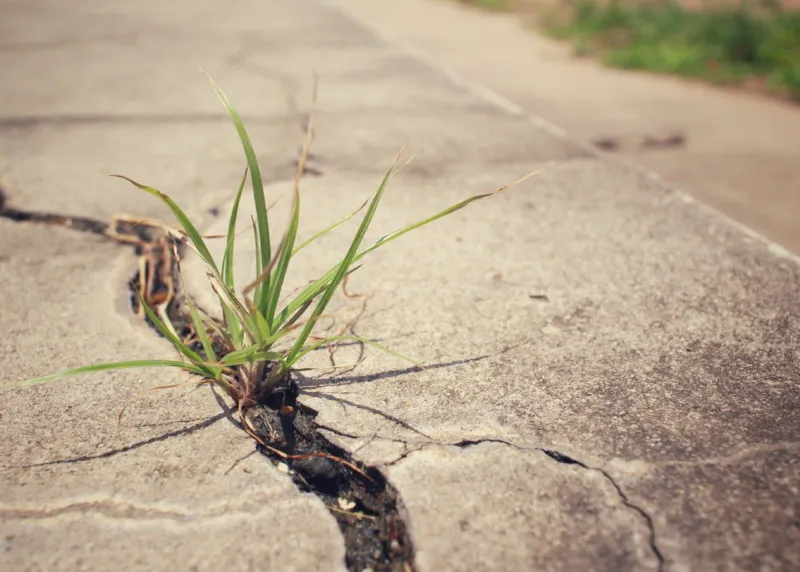
Start with a notebook or your phone camera. Photograph the crack or raised section, and note exactly where it sits compared with the trunk and any visible roots.
Measure the gap or height with a ruler, then recheck every month or two. A change over time tells you much more than a single snapshot.
Resist the urge to blame the tree from proximity alone. University of Florida guidance on sidewalks cautions that roots are not necessarily the cause of cracks, and that appearance alone is a poor guide to cause.
Look at the whole site. Is the pavement old or patched?
Does water pool or run along the slab after a storm? Is the soil beneath sinking or washing out?
Red clay in the Piedmont and sandy soils on the coastal plain can both shift in different ways.
Also notice whether the damage lines up with the tree or runs across the driveway in places far from any roots. Damage far from the tree points toward other causes.
Keep this as a record you can hand to a professional, not as a repair plan.
Choose the planting spot for the tree it will become
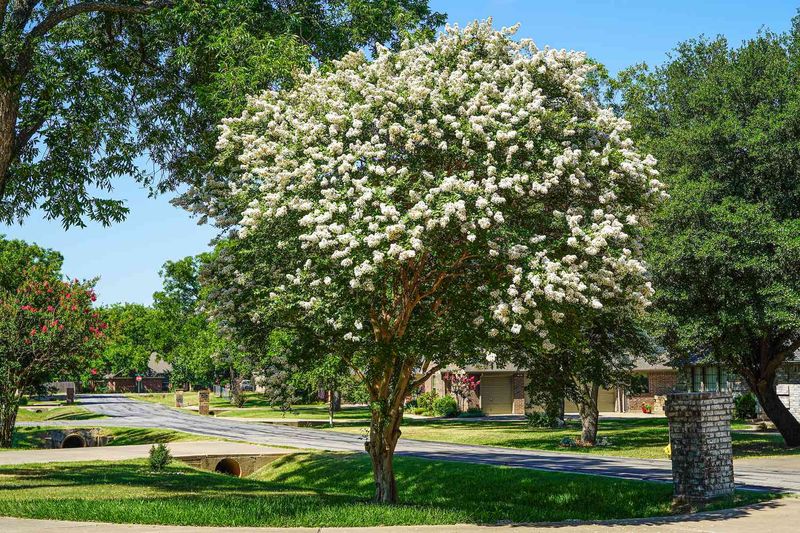
A nursery pot tells you very little about what you are buying. The label matters more, because it lists the mature height and width.
NC State’s crape myrtle profile shows the spread from 6 to 30 feet, so the right spot for a dwarf may be wrong for a large selection.
That same page suggests planting at least 10 feet from walls in one garden situation. Treat that as guidance for that setting, not a blanket driveway rule.
The sources reviewed do not give a universally safe distance between a crape myrtle and pavement.
A better habit is to match the tree to the space. Measure from where the trunk will stand to the driveway edge, then compare that with half the mature width, and leave extra room.
NC State’s note on ‘Catawba’ is a reminder to read cultivar details before choosing a spot near a drive or walk.
Thoughtful placement can reduce the chance of conflicts, including falling blooms on pavement and cars. It does not mean crape myrtles are inherently damaging.
Many grow beside pavement for years without trouble.
Do not cut a substantial root before getting an on-site assessment
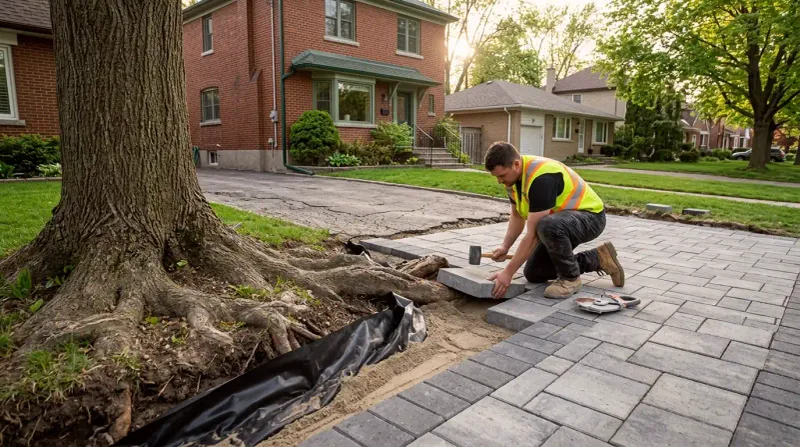
If you suspect roots, the shovel and saw can wait. The Morton Arboretum explains that cutting a substantial root can stress a tree or make it less stable.
An extension specialist also cautions that herbicide could affect connected roots in some circumstances. So skip stump-killer and do not grind roots as a do-it-yourself fix.
Instead, ask an ISA-credentialed arborist to look at the tree and the pavement together. They can judge whether roots are involved, what repair options exist, and whether any cutting is safe.
You can search for one through the International Society of Arboriculture’s Find an Arborist tool.
Some signs call for a faster call. If the lean is getting worse quickly, or soil is heaving up around the base, get an assessment right away.
University of Florida guidance on tree failure lists such changes among conditions that can raise the likelihood of failure.
These are warning signs, not proof that a tree is about to fall. Keep people and cars away from the area until someone qualified has looked.
Make the decision from the site, not the headline
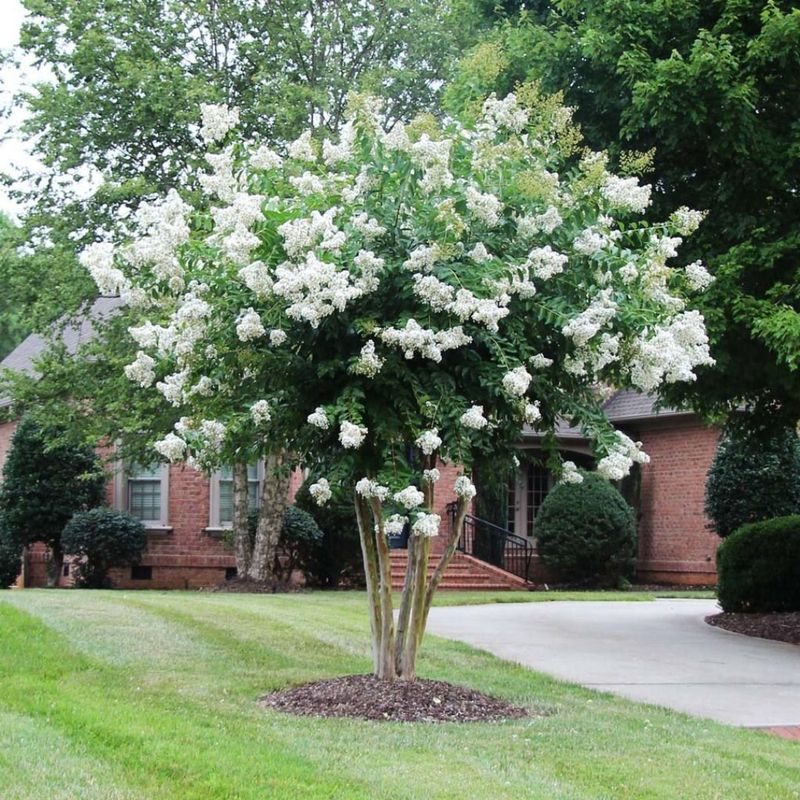
One extension case shows that a crape myrtle root can lift a driveway, but that does not make every nearby tree or crack a root problem. Use the mature size of your cultivar when you plan, and call a qualified arborist before touching established roots, as The Morton Arboretum advises.
Your yard, not a headline, holds the answer.