

Most California homeowners assume that planting a hedge on their own side of the fence settles the matter permanently. That assumption can be wrong in ways that are both surprising and costly.
State law, local codes, fire rules, and a handful of narrow legal theories can all give a neighbor legitimate grounds to push back, even when every plant sits firmly on your parcel.
Growing on your side of the fence does not settle every issue
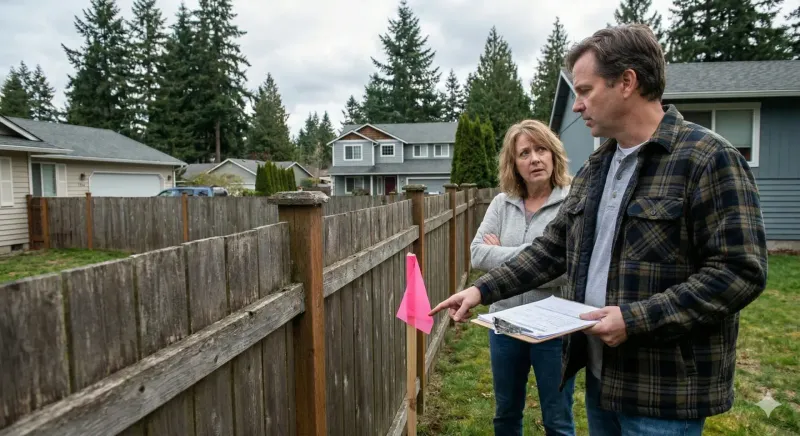
Planting a hedge on your own side of the fence feels like a straightforward act of ownership, but the fence itself is rarely a reliable boundary marker. Fences are often built a few inches or even a few feet inside the actual property line, meaning the hedge could straddle or touch the true boundary in ways the homeowner never intended.
California Civil Code section 834 speaks directly to one ownership question: a tree whose trunk stands partly on land belonging to two or more coterminous owners is treated as their common property. That rule, however, applies to individual trees whose trunks physically cross the line.
It does not function as a blanket ownership rule for every hedge, shrub row, or multi-stem planting on a residential lot.
Ownership of a hedge or shrub grouping depends on the individual plants, the location of each stem or trunk, and the actual surveyed boundary. A row of ten shrubs might include nine plants that sit entirely on your parcel and one whose base crosses the line, and each plant could carry a different ownership analysis.
Getting that determination right matters before either side makes any cuts.
Ownership and legal control are also two separate questions. A plant can belong entirely to one owner while its growth, height, shadow, or fire-fuel characteristics remain subject to valid property law, nuisance doctrine, safety regulations, or local code.
Owning the land where a hedge grows does not create an unlimited right to maintain it at any height or in any condition, and the sections below explain exactly where those limits come from.
Identify the legal basis before treating a demand as enforceable

A neighbor’s frustration, preference, or blocked sightline does not automatically create a legal right to compel trimming. Before treating any demand as enforceable, the first practical step is asking what specific legal basis supports it.
That question matters because the answer controls everything: who can act, what they can demand, and how the process actually unfolds.
Private claims are one category. California Civil Code section 3479 defines a nuisance as anything that obstructs the free use of property or interferes with its comfortable enjoyment, and a hedge could theoretically qualify under that standard in specific circumstances.
A qualifying spite-fence claim under Civil Code section 841.4 is another private theory, addressed in detail in the next section. The Solar Shade Control Act creates a third narrow pathway involving qualifying solar collectors and specific shadow conditions under California Public Resources Code chapter 12, division 15.
Government enforcement is a different category entirely. Local height ordinances, zoning rules, sidewalk-clearance codes, and fire-safety regulations may authorize a city, county, fire authority, or other agency to act against a noncompliant hedge.
The neighbor who files a complaint with the relevant agency is not the one issuing the order; the agency is. That distinction matters because a neighbor cannot simply hand a homeowner a local code citation and demand compliance as if the code creates a personal right to a trimming order.
CAL FIRE and local fire agencies may require vegetation management in applicable fire-hazard severity zones, and a homeowner who receives an agency notice has an obligation to respond to that agency, not necessarily to the neighbor. Similarly, the Solar Shade Control Act has its own procedural requirements before a plant becomes a private nuisance.
Sorting out which category applies to the demand in front of you is the foundational step before any other analysis.
A tall hedge becomes a spite-fence case only under specific facts
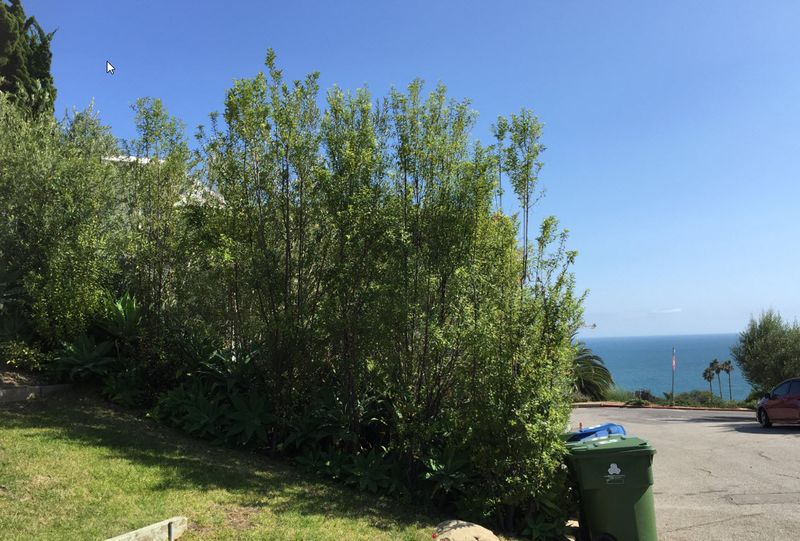
California Civil Code section 841.4 is the strongest statewide theory that directly targets hedge-like plantings. The statute defines a spite fence as any fence or structure in the nature of a fence that unnecessarily exceeds ten feet in height and was maliciously erected or maintained for the purpose of annoying the adjoining owner.
Both conditions must be present; height alone is not enough.
The California Court of Appeal confirmed in Wilson v. Handley that a planted row of trees can qualify as a structure in the nature of a fence under the statute.
That was a significant holding because it extended the spite-fence theory beyond wood, concrete, and masonry. Even so, the court made clear that a claimant must still prove the statutory elements, and a hedge that exceeds ten feet does not automatically satisfy them.
The unnecessary-excess question asks whether the height above ten feet serves any legitimate purpose. Privacy screening, wind buffering, aesthetic landscaping, and noise reduction can all constitute legitimate purposes.
A neighbor who wants to challenge the height must show that those purposes do not justify the excess, which is a harder argument when the homeowner can point to real, documentable benefits the hedge provides.
The dominant-purpose-of-annoyance question is equally demanding. A homeowner who planted the hedge years before any dispute arose, or who can show consistent landscaping decisions across the property, is in a stronger position than one who raised the hedge specifically after a conflict with the neighbor started.
Circumstantial evidence of timing, communications, and behavior all become relevant.
Blocked views deserve a specific note: a neighbor cannot rely on a lost view alone as the basis for either a spite-fence claim or a general nuisance claim under Civil Code section 3479. California does not broadly recognize a property right to an unobstructed view, and courts have been reluctant to extend nuisance doctrine to cover ordinary landscaping that happens to block a preferred sightline.
Local codes may regulate the hedge without giving the neighbor a private order
State law sets a floor, but local governments frequently go further. Cities and counties across California regulate hedge height, front-yard setbacks, sidewalk clearance, corner-visibility triangles, and driveway sight lines through their own municipal or county codes.
Some of those rules impose limits well below the ten-foot spite-fence threshold, and some apply specifically to front yards, street corners, or public-right-of-way adjacencies rather than to rear or side yards.
The City of Dublin’s residential fence, wall, and hedge regulations illustrate how a local code can treat hedges as fences and regulate them accordingly, with height limits that vary by yard location and zoning district. Pacific Grove’s visual-obstruction rules address corner lots and traffic-safety concerns.
San Mateo’s code targets sight obstructions near streets. These are examples of local regulation, not evidence of a statewide rule, and each jurisdiction’s specific language controls.
The enforcement mechanism is the critical detail that many homeowners and neighbors overlook. A local ordinance may authorize the city or county to issue a notice of violation, order corrective work, or assess fines.
That is a government enforcement process, not a private right of action. Whether a neighbor can also bring a private lawsuit based on the same ordinance depends on the specific code language, and many codes do not create that pathway at all.
Before concluding that a neighbor’s ordinance citation is either devastating or meaningless, a homeowner should locate the exact municipal or county code section, read its substantive rule and its enforcement provisions, and determine whether the city or county actually enforces it proactively or only on complaint. A local attorney familiar with that jurisdiction can help interpret what the code actually authorizes and what a neighbor can realistically do with it.
Fire rules and solar-shade law operate differently
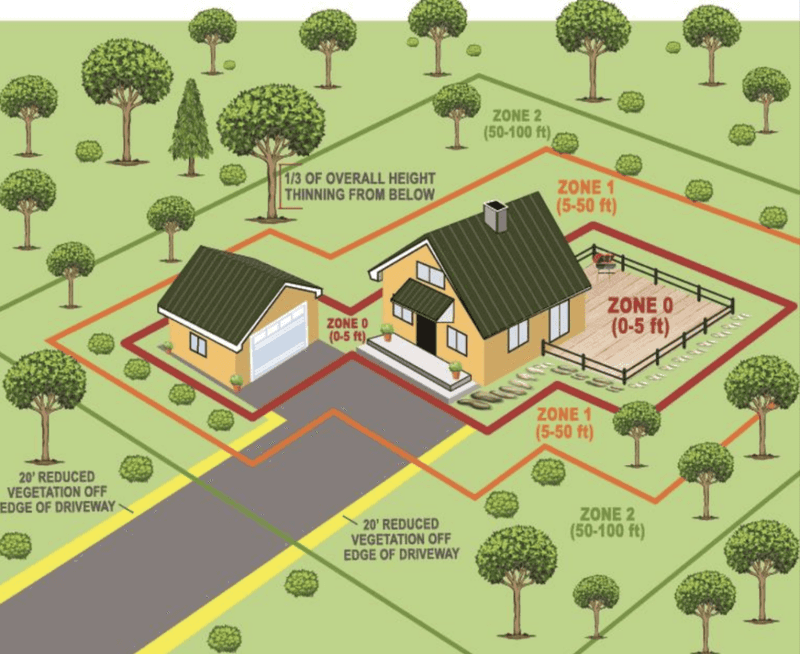
Wildfire-defensible-space requirements create a separate and independent reason why a hedge may need modification, but the mechanism is public safety regulation, not a neighbor’s private claim. CAL FIRE’s defensible space program requires property owners in applicable fire-hazard severity zones to manage vegetation within specified distances from structures, including removing dead material, spacing shrubs horizontally, and maintaining vertical clearance between ground fuels and tree canopies.
Local fire agencies may impose stricter standards than the state baseline.
When a homeowner receives a notice from a fire agency, the obligation runs to that agency, not to the neighbor who may have filed the complaint. A neighbor who reports a potential defensible-space violation to CAL FIRE or a local fire department is using a government reporting channel, not exercising a private right to order trimming.
Whether the agency acts, and what it requires, depends on its own inspection and enforcement process.
The Solar Shade Control Act operates through a completely different framework. Under the relevant provisions of the Public Resources Code, a tree or shrub that casts a shadow covering more than ten percent of a qualifying solar collector’s absorption area between 10 a.m. and 2 p.m. may become a private nuisance, but only after specific conditions are met.
The solar collector must have been installed before the offending vegetation grew to its current shading height, the owner must receive written notice, and the vegetation must fail to come into compliance within a reasonable period.
Pre-existing vegetation is generally exempt, and Public Resources Code section 25983 allows local jurisdictions to modify or opt out of the state framework entirely. A neighbor with solar panels who is unhappy about shade cannot simply cite the Act without establishing that all of its specific conditions apply to the actual situation.
A neighbor may trim overhangs, but not recklessly
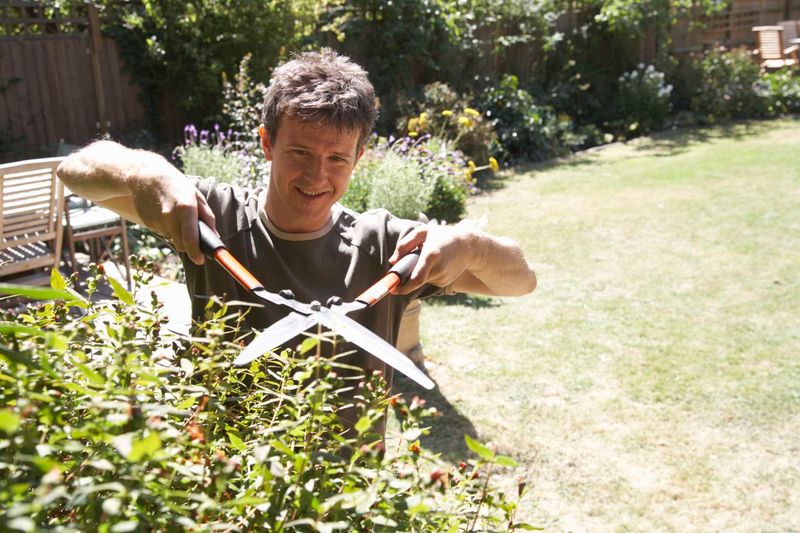
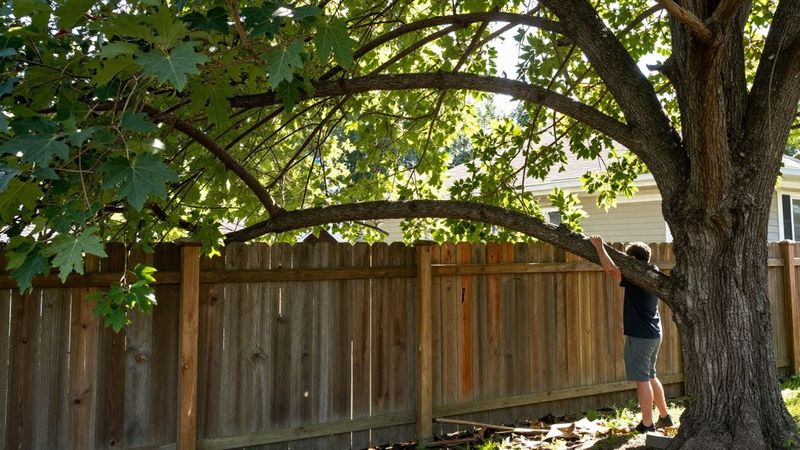
Self-help trimming is a real option for neighbors, but it comes with limits that California courts take seriously. The general principle is that a neighbor may cut back branches or roots that physically extend onto the neighbor’s own property.
That right does not require the homeowner’s permission, but it does require that the work be performed reasonably and without causing foreseeable injury to the plant’s health, structural integrity, or function.
The California Court of Appeal addressed this directly in Booska v. Patel, rejecting an unlimited right to cut overhanging branches and roots back to the property line without regard for the consequences.
The court recognized that cutting all roots to the line, for example, could kill or destabilize a mature tree, and that a neighbor who causes that outcome through reckless self-help faces real liability exposure. The instruction to simply cut everything back to the line is not safe advice for significant or structurally important growth.
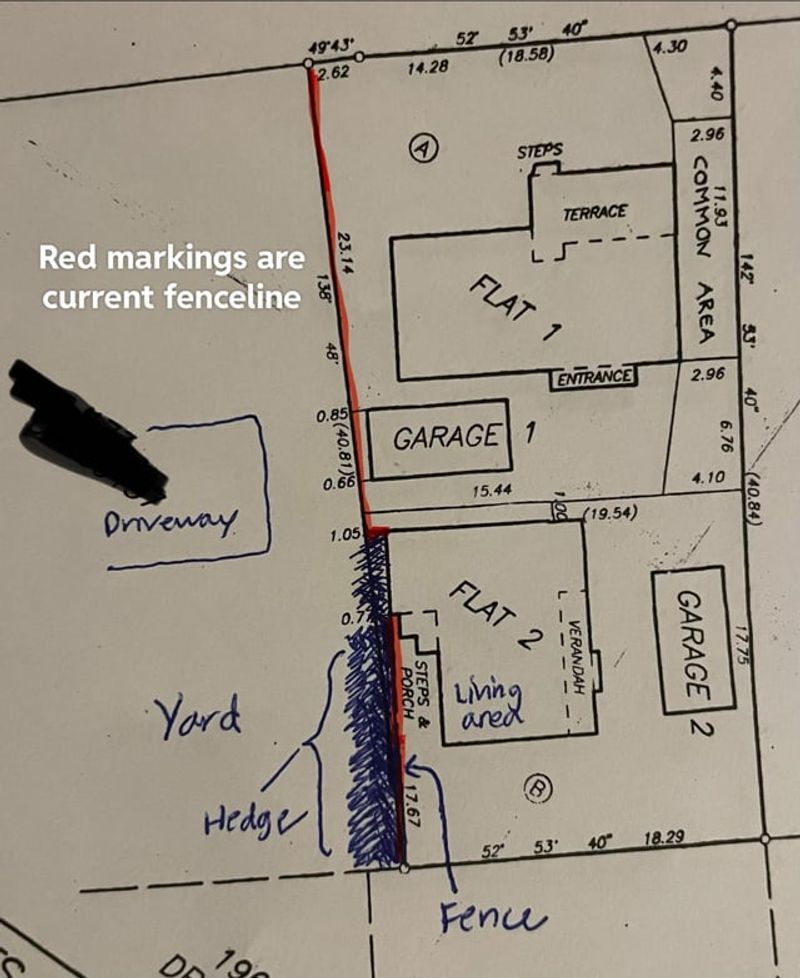
The actual property boundary, not the fence, controls where self-help is legally permissible. Because fences are often set inside the true line, a neighbor who trims to the fence may be cutting well short of what is allowed, while a neighbor who trims to an assumed line without verifying the survey may be cutting into the homeowner’s side.
The University of California Agriculture and Natural Resources guide on tree disputes specifically notes that California’s former absolute self-help rule has been replaced by a reasonableness standard.
Entering the homeowner’s land to perform trimming without permission raises a separate set of legal concerns entirely. Trespass, damage to vegetation, and potential liability under Civil Code section 3346 all become relevant the moment a neighbor crosses the property line.
A licensed land surveyor can establish the exact boundary if there is any doubt, and that step is worth taking before any significant cutting begins on either side.
Verify the facts before agreeing to substantial trimming
Receiving a demand to trim a hedge is not the same as receiving a court order. Before agreeing to any substantial cutting, a homeowner should take a series of documented, practical steps that protect both the property and any future legal position.
Start by preserving every written communication from the neighbor, including texts, emails, letters, and any formal notices from a city or agency. Photograph the hedge thoroughly, capturing its current height, density, proximity to the fence, and any features that cross or appear to cross the boundary.
Those photographs create a timestamped record of conditions at the time of the demand, which matters if the dispute escalates.
Next, identify the individual plants. Note which stems or trunks appear to sit entirely on your parcel and whether any appear to straddle or cross the line.
The UC Agriculture and Natural Resources guide on California tree disputes emphasizes that ownership of individual plants depends on their specific locations, not on who paid for them or who planted them. When the boundary is genuinely uncertain, engaging a licensed land surveyor, the profession California law designates as responsible for locating and reestablishing property boundaries, is often the most reliable way to resolve that uncertainty before any cutting occurs.
For substantial trimming, particularly where major roots, structural limbs, or the entire canopy of a mature plant are involved, a qualified arborist should assess what the work would do to the plant’s health and stability. Cutting a hedge back to the line can kill it entirely if the cut removes most of its root system or crown, and a dead or destabilized plant creates its own liability questions.
Wrongful injury to trees and vegetation carries real financial consequences. Civil Code section 3346 provides for double damages in some casual or involuntary trespass situations and potentially triple damages for willful or intentional wrongful injury, subject to the statute’s specific conditions.
The published decision Fulle v. Kanani further held that qualifying annoyance and discomfort damages may be subject to that statutory multiplier.
Those are not automatic outcomes, but they illustrate why reckless cutting carries risk for whoever performs it.
The qualified answer: sometimes, but not merely because the hedge blocks a view
Answering the title question directly: yes, a neighbor may sometimes have legal grounds to seek trimming, but not simply because a hedge blocks a preferred view or because the homeowner planted it on their own side of the fence. The outcome depends on which legal theory actually applies and whether the supporting facts are present.
The controlling distinctions are practical ones. Individual plant ownership differs from boundary-tree issues under Civil Code section 834.
The actual surveyed boundary differs from the fence. Personal dislike differs from a recognized private claim under nuisance law or the spite-fence statute.
Local or fire-agency enforcement differs from a private right to a trimming order. And reasonable overhang trimming on the neighbor’s own side differs from damaging self-help that crosses the line or kills the plant.
A neighbor who has a legitimate claim still must identify the specific legal basis, satisfy its factual requirements, and follow the appropriate enforcement process. A homeowner who receives a demand should identify what theory is being asserted, verify the boundary, document the hedge’s current condition, and obtain qualified legal, surveying, arboricultural, or agency guidance before consenting to or undertaking any major work.
This article provides general information, not legal advice; a California attorney familiar with local property law is the right resource when the stakes are real.
Ownership of the land is a meaningful starting point, but it has never been the end of the analysis in California property disputes. Knowing exactly where your rights stop, and where a neighbor’s legitimate claims begin, is what actually protects the hedge you planted.