
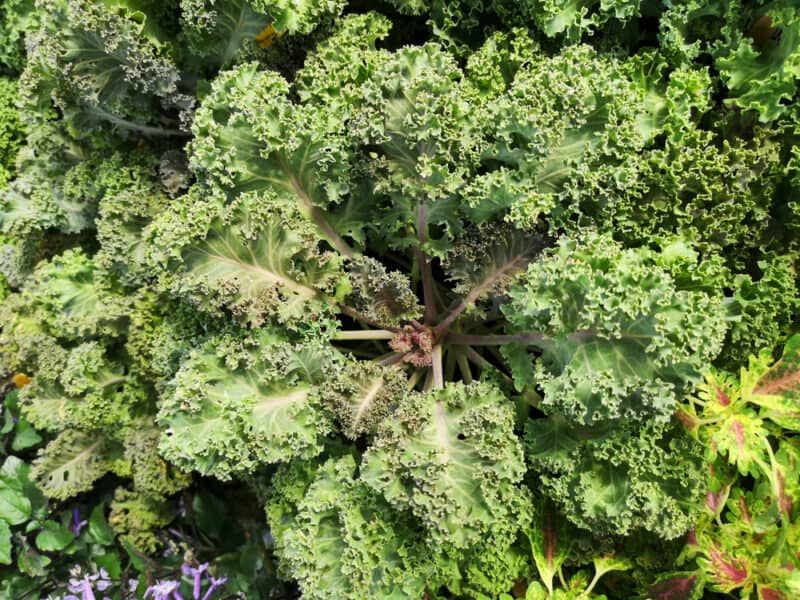
Walking out to your fall garden and finding kale leaves that have turned deep purple and stopped growing is genuinely alarming, especially when you planted everything right on schedule. The good news is that purple coloring and slow growth in young kale do not automatically mean your bed is ruined or that you need to buy a bag of fertilizer.
Several things can cause these symptoms, and cold, wet, or compacted soil is one plausible explanation worth investigating. Working through a short checklist before spending money on a treatment will save you time and protect your soil from unnecessary amendments.
Fall timing can expose young kale to several root-zone stresses
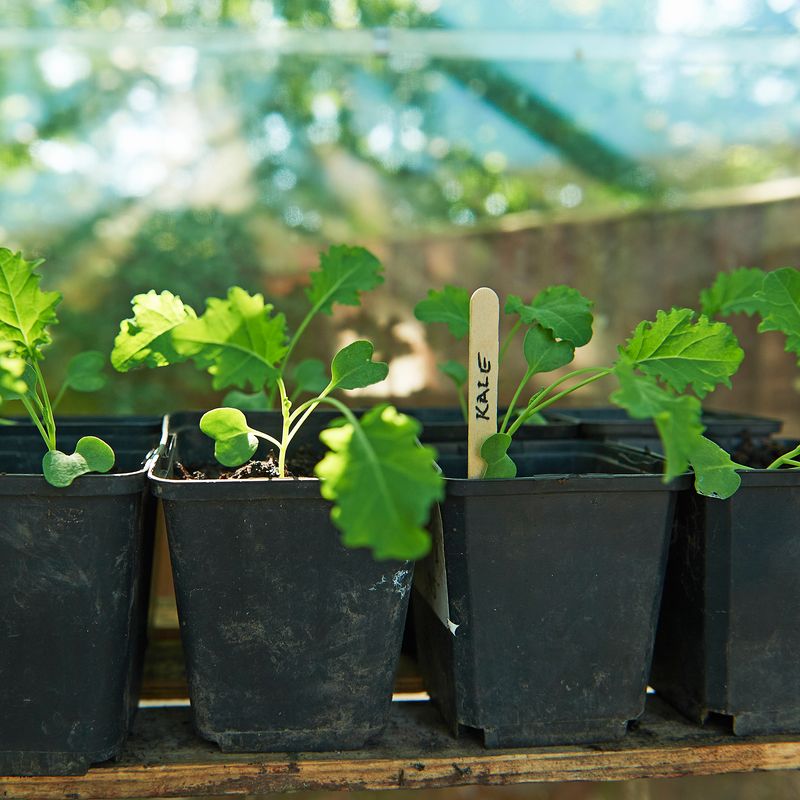
Kale earns its reputation as a cool-season workhorse, but that label covers a surprisingly wide range of conditions across the South. UF/IFAS Florida Fresh planting data shows approximate windows of August through February in north Florida, September through February in central Florida, and September through January in south Florida – meaning some gardeners are putting plants in the ground while afternoons are still warm and humid, while others are planting into genuinely cool fall air.
Texas complicates the picture further. Texas A&M AgriLife Extension’s fall vegetable gardening guide notes that timing for fall brassicas varies substantially by region, ranging from August in some areas to October or later in others, and recommends using local regional schedules rather than a single statewide date.
Planting on the early end of that window can mean young kale sits in warm, sometimes saturated soil before cooler weather settles in, while late plantings may face cooler soil right from the start.
Young transplants and newly germinated seedlings share one vulnerability regardless of timing: their root systems are small. NC State Extension’s kale production guide notes that kale performs best in fertile, well-drained soil with consistent moisture.
When fall rains arrive right after planting, beds that drain slowly can stay wet for days, limiting the young root system’s ability to explore and absorb nutrients. That combination of small roots and stressed soil is the backdrop for the purple, stunted symptoms worth investigating – not proof that anything went wrong at planting time.
Purple, stunted leaves suggest phosphorus stress but do not diagnose it
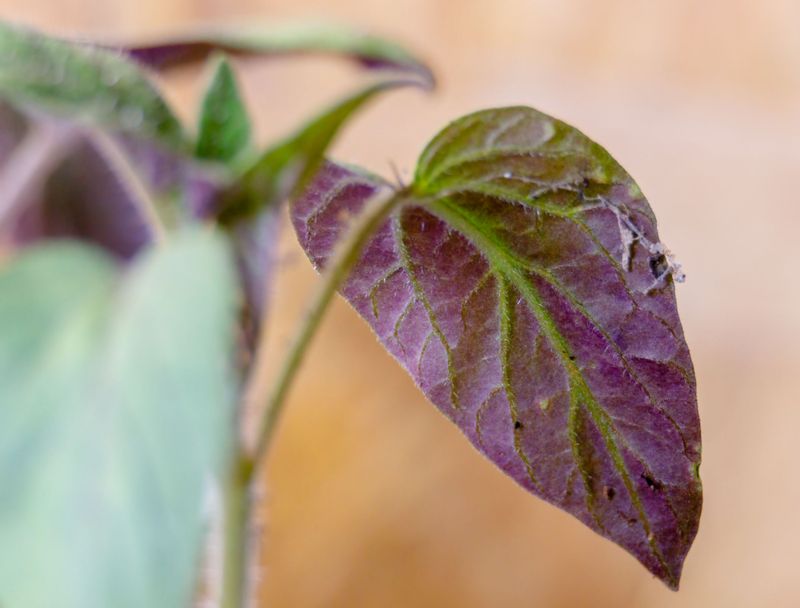
A specific pattern tends to catch gardeners’ attention: the plant is not growing at its normal pace, and the older or lower leaves have shifted from healthy green to a dark, slightly blue-green or outright purple and reddish-purple color. Stems may look thinner than expected, and the overall plant appears compressed rather than reaching upward.
UF/IFAS guidance on vegetable nutrient deficiencies and the UF/IFAS plant nutrient deficiency reference both describe this pattern – stunted growth, thin or shortened stems, and older leaves turning purple – as associated with phosphorus stress.
University of Georgia Extension’s vegetable garden fertilization guide similarly connects reduced growth and purpling foliage to inadequate phosphorus availability in the plant. Recognizing this pattern is a useful starting point, but a visual clue is not the same as a confirmed deficiency.
The same appearance can result from cold weather intensifying natural pigmentation, root restriction from compaction, pest or disease injury, or several other stresses unrelated to phosphorus levels in the soil.
Here is where a key distinction matters. NC State’s mid-season phosphorus deficiency resource and Penn State Extension’s phosphorus management guidance both note that plants can show phosphorus-stress symptoms even when the soil contains adequate phosphorus, because cold, wet, or compacted conditions reduce the plant’s ability to take it up.
That means purple, stunted kale may be telling you something about the root zone rather than the soil’s nutrient inventory. Treating it as a confirmed deficiency before investigating further is a jump the symptoms do not support.
Cold, wet soil can limit phosphorus uptake without removing phosphorus
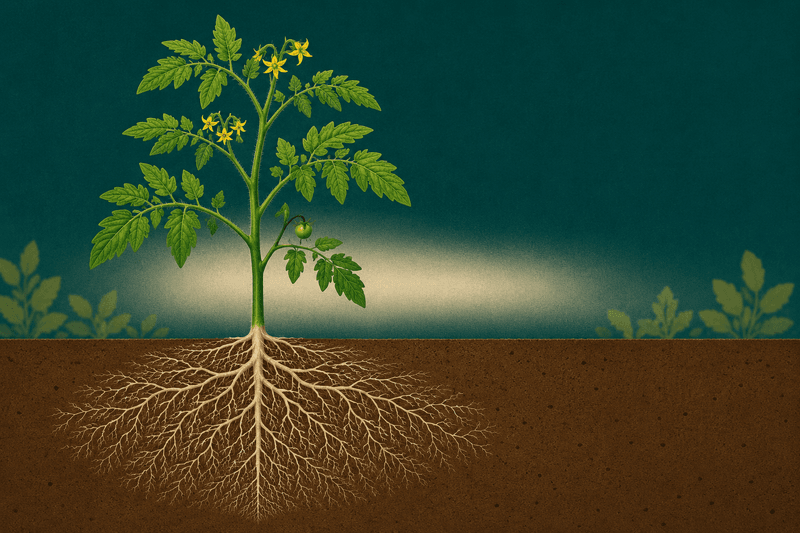
Phosphorus behaves differently from nitrogen or potassium in the soil. Rather than moving freely with water, it stays close to where it lands and relies heavily on roots physically growing into the surrounding soil to make contact with it.
Penn State Extension’s phosphorus management resource explains that phosphorus moves very little in soil, making root exploration the primary way plants access it. When something interrupts root growth, the plant’s access to phosphorus shrinks even if the nutrient itself is present in adequate amounts.
Cool soil temperatures slow root growth and reduce the metabolic activity that drives nutrient uptake. Saturated or compacted soil compounds the problem by reducing oxygen in the root zone, which roots need to function.
NC State’s phosphorus deficiency reference describes how cold, wet conditions reduce phosphorus uptake in crops even when soil-test levels are adequate, and Penn State’s starter fertilizer guidance notes that young plants with limited root systems are particularly vulnerable to reduced phosphorus access in cold soils.
The phrase “nutrient lockout” appears frequently in gardening discussions, but it overstates what is happening. Cold or wet soil does not remove phosphorus from the bed or permanently trap it.
A more accurate description is reduced phosphorus availability to the plant, meaning the nutrient is present but the root system cannot reach enough of it under current conditions. Texas A&M Aggie Horticulture’s tomato phosphorus deficiency resource illustrates this mechanism in another common vegetable, and the underlying biology applies broadly.
For kale specifically, direct research is less extensive than for corn, tomatoes, or soybeans, so readers should treat this explanation as biologically plausible rather than as a confirmed diagnosis for their specific planting.
Check the cultivar, bed, roots, and newest leaves before treating

Before reaching for any amendment, run through a short sequence of checks that costs nothing and takes less than twenty minutes. Start by confirming what you actually planted.
NC State Extension’s kale guide lists many cultivars, and NC State’s brassica ornamental guide notes that varieties like Red Russian, Redbor, and ornamental kale types are naturally purple or red, and that cold weather can deepen their pigmentation considerably. If the seed packet or plant tag describes a purple or red variety, the color you are seeing may be exactly what the plant is supposed to look like.
Next, check moisture. Press your finger two inches into the bed after a rain or irrigation cycle and notice whether water pools or the soil feels consistently waterlogged.
A bed that stays saturated is limiting root oxygen and reducing the plant’s ability to take up any nutrient, not just phosphorus. Iowa State University Extension’s nutrient deficiency guide and University of Arizona Extension’s nutrient deficiency quick reference both caution that visual symptoms can be misleading and that root-zone conditions must be considered alongside leaf color.
Then gently remove one plant and look at its roots. Healthy roots on a young kale plant should be cream to white, reasonably branched, and actively exploring the surrounding soil.
Severely restricted, brown, mushy, or knotted roots point toward a different investigation than a simple nutrient-availability issue. Finally, watch the newest leaves over the following week or two.
Iowa State University Extension’s plant color and weather resource notes that new growth emerging greener as conditions improve can support a temporary environmental or uptake problem, though it cannot confirm the cause on its own.
Rule out lookalike stresses before blaming phosphorus
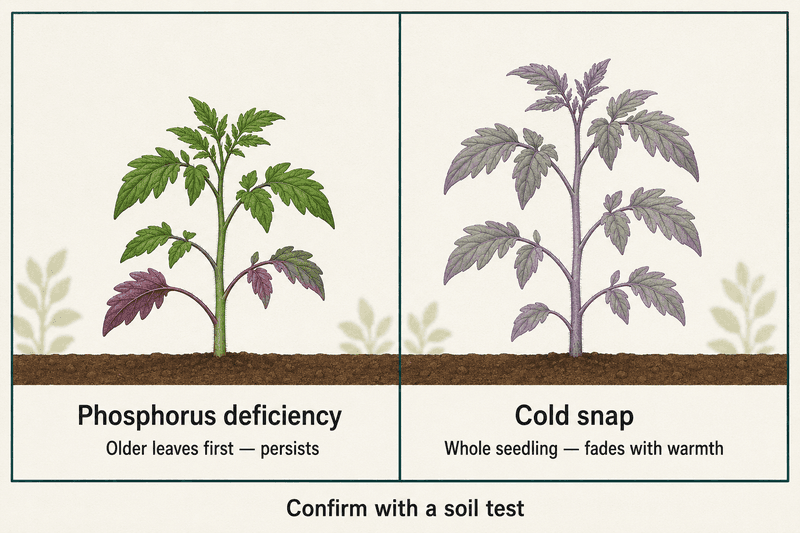
Purple or stunted kale has more than one possible explanation, and several of them have nothing to do with phosphorus. Iowa State University Extension’s plant color and weather guide describes how general stress from cold, drought, compaction, and other environmental factors can trigger pigment changes in young plants that look nearly identical to a nutrient problem.
Mississippi State Extension’s resource on stunted purple corn makes the same point in a related crop: purple color in young plants is a stress response that requires investigation, not an automatic diagnosis of deficiency.
Pay attention to where the color change begins and how it progresses. Broad yellowing that starts on the oldest leaves and moves upward points more strongly toward nitrogen stress than toward the dark-green or purple pattern associated with phosphorus.
UF/IFAS’s plant nutrient deficiency reference and NC State’s kale guide both note that leafy vegetables need consistent nitrogen for vigorous growth and good green color, and that nitrogen stress looks different from the classic phosphorus pattern. Herbicide drift or residue injury can also produce stunted, discolored, or distorted leaves in young brassicas and deserves consideration if you recently applied a lawn or weed treatment nearby.
Persistent stunting that does not improve with better weather or drainage warrants a closer look at the roots. Texas A&M AgriLife Extension’s fall vegetable gardening guide for Texas flags root-knot nematodes as a concern in Southern soils, noting that these microscopic pests cause persistent stunting and root galls.
Adding phosphorus will not address that problem, and University of Arizona Extension’s diagnostic quick reference reinforces the broader point: visual symptoms alone are not sufficient to confirm any nutrient deficiency, and root-zone conditions must be evaluated as part of the investigation.
Use soil testing to decide whether phosphorus belongs in the bed
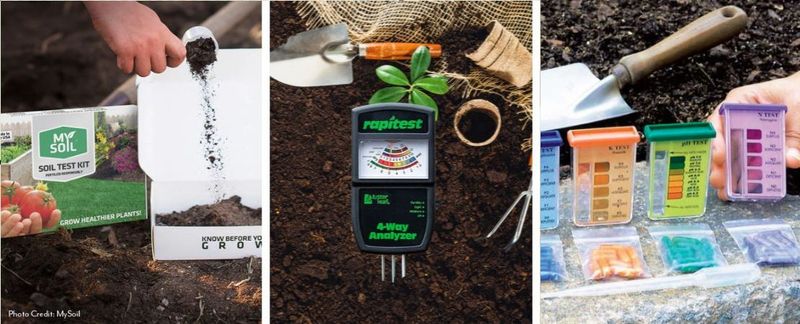
A soil test is the clearest tool available for deciding whether phosphorus actually belongs in your bed right now. Submitting a sample through your state’s cooperative extension service or a reputable lab will return both a phosphorus reading and a pH value, two pieces of information that matter together.
NC State Extension’s kale guide recommends testing before planting and fertilizing according to the results rather than guessing. Kale grows best at a pH around 6.0 to 7.5, and soil that is too acidic or too alkaline can reduce phosphorus availability regardless of how much is present.
What a soil test cannot do is prove that your plant is currently taking up phosphorus or confirm that cold, wet soil caused the purple color. University of Arizona Extension’s nutrient deficiency quick reference is explicit that visual diagnosis alone is unreliable, and that soil and tissue data are needed to confirm a deficiency.
Iowa State University Extension’s nutrient deficiency identification resource echoes this, noting that test results must be interpreted alongside plant and root-zone observations.
If the test shows low phosphorus, follow the recommended product and rate from your extension service. If it shows adequate or high phosphorus, adding more is unlikely to fix the problem and may create a long-term buildup.
Iowa State University Extension’s guide on lowering phosphorus in garden soil explains that phosphorus accumulates easily because it moves so little, and that repeated unnecessary applications can eventually contribute to runoff. Penn State Extension’s phosphorus management resource reinforces that point: apply based on confirmed need and local recommendations, not on the color of the leaves alone.
Correct the root zone and monitor recovery without promising a cure
Once you have gathered information from the cultivar check, drainage assessment, root inspection, and soil test, the next step is addressing whatever the root zone actually needs rather than defaulting to fertilizer. Stop watering if the bed is already saturated, and give the soil time to dry to a workable level before adding more moisture.
Working wet soil compresses the pore spaces that roots and oxygen travel through, making the problem worse rather than better. Texas A&M AgriLife Extension’s soil preparation guidance notes that avoiding tillage or heavy foot traffic on saturated soil is one of the most practical steps a gardener can take to protect bed structure.
Where drainage is a recurring issue, the Texas A&M fall vegetable gardening guide notes that fall crops generally establish better from transplants than from direct-seeded plants, particularly when soil conditions are uncertain. Transplants arrive with a more developed root system, giving them a head start in a challenging environment.
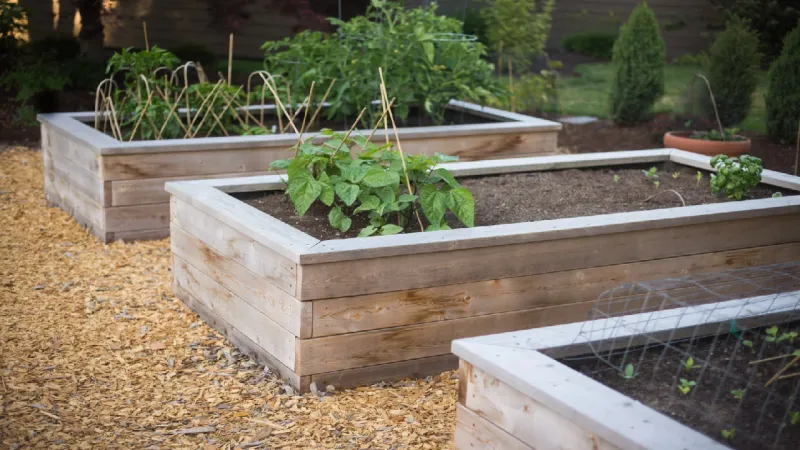
For future fall beds, raised or mounded planting areas with well-amended, freely draining soil reduce the risk of waterlogging during heavy rain events. Penn State Extension’s phosphorus management resource and Iowa State University Extension’s nutrient deficiency guide both point toward root-zone health as a prerequisite for any nutrient management to work.
Monitor the plants over the following two to three weeks. Iowa State University Extension’s plant color and weather resource notes that cold-related pigmentation and temporary uptake problems may ease as root activity resumes with improving conditions – but recovery is not guaranteed.
Persistent stunting, worsening leaf symptoms, or abnormal roots after conditions improve are signals to keep investigating rather than to apply another round of fertilizer. The goal is a root zone that works, because no amendment performs well in soil that roots cannot use.