
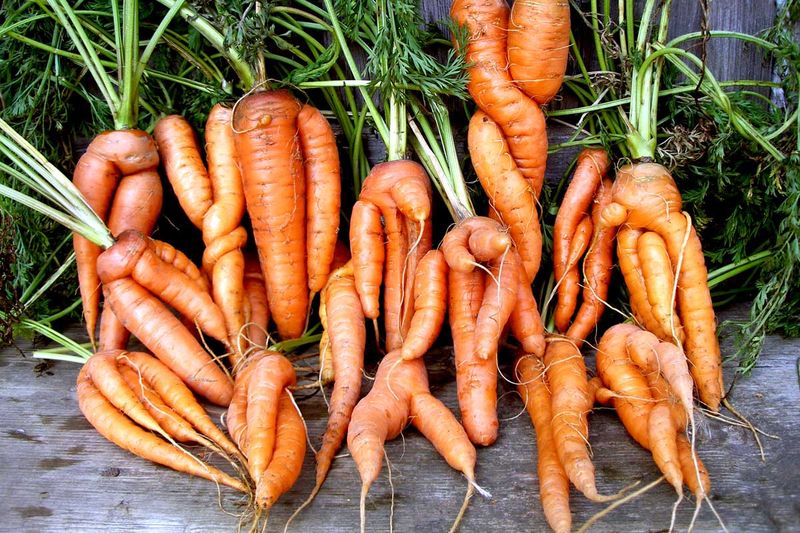
Pull up a batch of carrots and you might find a tangle of forked, branched, or cracked roots hiding beneath perfectly healthy green tops. Those misshapen roots are frustrating, especially when you did everything right above ground. The good news is that most of these problems trace back to fixable habits in the garden bed, and understanding which habit causes which symptom puts you one step ahead for the next planting.
Forks and cracks point to different problems
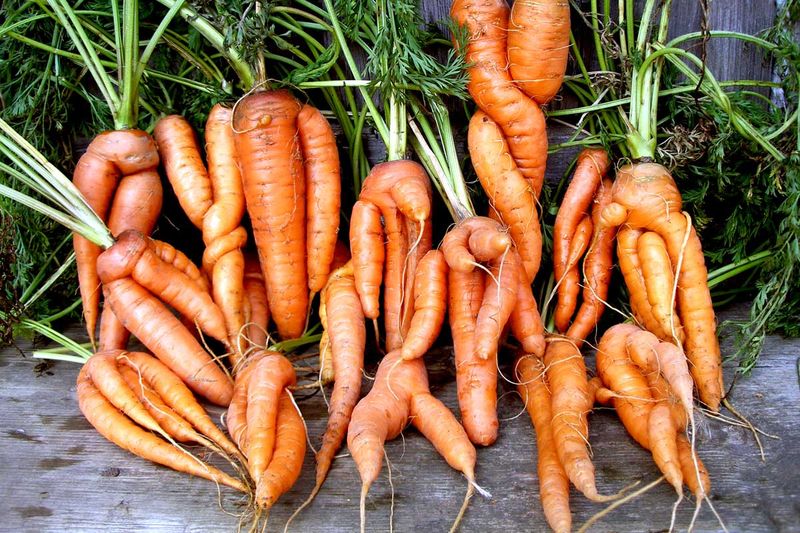
Forked, branched, or stubby carrots and longitudinally cracked carrots may turn up in the same harvest basket, but they usually have different causes. USU Extension’s physiological problems guide notes that forks and multiple roots typically develop when the growing taproot is deflected or physically damaged, while longitudinal splitting is more closely tied to moisture fluctuation. Treating both problems with the same fix often means one of them keeps coming back.
Cracks that run lengthwise along the root are a separate story. RHS guidance on root-vegetable splitting explains that dry soil followed by a sudden surge of water, whether from heavy irrigation or a rainstorm, causes the root to expand rapidly and the skin to tear. Soil preparation can affect how well a bed drains and holds moisture, but it does not directly explain every split the way compaction or rocks can explain a fork.
One crop can honestly show both symptoms at once, which is why the remedies differ. University of Minnesota Extension points out that healthy, leafy tops do not reveal what is happening underground, so green foliage alone cannot tell you whether the root forked because of compaction, crowding, a pest, or something else entirely. Diagnosing correctly means looking at what the root actually shows, not just how the plant looks from above.
Build a clear path for the taproot
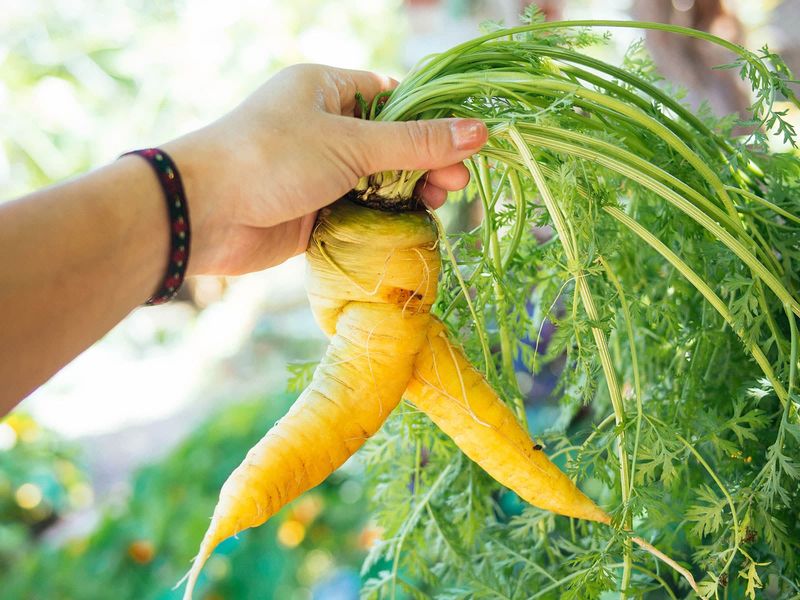
A carrot taproot pushes straight down and follows the path of least resistance. When it meets a rock, a hard clod, a stick, or a zone of compacted soil, it deflects sideways or splits into branches to work around the obstacle. University of Illinois Extension recommends loosening the growing zone approximately 8 to 10 inches deep for standard or long-rooted varieties, breaking up clods, and clearing out stones, sticks, wood chips, and any other debris that could redirect a young root.
UC IPM’s dense or rocky soil guide for carrots reinforces that heavy or compacted soil is a real risk factor, though carrots can still perform reasonably well in heavier soil provided it drains well and is not compacted. Loose, well-drained soil lowers the odds of forking; it does not guarantee a perfectly straight root every time.
One caution worth keeping in mind: Minnesota Extension’s tillage guidance notes that repeated or poorly timed cultivation can damage soil structure and create new compaction layers over time. The goal is a noncompacted, obstruction-free seedbed prepared before sowing, not aggressive or repeated digging throughout the season. Illinois Extension’s carrot-growing blog also suggests that a well-prepared bed done once before planting is more useful than multiple rounds of cultivation after seeds are in the ground.
Use finished organic matter and remove large debris
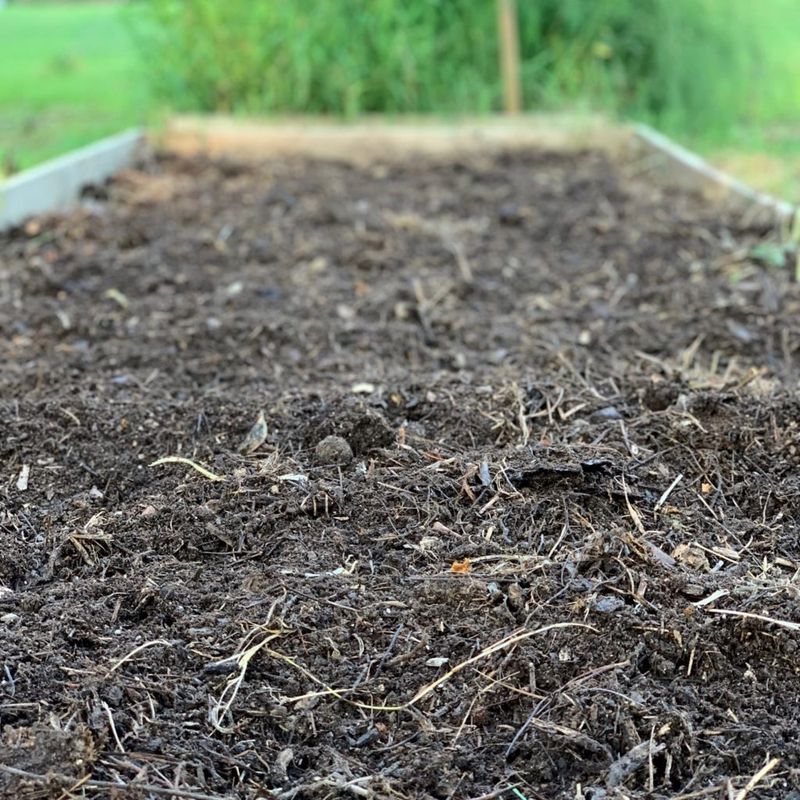
Not all organic matter works the same way in a carrot bed, and mixing them up is one of the more common preparation mistakes. Finished compost and well-rotted organic matter genuinely help by improving soil structure and moisture management, making it easier for roots to penetrate evenly. USU Extension’s physiological problems resource and Minnesota Extension’s carrot guide both recommend working in finished compost or well-rotted material rather than raw or fresh inputs right before sowing.
Fresh manure and high-nitrogen amendments applied immediately before planting create a different kind of problem. Colorado State University Extension’s vegetable garden hints caution that too much available nitrogen can push excessive leafy growth at the expense of root quality and may contribute to rough, branched, or poorly formed roots. The fix is timing: use well-rotted manure or compost, and avoid fresh manure in the weeks right before you sow.
Large pieces of undecomposed debris, including sticks, wood chips, and chunky organic material, belong in a separate category from manure. USU Extension’s soil preparation tips note that bulky, undecomposed material can physically block root penetration, acting much like a rock or clod. Remove this debris from the seedbed before sowing rather than turning it in, since burying it does not eliminate the obstruction problem.
Give each carrot room and protect its growing point
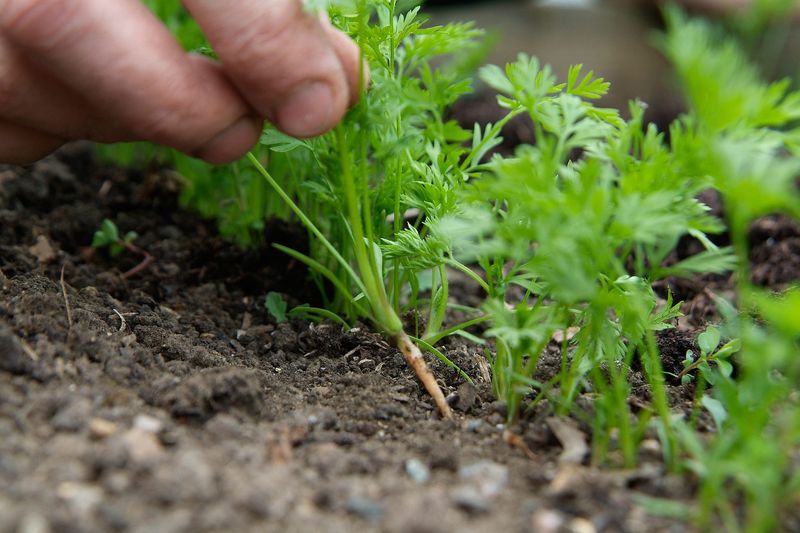
Carrots need to be sown directly in the garden, not started in pots and moved later. Minnesota Extension and Oregon State University Extension both stress that any disturbance or damage to the primary root early on can cause branching or misshapen development. Transplanting, even carefully, risks bending or nicking that young taproot in ways that show up weeks later at harvest.
Thinning is the step many gardeners skip, and crowded carrots pay for it. USU Extension’s carrot-growing guide recommends spacing plants roughly 2 to 3 inches apart, though the right distance varies with variety and the size you are aiming for at harvest. Roots that compete for space can become intertwined, stunted, or oddly shaped, and thinning early, before the roots have started jostling each other, produces better results than waiting.
Cultivating around established plants is another place where good intentions can cause real damage. Illinois Extension warns against deep hoeing near carrot rows because the hoe can sever the developing taproot just below the soil surface. Shallow, careful weeding close to the plants protects the growing point and reduces the branching that root injury tends to trigger.
Keep moisture steady to reduce cracking
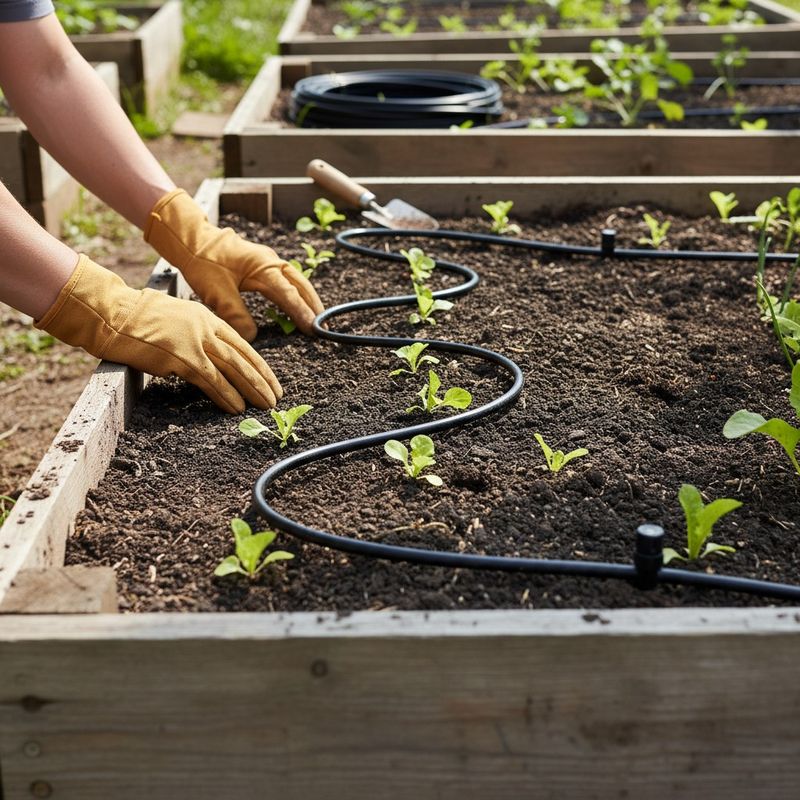
Splitting in carrot roots follows a predictable pattern: the soil dries out, and then a heavy rain or a long irrigation session arrives all at once. RHS guidance on root-vegetable splitting explains that this rapid shift causes the root to absorb water quickly and expand faster than the skin can stretch, resulting in longitudinal cracks. Keeping the moisture supply reasonably consistent is the most direct way to reduce that cycle.
A practical home-garden benchmark is roughly 1 inch of water per week, though some guidance, including USU Extension’s vegetable water recommendations, suggests 1 to 2 inches weekly for carrots depending on conditions. Adjustments for sandy or clay-heavy soil, summer heat, natural rainfall, and drainage are necessary, and the real target is soil that stays evenly moist through the root zone without becoming waterlogged. Illinois Extension’s root-vegetable guidance echoes this principle, noting that steady moisture matters more than hitting a precise number each week.
Mulch can help by slowing evaporation and buffering the soil against sharp temperature and moisture swings. Minnesota Extension recommends mulching the bed to moderate moisture, but mulch works best as a stabilizer, not a substitute for good drainage or a correction for overwatering. A mulched bed sitting in poorly drained soil can stay too wet and create its own root problems, so drainage and watering habits still matter alongside any surface covering.
Choose a carrot that fits the bed
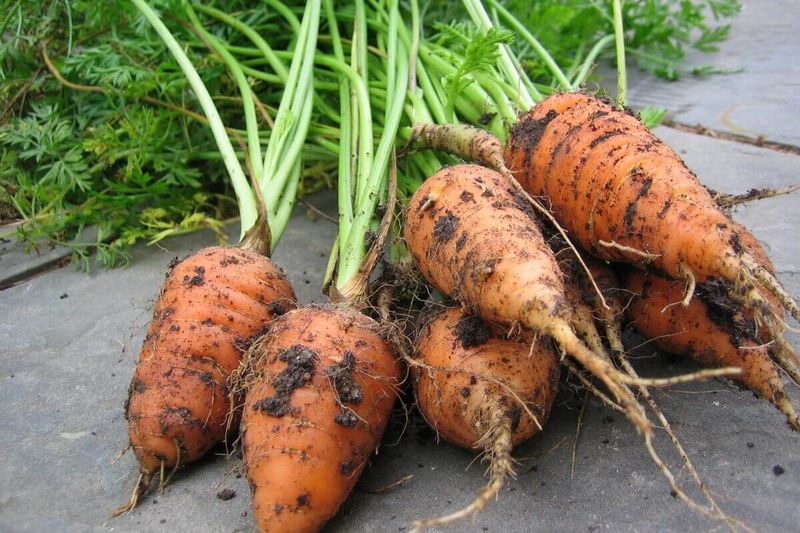
Sometimes the most practical response to difficult native soil is choosing a carrot that works with what you have rather than trying to transform the ground completely. Illinois Extension’s carrot blog notes that shorter-rooted varieties such as Chantenay, Nantes, Thumbelina, and miniature or Oxheart types handle shallower or heavier conditions much better than long Imperator types, which need a full 10 to 12 inches of loose, unobstructed soil to develop properly.
Raised beds offer a workable path when the native soil is rocky, compacted, or too shallow to loosen adequately. USU Extension’s soil preparation guide and Oregon State University Extension’s carrot publication both point to raised beds as a manageable alternative for gardeners who cannot improve in-ground depth easily. One thing to watch: foot traffic alongside or across a raised bed can compact the soil over time, undoing the benefit of the looser fill.
RHS carrot-growing guidance reinforces that variety selection is a form of risk reduction, not a guarantee. Shorter types are more forgiving of imperfect conditions, but they can still fork or crack if the soil has sharp obstructions, if moisture swings are extreme, or if other risk factors are present. Matching the variety to the actual bed depth and soil type simply removes one more obstacle from the list.
Look beyond soil preparation when symptoms do not fit
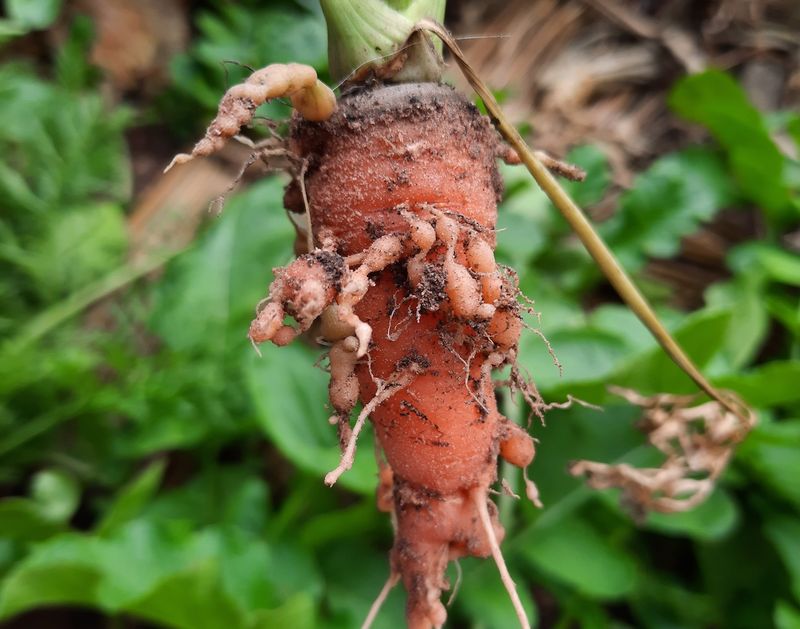
Misshapen carrot roots do not always trace back to rocks, clods, or compaction. Root-knot nematodes are a different cause entirely, and they leave recognizable clues. UC IPM’s nematode guide for carrots describes galls, beadlike swellings, and excessive branching on the root surface as the characteristic signs, and notes that these symptoms require soil or root testing for confirmation rather than a visual guess based on root shape alone.
Pythium root dieback is worth considering when short or forked roots appear alongside root lesions, decay, yellowing foliage, or wilting, particularly in heavy, waterlogged soil. Minnesota Extension’s carrot root diagnostic guide lists Pythium as one possibility when root damage comes with visible decay rather than clean branching. Improving drainage and avoiding overwatering lowers the conditions Pythium favors, but it is not the same correction as loosening the soil for physical obstructions.
Aster yellows is a third possibility, and it looks different from ordinary forking. Minnesota Extension’s leafhopper and aster yellows post describes yellow or distorted tops, shortened roots, and a dense mat of hairlike secondary roots as the hallmark symptoms, spread by leafhoppers rather than soil conditions. Illinois Extension also flags aster yellows as a disease to distinguish from purely physical soil problems. If the symptom pattern does not fit compaction or moisture, USU Extension suggests contacting a local extension office or submitting a sample for testing before drawing conclusions.
Start the next crop with the right correction

Before the next sowing, prepare a seedbed that is loose, obstruction-free, and roughly 8 to 10 inches deep for standard varieties. Remove rocks, clods, sticks, and undecomposed debris; work in finished compost rather than fresh manure or high-nitrogen amendments; and choose a shorter variety if the native soil depth is limited. Illinois Extension and USU Extension both frame this preparation as the foundation for reducing forked roots.
For splitting, the correction shifts to moisture management. RHS guidance and Minnesota Extension both point to consistent watering as the primary tool against longitudinal cracks, with mulch as a supporting measure. Sow directly, thin to give roots adequate space, and cultivate shallowly to avoid injuring the taproot as it develops.
These practices lower the most common risks, but they cannot override every variable. Variety genetics, unexpected pest pressure, disease, and weather will always play some role in what comes up at harvest. A well-prepared bed with steady moisture simply gives each carrot the clearest path it can have.