
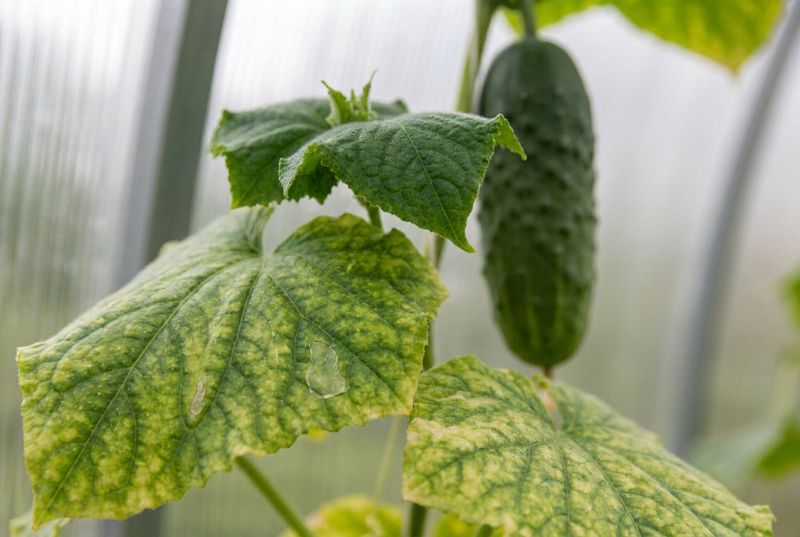
Watching your cucumber leaves turn yellow between the veins during a heat wave is genuinely alarming, especially when the rest of the plant looks like it’s trying its best. The instinct to grab the hose or reach for a fertilizer bag is understandable, but the actual cause may be more specific than either of those fixes. That yellow-between-green-veins pattern is a useful clue worth investigating carefully before you treat anything. Getting the diagnosis right is what separates a rescued plant from one that gets the wrong remedy at the worst possible time.
Yellow Between Green Veins Is a Clue, Not a Diagnosis
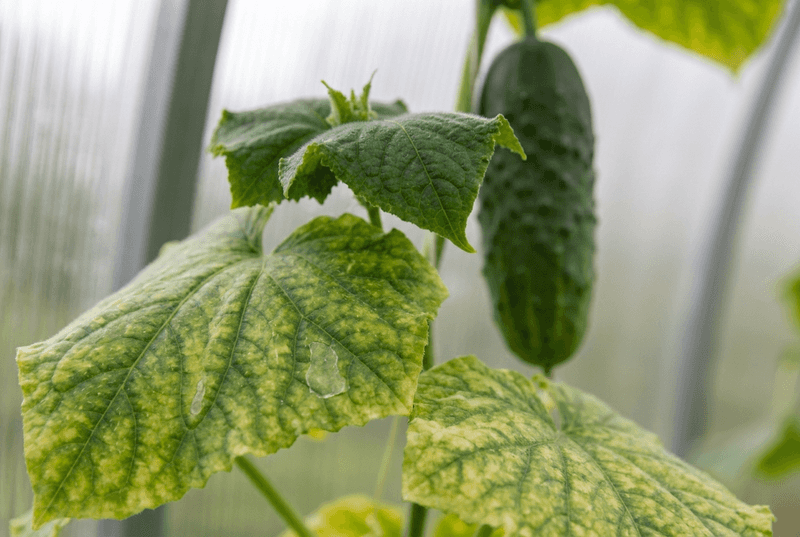
Spotting yellow tissue between the veins of a cucumber leaf while the veins themselves stay green is called interveinal chlorosis, and it is one of the more informative patterns a plant can show you. The key word, though, is “clue.” As Utah State University Extension explains, interveinal chlorosis can result from several different nutrient deficiencies, not just one, and the pattern alone does not tell you which nutrient is involved or whether a nutrient is even the primary problem.
Iron, manganese, magnesium, zinc, and other nutrients can each produce variations of that green-vein-yellow-tissue look. Water stress, herbicide drift, root damage, pests, and certain diseases can create similar discoloration too. University of Minnesota Extension notes that visual nutrient diagnosis is genuinely difficult because symptoms overlap and more than one problem can affect a plant at the same time.
Magnesium is a reasonable possibility to consider, but only under specific circumstances. According to University of Kentucky cucurbit scouting guidance, magnesium deficiency in cucurbits typically begins on the oldest leaves and tends to appear during rapid growth or when fruit is enlarging, particularly in sandy, low-pH, or dry soils. That context matters before you reach for any amendment.
Heat Can Reveal or Intensify Several Problems
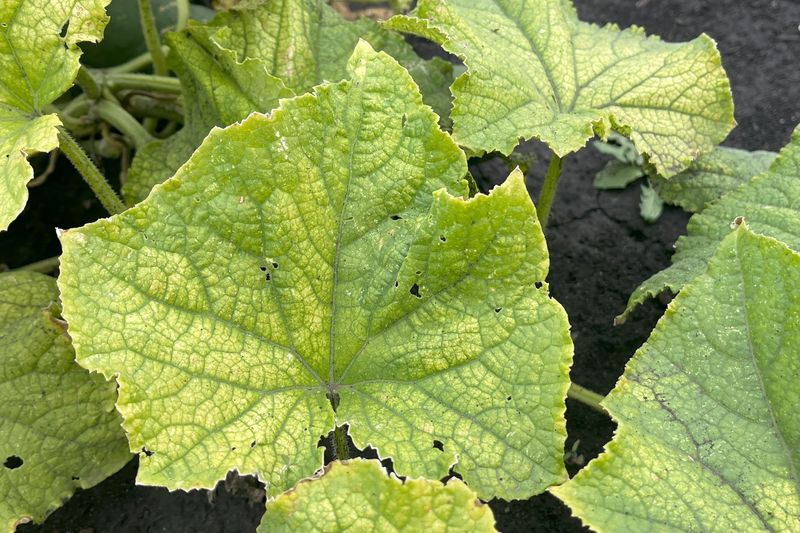
Hot weather does not directly pull nutrients out of your soil, but it sets up a chain of conditions that can make an existing problem much more visible. When air temperatures climb, leaves lose water faster than roots can replace it, and that water deficit slows the movement of dissolved nutrients from the soil into plant tissue. University of Minnesota Extension’s guidance on hot-weather gardening explains that daytime wilting during extreme heat can happen even when the soil is adequately moist, simply because evaporative demand outpaces uptake.
Peak heat also coincides with the part of the season when cucumber plants are producing fruit rapidly. That growth surge increases demand for several nutrients, including magnesium, which the plant redistributes from older leaves toward new growth and developing fruit. UMN’s watering guidance reinforces that drought can reduce nutrient movement into roots, making a borderline soil situation more apparent under stress.
None of that means heat causes magnesium deficiency in every cucumber, or in any particular one of yours. UK cucurbit scouting resources connect magnesium deficiency with specific soil and crop-growth conditions, not heat alone. Check soil moisture first before interpreting yellow leaves as a nutrient problem, because wilting and discoloration during a heat wave can reflect thirst just as easily as a feeding gap.
Use Leaf Age to Narrow the Possibilities
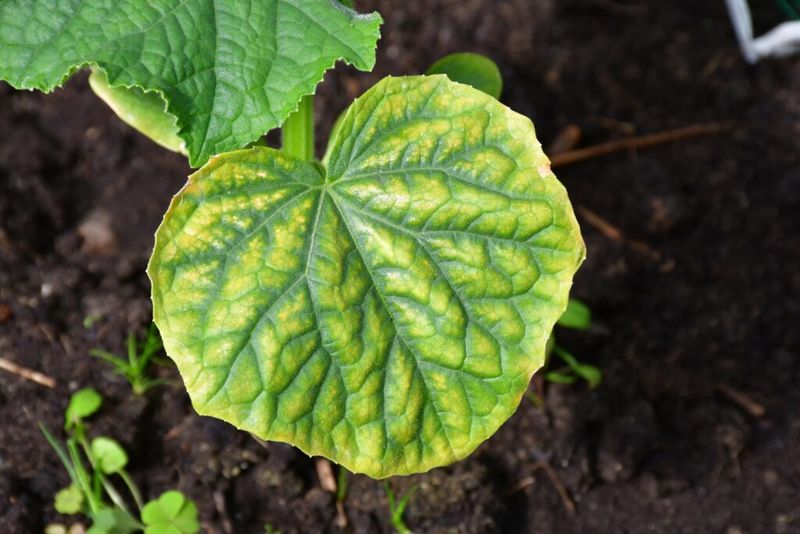
Leaf age is probably the single most useful observation you can make when trying to narrow down what is causing interveinal yellowing. Where the symptom appears on the plant tells you something meaningful about which nutrients are most likely involved, because some nutrients move freely within a plant while others do not.
Magnesium is a mobile nutrient, meaning the plant can pull it from older tissue and redirect it toward actively growing parts. That mobility is why UK cucurbit scouting guidance describes magnesium deficiency as starting on the oldest, lowest leaves and gradually moving upward as deficiency worsens. If your interveinal yellowing is appearing on the older leaves closer to the base of the plant while new growth near the tips looks reasonably healthy, magnesium availability is a reasonable suspect worth investigating further.
Newer leaves showing interveinal yellowing tell a different story. Iron and manganese are much less mobile in plant tissue, so when the plant cannot access enough of them, the symptoms show up first in young, actively developing leaves. University of New Hampshire Extension’s greenhouse nutrient-problem guide confirms that iron deficiency typically appears first on young leaves, which distinguishes it from magnesium deficiency. Meanwhile, UMN Extension notes that uniform yellowing of older leaves without a clear green-vein pattern can point toward nitrogen deficiency or root-related uptake problems instead.
No visual pattern is conclusive on its own, but leaf age gives you a meaningful starting point.
Check Soil Moisture and Root Conditions First
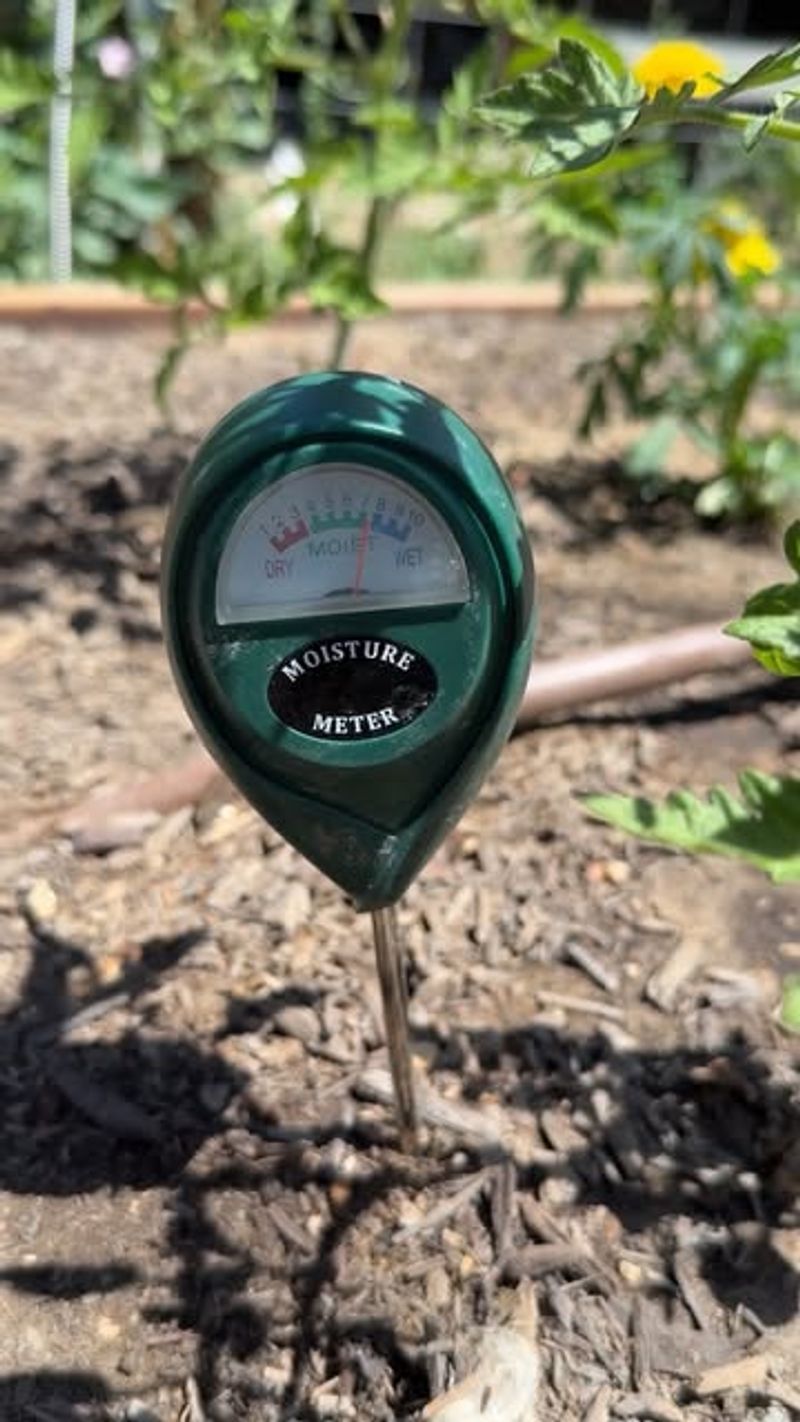
Before reaching any conclusion about nutrients, push your finger or a small trowel about two inches into the soil near the roots. That simple check tells you more than staring at wilted leaves at noon ever will. University of Minnesota Extension’s cucumber growing guide recommends watering when soil is dry about two inches below the surface, and notes that cucumbers generally need about one inch of water per week from rain or irrigation, with adjustments for sandy soil, containers, or extreme heat.
Midday wilting during hot weather does not automatically mean the plant is thirsty. UMN’s hot-weather gardening advice explains that leaves can droop even in moist soil when evaporative demand simply outpaces what roots can deliver. Check early in the morning instead, when temperatures are cooler and a plant that is still wilted is more likely to be genuinely water-stressed.
When the soil is dry, water deeply and thoroughly at the soil surface rather than giving shallow sips that keep roots near the dry upper layer. A layer of mulch around the base of the plant helps slow evaporation and moderate soil temperature during heat waves. UMN’s vegetable garden watering guidance also cautions that overwatering and poor drainage can damage roots and impair nutrient uptake just as drought can. Water stress and nutrient stress are overlapping possibilities, not mutually exclusive explanations.
Inspect Leaves for Pests and Disease Look-Alikes
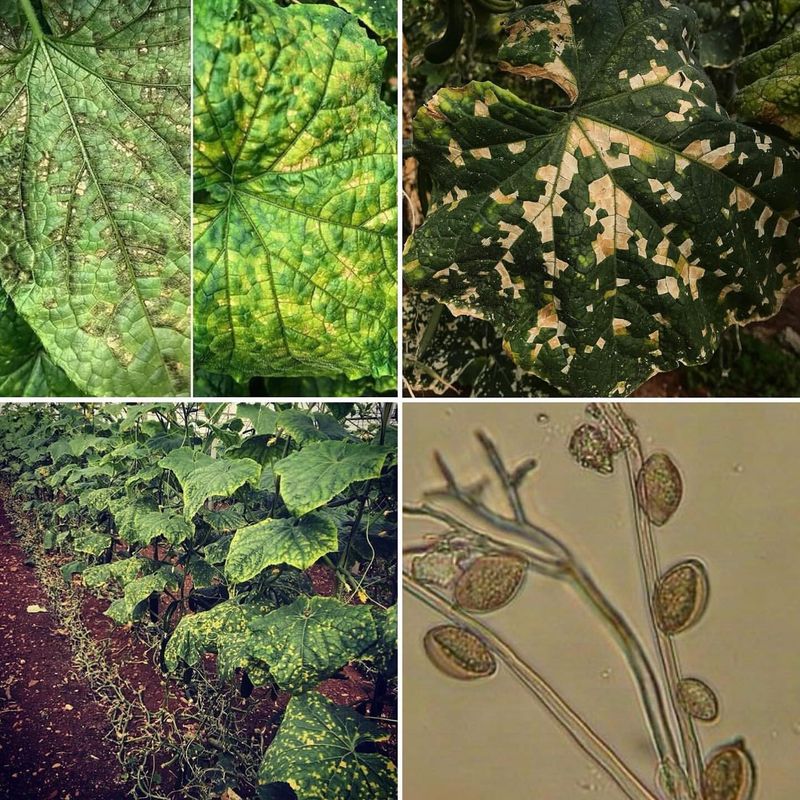
Turning a leaf over and looking at its underside takes thirty seconds and can save you from treating a problem that does not exist. Several pests and diseases produce yellow, pale, or mottled discoloration on cucumber leaves that can look convincingly like a nutrient disorder at first glance.
Spider mites are one of the most common culprits during hot, dry weather. UC IPM’s cucurbit spider-mite guide describes pale stippling, general yellowing, bronzing, and sometimes fine webbing on the undersides of leaves. Mite populations build quickly on water-stressed plants in hot conditions, which is exactly the environment that also makes nutrient problems more likely, so both can occur together.
Disease patterns have their own tells. UMN Extension’s downy mildew resource describes pale green or yellow angular spots bounded by leaf veins, often followed by browning and a gray-purple fuzzy growth on the underside of the leaf in humid conditions. That angular, vein-bounded shape is a key distinction from the broader interveinal pattern of a nutrient problem. Illinois Extension’s angular leaf spot page describes small brown or straw-colored lesions with yellow halos that may eventually fall out and leave holes in the leaf.
Herbicide drift is another look-alike worth considering if neighboring areas were recently sprayed. Oklahoma State University Extension’s herbicide-injury fact sheet notes that unusual leaf distortion, cupping, or discoloration after nearby chemical applications warrants herbicide injury as a possibility before assuming nutrient deficiency. Sudden general decline or distorted new growth also signals that something beyond a simple feeding gap may be happening.
Use Testing to Assess Magnesium and Soil Conditions
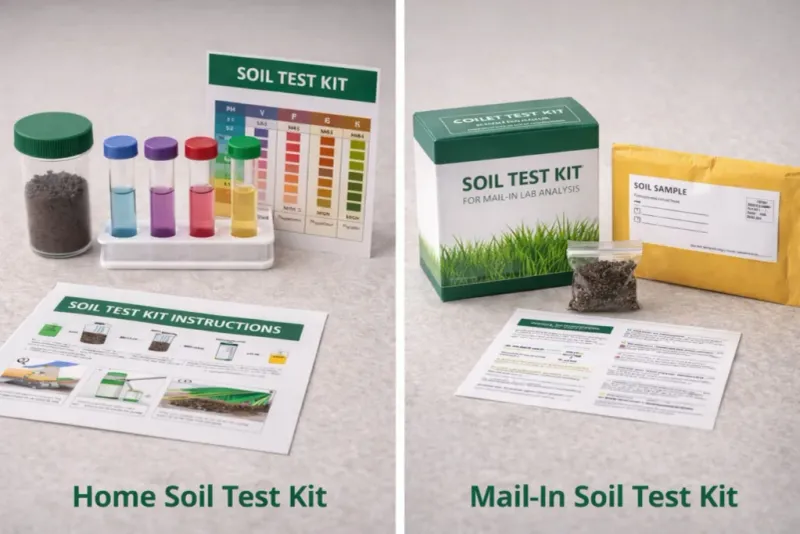
Visual symptoms and leaf-age patterns can point you toward a reasonable hypothesis, but a soil test is what moves you from guessing to knowing. Penn State Extension’s soil testing overview explains that a standard soil test measures available nutrients including magnesium, soil pH, and lime requirements, giving you a factual basis for deciding whether an amendment is warranted and which one fits your situation.
Soil pH matters here because nutrient availability depends on more than just how much of a nutrient is physically present in the soil. At the wrong pH, a nutrient can sit in the soil in a form roots cannot absorb. For cucumbers specifically, UMN Extension’s cucumber growing guide recommends maintaining a pH of approximately 6.0 to 6.5. That range is specific to cucumbers and should not be applied as a universal target for every plant in your garden.
Adjusting pH without test results can shift one nutrient into better availability while pushing another out of reach.
When diagnosis remains uncertain after a soil test, foliar or tissue testing is an additional option worth considering. UMN’s fertilizing guide acknowledges that symptoms overlap and multiple problems can occur at once, which is exactly the situation where a tissue test can add useful confirmation. Neither a soil test nor a tissue test alone proves what is causing the plant’s symptoms, but together with your symptom pattern and plant inspection, they give you a much more reliable picture than color alone ever could.
Match the Amendment to the Test Results
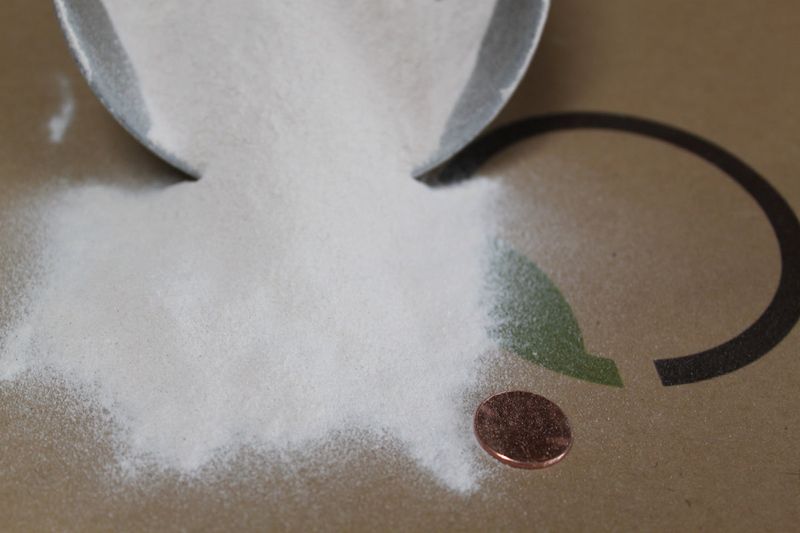
Treatment decisions belong after the soil test, not before. When test results and the symptom pattern together support a magnesium-availability problem, the right amendment depends on what else the test reveals, particularly your soil’s pH. Oregon State University Extension’s soil test interpretation guide provides a useful framework for reading those results and matching them to appropriate amendments.
Dolomitic lime supplies magnesium while simultaneously raising soil pH, making it the better fit when your test shows both low pH and low magnesium. Magnesium sulfate, sold widely as Epsom salt, supplies magnesium without changing pH, which makes it more appropriate when magnesium is low but pH is already in the right range. Follow the test recommendation and product label for rates. Excess magnesium can compete with calcium for uptake, so more is not better.
Routine Epsom-salt applications without a test are not recommended. UMN Extension’s review of common soil remedies cautions that Epsom salts should only be used when a soil test indicates magnesium deficiency, and warns that foliar sprays can scorch leaves if concentration or application conditions are off. UK cucurbit guidance adds that foliar sprays are generally ineffective for correcting significant magnesium deficiencies anyway. Adding dolomitic lime to soil that is already near the cucumber target pH range can create new nutrient-availability problems rather than solving the original one.
Let the test results guide the choice, and apply only what the data supports.
Measure Recovery by New Growth and Slower Spread
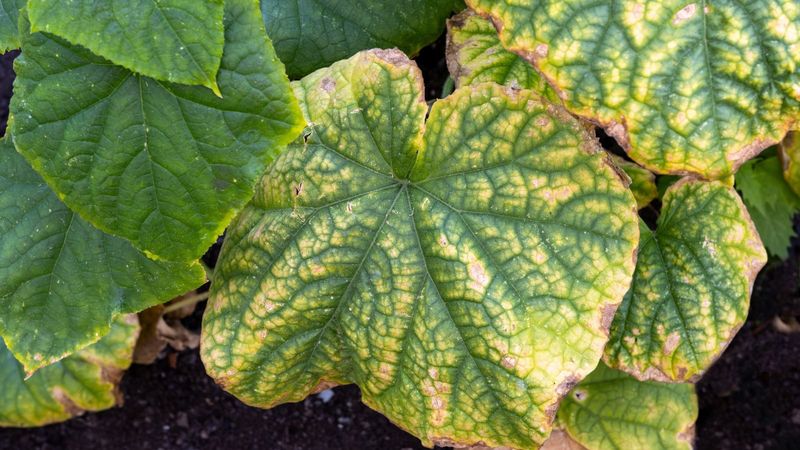
Once you have addressed the most likely cause, whether that was moisture, pests, disease, pH, or a confirmed nutrient deficiency, resist the urge to judge success by whether yesterday’s yellow leaves turn green. They probably will not. Existing chlorotic or necrotic tissue tends to stay damaged even after the underlying problem is corrected.
A peer-reviewed study on magnesium and nitrogen recovery in cucumber plants found that magnesium resupply partially alleviated symptoms in upper leaves but did not immediately reverse damage in older, already-affected tissue. That finding reinforces what UK cucurbit guidance also suggests: the practical sign of improvement is healthier new growth appearing at the tips of the vine and a slowing in how quickly the yellow pattern advances toward newer leaves.
Keep checking soil moisture regularly, continue inspecting for mites and disease, and revisit your amendment plan if yellowing keeps spreading despite your corrections. Green-vein yellowing is a reliable signal that something in the plant’s environment deserves attention, but it is a starting point for diagnosis rather than a permission slip to skip straight to treatment. A plant that pushes out firm, well-colored new leaves after you address the problem is telling you the fix is working, one leaf at a time.