
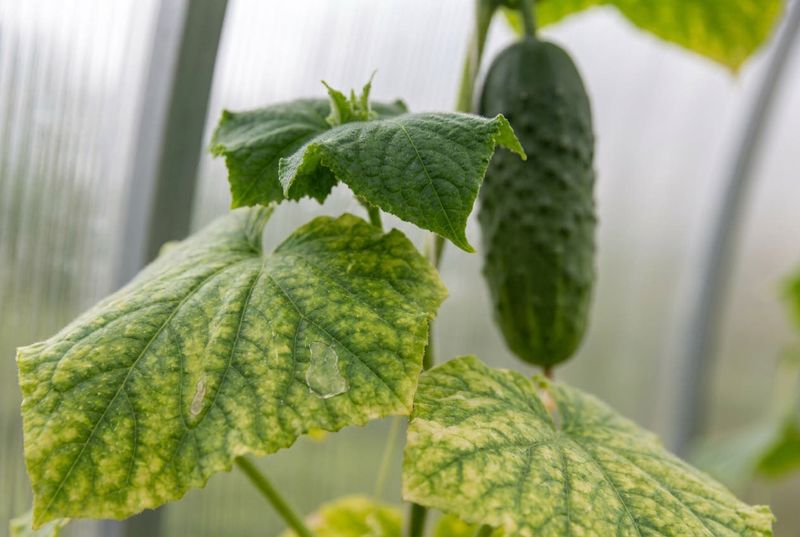
Watching your cucumber leaves develop yellow edges during a summer heat wave is genuinely worrying, and the instinct to reach for a quick fix makes sense. But yellow leaf margins can come from several different problems, and treating for the wrong one can make things worse. Before adding anything to the soil, a closer look at the symptom pattern and a few other clues can point you toward the real cause.
Yellow edges do not identify magnesium deficiency
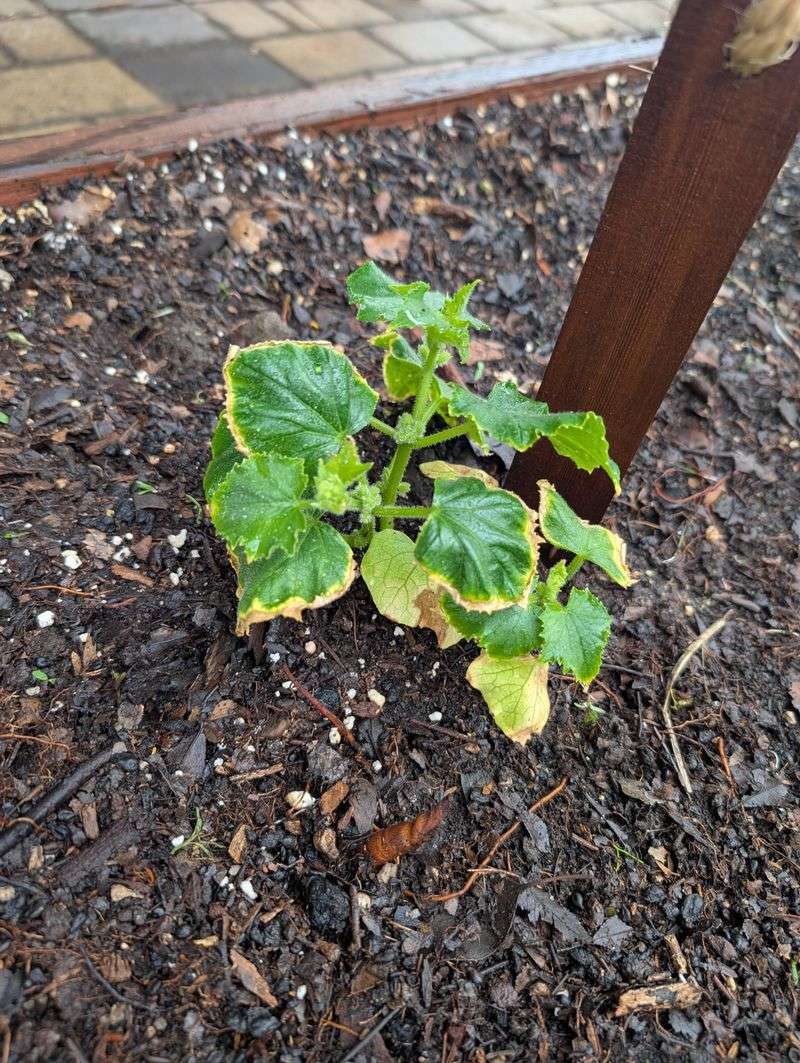
Seeing yellow or brown tissue creep along the edges of cucumber leaves is unsettling, especially when temperatures climb and the plants already look stressed. The trouble is, that margin pattern is more consistent with several possibilities, including potassium deficiency, heat-related scorch, salt injury, and uneven watering, than with the typical magnesium-deficiency picture. Penn State Extension’s cucumber growing guide specifically links yellow leaf margins in cucumber to potassium deficiency, while the University of Georgia’s guide to nutritional deficiencies in vegetables describes magnesium deficiency as primarily an interveinal pattern, not an edge problem.
Salt stress is another common look-alike. High salt concentrations in the soil can impair water uptake and produce leaf-tip or leaf-margin burn that closely mimics drought or scorch, as Colorado State University Extension’s guidance on saline soils explains. Disease and insects can add to the confusion further.
Rather than treating summer heat as a diagnosis, pay attention to where on the plant the yellowing appears, whether it is spreading, and how quickly. A symptom confined to the very edge of leaves across multiple parts of the canopy calls for a different investigation than yellowing that starts between the veins on the lowest leaves. Location, distribution, and progression matter more than the season alone.
Learn the magnesium pattern before adding magnesium
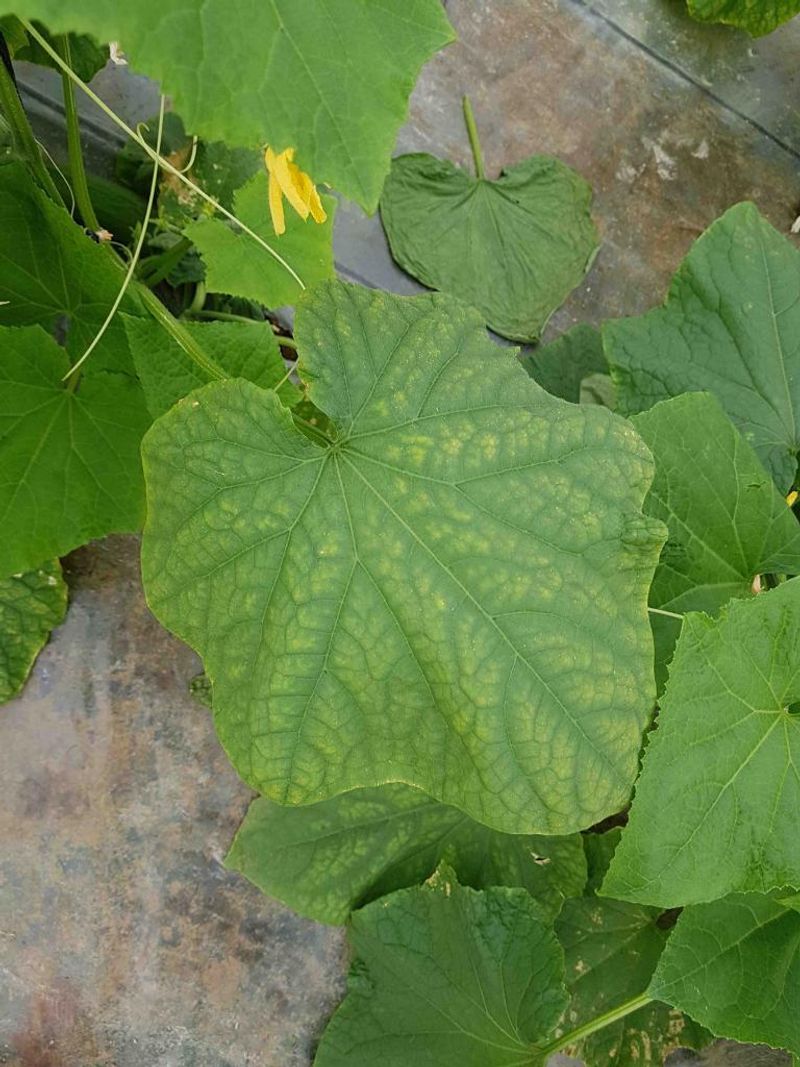
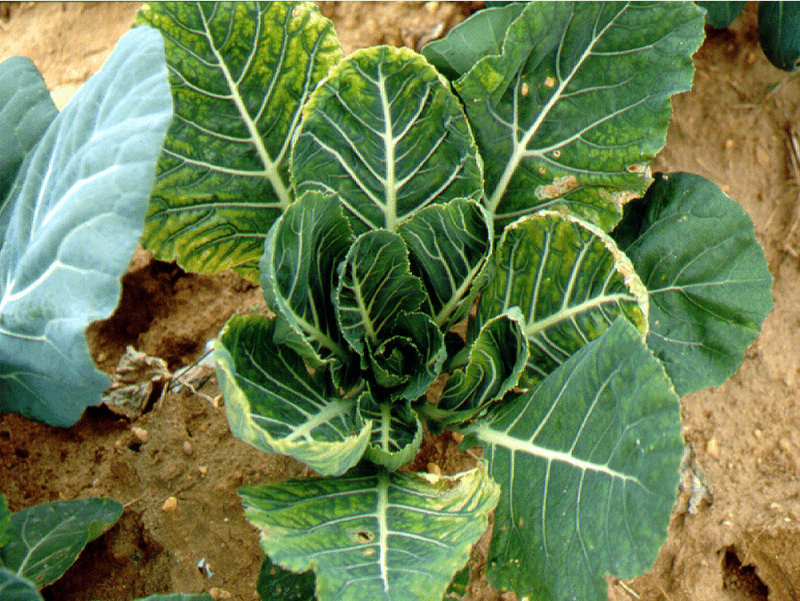
Magnesium deficiency has a fairly recognizable look once you know what to search for. The tissue between the leaf veins turns yellow while the veins themselves stay green, a pattern called interveinal chlorosis. As the deficiency progresses, the yellow areas may develop brown or dead spots. UGA Extension’s nutritional deficiency guide and University of Minnesota’s magnesium-for-crop-production resource both describe this interveinal pattern as the characteristic presentation.
Magnesium is a mobile nutrient, meaning the plant can pull it from older tissue and move it toward younger, actively growing leaves when the supply runs short. That mobility is why deficiency symptoms tend to show up first on the older or middle leaves rather than on new growth at the tips. If you are seeing yellowing primarily on new leaves, a different problem is more likely at play.
There is an important cucumber-specific qualification worth keeping in mind. A peer-reviewed study on magnesium thresholds in cucumber and rice found that even under severe magnesium deficiency, cucumber leaf margins could remain green. That finding means a generic nutrient-deficiency chart designed for other crops may not translate cleanly to cucumbers. If the edges of your cucumber leaves are yellow but the area between the veins looks fine, the symptom pattern does not fit the typical magnesium picture, and adding magnesium is unlikely to help.
Recent fertilizer use can affect magnesium uptake
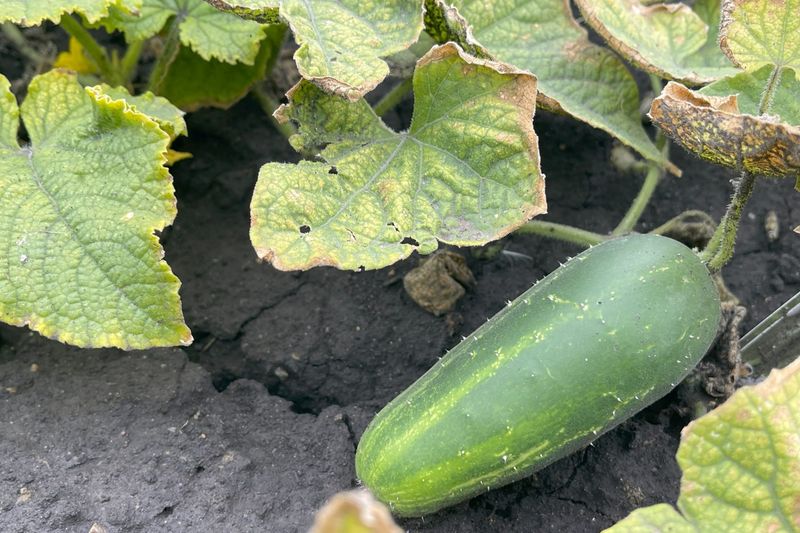
There is a real connection between fertilizer habits and magnesium availability, though it is narrower than the title suggests. When the soil contains excessive potassium, it can compete with magnesium at the root level and suppress magnesium uptake, eventually producing genuine interveinal chlorosis on older leaves. This is a plausible mechanism, but it explains only one pathway to one specific symptom pattern, not every case of yellow-edged cucumber leaves.
Think back over what you have applied in recent weeks. Repeated granular fertilizers high in potassium, frequent liquid feeds, heavy compost additions, or manure can all push potassium levels higher than the plant can balance. UGA Extension’s nutritional deficiency guide and Oregon State University’s nutrient management guide for vegetable systems both note that high potassium can reduce magnesium uptake and lead to deficiency symptoms.
Before drawing any conclusions, check whether the yellowing you are seeing matches the interveinal pattern described in the previous section, not just yellow edges. A fertilizer imbalance may be contributing to a genuine magnesium shortage, but it is not a reliable explanation for leaf-margin yellowing by itself. Pausing additional feeding while you investigate is a sensible first step that costs nothing and prevents the situation from getting worse.
Heat can expose moisture and salt stress
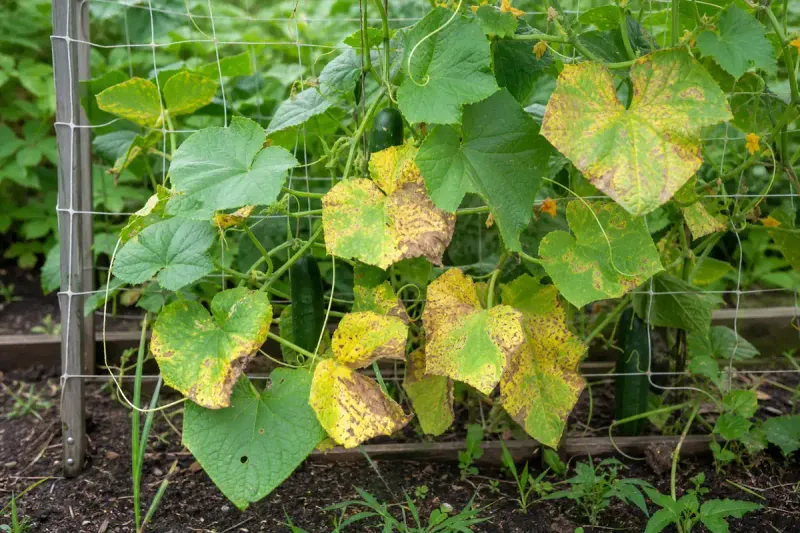
Hot weather does not cause magnesium deficiency on its own. What heat does is increase the plant’s water demand sharply, and that added pressure can expose or worsen problems that were already lurking, including uneven irrigation, shallow root zones, salt buildup, and pre-existing nutrient imbalances. Utah State University Extension’s cucumber growing guide and University of Minnesota Extension’s heat-gardening guidance both emphasize that moisture stress during hot spells is a primary driver of cucumber decline.
Salt buildup is a particular concern that gardeners often overlook. Concentrated fertilizers, frequent liquid feeds, compost, manure, high-tunnel conditions, or irrigation water with dissolved minerals can all raise salt levels in the root zone over time. As Colorado State University Extension explains in its guide to saline soil problems, elevated salts impair the plant’s ability to take up water even when moisture is present, producing symptoms that look a lot like drought stress, including leaf-tip and leaf-margin burn.
How quickly salt or heat stress produces visible symptoms depends on your specific soil, container, irrigation frequency, salt concentration, and plant size, so there is no single timeline to expect. The practical takeaway is that heat is better understood as a trigger that reveals existing vulnerabilities than as a direct cause of any particular nutrient problem.
Inspect for disease, insects, and normal aging
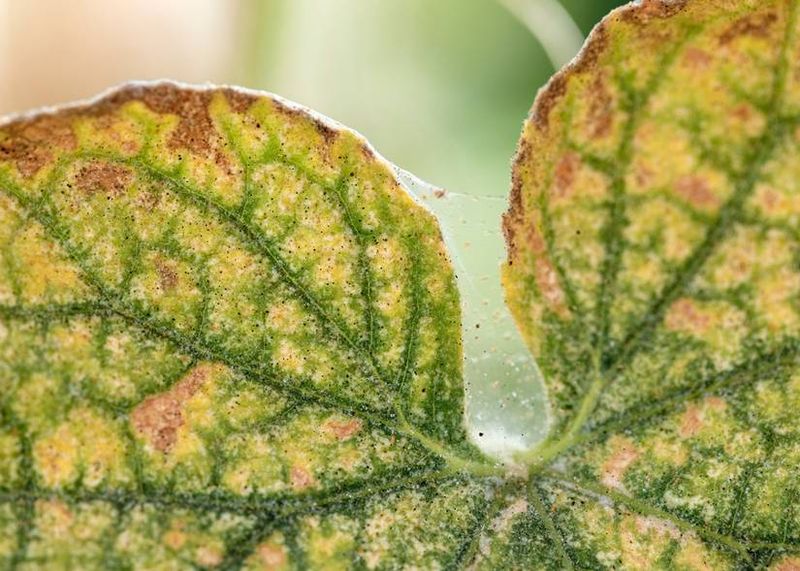
Before reaching for any amendment or spray, a thorough whole-plant inspection can save you from treating the wrong problem. Several common cucumber diseases and insects produce leaf discoloration that looks enough like a nutrient issue to cause real confusion. Working through a visual checklist takes only a few minutes and can redirect your response entirely.
Powdery mildew starts as pale yellow spots on the upper leaf surface and later develops the distinctive white powdery coating. Downy mildew is trickier: it produces angular yellow lesions bounded by the leaf veins, and if you flip the leaf over, you may see gray or purple fuzzy growth on the underside. University of Minnesota Extension’s powdery mildew guide and their downy mildew resource describe both diseases in detail and are worth bookmarking for the season.
Spider mites thrive in hot, dry weather and leave behind a pale, speckled stippling across the leaf surface rather than solid yellow patches. Aphids cluster on new growth and leaf undersides and can cause general yellowing as they feed. The University of Minnesota’s cucumber leaf-discoloration diagnostic tool can help you work through these possibilities systematically.
Finally, a few yellowing leaves on the lowest, oldest part of the plant can simply reflect normal aging, especially as the season advances. Ask Extension’s cucumber yellowing FAQ notes this distinction. Rapid yellowing spreading across the canopy or affecting new growth is a different situation and warrants a closer look right away.
Stabilize the root zone before feeding again
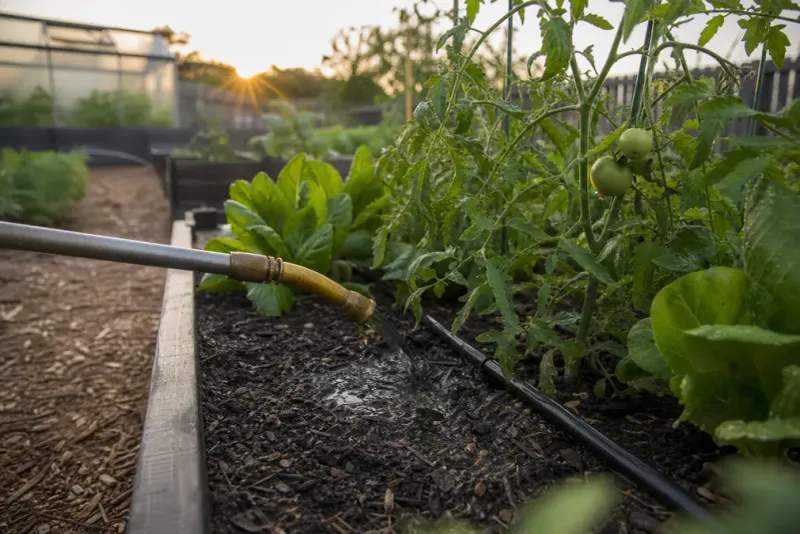
When the cause of leaf yellowing is still unclear, the lowest-risk move is to stabilize moisture and hold off on adding anything new to the soil. Check the moisture level at root depth before each watering rather than going by a fixed schedule, because surface soil can dry out quickly while the root zone stays adequately moist, or vice versa.
Utah State University Extension’s cucumber guide suggests targeting roughly 1 to 2 inches of water per week as a general reference, but treat that as a starting point rather than a fixed rule. Plant size, soil type, container versus in-ground growing, recent rainfall, and current temperatures all shift actual water needs, sometimes considerably. University of Minnesota Extension’s heat-gardening tips and Penn State Extension’s cucumber resource both recommend keeping irrigation at soil level when possible to reduce evaporation and avoid wetting foliage.
A 2-to-3-inch layer of organic mulch around the base of the plants can meaningfully slow moisture loss from the soil surface during hot weather. Beyond watering, hold any additional fertilizer applications until you have a clearer picture of what the symptom pattern and recent inputs suggest. Adding more nutrients to an already stressed or salt-loaded root zone can intensify the problem rather than correct it.
Use soil testing to guide the next decision

A soil test is the most reliable tool available to a home gardener trying to sort out a nutrient question, but understanding what it can and cannot tell you matters. Testing will show whether available magnesium, potassium, and pH are within a healthy range for vegetable production, and that information supports an informed amendment decision. What it cannot do is prove that a nutrient level caused the specific leaf symptoms you are seeing, since several problems can produce similar visual results.
For cucumber yellowing concerns, ask for a test that includes pH, available potassium, and available magnesium at minimum. If you have been using containers, a high tunnel, repeated liquid feeds, concentrated granular fertilizers, compost, manure, or irrigation water with high mineral content, adding a soluble-salts or electrical-conductivity measurement is worth considering. Penn State Extension’s soil-testing page and resources from Colorado State University Extension on saline soils explain how these measurements help clarify conditions that visual symptoms alone cannot.
Cucumber pH guidance varies somewhat by region and soil-testing method. University of Minnesota Extension and UGA Cooperative Extension’s cucumber guide suggest approximately 6.0 to 6.5, while other regional sources allow a wider range. Follow your lab report’s specific recommendation for your soil rather than applying a number from a general gardening article. The report will give you a much clearer starting point than any visual diagnosis alone.
Choose a magnesium amendment only when the evidence fits
If a soil test confirms that magnesium is genuinely low, you have two main options, and the right one depends partly on what else the test reveals. Dolomitic lime supplies both magnesium and calcium while raising soil pH, making it a reasonable choice when the test shows low pH alongside low magnesium. Magnesium sulfate, commonly sold as Epsom salt, supplies magnesium without affecting pH, which makes it more appropriate when pH is already in an acceptable range. Oregon State University Extension’s soil test interpretation guide and Penn State Extension’s report-interpretation resource both walk through how to read amendment recommendations in context.
Rates matter. Follow the rate your soil-test report recommends or the product label specifies for your situation, not a generic tablespoon-per-gallon recipe found online. University of Minnesota Extension’s review of common soil remedies is direct on this point: Epsom salt should be used only when a test confirms magnesium deficiency. Excess magnesium can interfere with calcium uptake and contribute to environmental problems in the soil and beyond.
Routine, repeated, or foliar Epsom-salt applications are not supported by extension research as a general cucumber booster. Oregon State University Extension’s look at Epsom salt gardening myths finds no productivity or color benefit when magnesium is not deficient, and foliar sprays carry a real risk of leaf scorch. When the soil test, the symptom pattern, and the plant history all point to a genuine magnesium shortage, a targeted amendment can genuinely help. Absent that alignment, the most useful thing you can do for yellow-edged cucumbers is keep watering steady and let the diagnosis catch up to the treatment.