
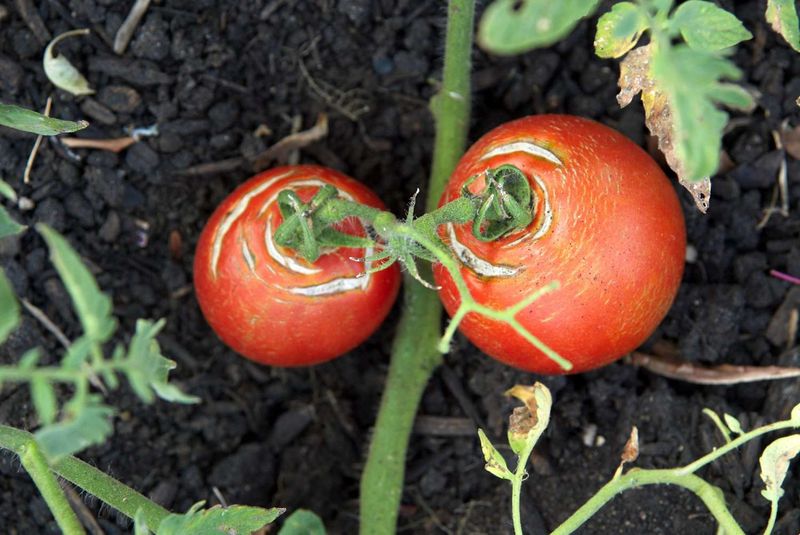
Watching a nearly perfect tomato split open right before you pick it is one of the most frustrating sights in a summer garden. The good news is that the crack usually traces back to a single, fixable habit rather than a mysterious disease or bad luck. When soil dries out between waterings and then gets a heavy soak, the fruit can expand faster than its skin can handle. Understanding that pattern puts you in a much better position to protect the tomatoes still ripening on the vine.
The split usually begins with a dry-to-wet surge
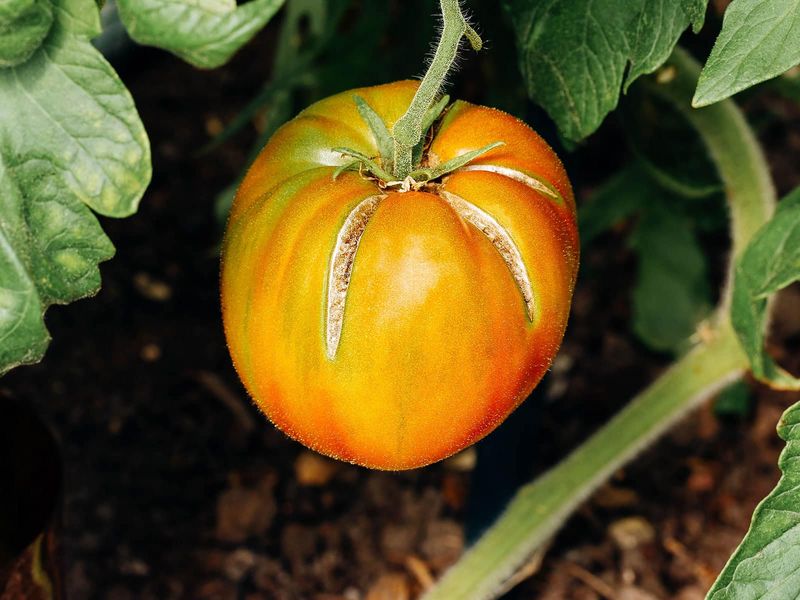
Radial cracks extend outward from the stem scar like spokes on a wheel, while concentric cracks form rings around that same area. Both patterns show up on ripening tomatoes and both are commonly linked to the same underlying event: soil that dried out significantly and then received a heavy supply of water, whether from irrigation or a sudden rainstorm.
When that dry-to-wet swing happens, water moves quickly into the plant’s roots and pushes upward into the fruit. University of Minnesota Extension’s tomato fruit crack guide explains that the interior of the fruit expands rapidly while the outer skin, already tightened by the ripening process and heat stress, cannot stretch fast enough to keep up. The skin gives way, and a crack forms.
Hot weather and advanced ripeness both make the skin less forgiving, so the same moisture swing that causes minor damage in cooler conditions can produce deep splits in late summer. Direct wetting from rain or overhead irrigation around the stem scar can also contribute, so this is not purely a hose-watering problem. Penn State Extension notes that existing cracks will not close once they form. The practical goal from this point forward is to prevent repeated moisture shocks and limit new damage on fruit that has not yet split.
Check the soil before giving the plant another deep drink
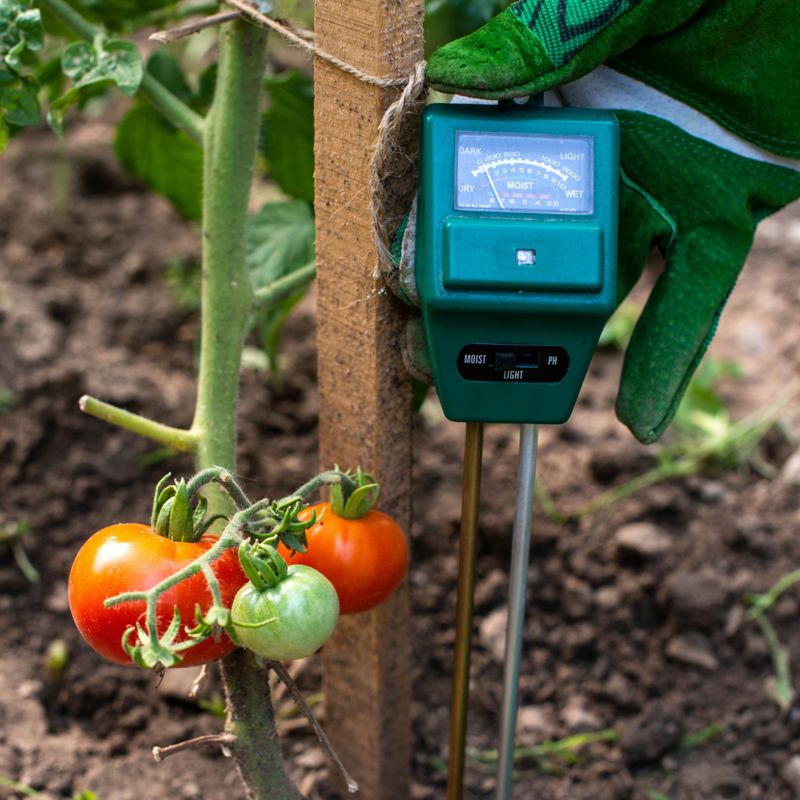
Stopping water entirely after a crack appears feels logical, but it usually makes the next swing worse. Letting the soil go bone dry again sets up the exact dry-to-wet surge that caused the problem in the first place. A better first step is to check what the soil is actually doing right now.
Push your finger or a wooden dowel about two inches below the surface near the root zone. Penn State’s tomato growing guide suggests watering when the soil feels dry at roughly that depth, rather than following a rigid calendar. The goal is consistently moist soil, not a predictable schedule. University of Minnesota Extension offers a general starting benchmark of about 1 to 1.5 inches of rain or irrigation per week for garden tomatoes, but that figure is a starting point only.
Many variables shift that number considerably. Containers and raised beds dry out much faster than in-ground plots, especially during a heat wave. Sandy soils drain quickly and may need more frequent, lighter applications, while heavy clay holds moisture longer but can become waterlogged if overwatered. Wind pulls moisture from both plants and soil faster than calm days, and Oregon State Extension’s tomato guide reinforces that extreme heat raises plant water demand beyond any standard recommendation.
Use the soil-check method as your actual guide, and adjust from there.
Mulch and soil-level watering smooth the next swing
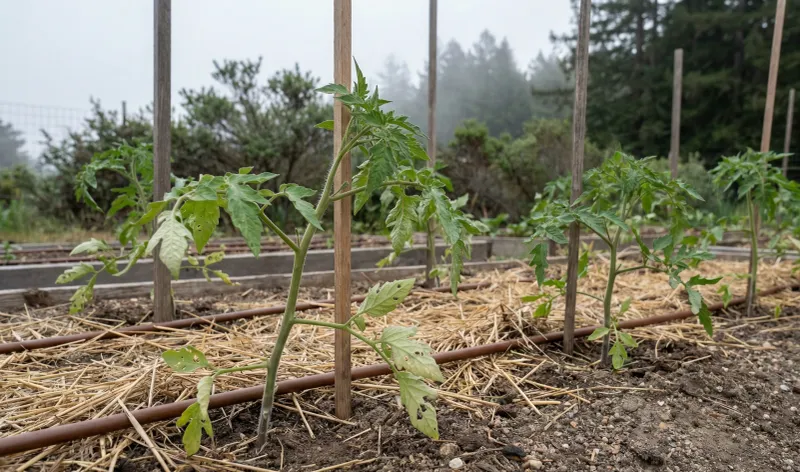
Once you have a sense of the soil’s current moisture, the next move is to build a routine that keeps that moisture from swinging wildly between waterings. Two adjustments work together to do that: where the water goes and what covers the soil between sessions.
Watering directly at the soil surface, rather than spraying the foliage and fruit overhead, delivers moisture more efficiently to the roots and avoids wetting the plant unnecessarily. Morning is the preferred time according to University of Minnesota Extension, because any moisture that does land on leaves has the full day to evaporate before cooler nighttime conditions settle in. Wet foliage that stays damp overnight creates conditions that favor fungal disease. Drip lines or soaker hoses offer a separate benefit: they can deliver water slowly and steadily to the root zone over a longer period, which reduces the surge effect more effectively than a quick overhead spray.
Colorado State Extension and Minnesota’s heat gardening guidance both recommend keeping water at ground level during hot spells.
Mulch handles the space between waterings. Applying 2 to 3 inches of straw or bark mulch, as recommended by Penn State Extension, slows evaporation and moderates how quickly the top layer of soil dries. Minnesota recommends up to 4 inches of organic mulch for tomatoes. Keep mulch pulled back a few inches from the main stem to allow airflow and prevent rot at the base.
These steps can reduce moisture fluctuations noticeably, though they do not guarantee crack-free fruit.
Heat and missing foliage leave ripening fruit more exposed
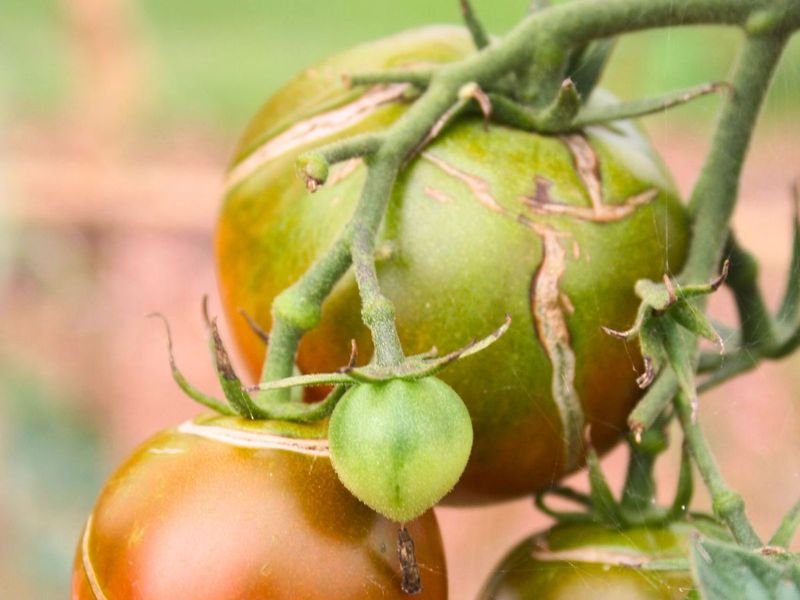
A dry-to-wet moisture swing is the usual starting point for cracking, but the same surge can cause far more damage when temperatures are high and the plant’s canopy has thinned out. Hot, sunny conditions accelerate how fast a nearly ripe tomato grows internally, and they also reduce the skin’s ability to flex. Fruit that is already deep red and close to fully ripe has less elastic skin than younger green fruit, which is why late-summer tomatoes crack more readily than those earlier in the season.
Healthy foliage plays a quieter protective role. Leaves shade the fruit from direct sun, which can keep surface temperatures lower and reduce the rate of skin tightening. Penn State Extension and UC ANR’s integrated pest management resource on fruit cracks both note that canopy loss from aggressive pruning, disease-related defoliation, or insect feeding strips away that buffer and leaves fruit more vulnerable. University of Minnesota Extension identifies heat stress and sunlight exposure as contributing factors in cracking risk.
Preserving the leaves you have is a practical, low-effort step at this point in the season. Removing diseased or badly damaged foliage still makes sense, but stripping healthy leaves in the name of airflow or tidiness can backfire. Keeping the canopy reasonably intact may lower cracking risk during the next heat wave, though it cannot prevent every split when moisture and temperature conditions are severe.
Earlier harvest can protect fruit that is already coloring
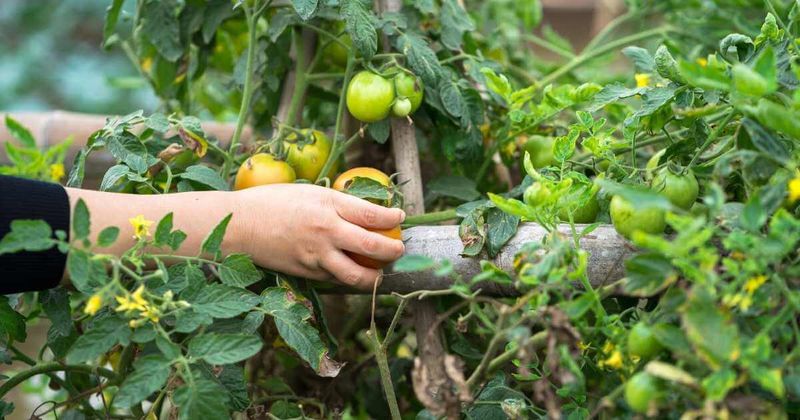
When cracking has already become a serious problem in your garden, picking fruit a bit earlier can save tomatoes that would otherwise split before you get to them. The window to act is as soon as a tomato begins to show its first blush of color change, often called the breaker stage, when the skin transitions from solid green to a mix of green, pink, or yellow depending on the variety.
Penn State Extension reports that harvesting at the breaker-to-pink stage rather than waiting for full vine ripeness can meaningfully reduce late-stage cracking. Tomatoes harvested at this point will continue ripening indoors at room temperature, out of direct sunlight. This is not a workaround for poor watering habits; it is a damage-reduction measure for a season already in progress.
Cultivar choice matters for future seasons. Large slicer types and many popular heirlooms tend to crack more readily because of their size and thinner skin. Minnesota Extension’s fruit crack resource notes that varieties differ substantially in cracking resistance, and K-State Extension’s 2025 tomato cracking report identifies Jet Star and several Mountain-series cultivars as comparatively crack-resistant in its regional evaluations. Those comparisons are not a guarantee, and variety performance varies by climate, soil, and season, so treat them as a starting point for next year’s seed selection rather than a definitive answer.
Not every blemish at the top is a moisture crack
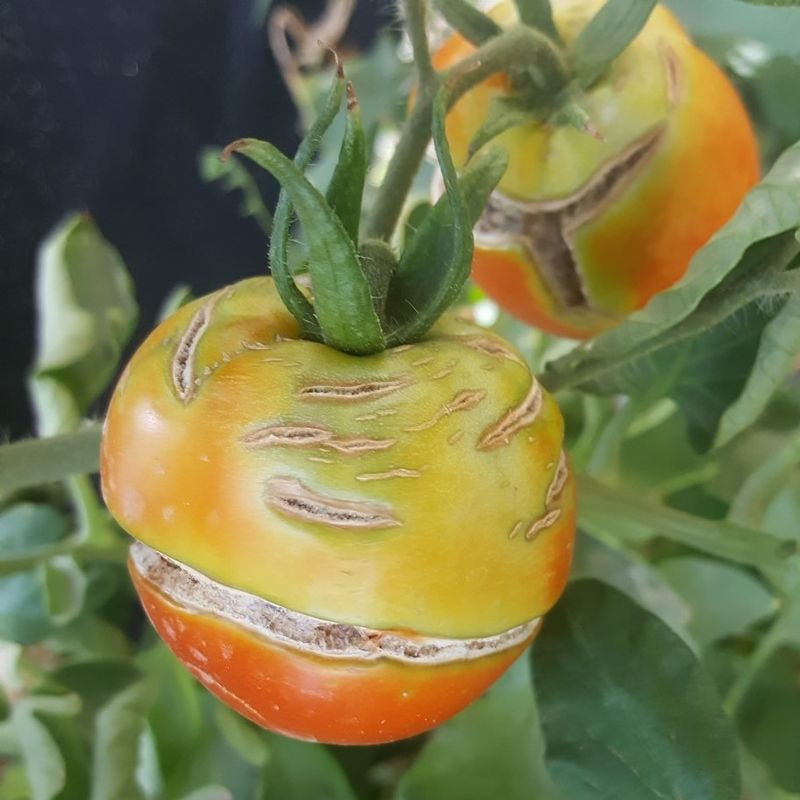
Before adjusting your entire watering routine, take a close look at where exactly the damage appears and what it looks like. Growth cracks follow a specific pattern: radial lines extending outward from the stem scar, or concentric rings circling that same area. Those locations and shapes are reliable clues that a moisture surge was involved.
Fine surface cracking or a rough, russeted texture that covers a broader area of the fruit is more likely rain check, sometimes called cuticle cracking or crazing. Penn State’s blossom-end rot and rain check guide notes that rain check has less certain causes and should not automatically be blamed on one watering mistake. Changing your irrigation habits may not reduce it the same way it can reduce growth cracks.
Blossom-end rot looks entirely different. It produces a sunken, leathery tan, brown, or black lesion on the bottom of the fruit, the blossom end, not the stem end. University of Minnesota Extension explains that blossom-end rot involves disrupted calcium movement within the developing fruit and is a separate physiological disorder from growth cracking. Calcium sprays, eggshells, and Epsom salts are sometimes suggested for blossom-end rot but are not a routine treatment for growth cracks.
Other look-alikes include sunscald, which produces pale, papery, or bleached patches on sun-facing sides of fruit; insect feeding punctures, which tend to be small, irregular, and scattered; and disease lesions, which often show discolored margins, sunken centers, or associated mold. Colorado State Extension’s pest and problem identification resource can help distinguish those. Growth cracking itself is a physiological disorder, not an infection, but open cracks can invite fungi, bacteria, and opportunistic insects that cause secondary decay, so prompt harvesting still matters once a crack appears.
Handle cracked tomatoes as damaged fresh produce
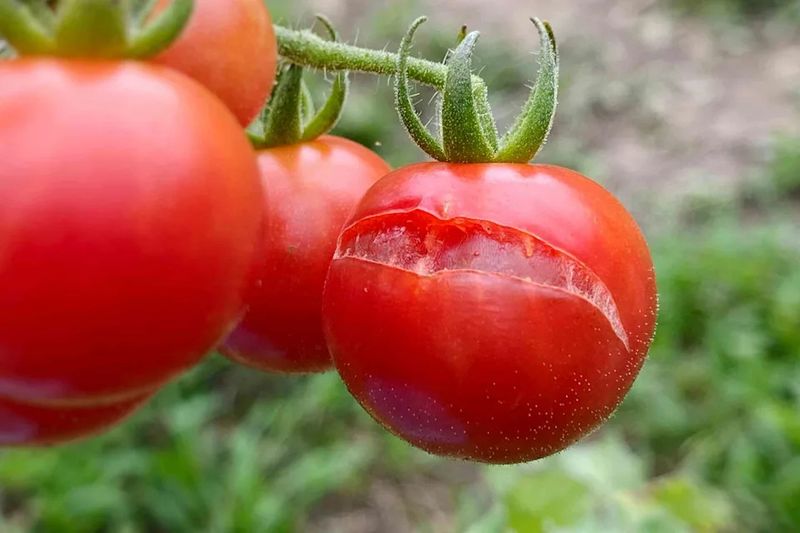
A tomato with a fresh, shallow crack and firm flesh is not automatically ruined, but it does need to be handled more carefully than an intact one. Open cracks expose the interior to soil, insects, and airborne microorganisms, so the window between splitting and spoiling is shorter than it would be for an undamaged fruit.
Harvest cracked tomatoes promptly rather than leaving them on the vine to finish ripening. USDA FSIS guidance on washing fresh produce recommends rinsing under cool running water before eating, without soap or produce washes, and USDA FNS produce safety best practices support cutting away visibly damaged tissue before serving. For a cracked tomato, that means trimming generously around the split and any discolored or soft tissue nearby, then using the remaining firm flesh promptly.
Some cracked tomatoes should not be eaten at all. Discard any fruit that is soft throughout, leaking juice, visibly moldy, badly decayed, punctured by insects or animals, or otherwise questionable. Do not attempt to salvage and home-can damaged or overripe cracked tomatoes. University of Minnesota Extension’s tomato canning guidance cautions that damaged or overripe fruit can compromise the acidity and safety of home-canned products.
When in doubt, composting a cracked tomato is a better outcome than a food safety risk.
Consistency, not a bigger watering blast, is the lasting fix
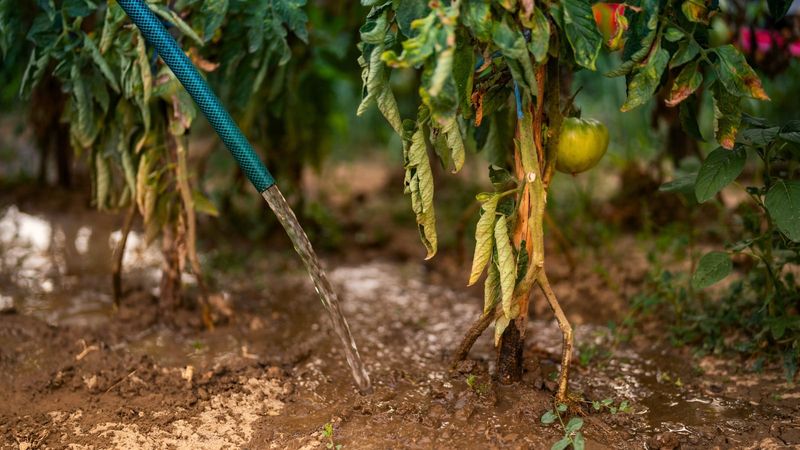
The core correction is straightforward: a dry-to-heavy-wet cycle is usually what triggers growth cracking, so the fix is to keep that cycle from repeating. Check the soil regularly, restore moisture when the top two inches dry out, and do it gradually enough that you are not sending a sudden surge into fruit that has been sitting in dry ground.
Penn State Extension and University of Minnesota Extension both point toward consistency as the practical goal. Mulch, soil-level irrigation, healthy foliage, and earlier harvesting of coloring fruit all support that goal in different ways. Weather, ripeness, cultivar genetics, canopy condition, and direct rain still influence the outcome, so these steps can reduce new cracking but cannot erase splits that have already formed or promise a perfect harvest. A garden that cracks less than last week is real progress.