
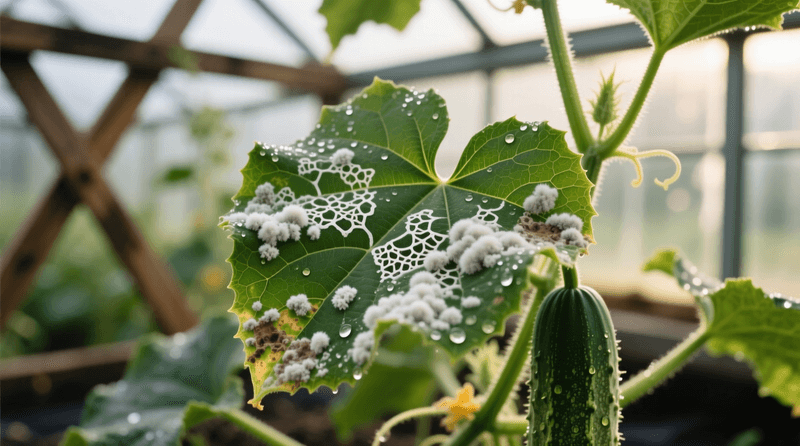
White powder creeping across your squash leaves is one of the most frustrating sights in a late-summer garden. That fuzzy coating is almost certainly powdery mildew, a fungal disease that loves the warm, humid conditions that August and September bring to most of the US. Many gardeners blame their watering routine first, and while switching to smarter watering is genuinely worth doing, the full picture is a little more complicated. Understanding what actually drives this disease will help you protect your plants and still bring in a good harvest.
Confirm that the white pattern is powdery mildew
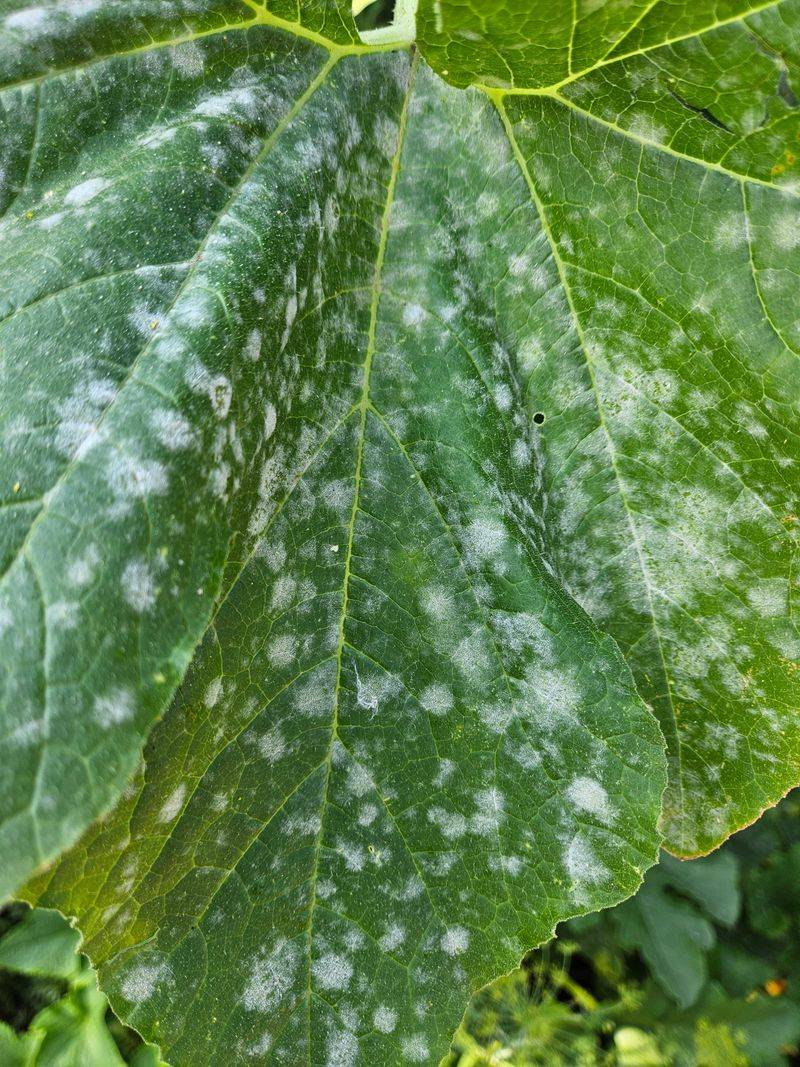
Before adjusting your watering schedule or reaching for a spray bottle, take a close look at what is actually on those leaves. Powdery mildew on squash and other cucurbits shows up as white-to-gray, talcum-like patches that look almost as if someone dusted the leaf with flour. UC IPM’s cucurbit powdery mildew guide describes these patches as appearing first on older, shaded, or lower leaves, then spreading as spores move through the garden.
Pay attention to whether the patches are expanding and irregular. Some squash and zucchini varieties naturally have pale or silvery markings built into their genetics, and those consistent patterns look nothing like the spreading, smudgy colonies that powdery mildew produces. If the white areas are growing larger over days and feel powdery when you rub them gently, you are almost certainly dealing with the disease rather than a harmless leaf pattern.
Powdery mildew is also not the same thing as downy mildew, and the difference matters for how you respond. Penn State Extension’s guide to mildew in the home garden explains that downy mildew more often causes angular yellow or brown lesions on the upper leaf surface, with gray, brown, or purplish fuzzy growth underneath. Flip a suspicious leaf over and check both sides before deciding what you are dealing with, because accurate identification should always come before any treatment decision.
Treat evening overhead watering as a habit to replace, not the usual cause
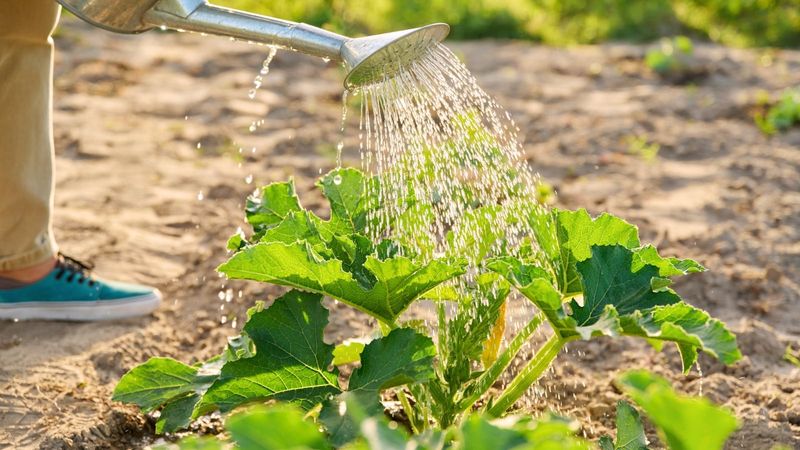
Many gardeners hear that evening watering causes powdery mildew and assume the fix is simply to stop running the sprinkler after dinner. The connection is worth taking seriously, but it is not quite that straightforward. UC IPM notes that cucurbit powdery mildew can germinate and infect without any free water on the leaf surface at all, which sets it apart from many other plant diseases. High relative humidity, moderate temperatures, shade, and dense foliage are more central to infection than whether the leaves got wet from a sprinkler.
That said, evening overhead watering is still worth replacing as a routine habit. Wetting the foliage and adding moisture to an already crowded canopy late in the day can push conditions in a direction that favors disease, and the practice is especially relevant for other leaf diseases whose pathogens actually do require liquid water to spread. Minnesota Extension’s cucurbit disease page points to canopy humidity, plant density, and airflow as key influences on powdery-mildew pressure.
The honest framing is this: evening overhead watering is an avoidable contributor to a favorable disease environment, not something that reliably triggers mildew on its own. Switching to soil-level watering makes sense as a precaution, and it is a change worth making regardless of whether mildew is already present. Penn State Extension recommends replacing overhead irrigation with drip or soaker methods specifically because keeping foliage drier addresses multiple disease risks at once.
Deliver water to the root zone
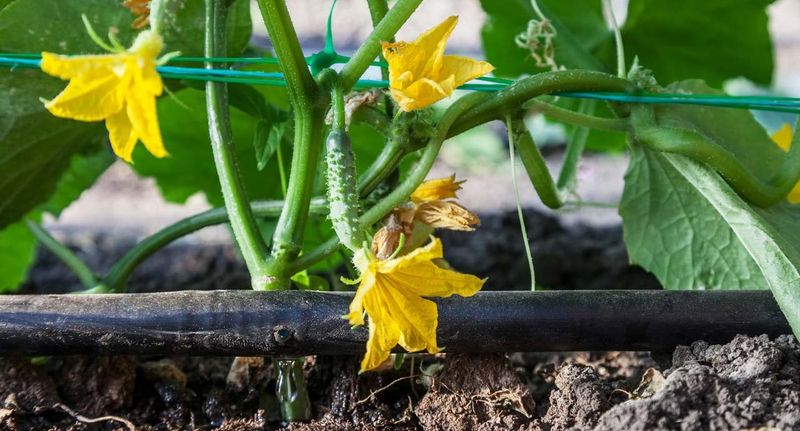
The most practical adjustment you can make right now is also the simplest: stop watering the leaves and start watering the ground. Drip irrigation, a soaker hose laid along the row, or careful hand-watering aimed at the soil line all deliver moisture directly to the root zone where the plant can actually use it. University of Minnesota Extension’s squash growing guide recommends roughly one inch of water per week from rainfall or irrigation as a general starting point during the growing season.
That one-inch figure is a guideline, not a rule. Sandy soils drain quickly and may need more frequent, lighter watering, while heavier clay soils hold moisture longer. A stretch of hot, dry weather increases demand, and a rainy week may mean you skip irrigation entirely. Stick your finger two to three inches into the soil near the plant; if it feels dry at that depth, it is time to water.
One caution worth stating plainly: do not withhold water from a thirsty squash plant just to keep its leaves dry. A stressed, drought-weakened plant is in no better position to fight off disease than a well-watered one, and squash in active fruit production needs consistent soil moisture to produce well. The goal is to supply water at the root zone efficiently, not to keep the plant artificially dry. Penn State Extension echoes this approach, recommending soil-level irrigation as the preferred method for managing disease risk without compromising plant health.
Use morning timing when overhead watering is unavoidable

Not every backyard gardener has a drip system, and not every garden layout makes soil-level watering easy. If overhead watering is your only realistic option, timing matters more than the method itself. Watering early in the morning gives foliage and the surrounding canopy several hours of warmth and airflow to dry out before nightfall, reducing the period when moisture lingers in a dense planting.
Evening watering, by contrast, leaves the canopy humid through the cooler overnight hours when evaporation slows down. That prolonged dampness is more relevant to diseases that require liquid water on the leaf – things like bacterial leaf spot or downy mildew – but it is still an avoidable condition worth skipping when you can. Penn State Extension’s powdery mildew resource notes that daytime leaf wetting has actually been discussed as potentially suppressive for some powdery mildews, while also cautioning that it can encourage other diseases whose pathogens need free water. That nuance means you should not take leaf wetting as either a guaranteed cure or a guaranteed harm for every disease at once.
For a backyard squash garden, the simplest and most reliable default remains soil-level watering regardless of the time of day. Morning irrigation is the practical second choice when overhead is unavoidable, and Penn State’s home garden mildew guide specifically recommends early-morning irrigation over evening irrigation as a disease-management precaution. The goal in either case is to give your plants what they need while leaving the canopy as dry as conditions allow.
Improve airflow inside the canopy
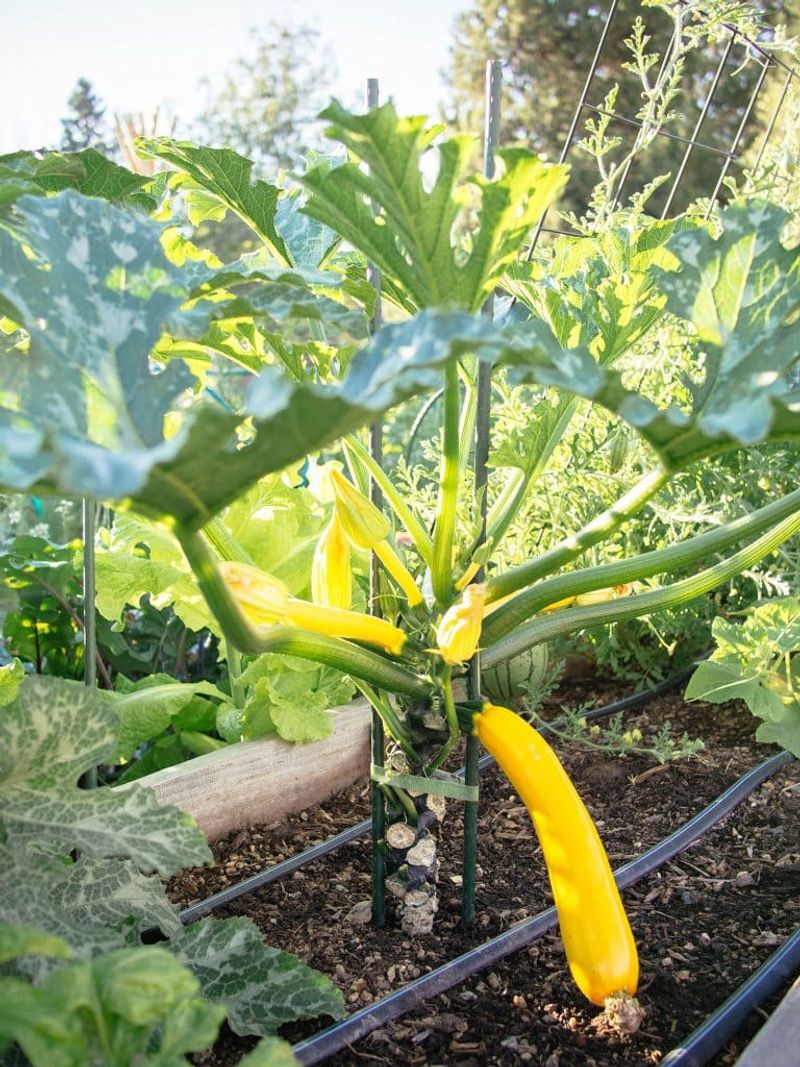
Watering habits are only one piece of the environment that powdery mildew prefers. A dense, crowded squash planting traps warm, still air inside the canopy, and that pocket of humidity is where mildew thrives regardless of how carefully you water. Giving plants enough room to breathe is one of the most effective structural changes you can make, and it starts at planting time.
Most summer squash varieties perform best when spaced roughly 18 to 36 inches apart in rows set three to four feet apart, though you should follow the guidance on your specific seed packet or transplant tag. Minnesota Extension’s squash growing guide recommends proper spacing as a foundation of healthy cucurbit culture, and that spacing directly affects how well air moves through the planting. Weeds growing up through and around squash add another layer of obstruction, so keeping the bed clear improves airflow as well as reducing competition for water and nutrients.
For vining types, trellising is worth considering when your garden space allows it. Training vines upward opens the center of the planting to more air movement and light, and it makes scouting for early disease symptoms much easier. Reducing unnecessary shade from nearby structures or taller plants also helps. Minnesota Extension’s cucurbit disease page describes airflow as an important influence on humidity within a dense canopy, though it works alongside appropriate watering, cultivar choice, and site conditions rather than replacing any of them.
Scout early and remove diseased foliage selectively
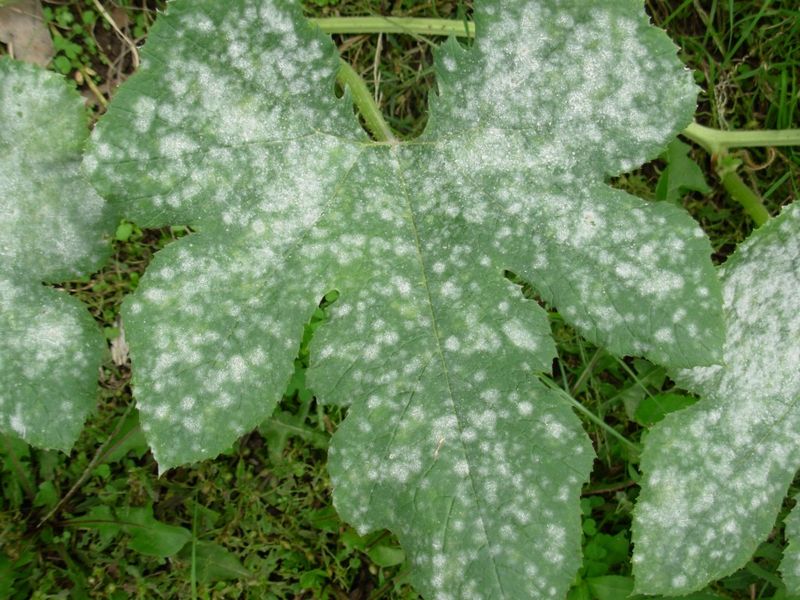
Catching powdery mildew early gives you more options than trying to manage it after it has spread across most of the plant. Set aside a few minutes each week to walk through the squash bed and check older leaves, lower foliage, and any growth tucked into the shaded interior of the plant. Those spots tend to show symptoms first because they receive less light and less air movement than the outer canopy.
When you find a leaf that is heavily covered in white growth, removing it can help slow the spread of spores to neighboring foliage. Minnesota Extension advises beginning action when disease is first detected, because chemical control and sanitation both work better on early infections than on leaves that are already completely covered. Remove affected leaves by cutting cleanly at the stem rather than tearing, and place them directly into a bag rather than dropping them on the soil.
The key word in all of this is selectively. Stripping a squash plant of most of its leaves in an effort to eliminate every trace of mildew causes more harm than the disease itself at that stage. Healthy foliage is what drives photosynthesis and keeps developing fruit shaded from sunscald, so preserve as much sound leaf area as you can while removing the worst-affected growth. After the season ends, Colorado State University Extension recommends removing all diseased plant debris rather than leaving it in the garden, and cautions that a typical backyard compost pile may not reach temperatures high enough to reliably destroy the pathogen.
Bag the debris and dispose of it with household waste instead.
Choose resistant varieties and label-approved treatments carefully
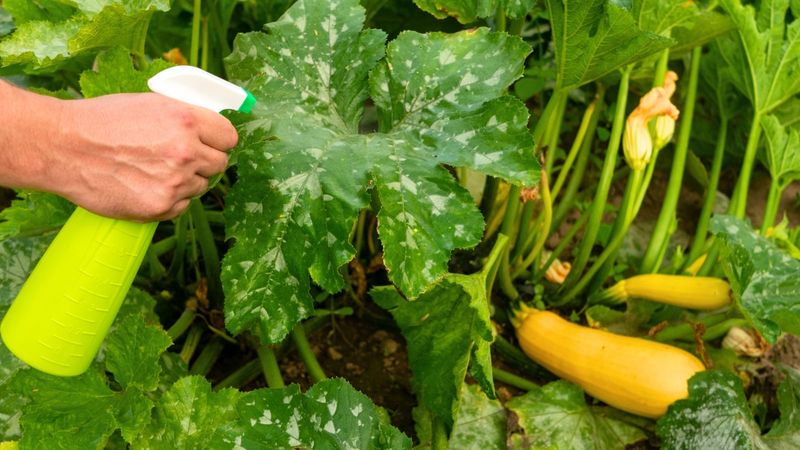
Starting with varieties that carry some resistance to powdery mildew is one of the most low-effort preventive steps available to a backyard grower. Many modern squash, zucchini, cucumber, and pumpkin varieties have been bred with partial resistance, and seed catalogs or packet labels often note this. UC IPM notes that resistant varieties can reduce disease severity, though resistance is not always complete or permanent against every race of the pathogen. Think of resistant varieties as reducing your risk rather than eliminating it.
When disease pressure warrants a treatment, fungicides work best when applied preventively or at the very first sign of visible symptoms, before the infection becomes widespread. Minnesota Extension’s cucurbit mildew guidance states that chemical control becomes far less effective once leaves are already heavily covered. Any product you choose must be registered and labeled specifically for use on the edible crop you are growing, and the label is a legal document that governs application rate, pre-harvest interval, temperature restrictions, and required protective equipment. Read it in full before mixing or applying anything.
A few common options deserve specific caution. Homemade baking-soda-and-oil sprays appear in many online guides, but Colorado State University Extension describes homemade formulations as experimental and notes they can burn foliage. Sulfur-based products and horticultural oils both carry temperature restrictions, and Utah State University Extension materials warn that applying sulfur in hot conditions or mixing sulfur and oil too close together can cause phytotoxicity. The product label sets the temperature limits and mixing rules that apply to that specific formulation, so there is no substitute for reading it carefully before late-summer applications.
Use the watering change as one part of a larger plan
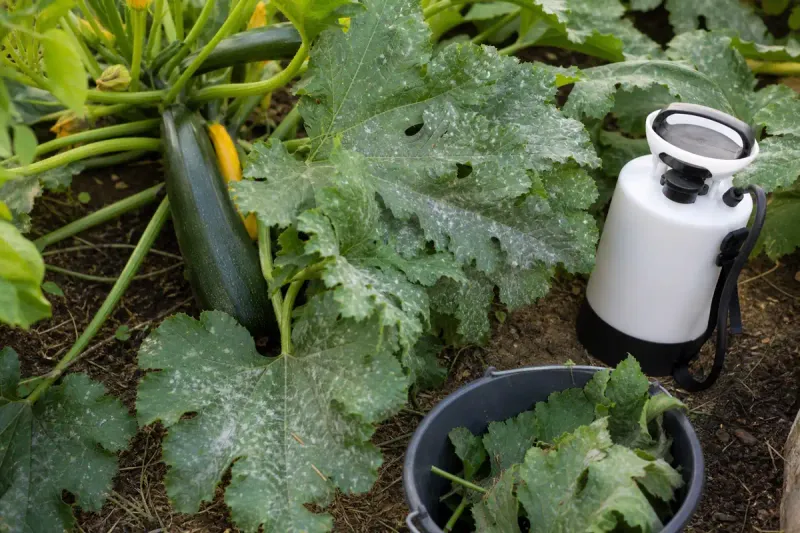
Switching from routine evening overhead watering to root-zone irrigation is a sensible step that avoids unnecessary foliage wetting and may reduce humidity trapped in a crowded canopy. It is worth doing, and it is worth doing now if you have not already. What it will not do on its own is prevent or eliminate powdery mildew, because this disease does not need wet leaves to infect, and its direct relationship to evening irrigation in squash remains uncertain.
The practical sequence that gives you the best chance of protecting your plants is straightforward. Confirm the symptom, water the soil rather than the foliage, keep the canopy open through proper spacing and weed control, inspect plants at least once a week, remove heavily infected leaves selectively while preserving healthy foliage, and use only labeled treatments when disease pressure makes them worthwhile. Minnesota Extension notes that powdery mildew can reduce photosynthesis and affect fruit number and size, but it does not automatically end the season for every plant it touches.
A squash plant with a manageable mildew infection and good cultural support can still produce fruit worth harvesting. The disease is common, the steps to address it are practical, and catching it early makes every response more effective.