
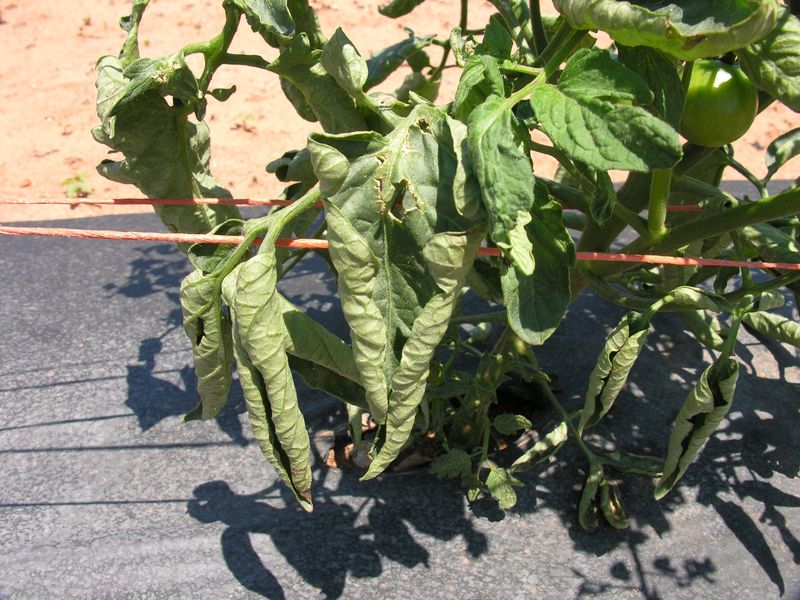
Watching your tomato plant curl its leaves into tight green tubes on a scorching afternoon is enough to make any gardener’s stomach drop. The good news is that this symptom is often a harmless stress response called physiological leaf roll, not an automatic sign of disease. But it can also be a clue worth investigating, because a few other problems look almost identical. Knowing what to check and what to watch for can save you from panicking over a healthy plant or missing a real issue.
Tight green tubes often indicate physiological leaf roll
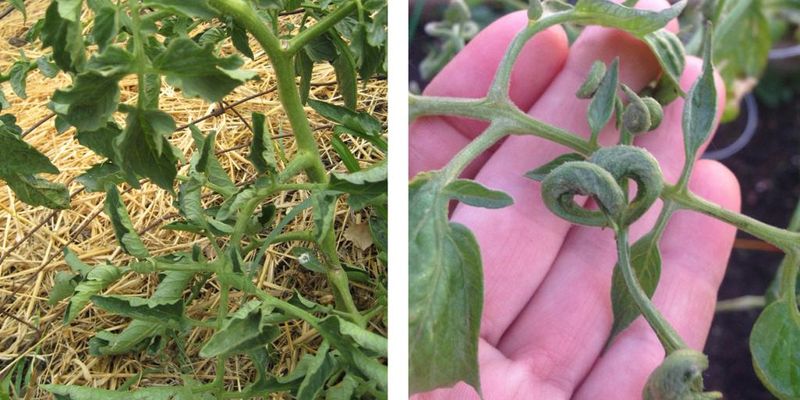
When tomato leaf margins roll upward and inward until they touch or overlap, sometimes forming a near-perfect tube, that pattern has a name: physiological leaf roll. University of Minnesota Extension guidance on tomato disorders describes it as a noninfectious condition – meaning no pathogen is causing it – and notes that older, lower leaves tend to show the symptom first. The rolled leaves typically stay green, firm, and leathery rather than turning yellow or becoming soft and limp.
What makes this pattern recognizable is the texture. A leaf caught in physiological roll feels almost waxy and stiff when you press it, unlike a leaf that has collapsed from disease or root failure. UC IPM’s overview of physiological leaf roll in vegetables confirms that the condition is generally noninfectious and that plants can continue growing and producing fruit without a noticeable reduction in yield or quality.
That last point matters a great deal. Tight curling alone does not mean the plant is diseased, and it does not justify removing the plant or reaching for a pesticide. Washington State University Extension’s fact sheet on physiological leaf roll of tomato makes clear that this condition is widely recognized and generally does not require treatment. Seeing rolled leaves is a signal to look more carefully, not to assume the worst.
Heat and water demand can trigger the response
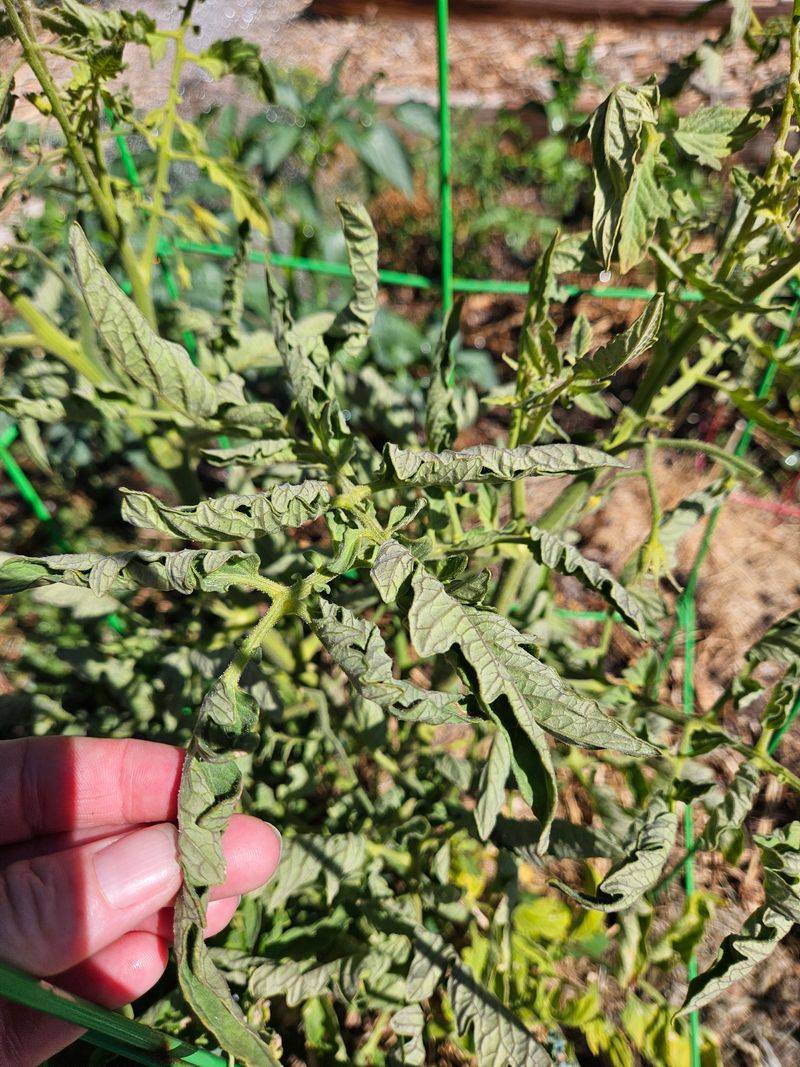
Hot weather raises the rate at which a tomato plant loses water through its leaves, and when that demand outpaces what the roots can deliver, the plant may respond by rolling its leaves inward to reduce the exposed surface area. Oregon State University Extension’s heat-wave garden guide explains that high temperatures can push plants into visible stress responses even when soil moisture appears reasonable, because the rate of water loss through leaves can exceed what roots supply during peak heat.
Several other conditions can contribute alongside or instead of heat alone. Dry soil, inconsistent watering, strong drying winds, root limitations from a container or compacted soil, root injury from cultivation or pests, rapid vegetative growth, and heavy pruning are all associated with the symptom, according to WSU Extension’s physiological leaf roll fact sheet. Some cultivars are simply more prone to rolling than others.
Rolling can show up even when the soil feels adequately moist, because the problem may reflect the plant’s current demand rather than a straightforward shortage of water in the ground. The visible rolling may reflect stress that built up over several days or during an earlier period of heat or drought – but there is no universal timeline that applies to every plant or every garden. What matters is understanding the range of possible contributors so you can check each one rather than assuming a single hidden cause explains what you are seeing.
Green fruit offers reassurance but no guarantee
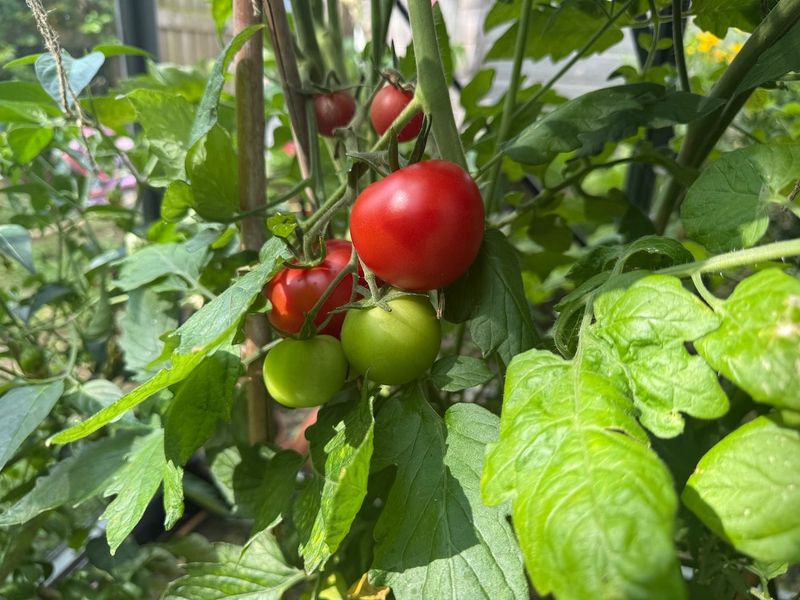
A plant loaded with green fruit feels reassuring when the leaves are rolling. That reassurance has some real basis: UC IPM’s physiological leaf roll resource and University of Minnesota Extension both note that classic physiological leaf roll generally does not noticeably reduce plant growth, fruit yield, or fruit quality. A plant rolling its leaves in summer heat can still carry a full load of tomatoes to a normal harvest.
The qualification, though, is worth understanding. Fruit may have set and begun developing before a viral disease or chemical injury became apparent on the plant. University of Minnesota Extension’s tomato virus guide notes that future flowering, fruit set, growth, and fruit quality can still be affected even when existing fruit looks normal. Green tomatoes already on the plant are not proof that everything is fine going forward.
The more useful thing to watch is what the plant does next. New flowers opening, new fruit setting, new leaves emerging normally, and overall vigor holding steady are better indicators of plant health than counting the green tomatoes already hanging on the vine. UC IPM’s tomato yellow leaf curl resource notes that infections occurring earlier in the season can sharply reduce production, while fruit already set before infection may continue to develop. Treat existing green fruit as one encouraging data point, not as a final verdict on plant health.
New growth exposes the warning signs
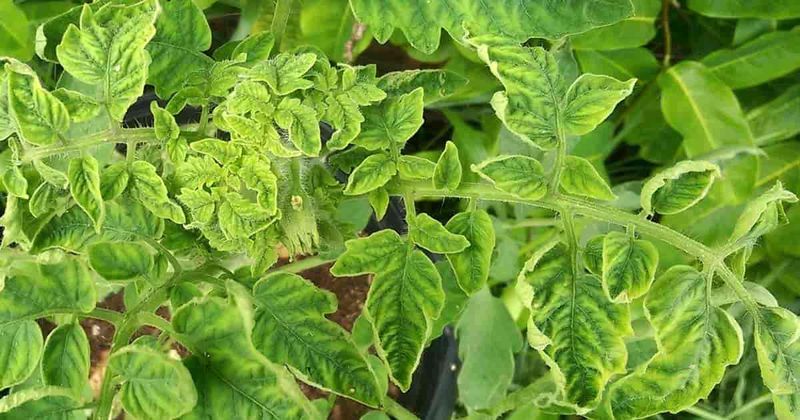
The clearest place to look when you suspect something more serious than heat stress is the newest growth at the top of the plant. Classic physiological leaf roll stays on older, lower leaves and leaves new growth looking normal. When the newest leaves are also stunted, crinkled, distorted, or discolored, that combination raises concern. University of Minnesota Extension’s tomato virus guide lists symptoms that push a diagnosis toward viral disease: stunting, shortened internodes, yellowing, mottling, severe crinkling, purple veins, necrotic spots, flower drop, premature fruit ripening, and a sharp drop in new fruit production.
Two viruses come up often in home-garden conversations, and both have regional and biological specifics worth knowing. Tomato yellow leaf curl virus produces small, strongly crumpled leaves that curl upward, yellowing along leaf margins and between veins, shortened internodes, stunting, and sharply reduced fruit production. UC IPM’s tomato yellow leaf curl page explains that it is transmitted by whiteflies and is particularly associated with susceptible regions where those vectors are established.
Curly top virus is a more relevant concern in parts of the western United States. It commonly causes thick or brittle upward-curled leaves, yellowing, purple veins on the undersides of leaves, stunting, premature fruit ripening, and poor or absent new fruit production. Utah State University Extension’s curly top page and USU’s curly top of tomato research summary note that it is transmitted by the beet leafhopper. Even with those patterns in mind, visual inspection alone cannot reliably name a particular virus, because symptoms overlap significantly across different pathogens and other disorders.
Chemical injury and insects can mimic disease
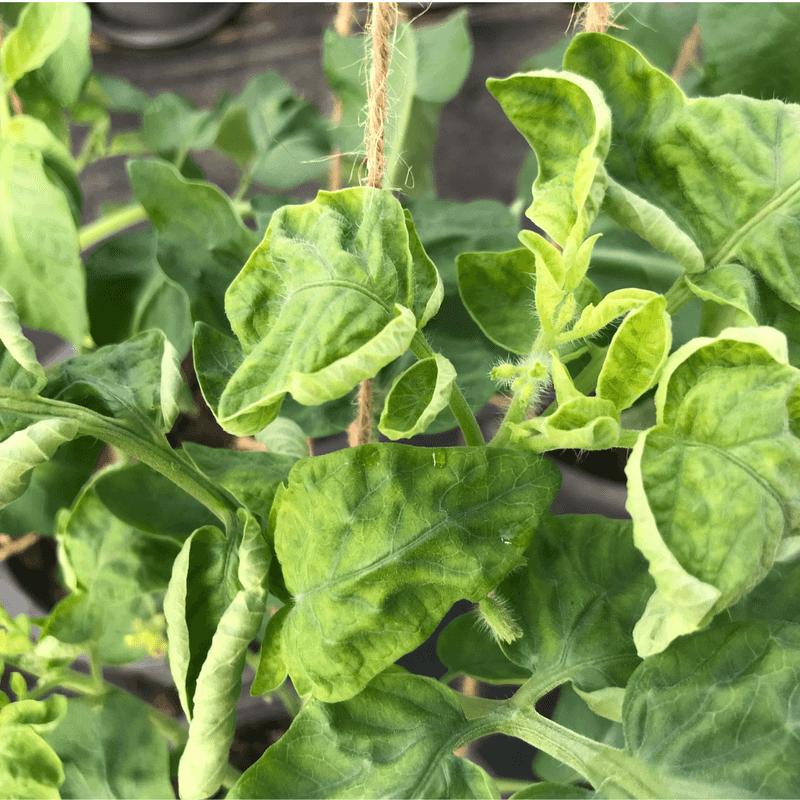
Before concluding that a virus is responsible for distorted or curled tomato leaves, two other possibilities deserve a close look: herbicide injury and insect feeding. Both can produce symptoms that closely resemble viral disease, and both have specific clues that help distinguish them from an infection. University of Maryland Extension’s herbicide damage resource describes how drift from nearby lawn or agricultural herbicide applications, contaminated equipment, or grass clippings from a lawn treated with an unsuitable product can cause narrow, twisted, cupped, strappy, or undersized new leaves on vegetable plants.
A useful clue for herbicide injury is the pattern across your garden. When several plant species show similar distortion – particularly on their newest growth or on the side of the plant facing a recently treated lawn or field edge – chemical exposure becomes a more likely explanation than a virus. University of Minnesota Extension’s guide to herbicide injury in garden plants notes that symptoms often concentrate on new growth and may affect multiple unrelated plant species in the same area.
Insects add another layer to consider. Aphids feeding on young growth can cause curling, distortion, yellowing, stunting, and wilting, especially on tender new tissue. Whiteflies can cause yellowing and curling through their feeding and are also capable of transmitting certain viruses. University of Minnesota Extension’s tomato leaf curl diagnostic tool includes both pests as possible contributors.
Finding aphids or whiteflies on a curled leaf is a reason to manage those pests – but their presence does not prove that a virus is what caused the symptom you are seeing.
Inspect the whole plant before changing its care
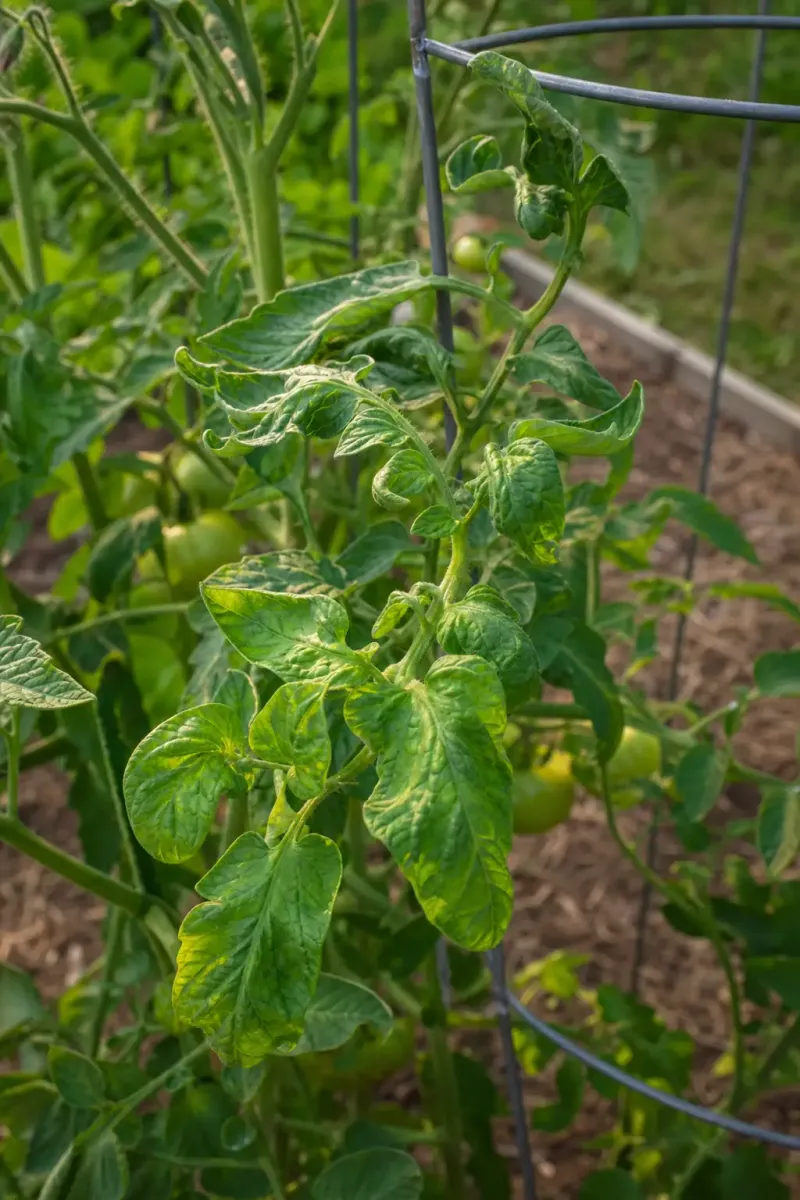
A systematic look at the whole plant takes only a few minutes and gives you far more useful information than a quick glance at the most dramatic leaves. Start at the bottom. Older lower leaves rolling upward while remaining green and leathery fit the classic physiological leaf roll pattern. Then move to the newest growth at the top of the plant and compare: if those leaves are emerging normally and look healthy, that is an encouraging sign.
If new growth is stunted, crinkled, discolored, or distorted, make note of it. University of Minnesota Extension’s tomato leaf curl diagnostic tool walks through this comparison as a key step in narrowing down the cause.
Next, check the fruit. Look for rings, blotches, premature color change, unusual softness, deformation, or internal discoloration when you cut one open. Fruit abnormalities alongside leaf symptoms increase the likelihood that something beyond ordinary stress is involved. Then flip some leaves over and look carefully for aphids, whiteflies, or thrips – tiny insects that can cause curling directly or transmit disease.
University of Minnesota Extension’s tomato virus guide recommends checking for insect vectors as part of any symptom investigation.
Finally, think about the area around your garden. Ask whether any lawn herbicide, weed killer, or broadleaf treatment was applied nearby within the past few weeks. Check whether other plant species in the same bed or along the same edge show similar distortion. University of Maryland Extension’s herbicide damage guidance notes that multi-species symptoms concentrated near a treated boundary are a strong clue pointing toward chemical exposure rather than a pathogen.
This inspection process can surface important clues, but it cannot confirm a virus on its own.
Correct moisture stress without drowning the roots
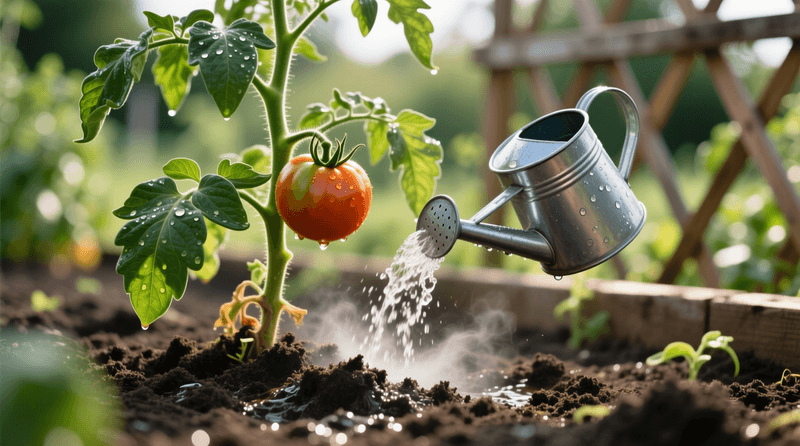
When your inspection points toward physiological leaf roll rather than disease, the most useful thing you can do is address the conditions that may have contributed. Start by checking soil moisture at root depth – not just the surface. Push a finger or a thin trowel several inches into the soil near the base of the plant. Surface soil can dry out quickly in heat while the root zone below still holds adequate moisture, or the reverse can be true after a light rain that barely penetrated.
University of Minnesota Extension’s guide to growing tomatoes recommends watering deeply and consistently at the root zone rather than giving frequent shallow sips, which can encourage shallow root development and leave plants more vulnerable during heat.
When the soil at root depth is dry, water thoroughly so the moisture reaches the full root zone. University of Minnesota Extension’s hot-weather gardening guide and Oregon State University Extension’s heat-stress plant guide both recommend soil-surface irrigation rather than overhead watering, because prolonged leaf wetness can increase the risk of foliar disease. Avoid spraying foliage with water in an attempt to cool the plant.
Mulch spread over the root zone helps retain moisture and moderates soil temperature during heat waves – a practical step that reduces stress without requiring repeated intervention. University of Minnesota Extension’s heat gardening tips support mulching as a reliable buffer against both heat and moisture fluctuation. Avoid heavy pruning during hot or dry weather, and resist the urge to push the plant with large nitrogen applications. WSU Extension’s physiological leaf roll fact sheet associates both heavy pruning and rapid fertilizer-driven growth with increased rolling.
Saturated soil, meanwhile, can damage roots and create new problems – water based on what the soil actually needs, not on whether the leaves are still rolled. Old rolled leaves may not straighten even after conditions improve; evaluate recovery through new growth, not by watching whether existing leaves unfurl.
Monitor new growth and escalate suspected disease
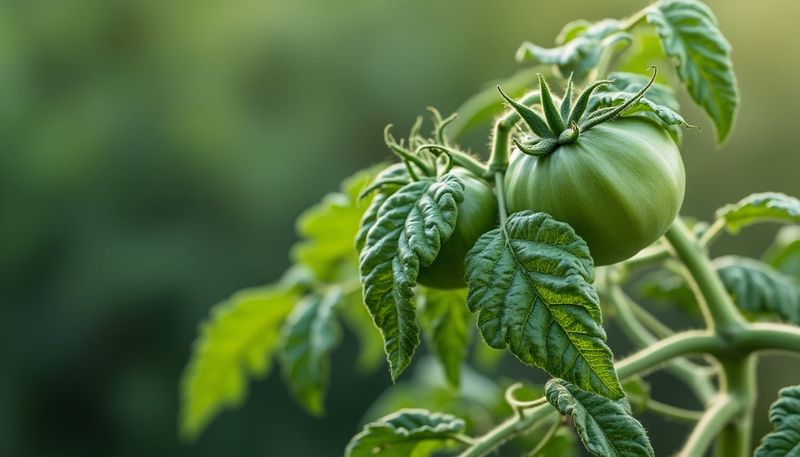
Older leaves that have already rolled are not the most informative thing to watch going forward. New leaves emerging at the top of the plant, new flowers opening, fruit setting on those new flowers, and the overall growth rate of the plant will tell you far more about where things are heading. University of Minnesota Extension’s tomato disorders guide notes that a plant with classic physiological leaf roll can continue growing and fruiting normally – so if new growth looks healthy and production continues, the older rolled leaves are not a crisis that demands immediate action.
The threshold for escalating concern is when new growth joins the problem. Stunted new leaves, severe distortion, spreading yellowing or mottling, flower drop, or a noticeable drop in fruit set are all reasons to look more carefully and consider reaching out for expert help. University of Maryland Extension’s guide to key tomato problems provides a useful reference for distinguishing common disorders. Local Cooperative Extension offices and plant diagnostic labs can test samples when symptoms strongly suggest a viral infection, because visual inspection alone cannot reliably name a virus and symptoms overlap with herbicide injury and other disorders.
Tomato viruses have no curative pesticide treatment. University of Minnesota Extension’s tomato virus management guidance and UC IPM’s tomato yellow leaf curl resource both explain that management focuses on prevention, sanitation, vector management where appropriate, resistant varieties when available, and removal of plants confirmed to be infected. Removing a plant showing only classic green, leathery rolling is not warranted – but a plant confirmed or strongly suspected to carry a virus is a different situation, and your local Extension service can help you make that call. A tomato that keeps putting out healthy new leaves and setting new fruit is usually telling you everything you need to know.