
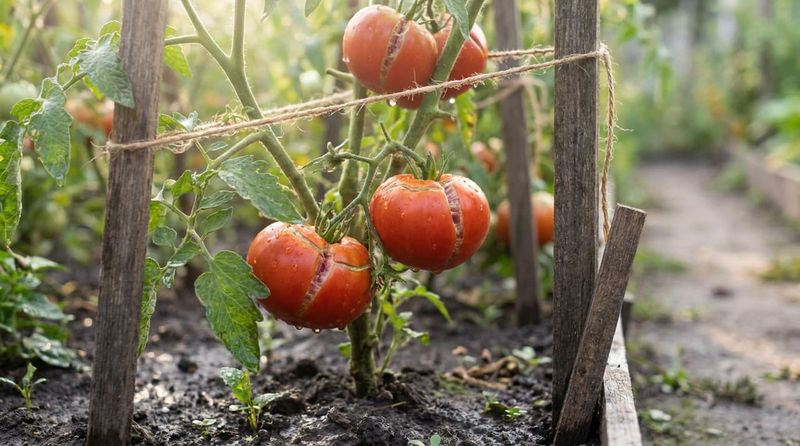
Walking out to your garden and finding a perfectly ripening tomato split open is one of the most discouraging moments of the summer growing season. The crack usually shows up right when you were about to pick that beautiful fruit, and it can feel like something went seriously wrong. Most gardeners assume they overwatered, but the real story is more nuanced and, honestly, easier to work with once you understand it.
If the crack runs from the stem, a moisture swing may be involved
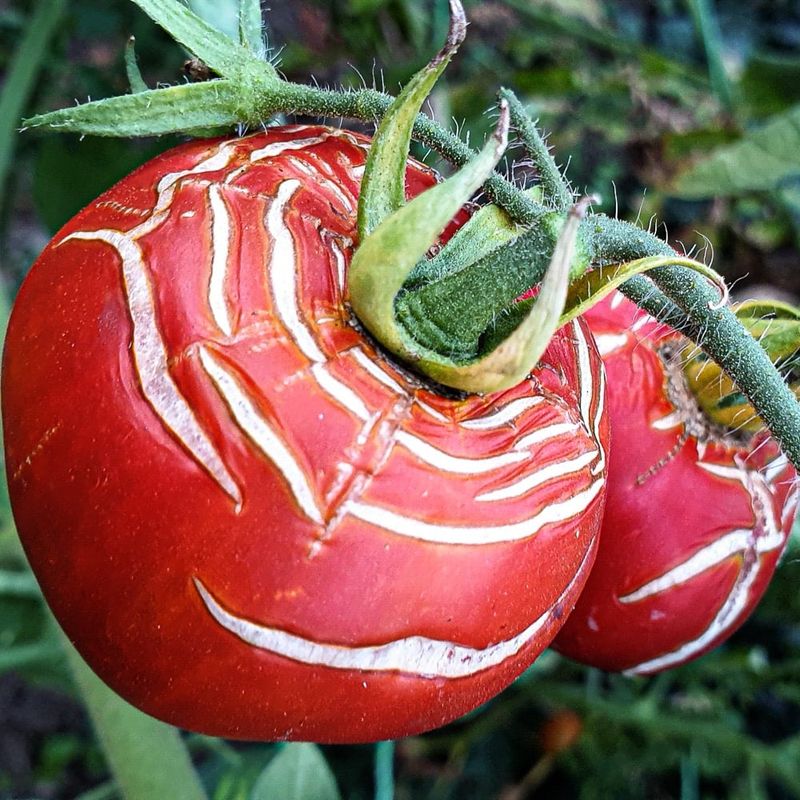
Not every split tomato has the same story behind it, so the first step is checking what kind of crack you are actually looking at. Characteristic growth cracks fall into two recognizable patterns: radial splits that extend outward from the stem end, running down the shoulders of the fruit, and concentric cracks that circle the shoulders like rings. Both patterns are closely associated with moisture fluctuations rather than with any single gardening mistake.
The trigger is typically a substantial swing from drier soil to abundant water, whether that water comes from a heavy rain or from irrigation. University of Minnesota Extension guidance on tomato fruit cracks explains that this rapid change in water availability can cause fruit to expand faster than its skin can keep up with. Importantly, that pattern can happen after a summer thunderstorm even when you have been watering carefully, so the cracks do not automatically point to something you did wrong.
Another thing worth knowing: cracking can start while a tomato is still green. Seeing the split appear as the fruit turns red does not mean that ripening caused the damage. The crack likely began during an earlier growth stage when conditions shifted, and it simply became visible as the skin stretched further during coloring. The corrected takeaway here is that inconsistent moisture availability is a common contributor to these specific crack patterns, not a single universally blameworthy watering habit.
Why dry-to-wet changes can outpace the tomato skin
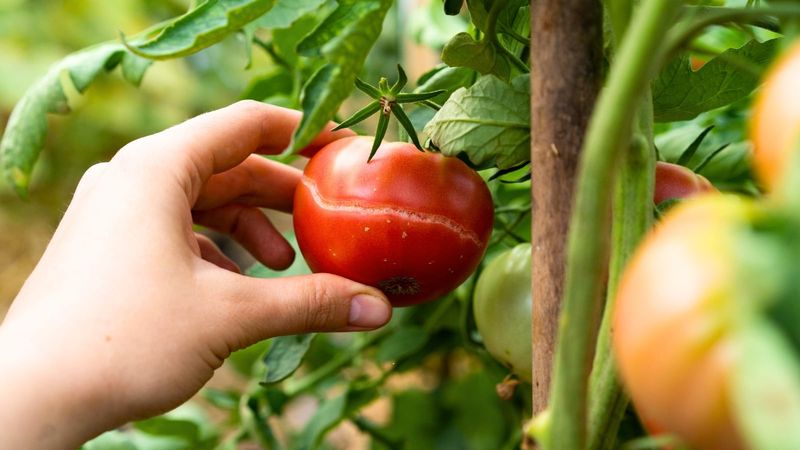
During warm summer weather, tomato fruit can grow surprisingly fast. When a plant has been working through drier soil and then suddenly gains access to abundant water, the internal pressure inside the fruit can rise quickly. The skin, which has been developing at a slower pace, may not be flexible enough to expand at the same rate, and that mismatch is what produces the characteristic splits described in the previous section.
Heat plays a real role here, but not as the sole explanation. Higher temperatures can accelerate fruit development and increase how much water a plant pulls in, which means the swing from dry to wet has a bigger effect during a heat wave than it might in milder conditions. University of Minnesota Extension’s overview of tomato disorders notes that large-fruited varieties and some heirlooms are more susceptible because their skins cover more surface area and may be thinner or less elastic relative to the fruit’s volume.
Several other factors can add to the risk. Excessive nitrogen can push rapid vegetative and fruit growth that the skin struggles to match. Root injury from cultivation or soil disturbance can disrupt how consistently the plant takes up water, creating uneven uptake even when soil moisture looks adequate. Wet and dry weather cycles that repeat across a season can compound the effect, stressing the skin repeatedly.
None of these factors works alone, which is why blaming heat or ripening misses the fuller picture.
Check the root zone before you decide to water
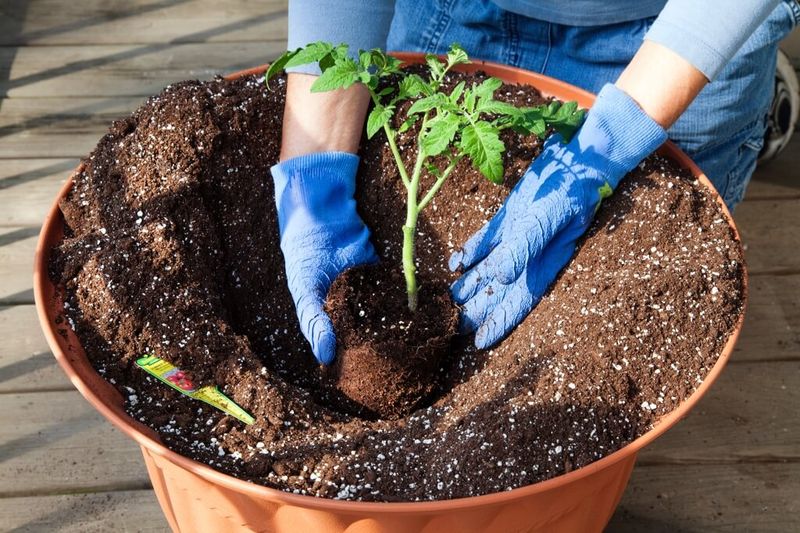
A calendar-based watering schedule feels reassuring, but it cannot account for rain, soil type, or how much heat the garden absorbed last week. A more reliable approach is checking the root zone directly before deciding whether to water. Push a finger or a trowel into the soil several inches down near the plant’s drip line. If it feels moist and cool at that depth, the plant likely has what it needs.
If it feels dry several inches down, it is time to water thoroughly.
When you do water, the goal is to wet the root zone deeply rather than applying a quick sprinkle at the surface. Penn State Extension’s tomato growing guide suggests watering when soil is dry at about 2 inches and ensuring the root zone is wetted to at least 6 inches. A common starting estimate during active growth is roughly 1 to 1.5 inches of water per week, including any rainfall, but that figure is a guideline to help you calibrate, not a fixed amount to add on top of whatever rain has already fallen.
Soil texture changes the math considerably. Sandy soils drain quickly and may need more frequent checks, while clay soils hold moisture longer and can stay wet well after rain. Containers dry out faster than in-ground beds, especially during hot or windy days. University of Arizona Cooperative Extension’s tomato challenges resource reinforces that after a substantial rain, you should wait and check the soil before irrigating again.
The goal is even, adequate moisture, not a saturated bed.
Use mulch and soil-level watering to moderate moisture changes
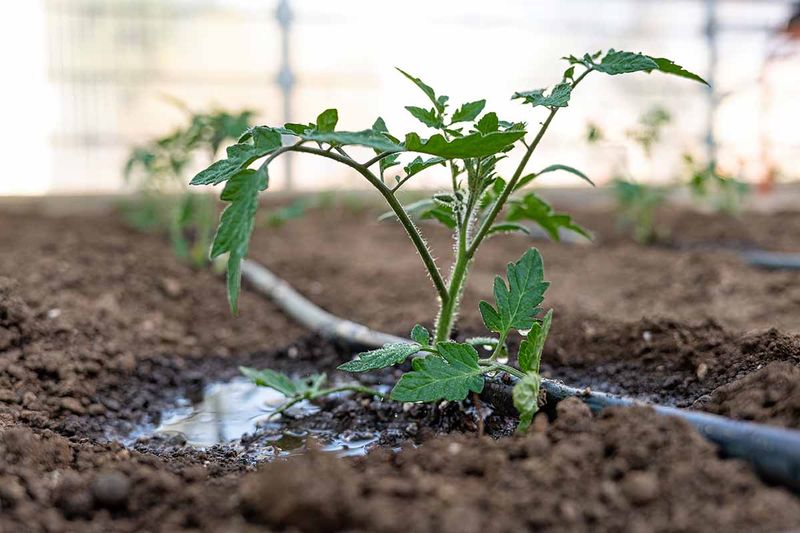
Knowing when to water is only half the equation. How and where water reaches the soil matters just as much for keeping moisture swings from getting extreme. Two practices work together well here: mulching the soil surface and delivering water at ground level rather than overhead.
Apply roughly 2 to 3 inches of mulch, such as straw, shredded leaves, or wood chips, around each plant. Keep the mulch a few inches back from the stem itself to allow airflow and prevent rot at the base. Penn State Extension notes that mulch slows evaporation from the soil surface, which helps reduce the sharp wet-to-dry swings that can stress developing fruit. It will not eliminate cracking on its own, but it gives the soil a more stable starting point between waterings and after rain.
For water delivery, drip irrigation lines or a soaker hose laid along the soil surface work well because they put water directly at the root zone and keep foliage drier. Wet leaves over time can invite fungal disease, so University of Minnesota Extension’s tomato growing guide recommends ground-level watering as a practical standard. During hot stretches, watering in the early morning is a useful preference because plants are hydrated before peak afternoon heat arrives and any moisture that does reach the leaves has time to dry off. Daytime watering itself does not cause cracking; the key issue is always the moisture pattern, not the clock.
Rule out sunscald, blossom-end rot, and other damage
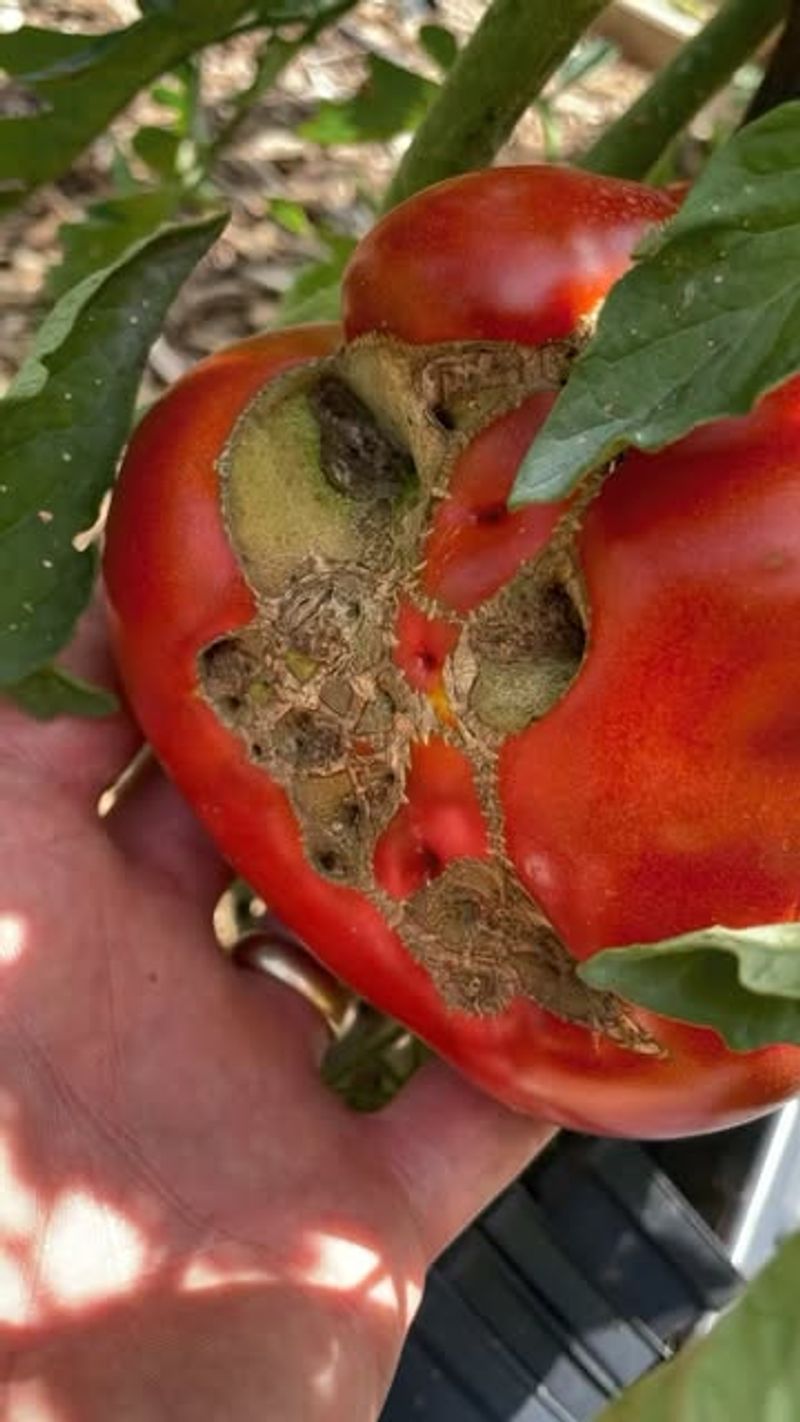
Moisture swings explain a lot of tomato cracking, but not every damaged fruit has a watering story behind it. Before adjusting your irrigation routine, take a closer look at where and how the damage appears, because several other common problems can look superficially similar and need different responses.
Sunscald creates pale, papery, or gray-white patches on the side of the fruit that was most exposed to direct sun. It tends to appear when foliage has been heavily pruned or when disease strips leaves away, leaving developing tomatoes without shade. University of Minnesota Extension’s tomato disorders page distinguishes sunscald clearly from growth cracks, and the fix is maintaining healthy leaf cover rather than changing how you water. Blossom-end rot shows up as a dark, sunken, leathery spot at the very bottom of the fruit, opposite the stem.
It is a different disorder entirely, linked to calcium movement within the plant and strongly influenced by uneven soil moisture, but adding calcium to the soil is not a reliable primary fix for characteristic growth cracks.
Catfacing produces distorted, puckered, or scarred tissue at the blossom end and is more often connected to flower-development disturbances during cool or fluctuating temperatures early in the season. Insect feeding can leave small puncture wounds or corky scars that look nothing like a radial split. Illinois Extension’s tomato trouble guide notes that disease lesions may be discolored, sunken, or surrounded by tissue that looks unhealthy in ways that growth cracks typically are not. Excessive nitrogen and root injury can complicate any of these diagnoses by pushing uneven, rapid growth that stresses the fruit in multiple ways at once.
Harvest cracked tomatoes promptly and skip damaged fruit in the canner
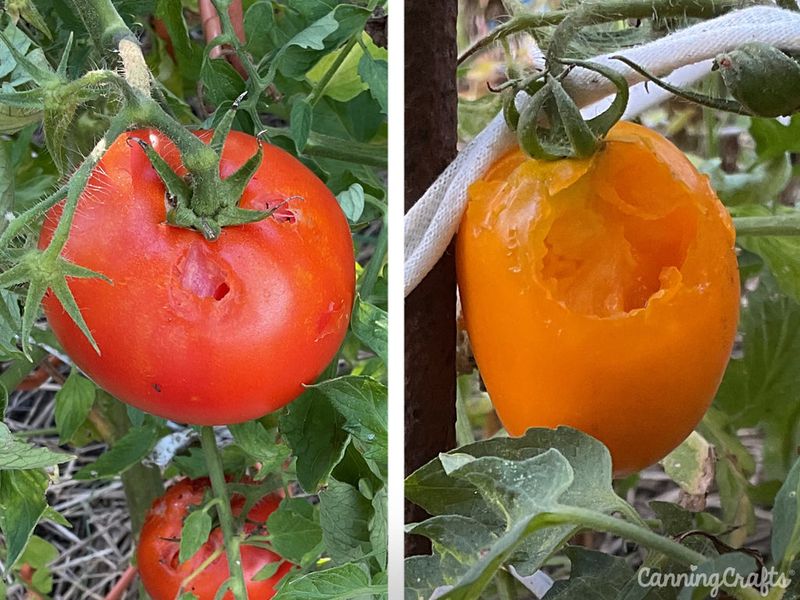
Once a tomato has split, the priority shifts from prevention to smart handling. A cracked tomato is not automatically ruined, but the crack does create an opening that fungi, bacteria, and opportunistic insects can use to get inside the fruit. That means the clock on using it starts running faster than it would for an undamaged tomato.
Harvest cracked fruit as soon as you notice it and bring it inside promptly. Minor surface cracks on an otherwise firm, good-smelling tomato can often be trimmed away, and the rest of the fruit used fresh in salads, sauces, or salsas within a day or two. University of Minnesota Extension’s vegetable irrigation guidance flags that cracks shorten shelf life and increase vulnerability to decay, so do not leave cracked tomatoes on the vine hoping they will hold.
Fruit that is visibly moldy, leaking juice, foul-smelling, deeply split through to the seed cavity, or badly damaged in any way should be discarded. University of Minnesota Extension’s home canning guidance for tomatoes is clear that only high-quality, undamaged fruit should go into the canner. Damaged tomatoes can have altered acidity and may harbor pathogens that standard home-canning processing cannot reliably eliminate. Cracked tomatoes are simply not suitable for preservation by canning, no matter how minor the split looks on the outside.
Lower next season’s risk with steadier conditions and suitable varieties
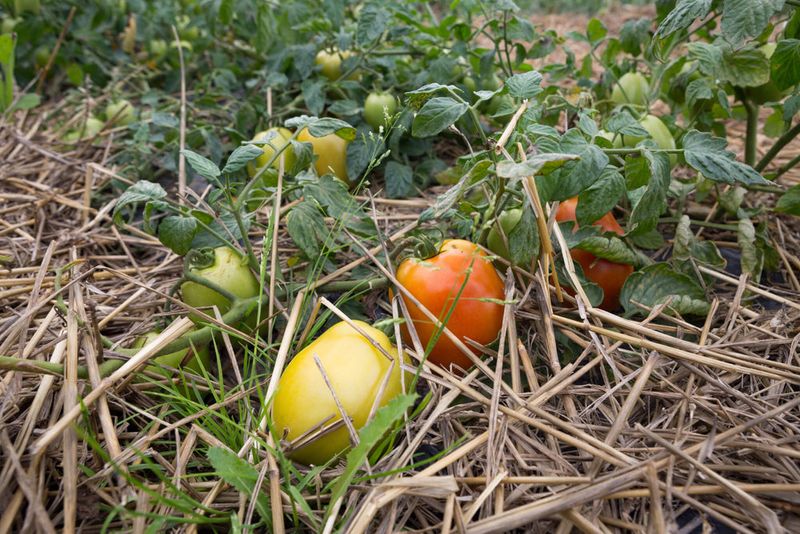
Reducing cracking next year comes down to a handful of practices that work together rather than a single fix. Check soil moisture before watering rather than following a fixed day-count schedule, and water deeply when you do irrigate so the root zone gets thoroughly wet rather than just the top inch or two. Keep 2 to 3 inches of mulch around each plant, pulled back from the stem, to slow evaporation between waterings and after rain. Maintain healthy foliage through the season so fruit stays shaded and the plant moves water more efficiently.
Avoid the pattern that most reliably triggers characteristic growth cracks: letting the soil dry substantially and then giving plants a heavy soak. That sequence, whether from skipped irrigation followed by a long watering session or from dry weather followed by heavy rain, is the condition most worth disrupting. Do not deliberately withhold water as tomatoes begin to ripen; plants still need steady moisture during that stage, and an intentional dry-down followed by irrigation can worsen the very problem you are trying to avoid.
If cracking has been a recurring problem despite consistent watering, consider trying crack-resistant varieties or smaller-fruited types. University of Minnesota Extension’s fruit crack diagnostic page notes that resistance lowers susceptibility rather than eliminating it, so even a labeled crack-resistant variety can split under severe moisture swings. UMN’s full tomato growing guide reinforces the broader goal: aim for even, adequate moisture throughout the season, not a rigid schedule, not a saturated bed, and not a watering cutoff at ripening. A garden that stays consistently moist gives tomato skins the steadiest possible conditions to keep up with the fruit inside.