
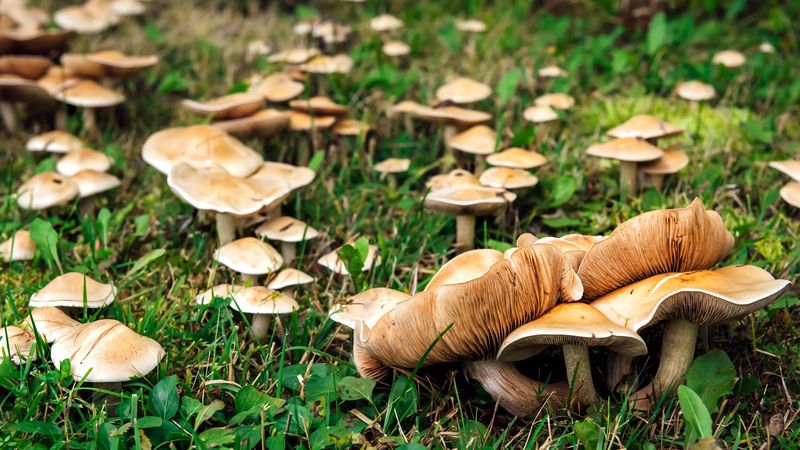
Stepping outside to find a cluster of mushrooms sprouting overnight in your lawn or garden bed can feel alarming, but what you’re seeing is usually a clue about what’s happening underground rather than a sign that something has gone terribly wrong. Fungi already living in your soil have simply found the right mix of moisture, warmth, and food to push up a temporary fruiting body.
Understanding what triggers that flush can help you respond calmly, spot the rare situations that do need attention, and keep your yard safe for kids and pets.
The mushroom is the visible part of a larger underground process
What pops up overnight in your lawn is only a small fraction of the organism responsible for it. Beneath the surface, a web of thread-like structures called mycelium has been quietly spreading through soil, thatch, mulch, or decaying wood for weeks, months, or even years before a single cap appears aboveground.
The visible mushroom is simply the fruiting body the fungus produces to release spores, and it can appear and disappear within a few days.
Rain, irrigation, a stretch of warm humid weather, or even a sudden break in a dry spell can trigger this fruiting phase. Penn State Extension’s fall fungus guide explains that the visible mushrooms may disappear quickly even though the fungal network underneath remains intact and active.
That is precisely why knocking or pulling mushrooms off at the surface does not stop them from returning: the mycelium and its food source are still in place.
Fungi typically colonize soil through organic material: buried roots, old stumps, decomposing grass clippings, thatch, or wood chips. University of Minnesota Extension notes that wet conditions from rainfall or irrigation are among the most common triggers for a sudden flush.
Recognizing this underground reality keeps the whole situation in perspective: the mushroom is a temporary signal, not a permanent verdict on your soil or your lawn.
Use timing, location, and pattern to make a first assessment
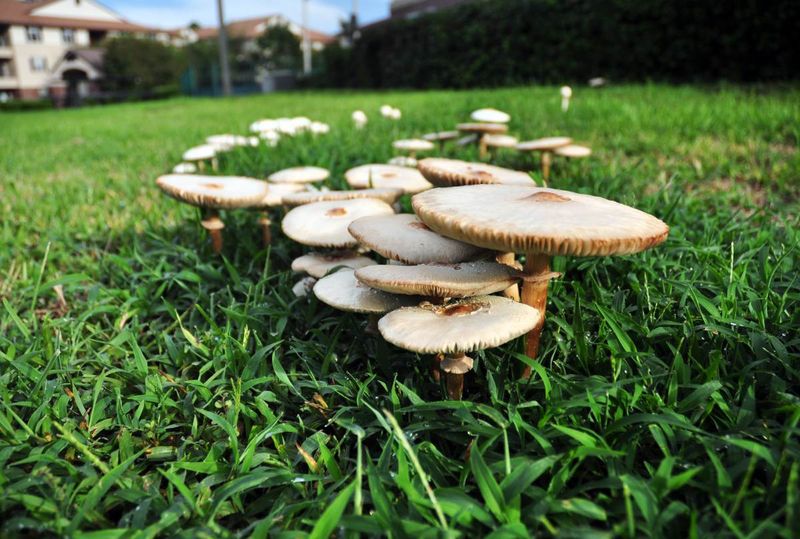
Before worrying about what species you have or whether your soil is damaged, pay attention to three simple clues: when the mushrooms appeared, exactly where they are growing, and whether they form any kind of pattern. Those three observations alone can narrow down the most likely explanation faster than any field guide.
Timing is the first clue. Mushrooms that show up within a day or two of heavy rain or a recent irrigation cycle are almost certainly responding to that moisture event.
University of Minnesota Extension identifies wet conditions from rainfall or excessive irrigation as a primary driver of mushroom fruiting in lawns. A dry period followed by sudden moisture can produce the same effect.
Location gives you the second clue. Mushrooms growing directly in mulch, bark chips, or pine straw usually indicate a fungus consuming that carbon-rich material.
Growth near the base of a tree, along a fence line, or in a spot where a stump was removed years ago often points to buried wood or old roots still decomposing underground. UF/IFAS Extension identifies saprotrophic mushrooms in mulch, leaf litter, potting soil, and lawns as especially common in Florida and the Southeast.
In containers, warm temperatures, high humidity, and low light can encourage fruiting from fungi already present in potting mix.
Check the area around the mushrooms for thatch buildup, leaf litter accumulation, buried debris, or persistently wet low spots. Those environmental details tell you more about the cause than the mushroom’s shape or color ever will.
Mushrooms offer a soil clue, not a soil-health score
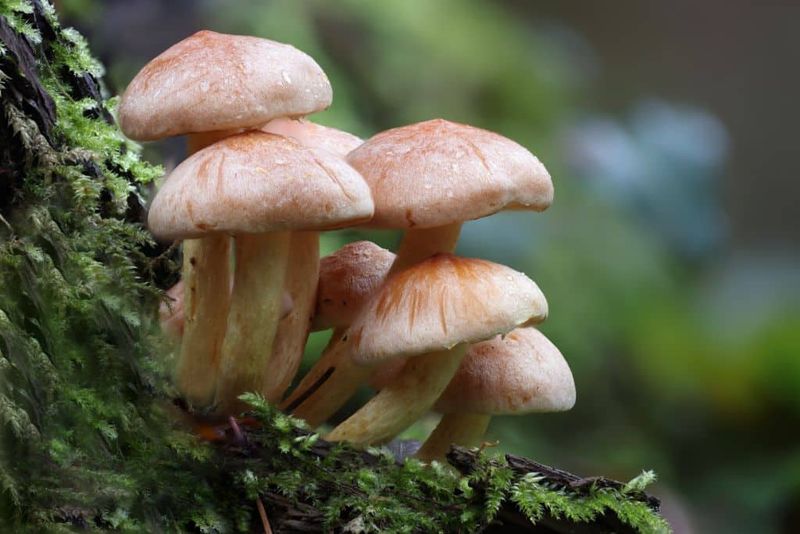
Two opposite conclusions get attached to yard mushrooms all the time, and both miss the mark. Some gardeners assume that mushrooms signal healthy, living soil teeming with beneficial microbes.
Others assume the opposite: that something is rotting, diseased, or dangerously wrong. The accurate interpretation is narrower and more useful than either of those reactions.
Fungi are real and important players in the soil food web. USDA NRCS guidance on the biological underground community describes fungi as key decomposers that break down complex plant residues and help cycle nutrients back through the system.
That ecological role is genuine. What a visible mushroom actually tells you, though, is that a specific fungus had enough moisture, warmth, and organic material to fruit at that moment.
That is useful environmental information, but it is not a soil test.
A mushroom cannot tell you whether your soil is compacted, nutrient-rich, deficient in a particular mineral, contaminated, or ideally structured for your turf. Decomposition can release nutrients over time, but spotting a mushroom in the lawn is not a sign that your grass just received a fertilizer boost or that no fertilizer is needed.
If you genuinely want to know your soil’s nutrient status or pH, a standard soil test from your local cooperative extension office is the only reliable method.
Treat the mushroom as one data point: moisture and a food source are present. Everything beyond that requires a separate look.
Most lawn and mulch mushrooms do not attack living plants
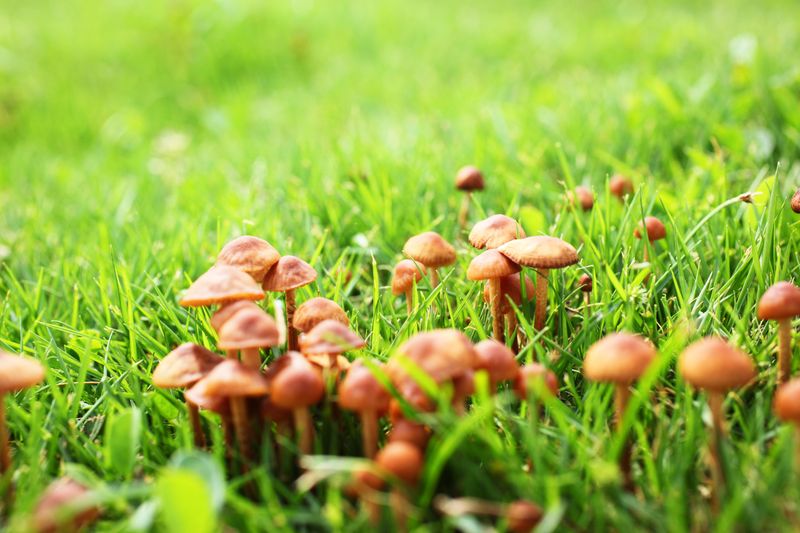
Seeing mushrooms next to your shrubs or growing through your lawn can make it easy to assume the fungi are attacking the plants nearby. For the vast majority of lawn and mulch mushrooms, that assumption is wrong.
Most are saprophytic, meaning they consume dead or decomposing material rather than living tissue. They are breaking down old roots, buried wood, leaf litter, thatch, or spent grass clippings, not feeding on your living grass or landscape plants.
Penn State Extension confirms that most lawn mushrooms are not plant pathogens and should not be confused with the fungi responsible for turf diseases. UF/IFAS Extension similarly identifies saprotrophic mushrooms in Florida lawns, mulch, and potting soil as common occurrences that generally pose no threat to living plants.
The key is to evaluate mushrooms and plant health as separate questions. If a nearby plant is wilting, showing leaf spots, losing roots to rot, or declining without explanation, those symptoms need their own diagnosis.
Mushrooms growing in the same area are not automatically the cause. Root rot, for example, is caused by specific water mold pathogens unrelated to the decomposer fungi fruiting aboveground.
One additional distinction worth knowing: not everything that looks like a mushroom in damp mulch or lawn actually is one. University of Georgia Extension explains that slime molds can appear as slimy or powdery patches in damp conditions but are biologically distinct from true fungi and generally cause no plant damage.
If the growth is brightly colored, gelatinous, or powdery rather than cap-shaped, it may be a slime mold rather than a mushroom.
A circular turf pattern changes the diagnosis
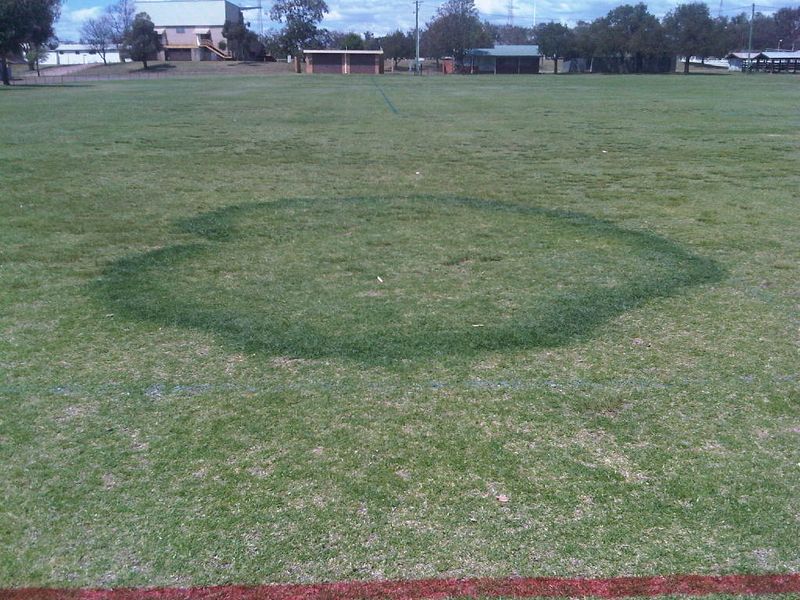
Scattered mushrooms after a rain are one situation. A circle, arc, or ring of mushrooms in your turf is a different situation that deserves closer attention.
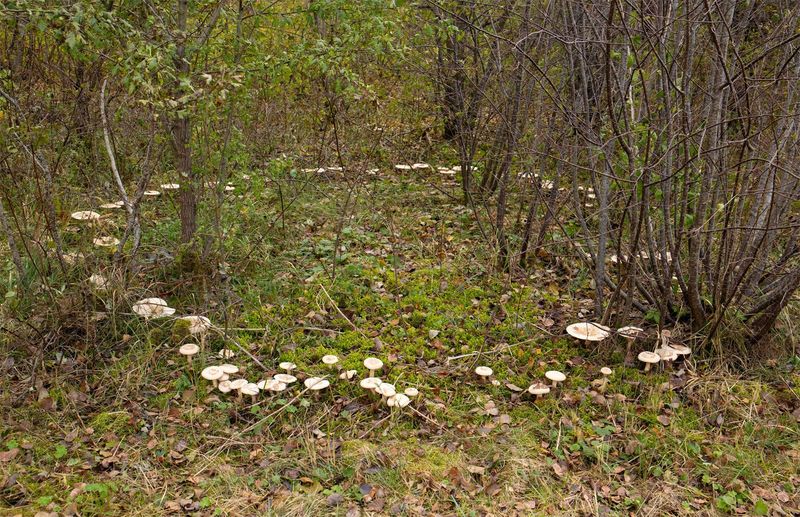
Circular patterns in lawns are the classic sign of a fairy ring, a condition caused by fungi that spread outward in all directions from a central starting point, often a buried piece of wood, an old stump, or decomposing roots.
Fairy rings do not all behave the same way. UF/IFAS Extension’s guide on fairy rings describes a range of effects depending on the fungal species and site conditions.
Some rings produce a band of noticeably darker, faster-growing grass as decomposition releases nitrogen. Others create localized soil that becomes dry and water-repellent, making it difficult for the turf to absorb moisture even during irrigation, which can lead to drought stress and dead grass in or around the ring.
Some rings produce mushrooms with little visible turf effect at all.
When assessing a ring, look at the turf inside and along the arc carefully. Is the grass darker green and growing faster?
Is there a band of dead or thinning turf? Does the soil in that area feel dry and hard to wet even after rain?
Those details tell you more about the severity than the mushrooms themselves. University of Georgia Extension’s fairy ring publication notes that management depends on diagnosis and cultural corrections, including aeration and wetting agents in cases involving water-repellent soil, rather than a single universal treatment.
A ring that produces only mushrooms and a slightly greener band may need no intervention beyond removal of the fruiting bodies. A ring that is killing turf in a drought-like pattern warrants a closer look and possibly professional diagnosis.
Manage moisture and organic matter without trying to sterilize the soil
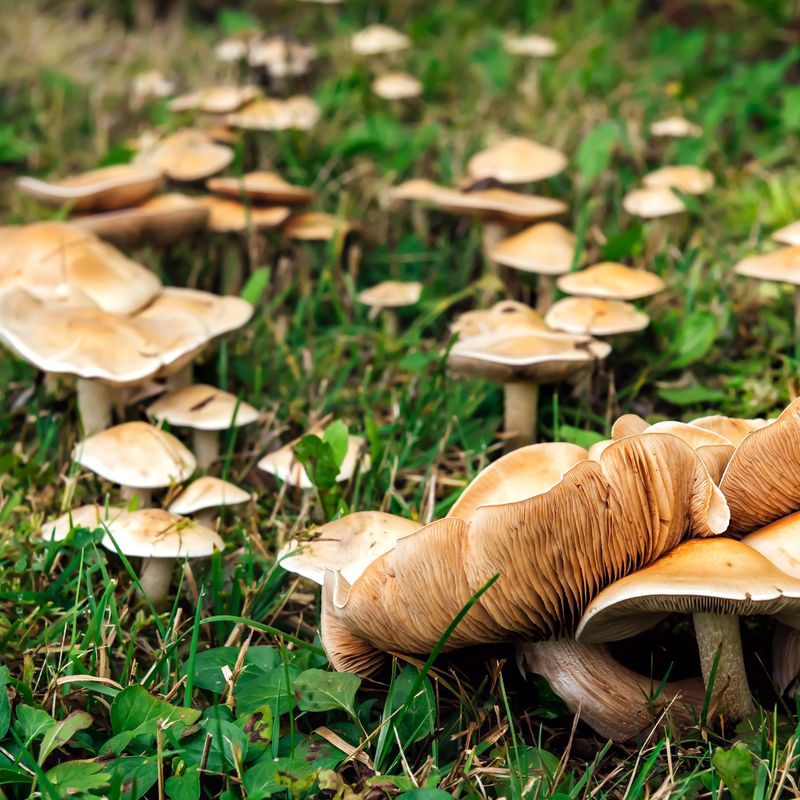
Recurring mushrooms are a signal that conditions favor fruiting: moisture, warmth, and organic material are present. Proportionate management targets those conditions rather than attempting to eliminate every fungus in the soil, which is neither realistic nor desirable.
Start with irrigation. University of Minnesota Extension recommends reducing unnecessary irrigation and correcting persistently wet conditions.
Water your lawn and beds according to what your turf and plants actually need, not on a fixed schedule that ignores rainfall. If a low spot in the yard stays soggy for days after rain, improving drainage there removes a condition that encourages fruiting far more effectively than any surface treatment.
Address compaction and thatch where they contribute to poor drainage or moisture retention. Core aeration improves water movement and air exchange in the root zone.
Thatch layers thicker than about half an inch can hold moisture and provide fungal food; dethatching or topdressing can reduce that reservoir over time. In landscape beds, mulch deeper than about three inches that stays persistently wet creates ideal fruiting conditions.
Pulling mulch slightly away from plant crowns and avoiding reapplication over already-thick layers are practical steps.
Where a buried stump, old tree roots, or significant wood debris is fueling repeated mushroom growth in one spot, removing that material where practical will eventually deplete the food source. That process can take time.
USDA NRCS guidance emphasizes that organic matter supports broader soil biology, so the goal is correcting excess or poorly placed material, not stripping the soil of all organic content.
Regarding fungicides: Penn State Extension states clearly that fungicides used for plant diseases do not manage ordinary decomposer mushrooms. UF/IFAS guidance on fungicides for lawn and landscape management reinforces that fairy-ring treatment is diagnosis-specific.
Reaching for a fungicide as a first response to scattered lawn mushrooms is unlikely to help and wastes resources.
Remove visible mushrooms for safety, not as a cure
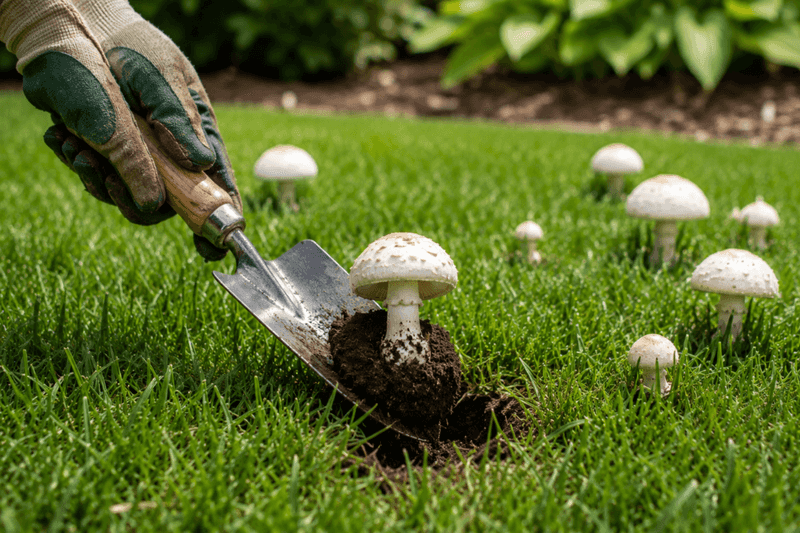
Physical removal is the right immediate response when mushrooms appear in areas where children or pets have access, but the goal is safety and appearance, not eradication. The underground mycelium and its food source remain after the fruiting bodies are gone, so new mushrooms may return when conditions favor another flush.
Use gloved hands or a small hand tool to knock over or pull up the mushrooms. Place them directly into a trash bag rather than leaving them on the lawn surface or composting them.
Wash your hands thoroughly after handling them. University of Minnesota Extension frames removal this way: it reduces visible mushrooms and limits access by children and pets without implying that the underlying fungal colony has been addressed.
Penn State Extension similarly recommends gloves as a sensible precaution followed by handwashing.
The safety message about eating yard mushrooms is non-negotiable. Do not eat any unidentified mushroom from your lawn, bed, or container, and do not rely on color, size, smell, or any visual shortcut to decide whether one is safe.
Wild mushrooms can cause gastrointestinal illness, organ damage, coma, or death. Poison Control’s wild mushroom warning is direct: there is no reliable safety determination based on appearance alone.
If a child or pet ingests a yard mushroom, do not wait for symptoms to appear. Contact Poison Control immediately at 1-800-222-1222.
Poison Control guidance on food poisoning confirms that prompt contact is the right first step after any suspected ingestion of an unknown mushroom. Keeping unidentified mushrooms out of reach is always the safer path.
Treat mushrooms as environmental clues, not verdicts
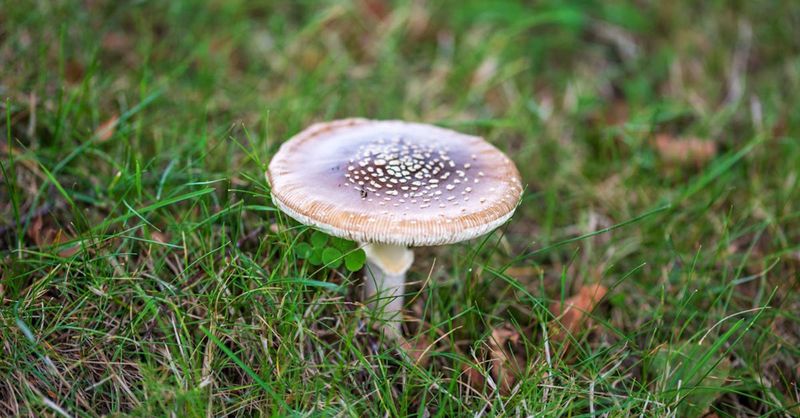
A practical decision rule for recurring yard mushrooms comes down to pattern and context. Scattered mushrooms appearing after wet weather or irrigation usually mean fungi are fruiting where moisture and organic matter have given them the right conditions.
That situation calls for sensible moisture management and, if needed, physical removal for safety, not alarm.
A ring or arc shape in the turf, especially one paired with unusual grass color, dry soil, or dead patches, deserves a closer look using the fairy-ring framework. Unexplained plant decline nearby, such as wilting, root problems, or thinning turf, needs its own diagnosis separate from the mushrooms.
UF/IFAS guidance on fairy rings and University of Minnesota Extension both support reading turf symptoms alongside the mushroom pattern rather than treating either in isolation.
Unidentified mushrooms should always remain inaccessible to people and pets regardless of how harmless they appear. Correcting excess moisture, managing thatch and mulch depth, and addressing buried organic debris can reduce how often mushrooms appear without requiring you to wage war on the soil biology that USDA NRCS identifies as essential to healthy decomposition.
The fungi were there long before the mushrooms appeared, and managing conditions, not chasing fruiting bodies, is what actually changes the outcome.