
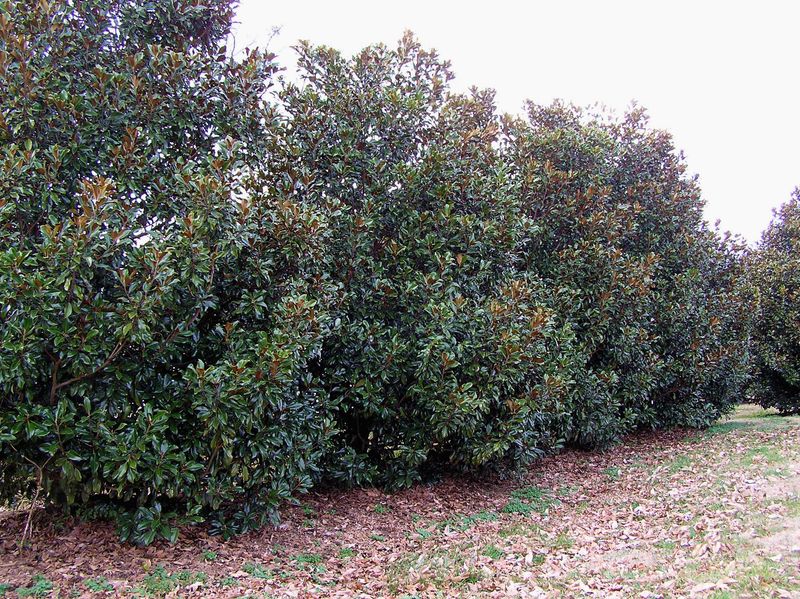
Rows of Leyland cypress once promised fast, thick privacy along North Carolina property lines, but many of those hedges are now browning out, thinning at the bottom, or falling over entirely. Cankers, needle blight, shallow roots, and brutal summer heat have exposed the tree’s limits in this climate.
The good news is that several native plants handle those same conditions far better, and matching the right one to your specific site can give you a screen that stays green for decades without the same recurring headaches.
Why Leyland cypress can struggle along North Carolina property lines
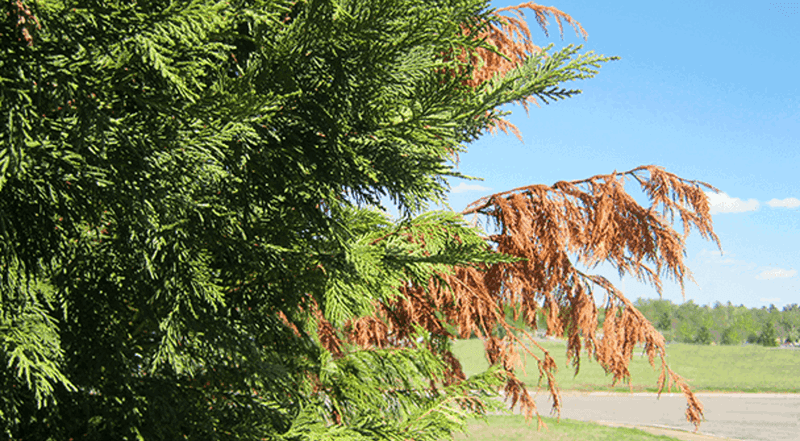
Leyland cypress arrived in North Carolina landscapes as a fast-growing privacy solution, and for a while it delivered. The problems tend to show up later, and they are not subtle.
NC State Extension’s Leyland cypress profile identifies Passalora needle blight and Seiridium canker as two of the most damaging diseases affecting this tree in the state. Both diseases cause branch dieback, and Seiridium canker in particular can girdle limbs and kill large sections of a tree before most homeowners realize what’s happening.
Shallow roots compound the stress. Leyland cypress is not well adapted to North Carolina’s hot summers, and large specimens have a documented tendency to topple in storms because they never develop the deep root system needed to anchor them.
A tree that grows 60 or 70 feet tall but roots mainly in the top 18 inches of soil is a liability in a wind event, especially along an exposed property line.
Some sources suggest that Leyland cypress reliably fails at the 20-year mark, but that timeline is not a universal rule. NC State’s plant record lists a typical lifespan of roughly 20 to 50 years depending on environment, while extension educators describe rapid decline around 20 years as a recurring local pattern rather than a guaranteed deadline.
The honest version is that performance varies, and many North Carolina homeowners are seeing problems much earlier than they expected.
Management can slow some of the damage. Union County Extension guidance notes that sanitation, careful pruning, watering during dry spells, adequate plant spacing, and improved airflow may extend service life.
What management cannot do is cure Seiridium or Bot canker once a tree is infected. Replacing Leyland cypress is not automatically a lower-maintenance decision; it is a site-selection decision that starts with asking what actually grows well in your specific conditions.
Eastern red cedar suits sunny, dry, exposed sites
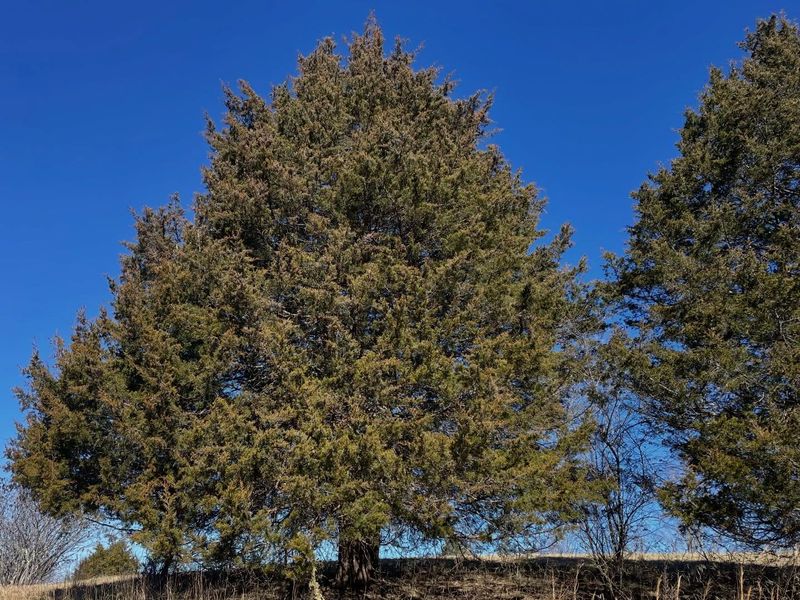
When the site is sunny, dry, and open, eastern red cedar (Juniperus virginiana) is the strongest native starting point for a North Carolina privacy screen. NC State’s plant profile for eastern red cedar describes it as a native, dependable evergreen that tolerates the state’s variable soils, handles drought, shrugs off salt spray and poor fertility, and resists deer browsing.
NC Cooperative Extension specifically recommends it over Leyland cypress for hot, dry North Carolina conditions, which is exactly the scenario where Leyland cypress tends to struggle most.
Eastern red cedar holds its dense, dark green foliage year-round, which is what makes it useful as a screen or windbreak. Unlike Leyland cypress, it developed in eastern North America and is broadly native across North Carolina, from the coastal plain through the Piedmont and into the mountains.
That native range matters because the tree’s drought tolerance and heat tolerance are not borrowed traits; they are the result of long adaptation to the region’s climate patterns.
The wildlife value is real and well-documented. Its small blue-gray cones are eaten by cedar waxwings, mockingbirds, bluebirds, and other birds, along with small mammals.
The dense branching provides winter cover, and the tree hosts larvae of the juniper hairstreak butterfly and the imperial moth. Those relationships are documented food, cover, and host-plant connections, not a guarantee that any particular species will appear in your yard.
None of this makes eastern red cedar disease-proof or maintenance-free. It can develop twig blight, scale insects, bagworms, mites, and cedar-apple rust.
The claim that any native screen will not blight or die is too absolute to stand up to reality. What eastern red cedar offers for a sunny, dry, exposed, and spacious property line is better adaptation to those specific conditions and a different problem profile than Leyland cypress carries.
That distinction matters when you are choosing a screen built to last.
Measure the mature screen before you plant
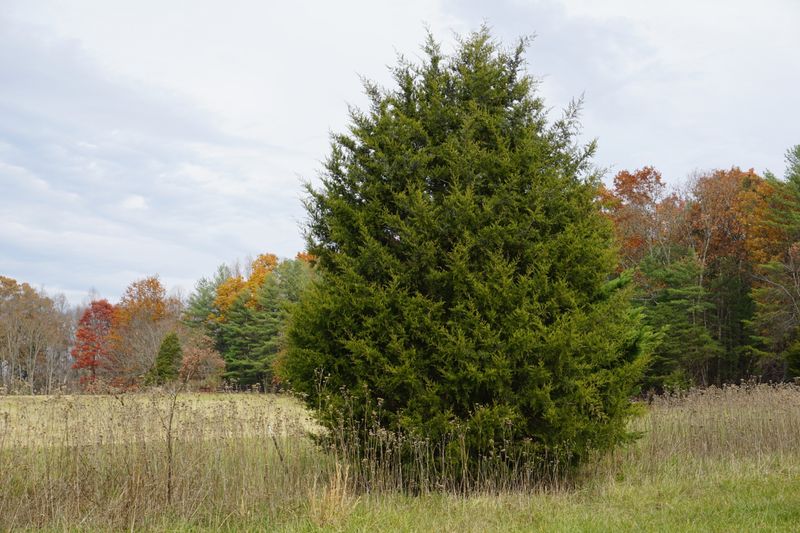
Eastern red cedar is a tree, not a hedge shrub, and treating it like one is one of the fastest ways to create a new set of problems along your property line. NC State’s plant data lists a typical mature size of approximately 30 to 40 feet tall and 10 to 20 feet wide.
A row of trees that size planted too close together will eventually compete for light and root space, develop poor airflow, and become more vulnerable to disease pressure.
NC Extension’s vegetative screening guidance recommends spacing trees 12 to 24 feet apart, using the plant’s mature width as the guide. Before you mark out the planting holes, check what is actually above and beside the intended row.
Overhead utility lines, neighboring structures, access paths, and the legal property line boundary all affect where the trees can realistically go and how large they can grow without creating conflict.
Narrow cultivars such as ‘Taylor’ exist for situations where the standard mature form is too wide for the available space. ‘Taylor’ grows in a tighter columnar shape and can be a practical fit for smaller lots, but only when its actual mature dimensions match the property’s constraints. A cultivar chosen for space should still be given appropriate spacing at planting, not crammed in for faster coverage.
NC State Extension’s privacy planting guide is direct about the crowding temptation: spacing plants tightly for instant coverage increases competition between plants, reduces airflow through the screen, and can accelerate the very disease and stress problems you were trying to avoid. Patience at planting is a practical investment in the screen’s long-term health, not a design compromise.
Mix species to make the privacy barrier more resilient
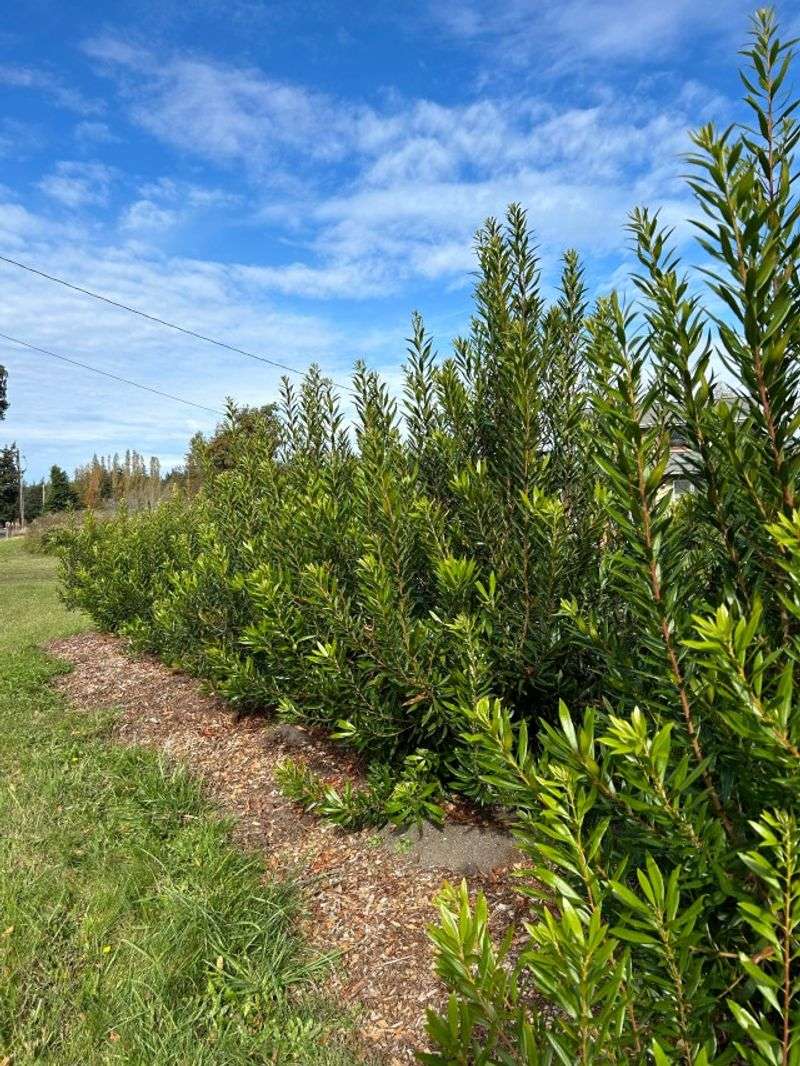
A continuous row of a single species is the most fragile privacy screen you can build. When one pest, disease, ice storm, or site mismatch hits, it can work its way through an entire uniform planting with nothing to stop it.
University of Maryland Extension’s mixed privacy screen resource and NC State both recommend mixing species specifically to limit how far any one problem can travel and to make individual plant failures less conspicuous.
Eastern red cedar stays at the center of the recommendation for sunny, dry, exposed, and spacious North Carolina property lines, but wax myrtle, yaupon holly, or other regionally appropriate natives can serve as risk-management partners rather than interchangeable alternatives. If bagworms hit the cedars hard one season, a wax myrtle or yaupon holly planted between them holds the screen together.
Polk County Extension’s screening plant overview reinforces this logic, pointing out that replacing one failed plant in a mixed row is far less disruptive than patching a long gap left by a single-species collapse.
Staggering the planting in two offset rows rather than a straight line adds depth to the screen and improves airflow through the planting. Each plant gets better light penetration, which keeps the lower branches of cedars from dying back, and the visual result is a fuller, more natural-looking barrier.
NC State’s privacy planting guidance connects mature-size spacing in a staggered layout to better long-term plant health and coverage.
A mixed screen does not eliminate failure. Each species still faces its own pest pressures, weather vulnerabilities, and site requirements.
What diversity does is prevent a single event from erasing the entire screen at once, which is the exact scenario that leaves homeowners looking at a long, bare property line and wondering what went wrong.
Use wax myrtle or yaupon holly when the site calls for them
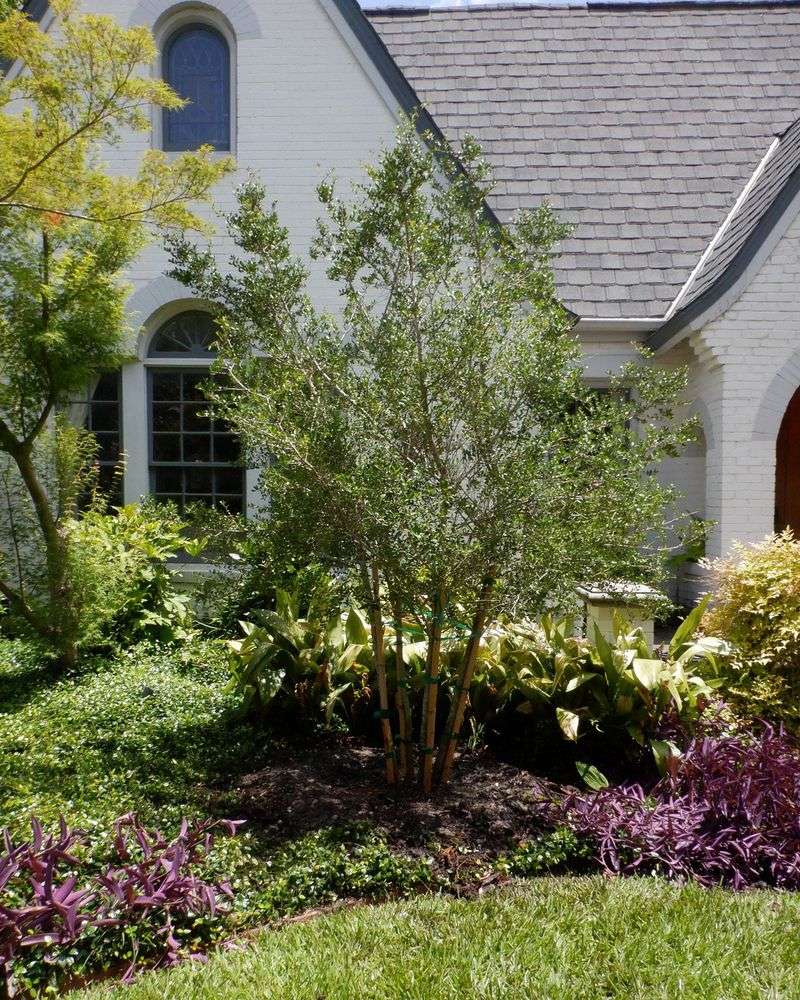
Not every North Carolina property line is sunny, dry, and wide open, and eastern red cedar is not the right answer for every site. Southern wax myrtle (Morella cerifera) earns its place on wet, salty, windy, or coastal sites where other plants struggle.
NC State’s wax myrtle profile describes it as adaptable to wet soils, drought after establishment, poor or sterile soil, salt spray, and coastal wind. For a low-lying yard that holds water after rain, or a property near the coast that takes direct salt and wind exposure, wax myrtle handles conditions that would stress eastern red cedar.
There are trade-offs worth knowing before you plant a row of wax myrtles. The plant can sucker and spread into colonies, which requires monitoring and occasional removal of unwanted growth at the margins.
Heavy wind or ice can break branches, and NC Extension notes that wax myrtle carries a high fire-risk rating in the NC State Plant Toolbox. That rating matters for placement decisions, especially if the screen runs close to a structure.
Yaupon holly (Ilex vomitoria) fills a different niche. It tolerates drought, salt spray, occasional flooding, full sun through deep shade, and heavy pruning, which makes it useful for smaller lots, shaded spaces under established trees, or situations where a formally sheared hedge is the goal.
NC State’s yaupon holly profile lists it as a 10 to 20-foot evergreen shrub or small tree suited to screens, windbreaks, and barrier plantings.
Yaupon holly’s regional native status deserves a careful read. It is native to the southeastern United States and is especially associated with the coastal plain.
NC Sea Grant’s coastal landscaping guidance highlights both wax myrtle and yaupon holly as strong coastal options, but inland Piedmont or mountain homeowners should check provenance and site fit before treating yaupon as a universal choice. NC Extension’s vegetative screening resource reinforces the broader lesson: match the plant to the actual site rather than assuming one species covers every yard in the state.
Account for disease, fire risk, and nearby plants
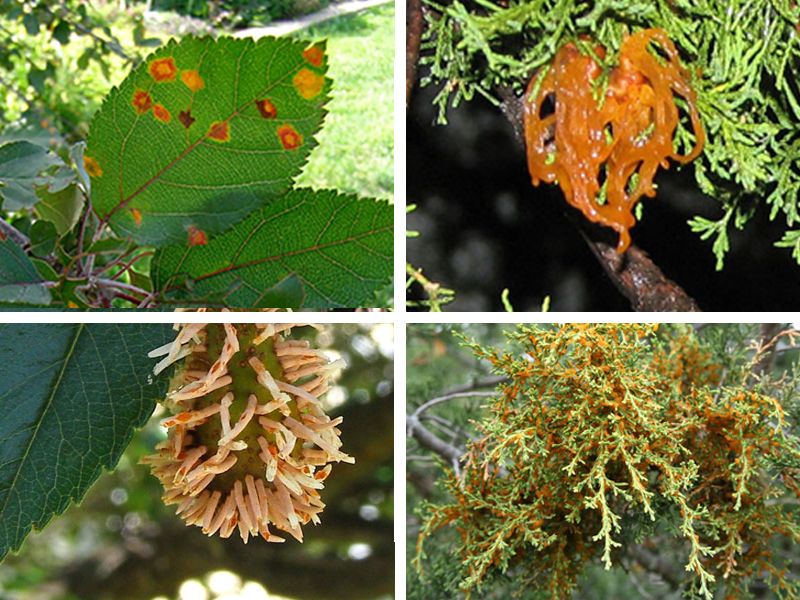
Eastern red cedar is a better-adapted option for many North Carolina sites, but it is not a disease-proof plant. NC State’s eastern red cedar profile lists twig blight, scale insects, bagworms, spider mites, and cedar-apple rust among its documented problems.
Each of those issues requires monitoring and, when caught early, targeted management. Ignoring pest pressure because the plant is native is a reliable way to lose trees you spent years establishing.
Cedar-apple rust deserves specific attention if your property includes apples, crabapples, hawthorns, or serviceberries. The fungus needs two hosts to complete its life cycle: a juniper species and a member of the rose family.
University of Minnesota Extension’s cedar-apple rust overview explains that the disease typically causes limited harm to the cedar itself, but it can cause significant damage to susceptible rose-family plants nearby. If you have a crabapple or hawthorn in the yard, factor that proximity into your site-selection decision before planting a cedar screen.
Fire risk is a separate concern that applies to all three of the plants discussed in this article. Eastern red cedar, wax myrtle, and yaupon holly all carry high fire-risk ratings in the NC State Plant Toolbox.
NC State’s wax myrtle record and the yaupon holly profile both carry this designation. None of these screens should be planted immediately beside a home, especially in areas where defensible space around structures is a consideration.
The practical takeaway is that site selection, monitoring, and occasional intervention remain part of the job regardless of which plant you choose. Correct matching to soil, moisture, sun, and space reduces the likelihood of recurring problems, but it does not remove the need to check your planting each season and act on what you find.
Establish the screen for its actual North Carolina conditions
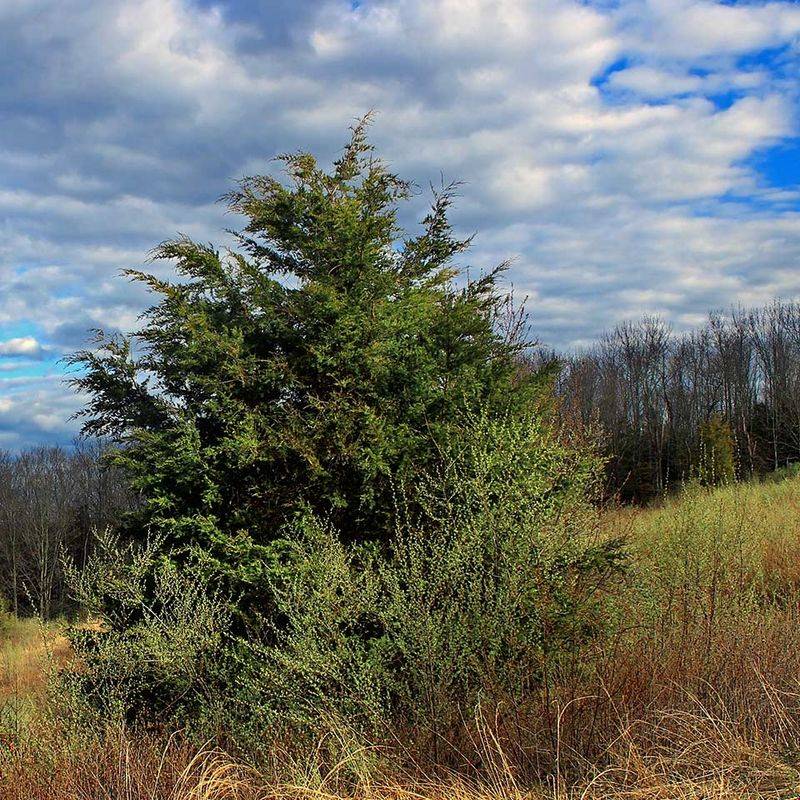
Getting the plant selection right is only the first step. How you establish the screen in its first two to three years determines whether the investment survives long enough to do its job.
Start by matching the plant to the actual conditions on your property, not the conditions you wish you had. Piedmont sites with clay soil and dry summers call for different choices than a coastal plain yard that drains poorly or a mountain property with heavier rainfall and cooler temperatures.
NC Extension’s vegetative screening guidance recommends allowing mature-size spacing from the beginning and using a staggered or mixed layout to improve airflow and long-term coverage. Plant at the correct depth, water consistently through the first growing season, and continue supplemental watering during dry spells even after the plants appear to be established.
Drought tolerance in eastern red cedar develops over time; a tree planted last spring is not yet the resilient specimen the catalog describes.
Wax myrtle and yaupon holly are dioecious, meaning male and female flowers are on separate plants. NC State’s wax myrtle profile and the yaupon holly record both note this.
If berry production and the associated wildlife value matter to you, a female plant will need a male plant or a compatible male nearby for reliable fruit set. Buying all plants from a single-sex nursery batch can leave you with a screen that never produces berries.
Faster-growing species are not automatically lower-maintenance. NC State’s privacy planting guide is clear that faster growth can mean more pruning, greater mature size, and more structural demands if plants are crowded.
Maintain airflow by pruning selectively rather than shearing flat. Remove damaged, diseased, or dead material promptly so it does not become a disease reservoir for neighboring plants.
A screen that gets routine attention stays healthier longer than one that is planted and ignored.
Choose the plant that matches the property, not the promise
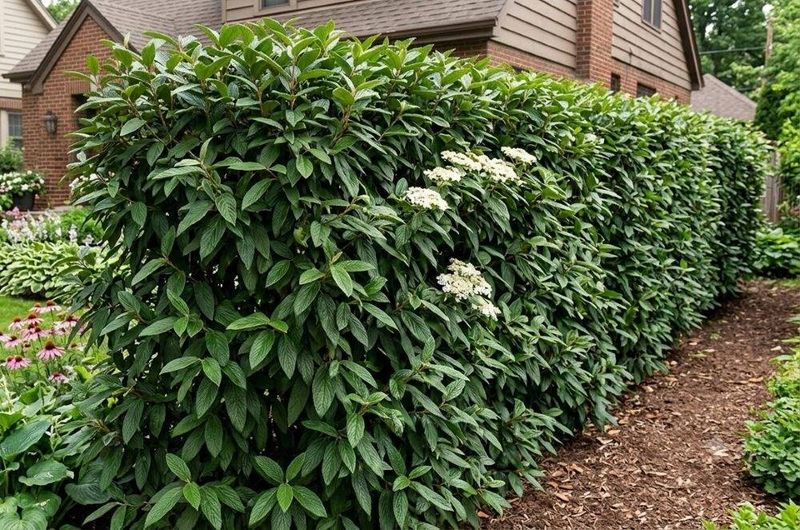
Every site decision starts with the same question: what does this specific property actually need? For a sunny, dry, exposed, and spacious property line, eastern red cedar is the best-supported native starting point in North Carolina.
It handles the conditions that break Leyland cypress and brings documented wildlife value along with it.
Wet or coastal sites shift the recommendation toward wax myrtle, which tolerates salt, flooding, and coastal wind better than cedar does. Smaller lots, shaded spaces, or situations requiring a formally sheared hedge point toward yaupon holly.
Long-term risk reduction on any site points toward a mixed design, as NC Extension’s screening guidance and the Leyland cypress performance record both reinforce.
Correct matching can provide evergreen privacy and genuine wildlife value while avoiding some of the recurring disease and structural problems that have made Leyland cypress a source of frustration across North Carolina. No screen plant is immune to disease, weather, fire risk, or eventual decline.
What you can control is how well the plant fits the ground it grows in, and that fit is what makes the difference between a screen that lasts and one you are replacing again in fifteen years.