
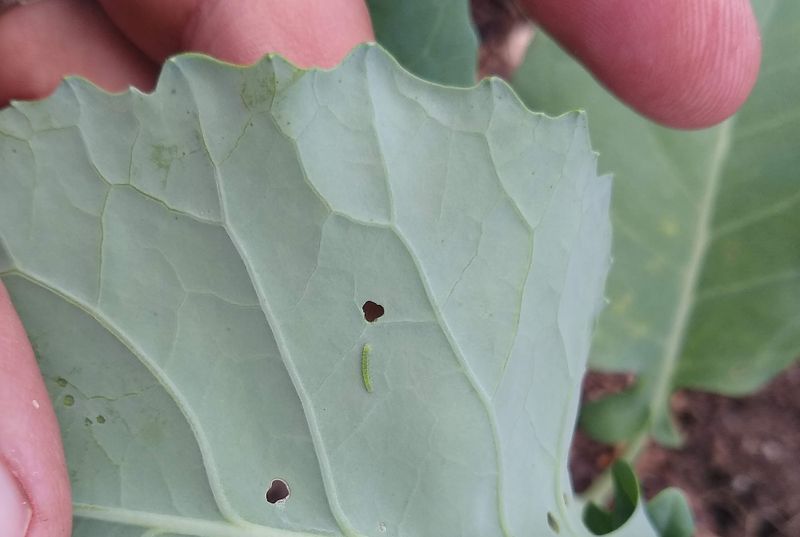
Walk out to your fall cabbage patch and you might find leaves riddled with ragged holes that were not there yesterday. For Southern gardeners growing cool-season crops in Florida, Georgia, Texas, and across the Southeast, this kind of damage is one of the most frustrating things to diagnose because the pest is rarely sitting in plain sight.
A small group of green caterpillars is almost certainly responsible, and knowing where to look and how to tell them apart can save your harvest before the damage gets worse.
Ragged holes suggest a caterpillar complex, not one guaranteed culprit
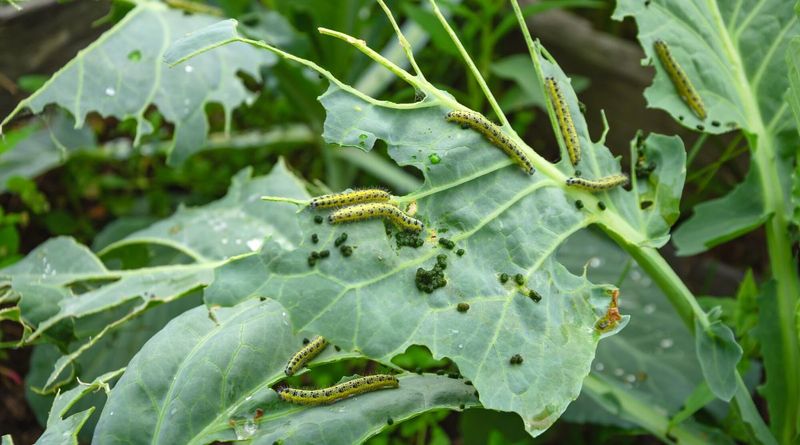
Irregular holes chewed into cabbage leaves are one of the most recognizable signs of caterpillar feeding, but the damage pattern alone cannot point to a single species. University of Utah Extension guidance on caterpillar pests of brassicas groups three insects together as the main culprits: cabbage looper (Trichoplusia niPieris rapae), imported cabbageworm (), and diamondback moth larvae.
Their feeding injuries overlap enough that symptoms from one species can look nearly identical to damage from another.
Cabbage looper is often the strongest suspect when damage appears to build quickly and the larvae are hard to find during a daytime inspection. Young loopers tend to feed from the underside of leaves, and UF/IFAS reporting on cabbage looper biology notes that larger larvae can create bigger holes and eventually work their way into a developing head.
Their tendency toward evening and nighttime activity also helps explain why fresh damage seems to appear between one morning and the next.
Even so, ragged holes by themselves are not proof that looper is responsible, or that the pest is hiding on the leaf underside. Imported cabbageworm and diamondback moth larvae produce similar-looking injury, and University of Minnesota Extension’s cabbage diagnostic tool lists all three as possible causes of holes in cabbage.
A confident diagnosis requires finding the larva itself, its eggs, or its frass, not just reading the damage.
Search the plant’s concealed spaces before choosing a treatment
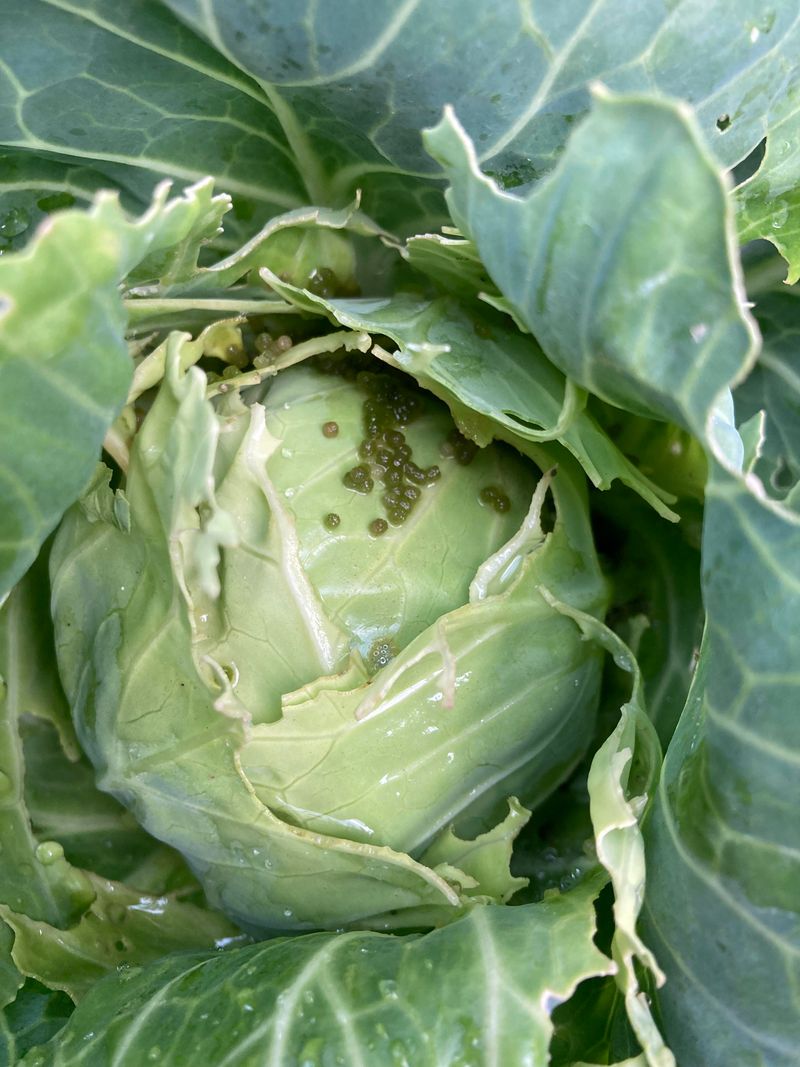
A quick glance at the top of a damaged leaf will almost never reveal the pest. Start your inspection by turning over the outer leaves one by one and looking closely at the lower surfaces, where young larvae often feed and rest.
Utah Extension’s brassica caterpillar guide specifically recommends checking leaf undersides, particularly toward the interior of the plant, as part of any thorough scouting routine.
After checking the outer leaves, work your way inward. Spread apart the inner foliage and peer into any developing head, because larger caterpillars often move deeper into the plant as they grow.
Utah Extension’s cabbage looper profile confirms that larvae may remain tucked on leaf undersides or inside the plant during daylight hours, which is why they can be easy to miss on a surface-level inspection.
Also check nearby plant debris on the soil around the base of the plant. Look for three things: green larvae of any size, small pale eggs laid singly or in clusters on leaf surfaces, and dark pellet-like frass that signals active feeding.
UF/IFAS looper biology documentation notes that frass is often the first visible sign that larvae are present even before the caterpillar itself is spotted. Finding any of these clues tells you the infestation is active and helps you choose the right response.
Use body shape and feeding clues to narrow the identification
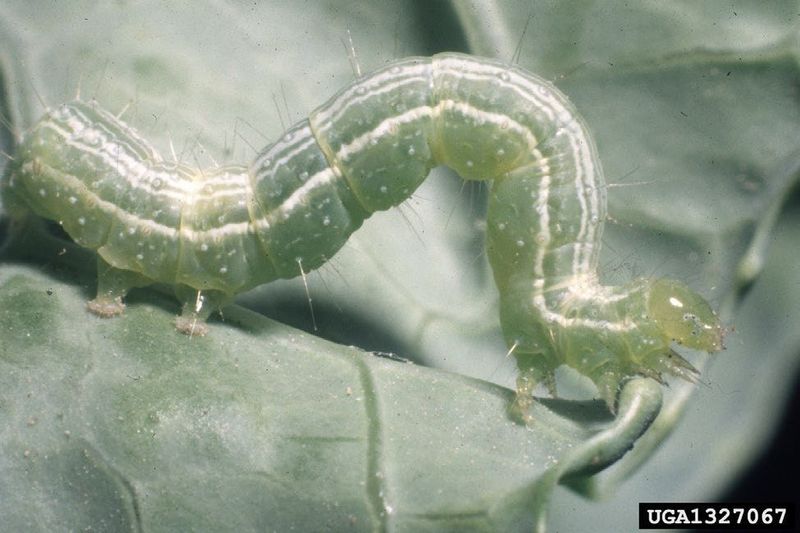
Once you find a larva, body shape and movement are your best identification tools. The cabbage looper is a light to dark green caterpillar, often marked with pale stripes running along its sides, and it moves by pulling its rear end forward and arching its midsection into a distinctive loop.
UF/IFAS looper documentation notes that fully grown larvae can reach about one and a half inches. The looping movement is usually the fastest way to tell it apart from the other two species at a glance.
Imported cabbageworm looks quite different up close. It is a velvety or slightly fuzzy green caterpillar, generally reaching about one inch, and may carry a faint yellow stripe down its back.
Utah Extension’s imported cabbageworm profile and UGA Extension’s imported cabbageworm fact sheet both describe larvae chewing irregular holes in leaves, which can look nearly identical to looper damage from a distance. Unlike the looper, this species does not arch into a loop when it moves.
Diamondback moth larvae are noticeably smaller and more slender, smooth and pale green, and tapered at both ends. University of Minnesota Extension’s cabbage diagnostic resource associates diamondback larvae with smaller holes or translucent “windowpane” patches where the larva has scraped the leaf surface without punching through.
Combining what you see, body shape, location on the plant, and the type of feeding damage, gives you a much better picture than any single feature alone.
Nighttime activity explains the timing, but fall patterns vary by region
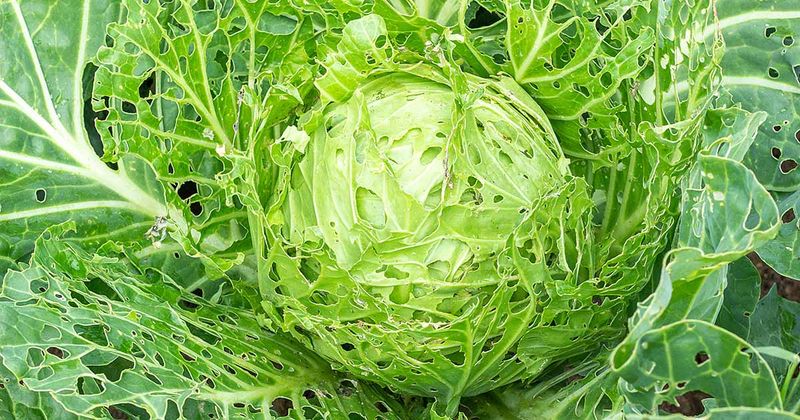
Finding fresh damage in the morning does not mean the pest only feeds after dark, but nighttime activity is part of the explanation. Cabbage loopers are more active during evening and nighttime hours, which means feeding can accumulate while the garden is unattended.
UF/IFAS looper biology reporting supports this pattern, while also noting that larvae can remain on leaf undersides or inside the plant during daylight, so the pest may still be present when you inspect in the morning.
Imported cabbageworm, by contrast, is primarily active during the day. If you are not finding caterpillars during morning or midday inspections, the species causing the damage may be harder to observe or may be tucked inside the plant rather than feeding on exposed leaf surfaces.
The timing of your inspection matters as much as the timing of the damage.
Fall seasonal pressure also varies across the South and should not be treated as a single regional pattern. UGA Extension reports that imported cabbageworm abundance peaks in fall in Georgia, while UF/IFAS notes that central Florida can experience increased looper pressure in early fall, with fall cabbage sometimes facing more looper activity than winter or spring crops.
These are regional observations, not rules that apply equally to every garden from the Florida Panhandle to West Texas.
Handpick visible caterpillars to reduce feeding right away
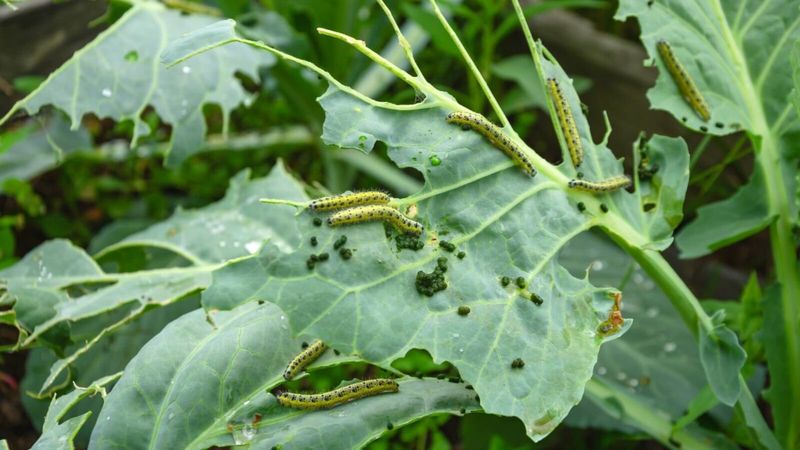
For most home gardeners, the most practical first response is also the simplest: pick off every caterpillar you can find and remove them from the garden entirely. Drop them into a container of soapy water or relocate them well away from the planting bed.
Oklahoma State University Extension’s mechanical pest control guidance recognizes handpicking as an established low-impact tactic that is appropriate for home garden situations.
Focus your effort on leaf undersides, inner foliage, and the developing head, since those are the spots where caterpillars are most likely to be resting during daylight hours. Work methodically from the outer leaves inward so you do not accidentally push larvae deeper into the plant.
Utah Extension’s brassica caterpillar resource supports thorough inspection of concealed plant spaces as part of any management effort.
Keep realistic expectations about what one session of handpicking can accomplish. Removing visible caterpillars reduces feeding immediately, but eggs may already be present on the leaves, and newly hatched larvae are small enough to miss even during a careful inspection.
A single removal session is a useful start, not a complete solution. Plan to inspect the plants again in two to three days, and repeat handpicking as needed until you stop finding new larvae or fresh damage.
Prevent new infestations with row covers and target young larvae with Btk
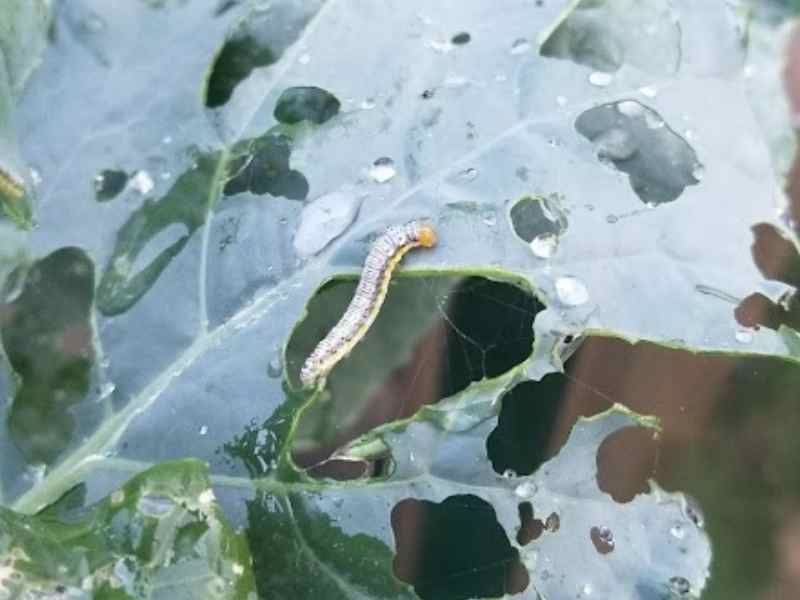
Row covers are the most reliable way to keep egg-laying adults off your cabbage in the first place, but timing matters. Install floating row cover immediately after planting or transplanting, before any moths or butterflies have had a chance to lay eggs on the foliage.
Utah Extension’s brassica caterpillar management guidance stresses securing every edge of the cover against the soil so adults cannot find a gap to enter. Row covers used this way work as a physical barrier, not a treatment, so they offer little benefit if adults or larvae are already trapped underneath.
When handpicking has not kept damage under control and you need an additional option, Bacillus thuringiensis subsp. kurstaki, commonly called Btk, is a caterpillar-specific product worth considering. It works only when a susceptible larva eats it, so thorough coverage of leaf undersides, where larvae feed and rest, is essential.
UC IPM guidance on leaf-feeding caterpillars explains that Btk works best on small, young larvae and breaks down relatively quickly in sunlight and rain, so repeat applications may be needed according to the product label.
Btk targets susceptible moth and butterfly larvae broadly, which means it is not a general remedy for aphids, slugs, beetles, or every worm in the garden. UF/IFAS natural products guidance and UC IPM’s cole crop looper management resource both caution that Btk affects butterfly and moth caterpillars broadly.
Avoid applying it near plants that host desirable butterfly larvae you are actively trying to support.
Always use a product that is registered for use on cabbage or the specific brassica you are growing. Read the full label before mixing or applying, including the pre-harvest interval and any limits on the number of applications per season.
The EPA-registered Btk product label and UC IPM’s floriculture looper notes both reinforce that product registrations and application directions vary by formulation and state, so the label is the final authority on how and when to apply.
Follow a confirmation-first plan for the next inspection
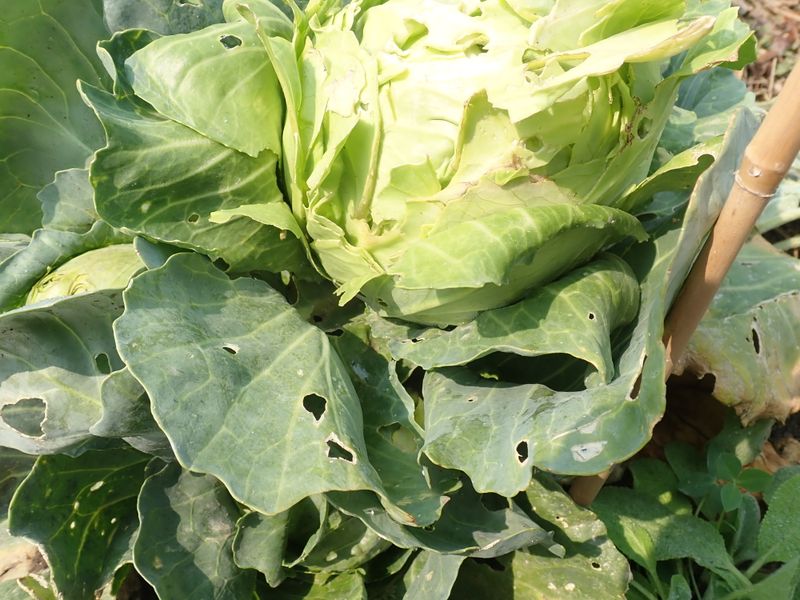
Before reaching for any control, go back to the plant and confirm what you are dealing with. Turn over outer leaves, check the undersides, spread inner foliage apart, and look inside any developing head for larvae, eggs, or dark frass.
University of Minnesota Extension’s cabbage diagnostic resource and Utah Extension’s brassica caterpillar guide both point to concealed plant spaces as the places most likely to reveal the pest.
Once you find a larva, handpick every visible caterpillar and remove them from the garden. If adults are still present or you have not yet installed protection, add floating row cover secured tightly at the soil line to block new egg-laying.
Reserve a properly labeled Btk product for situations where young larvae are still active after handpicking and row cover are in place, and apply it with thorough coverage of leaf undersides as directed on the label. UC IPM leaf-feeding caterpillar guidance reinforces that Btk works best on small larvae and may require repeat applications.
Cabbage looper may be the most likely explanation when damage is elusive and builds quickly overnight, but the honest answer is a caterpillar complex, and ragged holes alone do not close the case. Confirm before you treat, and your cabbage will have a better chance of making it to the table.