
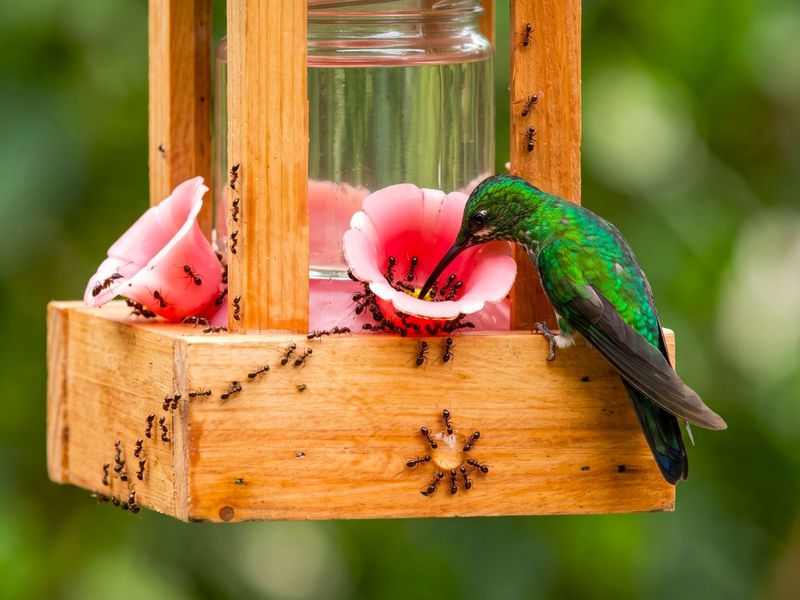
Ants have a remarkable ability to find sugar water, and once a single scout locates your hummingbird feeder, the whole trail follows fast. For gardeners in Florida, Texas, and across the South, a feeder overrun with ants is a frustrating but solvable problem.
The fix comes down to blocking their route and removing what keeps drawing them back – no harsh chemicals required.
The feeder problem is usually a route, not an ant attack
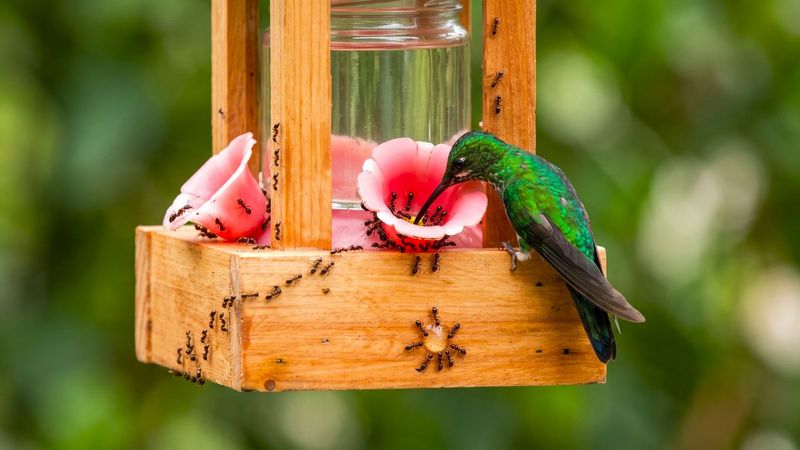
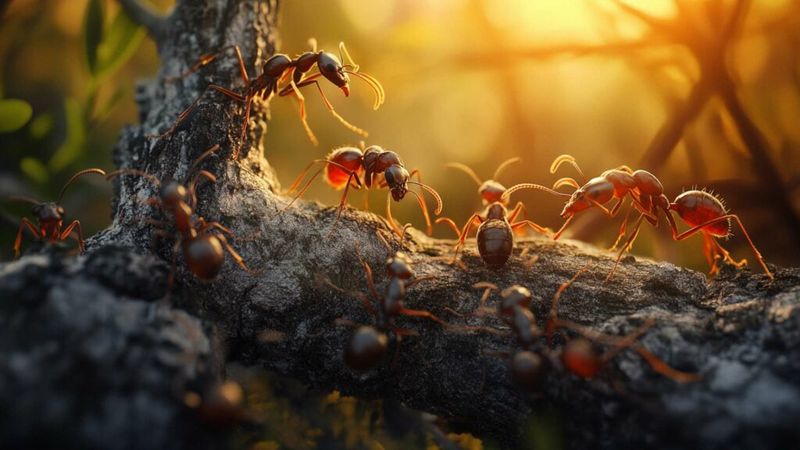
Watch a hummingbird feeder long enough on a warm Southern morning and you will eventually spot a thin dark line moving along the hanger, chain, branch, or nearby wall. That line is an ant trail, and the ants are not there to fight the hummingbirds.
They are following a scent path to the sweetest thing in your yard.
The real feeder problems that ants create are practical ones. As Iowa State University Extension notes, the documented concerns at hummingbird feeders include ants contaminating nectar, dead ants floating inside the reservoir, insects crowding the feeding ports, and nectar leaking faster when insects disturb the seals.
Ordinary ants are not predators of healthy hummingbirds, and framing them that way overstates the danger.
Knowing that the problem is a route problem changes how you fix it. Spraying ants directly at the feeder puts chemicals near nectar and feeding ports, which can expose hummingbirds and other wildlife to residues.
Blocking the path before ants reach the feeder, and removing the spills and leaks that signal “sugar here,” addresses the actual issue without putting the birds at risk. Cornell Lab of Ornithology’s yard-visitor guidance points to physical exclusion and leak prevention as the practical starting point, not pesticide application.
A water-filled moat breaks the ants’ path
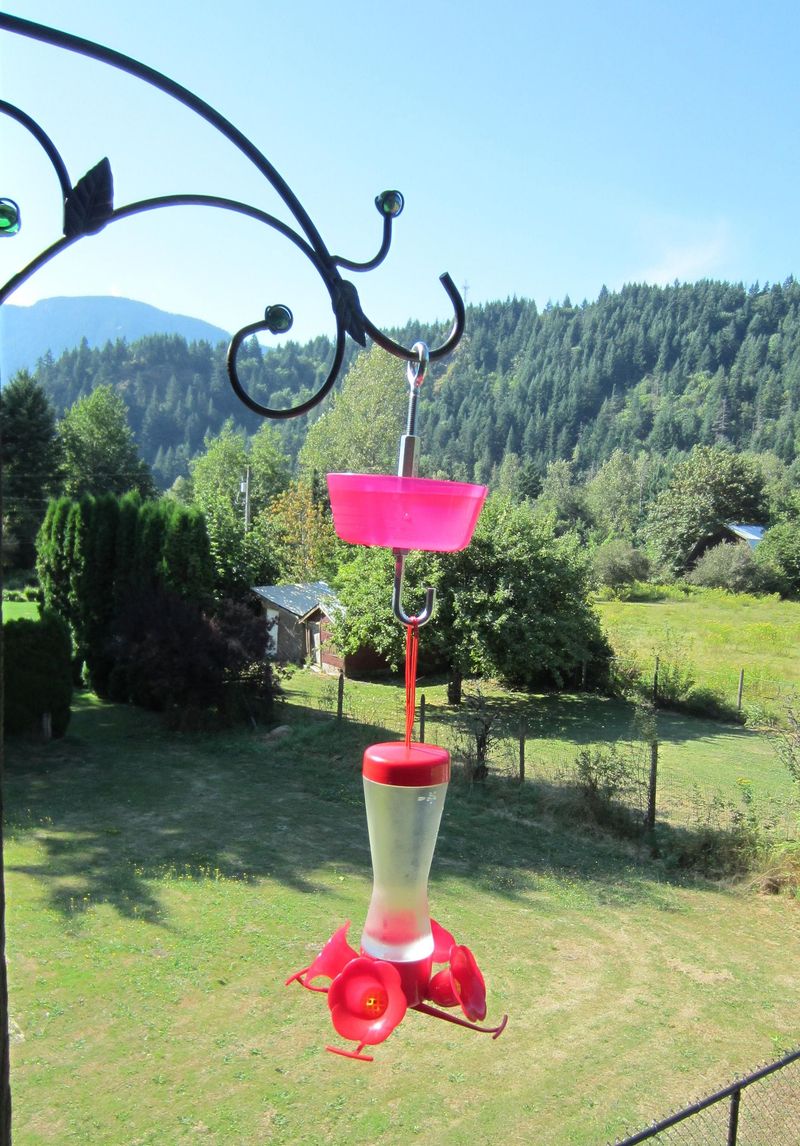
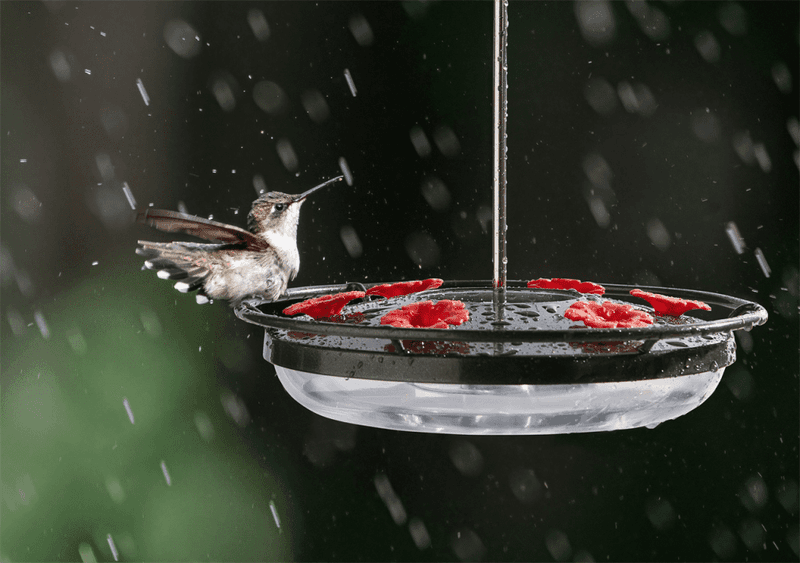
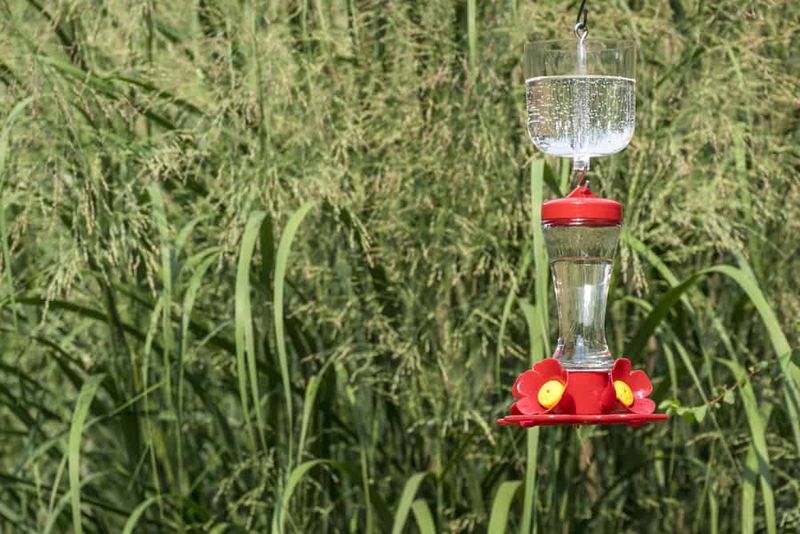
The most reliable first-line fix is a water-filled ant moat positioned between the feeder and whatever it hangs from. Ants cannot swim across standing water, so a properly filled moat stops the trail before it ever reaches the nectar.
Cornell Lab of Ornithology, Audubon, Texas Parks and Wildlife, and university extension sources all recommend this approach as the primary defense.
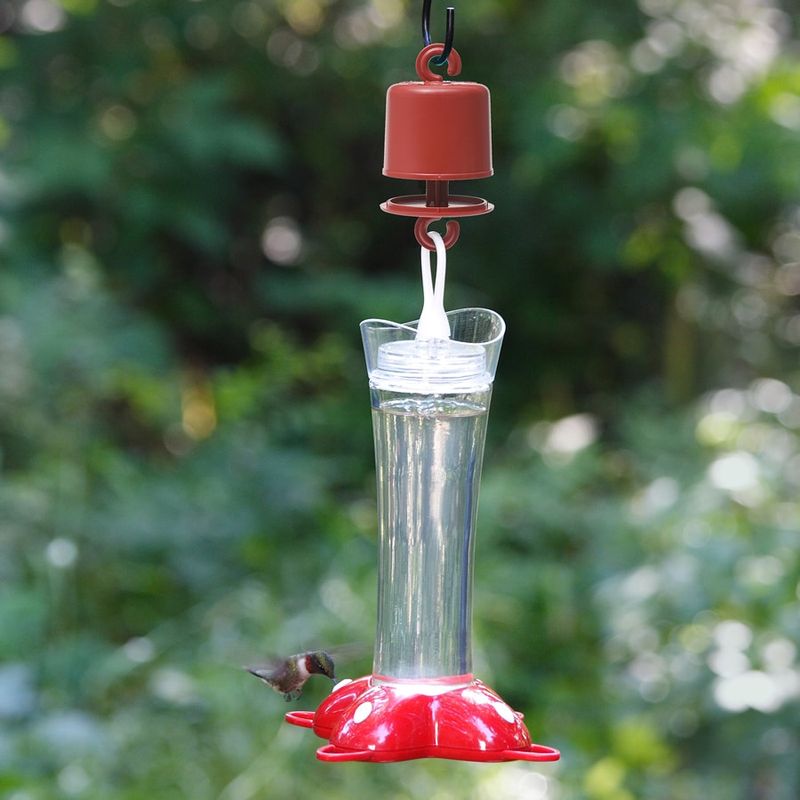
Many saucer-style feeders have a moat built into the top of the reservoir. If yours does not, a commercial ant guard screws between the feeder and its hook in minutes and costs only a few dollars.
A properly sealed homemade cup – drilled through the center, sealed around the hanging wire, and filled with water – can also work, but only if it cannot tip and spill onto the feeder below.
Fill the moat with plain clean water, not oil or any other liquid. Heat and evaporation can lower the water level or dry the moat entirely during a hot Southern summer, and once the moat dries out, ants can simply walk across the gap.
Check it every day or two and refill it whenever the level drops. In peak summer heat in Florida or Texas, that may mean topping it off daily.
A moat that is consistently full is one that consistently works; a moat that is forgotten becomes just another stepping stone on the ant trail.
Stop the leaks that keep calling ants back
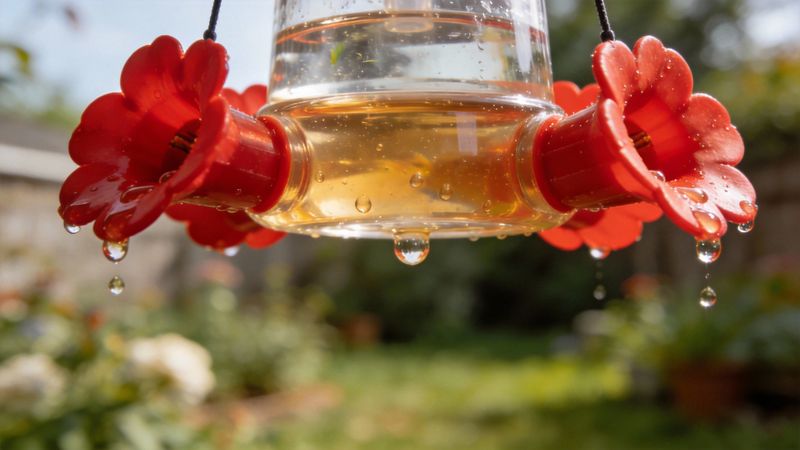
A water moat can block the main hanger route, but if the feeder is dripping nectar down its sides, ants will find that trail from below or from a nearby surface. Plugging the leak is what keeps the moat from having to do all the work alone.
Start by choosing a feeder that does not drip by design. Saucer-style feeders with the nectar reservoir below the ports tend to drip less than bottle-style feeders, where gravity and air pressure interact to push liquid out.
If you already have a bottle feeder, check that every port seal, stopper, and gasket is snug. Cornell Lab guidance on unwanted yard visitors notes that warming air inside a bottle-style feeder can expand and push nectar out, so placing that style in intense direct sun increases dripping.
Moving it to a shadier or more sheltered spot can reduce that pressure.
Wind is another leak trigger. A feeder swinging in a stiff breeze can slosh nectar over the ports and down the outside.
Penn State Extension’s hummingbird guidance suggests hanging feeders where they are sheltered from strong gusts. After any refill, wipe the outside of the feeder, the hanger, and the area around the hook with a damp cloth to remove any sticky residue.
That residue is the first signal ants receive, and removing it regularly makes your yard a less obvious destination.
Hot Southern weather makes cleanliness part of ant control
Nectar goes bad faster than most people expect, and in the heat of a Southern summer it can spoil in a day or two. Spoiled nectar is not just unhealthy for hummingbirds – the cloudy, fermented residue that builds up in ports and seams is an ant magnet in its own right.
Keeping nectar fresh and the feeder clean is part of blocking ant access, not a separate chore.
Use clear nectar made from one part plain white sugar dissolved in four parts water. University of Florida IFAS gardening guidance specifies that the red color on the feeder itself attracts hummingbirds, so there is no reason to add red food coloring, honey, artificial sweeteners, molasses, or specialty sugars.
Those additives can harm birds and accelerate fermentation.
Change the nectar every two to five days in moderate weather. University of Florida IFAS research on hummingbirds in Florida indicates that in very hot conditions, nectar may need replacing daily or every other day.
Discard it immediately if it looks cloudy or shows any mold. When you refill, scrub all ports, seams, and the reservoir with a brush, following the manufacturer’s cleaning instructions.
Rinse the feeder completely – never refill one that still holds cleaning solution. University of Florida IFAS guidance on attracting backyard birds emphasizes that thorough rinsing after cleaning is essential before nectar goes back in.
A clean feeder with fresh nectar creates far less of the sticky residue that signals ants to investigate.
What if ants are coming from somewhere else?
You filled the moat, tightened the feeder, wiped up the drips – and ants are still getting in. Before concluding the moat has failed, follow the actual trail from start to finish.
Ants are creative navigators, and the main hanger is not always the route they are using.
Look for alternate paths: a tree branch that swings close to the feeder, a wall or fence that runs near the hook, a wire or decorative chain the feeder shares with another object, or a bracket mounted to the house. Cornell Lab’s yard-visitor advice specifically recommends checking the entire route from the feeder to its support and looking for secondary contact points that bypass the moat entirely.
Trim any branch that touches or nearly touches the feeder, and move the hook away from walls or structures if the current placement creates a bridge.
Relocating the feeder to a more isolated spot – a freestanding shepherd’s hook in the middle of an open lawn area, for example – can interrupt an established ant route that has been reinforced over days or weeks. Hummingbirds are observant and will generally find the moved feeder, especially if you keep it within a reasonable distance of its original location.
The goal of relocation is to break the trail, not to hide the feeder. Once ants lose the scent path and cannot find a new route, the feeder becomes much easier to protect with the moat alone.
Skip the risky shortcuts around the feeder
When ants keep showing up, it is tempting to reach for something faster than a moat and a cleaning schedule. Most of the shortcuts people try near a hummingbird feeder are either ineffective or genuinely harmful to the birds you are trying to protect.
Never apply insecticide, ant spray, essential oils, Vicks VapoRub, or glue traps to the feeder, its hanger, the feeding ports, or the nectar. University of Maine Cooperative Extension advises avoiding pesticides around hummingbird feeders because the birds contact feeder surfaces directly and can also ingest contaminated insects.
Oil and petroleum jelly may seem like a harmless sticky barrier, but Cornell Lab specifically warns that these substances can mat hummingbird feathers – water is the safer default for any barrier filling. University of Florida IFAS feeder guidance similarly cautions against applying chemicals near feeders.
Natural remedies such as cinnamon, red pepper, orange peels, spearmint gum, and essential oils are popular suggestions online, but University of Minnesota Extension’s ant guidance lists these among methods that are not effective for controlling ants. They should not be treated as proven feeder solutions.
If you have traced the ant trail all the way to a nest or colony and other steps have not resolved the problem, targeted ant bait placed well away from the feeder is a cautious last resort. University of Tennessee Extension describes treating the colony rather than applying insecticide at the feeder as the appropriate approach.
Use only a product labeled for that use, follow the directions exactly, and place it where birds, pets, children, and pollinators cannot reach it. Bait is a secondary tool, not a replacement for the moat.
The durable fix is a routine, not a one-time cure
Keeping ants out of a hummingbird feeder is an ongoing maintenance habit, not a single installation project. A water moat installed once and never checked will dry out; a feeder cleaned once and left for two weeks in July heat will grow mold.
The steps work best as a short weekly routine rather than a one-time fix.
Run through this sequence regularly: check and refill the moat, inspect the feeder and hanger for drips or sticky residue, change the nectar on schedule (daily or every other day during the hottest stretches in Florida and Texas), scrub and rinse the feeder thoroughly, and look for any new branch or structure that may have grown close enough to create a bypass route. Cornell Lab’s feeder guidance and Penn State Extension both frame consistent maintenance as the key to keeping feeders functional and pest-free.
These measures can substantially reduce or block ants’ access to the feeder, but they will not eradicate every ant colony in your yard or guarantee that ants cannot eventually find another path. Ant colonies are persistent and adaptable.
What the routine does guarantee is that your feeder stays cleaner, your nectar stays fresher, and hummingbirds keep returning. Audubon’s hummingbird-friendly yard guidance notes that feeders work best as one part of a broader habitat that includes native flowering plants, water, and shelter – a yard built for hummingbirds is one they will keep choosing, ants or not.