
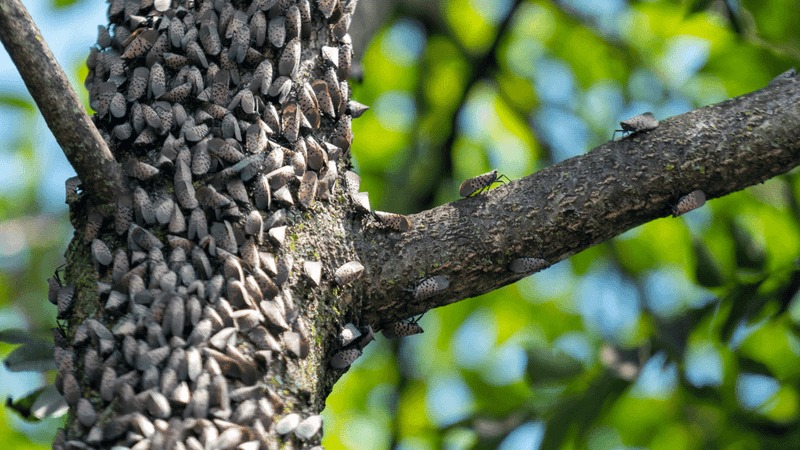
A colorful but destructive insect called the spotted lanternfly has been turning up in North Carolina yards, and one invasive tree is making it much easier for the pest to settle in. That tree is tree-of-heaven, a fast-growing invader that spotted lanternflies strongly prefer for feeding and gathering.
Understanding the connection between this tree and the insect can help homeowners make smarter decisions about their landscapes, but the full picture is more nuanced than simply blaming one plant.
Tree-of-heaven matters, but one tree does not explain every infestation
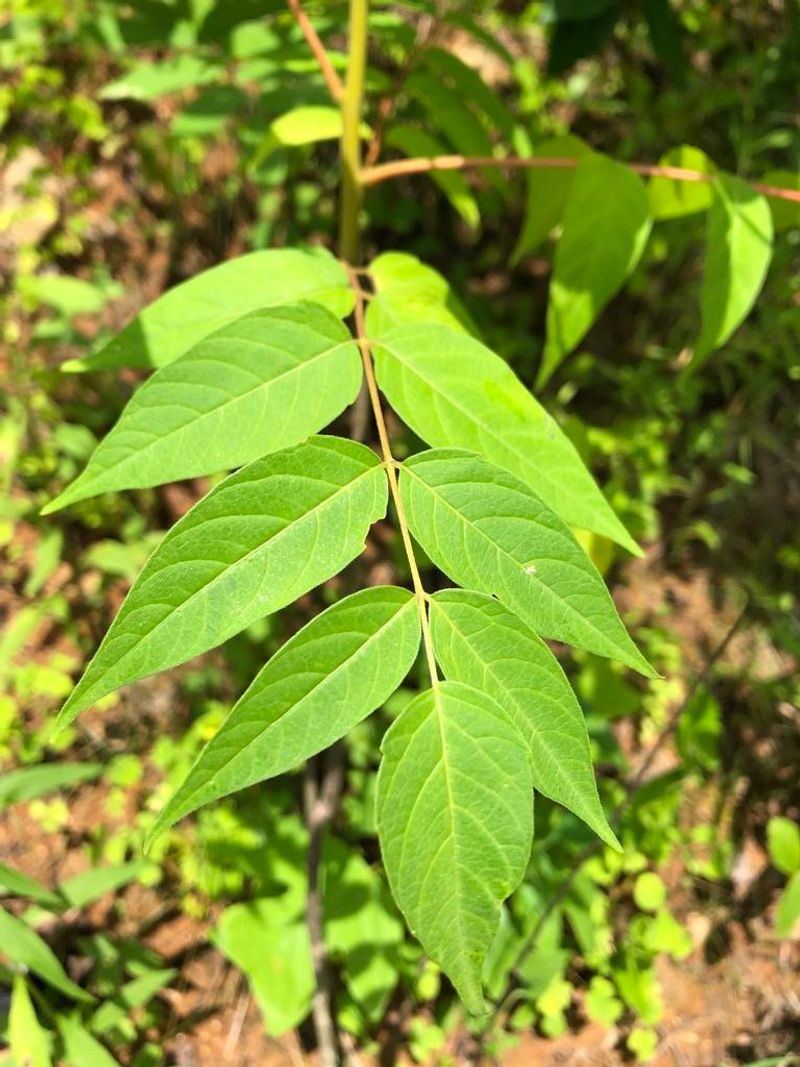
Spotted lanternflies have a clear preference when it comes to where they feed and gather, and tree-of-heaven (Ailanthus altissima) sits at the top of that list. North Carolina Department of Agriculture and Consumer Services (NCDA&CS) notes that late-stage nymphs and adults strongly favor this invasive tree, and USDA describes it as the pest’s preferred host.
You will find tree-of-heaven across the state wherever the ground has been disturbed: roadsides, field edges, fencerows, and vacant lots are common spots.
Having tree-of-heaven on or near a property can concentrate lanternfly activity in one place, which is why removing it is often the first management step worth considering. But that concentration effect does not mean the tree is the only reason lanternflies show up.
Adults move between properties on their own, and the insects use a broad range of trees, vines, fruit crops, and ornamentals beyond tree-of-heaven.
Human-assisted movement is also a major pathway. Egg masses get carried on vehicles, trailers, and outdoor equipment, which is how the pest jumps into areas where it was not present before.
As of February 10, 2026, NCDA&CS had confirmed established populations in seven counties: Forsyth, Guilford, Rockingham, Caldwell, Davidson, Rowan, and Caswell. Verify that count again before publication, because the situation is still developing.
Whether or not tree-of-heaven grows on your property, the insect can arrive – and managing this invasive tree is one practical step, not a complete solution by itself.
How tree-of-heaven can intensify a local nuisance
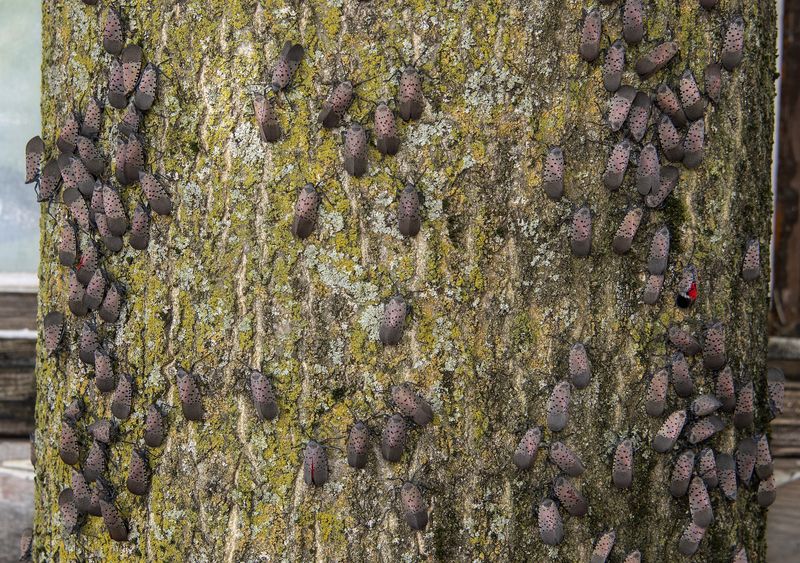
Tree-of-heaven does not just attract spotted lanternflies – it can pull them in from a wide area and keep them feeding in one spot for extended periods. When large numbers of insects gather on a single tree, the feeding activity becomes visible quickly.
The insects pierce plant tissue and extract sap, then excrete a sticky, sugary waste product called honeydew.
Honeydew coats surfaces beneath and around the tree, attracting ants and wasps that feed on the sugary residue. Over time, a black fungus called sooty mold colonizes the honeydew deposits, leaving dark, grimy patches on leaves, furniture, decks, and anything else underneath the canopy.
Tree-of-heaven adds to the problem because it is itself an aggressive spreader. It produces large quantities of wind-dispersed seeds and sends up root suckers that can emerge several feet from the parent plant, allowing it to form dense colonies if left unchecked.
The National Invasive Species Information Center describes tree-of-heaven as one of the most problematic invasive plants in the eastern United States precisely because of how quickly it colonizes disturbed ground.
Removing tree-of-heaven from a property may reduce the local feeding pressure, honeydew output, and nuisance concentrations associated with that particular tree. Penn State Extension cautions, however, that host-tree removal has not been specifically evaluated for reliably reducing spotted lanternfly populations, and adults can continue arriving from neighboring properties.
Egg masses are also laid on many surfaces besides trees, so eliminating one preferred host does not close every reproductive pathway.
Identify the tree before you remove anything
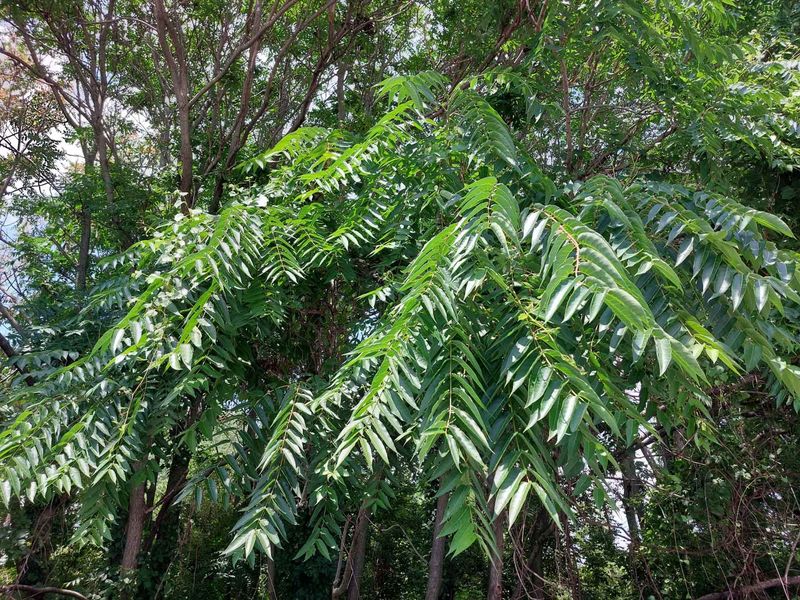
Before reaching for a saw or a herbicide, take time to confirm what you are actually looking at. Tree-of-heaven has a distinctive set of features, but compound leaves alone do not identify it – several native trees share that same basic structure and could easily be mistaken for the invasive species.
Penn State Extension describes tree-of-heaven leaves as large and compound, often reaching 1 to 4 feet in total length, with many leaflets arranged along a central stem. The edges of those leaflets are generally smooth rather than toothed or serrated.
When you crush a leaf or snap a twig, the plant releases a noticeably foul odor – sometimes compared to rancid peanut butter or burnt rubber – which is one of the most reliable field clues. Female trees in late summer and fall carry clusters of papery, winged seeds that spin like propellers when they fall.
Penn State’s native look-alike guide highlights black walnut and staghorn sumac as two native species that homeowners commonly confuse with tree-of-heaven. Black walnut leaves have more numerous, slightly toothed leaflets and a milder, distinctive walnut scent.
Staghorn sumac has leaflets with clearly toothed edges and produces dense, upright clusters of fuzzy red berries rather than winged seeds. Both are native to North Carolina and valuable to local wildlife, so misidentifying either one and removing it would be a real loss.
If the features still seem unclear after a careful look, get a second opinion before taking any action. USDA APHIS recommends confirming tree identity through a local cooperative extension office or a qualified arborist.
A few extra days spent on identification can prevent the accidental removal of a healthy native tree.
Cutting the trunk alone can make control harder
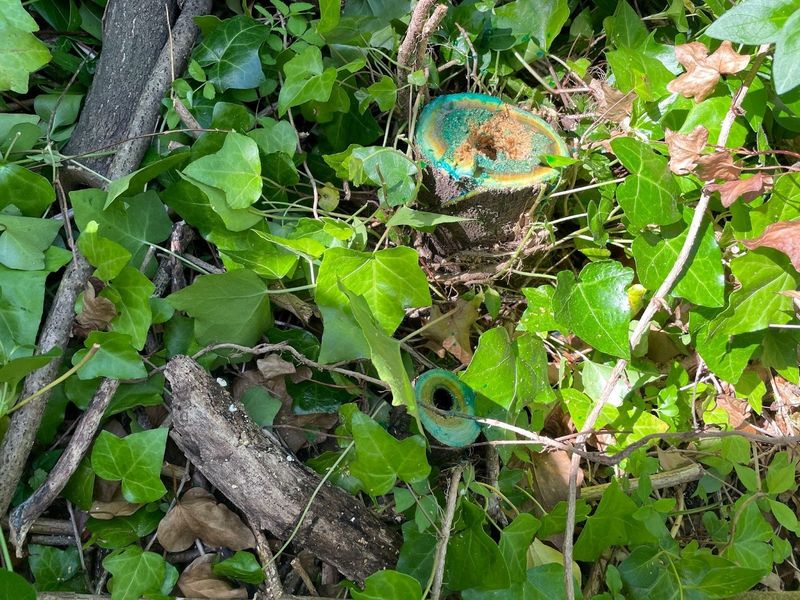
Cutting down a tree-of-heaven and walking away is one of the most common mistakes homeowners make with this plant. The trunk may be gone, but the root system remains fully alive and responds to that injury by sending up a flush of new growth.
Stump sprouts emerge from the cut base, and root suckers can push through the soil several feet in every direction, sometimes producing more stems than the original tree.
Penn State Extension explains that effective tree-of-heaven control requires treating the root system, not just removing the above-ground portion. A properly selected and labeled systemic herbicide moves through the plant’s vascular tissue and reaches the roots, which is what prevents the aggressive resprouting that follows a simple cut.
Without that root-system treatment, a single cut can result in a multi-stemmed thicket that is harder to manage than the original tree.
Timing matters as much as method. Penn State’s cut-stump herbicide guidance notes that late-season treatments tend to be more effective because carbohydrates are moving downward toward the roots at that time of year, carrying herbicide along with them.
Standard cut-stump applications made at the wrong time of year may control the stump without stopping root suckers from emerging nearby.
Any herbicide used must be applied strictly according to its label, which is a legal requirement under EPA labeling requirements for pesticide products. North Carolina may also have specific use requirements, so check state guidance before applying any product.
After treatment, plan to monitor the area through at least one full growing season and address any regrowth promptly, because a single follow-up application is often needed to finish the job.
Know when professional control makes sense
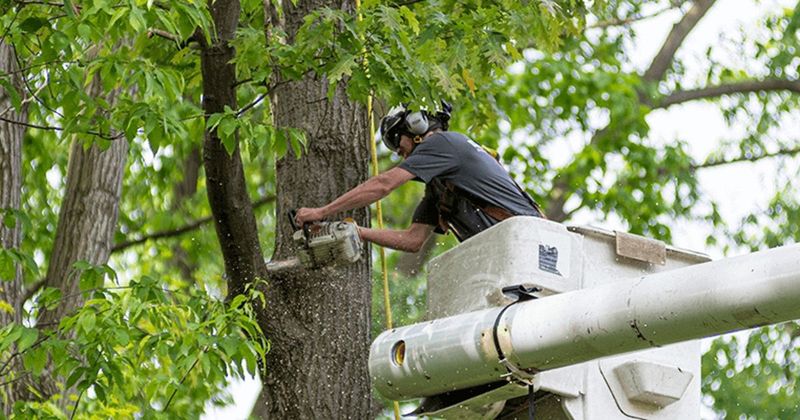
Some tree-of-heaven situations are straightforward enough for a careful homeowner to handle – a small sapling pulled by hand, or a young stem treated with a labeled herbicide. Others call for professional help, and knowing the difference can prevent property damage, personal injury, and a bigger invasive-plant problem down the road.
University of Maryland Extension advises homeowners to hire a qualified tree-care professional whenever a tree is large, structurally compromised, or positioned near a structure. Tree-of-heaven near power lines is never a do-it-yourself removal.
Utility-line work requires specialized equipment and training, and attempting it without both creates serious risks. A large colony of tree-of-heaven also benefits from professional assessment, because treating dozens of stems requires planning to avoid stimulating mass root-sucker regrowth across the whole area.
Professional help also reduces the risk of misidentification. A certified arborist or invasive-plant specialist can confirm the species on-site and recommend the right combination of removal and herbicide treatment for the specific situation.
Off-target herbicide drift is another concern when treating plants near gardens, water features, or neighboring properties – situations where a professional applicator’s judgment and equipment make a real difference.
North Carolina Forest Service recommends removing exotic invasive plants and replacing them with suitable native species where practical. If tree-of-heaven has been filling a spot in the yard, replacing it with a native tree after control is complete supports local wildlife and reduces the chance of another invasive plant colonizing the same disturbed ground.
Penn State Extension also notes that follow-up monitoring is essential regardless of who does the initial removal, because root systems can persist and resprout for more than one season.
Scout the yard instead of spraying everything
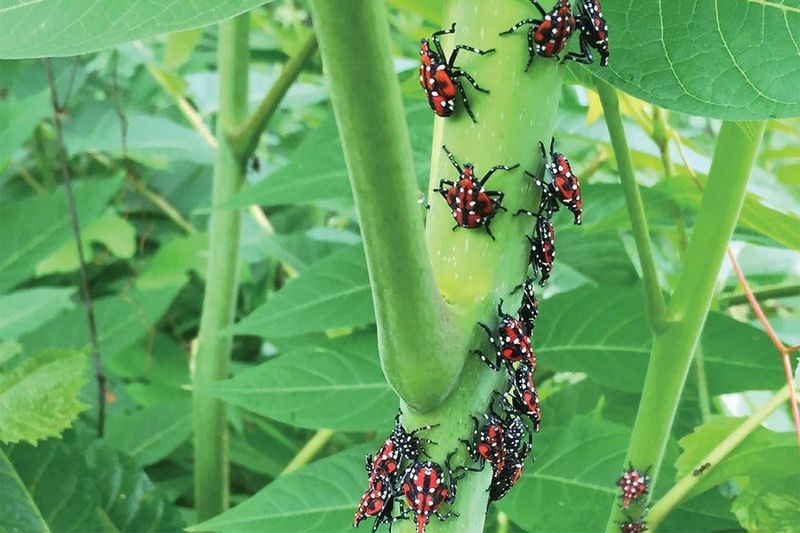
Finding spotted lanternflies in the yard does not automatically mean reaching for an insecticide. A measured response starts with looking carefully at what is actually happening: how many insects are present, what life stage they are in, which plants they are using, and how healthy those plants currently are.
Penn State Extension’s spotted lanternfly management guide recommends weighing all of those factors before deciding whether treatment is warranted, and it specifically notes that not every infested plant requires insecticide application. A few adults on a healthy, established tree represent a very different situation from a large nymph population on a stressed grapevine or a young fruit tree that is already struggling.
Nearby preferred hosts, including any remaining tree-of-heaven, also factor into the decision because they affect how quickly populations may build.
Broad, automatic spraying carries real costs. Insecticides that kill spotted lanternflies on contact also harm pollinators, parasitic wasps, and other beneficial insects that use the same plants.
Treating the entire yard without a clear target can disrupt those populations without meaningfully reducing the lanternfly pressure, especially when adults continue arriving from outside the treated area.
Penn State Extension specifically warns against using dish soap, vinegar, salt, essential oils, or homemade mixtures on spotted lanternflies. These remedies have not been adequately tested for this pest, can injure plants and non-target organisms, and may be applied in ways that violate pesticide law.
When treatment is appropriate, use a product labeled for the target pest and site, follow the label exactly, and consider consulting your local cooperative extension office for current North Carolina-specific recommendations. University of Maryland Extension also emphasizes that physical removal of egg masses and targeted spot treatments on high-priority plants are often more practical first steps than yard-wide spraying.
Check equipment and report suspected infestations
Removing tree-of-heaven from a property closes one feeding and aggregation site, but it does not seal every entry point. Adults fly and walk between plants, and egg masses travel on almost anything that moves.
Checking your own equipment before and after trips is one of the most effective things a North Carolina homeowner can do to slow the spread.
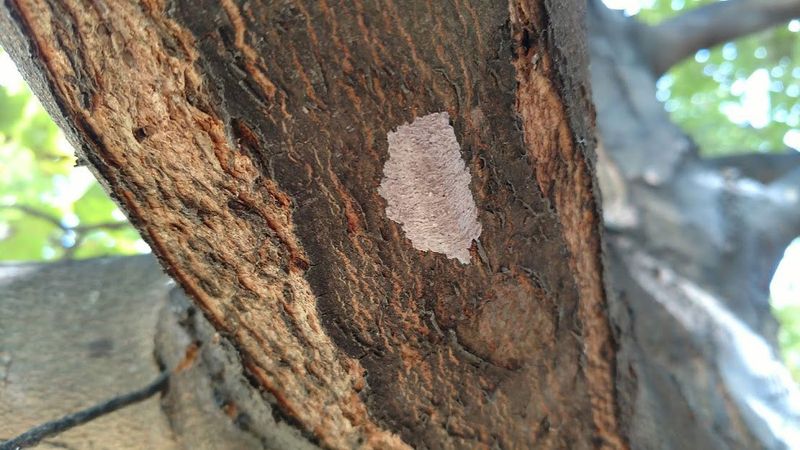
USDA APHIS identifies human-assisted movement as a primary spread pathway for spotted lanternfly, with egg masses found on vehicles, trailers, campers, grills, outdoor furniture, fences, rocks, firewood, and other hard surfaces. The egg masses themselves look like a smear of dried mud or putty – grayish-brown, roughly an inch long, and sometimes covered with a waxy coating.
They can be scraped off and dropped into a bag of rubbing alcohol to destroy them. Check the undercarriage, wheel wells, bumpers, and any flat surface on vehicles that have been parked near wooded areas or infested sites.
Reporting matters just as much as checking. NCDA&CS found spotted lanternfly in three additional counties in early 2026 and is actively tracking the pest’s spread across the state.
If you spot what looks like a spotted lanternfly or an egg mass, especially outside the seven confirmed counties, photograph it clearly and report it through the NCDA&CS spotted lanternfly reporting system. Early reports from new locations help the state respond before populations become established.
The practical decision rule is straightforward: identify accurately before cutting or treating anything, address tree-of-heaven and its regrowth when you find it, keep scouting through the growing season, and report anything uncertain to NCDA&CS. Penn State Extension notes that no single action eliminates spotted lanternfly from a landscape – consistent, layered management is what keeps pressure manageable over time.
The homeowner who scouts regularly and reports promptly contributes more to slowing this pest than any one-time yard treatment ever could.