
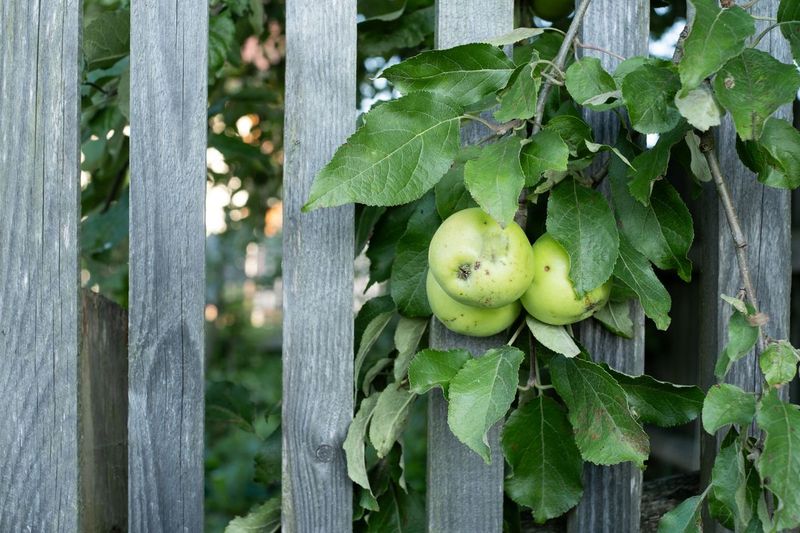
Most California homeowners assume the answer is simple: if fruit hangs over your fence, it belongs to whoever it hangs over. That assumption turns out to be wrong, or at least far less settled than people expect.
California law separates tree ownership, branch encroachment, and fruit ownership into three distinct questions, and only one of them has a clear answer. Understanding the difference can save you from a neighbor dispute, an expensive legal mistake, or a trespassing claim over a lemon.
The fence does not decide who owns the tree
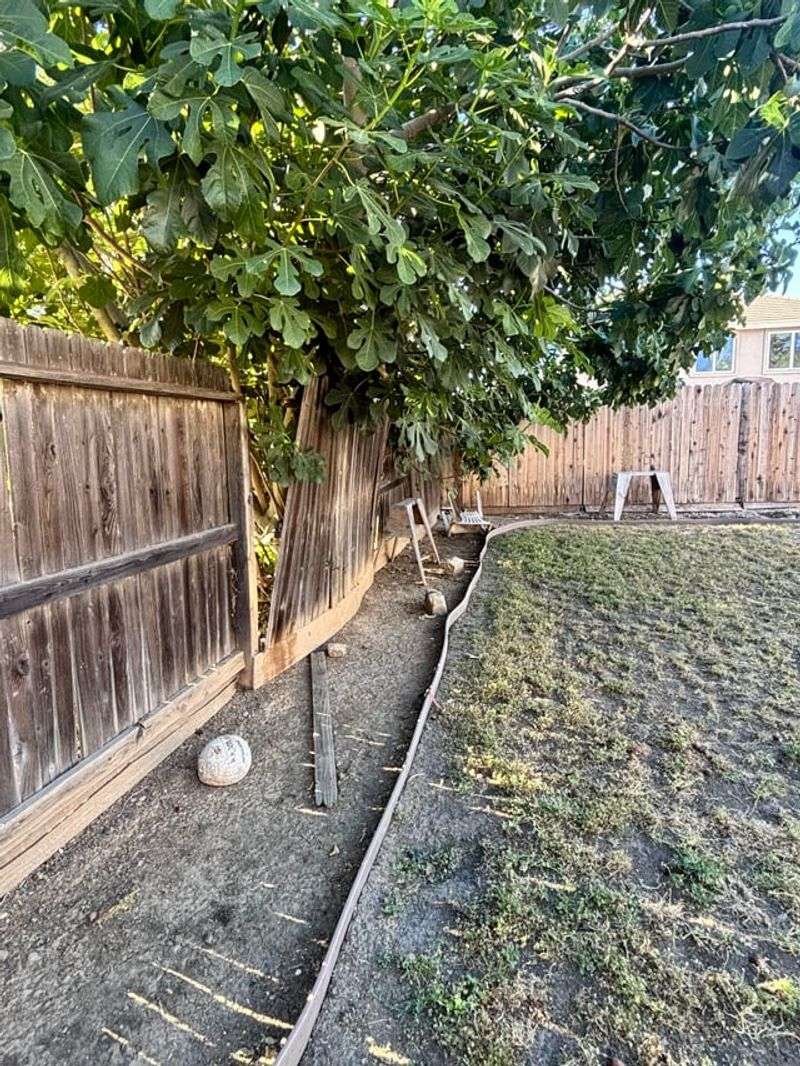
Property lines and fence lines are not the same thing. Many California homeowners discover this the hard way when a neighbor disputes a tree, a pruning cut, or a pile of fallen fruit.
The fence you see may have been built in the wrong place, shifted over decades, or simply agreed upon by prior owners without a formal survey. Before making any decision about a tree near a shared boundary, you need to know where the legal property line actually sits.
California Civil Code section 833 provides the starting rule for tree ownership: a tree whose trunk stands wholly on one owner’s land belongs to that landowner. That is true even if the tree’s roots creep into the neighbor’s soil or its branches shade the neighbor’s patio.
The roots and branches crossing the line do not transfer ownership of the tree itself. Civil Code section 833 makes the trunk’s location the controlling fact, not where the canopy spreads or where the roots travel.
A different rule applies when the trunk straddles the boundary. Under Civil Code section 834, a trunk that grows partly on both parcels creates common ownership.
Neither neighbor can unilaterally remove or seriously damage a boundary tree without the other’s agreement, and disputes over a shared trunk can become complicated quickly.
A University of California legal review of tree disputes in California confirms that the trunk location is the threshold question and recommends using a licensed surveyor when ownership is genuinely in doubt. Treating the fence as the boundary before verifying the survey can lead to pruning cuts or fruit-picking decisions that turn out to be legally wrong.
Establish the actual property line first, then apply the rules that follow.
An overhanging branch is an encroachment, not a blank check
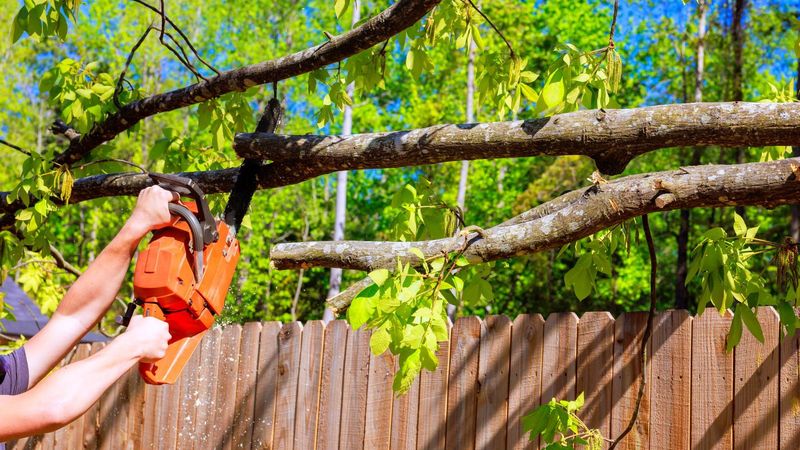
Once you know the trunk is on the neighbor’s side, the branches that cross your fence are a separate legal matter. California courts have addressed encroaching branches directly, and the rule they have established is narrower than most homeowners expect.
A neighbor whose branches grow over your land generally has the right to cut those branches back, but only to the actual property line, not an inch beyond it.
The California Supreme Court addressed this as far back as 1889 in Grandona v. Lovdal, recognizing that branches and growth extending over a neighbor’s land are treated as an encroachment that the affected landowner may address.
A later Court of Appeal decision, Bonde v. Bishop, reinforced that the neighbor’s right to cut is limited to the encroaching portion and does not give the cutter permission to cross into the other yard, climb trees on the owner’s side, or remove growth that has not crossed the line.
Critically, the right to prune encroaching branches does not mean you own the tree, and it does not automatically settle who owns the fruit attached to those branches. Those are separate questions.
The pruning right is a self-help remedy for an encroachment, not a transfer of property rights over the whole tree or everything it produces.
A practical point worth remembering: pruning from your own side of the fence only. The right to cut back encroaching growth does not authorize you to enter the neighbor’s yard, and it certainly does not mean you can trim branches that have not yet crossed the line.
A UC Agriculture and Natural Resources legal review of California tree disputes makes clear that entry onto the neighbor’s property for pruning purposes requires separate authorization, such as a written agreement or a court order.
Attached fruit raises an unexpected but unsettled argument
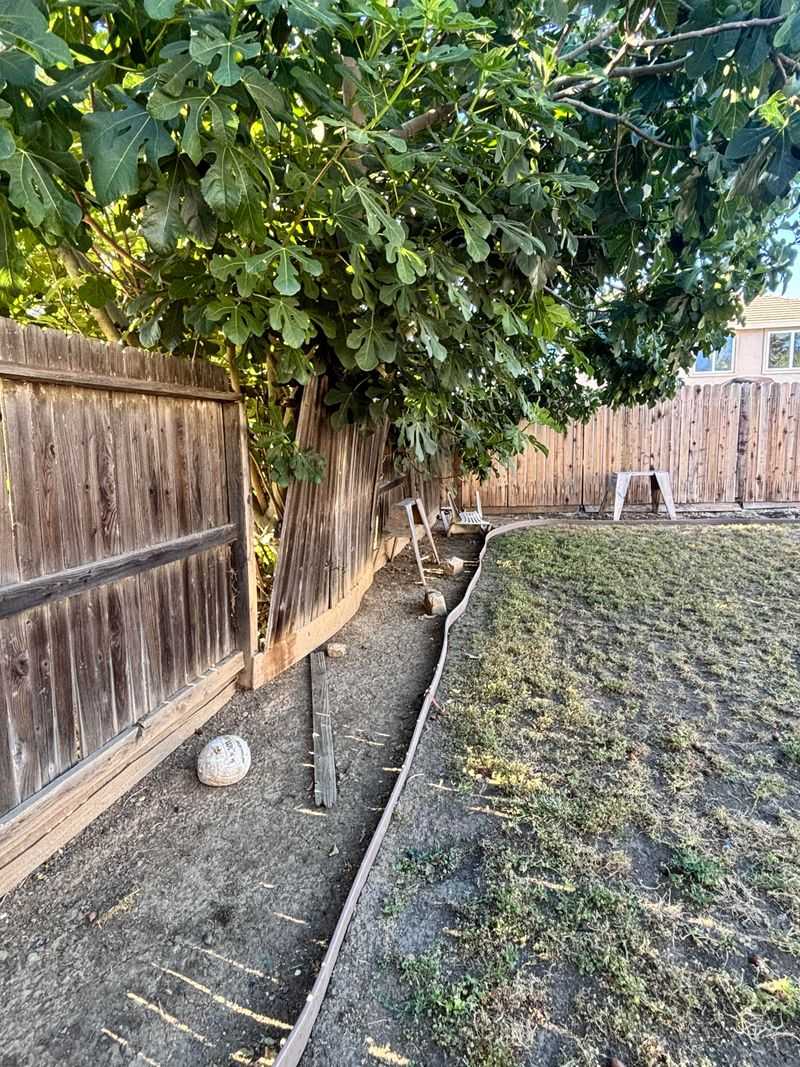
Here is where California law surprises most people. If the branch crossing your fence belongs, in a property-law sense, to you as the landowner beneath it, then what about the fruit still attached to that branch?
The answer is more complicated than a yes or no, and anyone who tells you otherwise is skipping the fine print.
The California Supreme Court’s decision in Grandona v. Lovdal stated that branches and useful material growing over the plaintiff’s land belonged to the plaintiff.
Some California legal analysts apply that reasoning to fruit attached to the overhanging portion of a branch, concluding that the landowner beneath the overhang may have a colorable claim to that fruit while it is still attached.
The UC Agriculture and Natural Resources legal review supports this interpretation as the best-reasoned reading of California property law. The Community Law Center’s Urban Agriculture Law Project similarly notes that the branch-encroachment framework creates an argument for the neighbor’s ownership of attached fruit over their land.
What is equally important to state clearly: this interpretation does not appear as an express command in Civil Code section 833 or section 834. No readily available current California appellate decision specifically resolves every attached-fruit dispute in a neighbor’s favor.
The fruit-specific conclusion is the strongest available California-based argument, not a settled statutory rule. Both common assumptions, that the trunk owner always owns the fruit and that the neighbor automatically gets whatever hangs over the fence, overstate what the law actually says.
The Sacramento Bee’s reporting on this question reflects the same honest uncertainty: California legal experts point to the branch-encroachment logic as the most persuasive framework, but caution that a court has not cleanly resolved the fruit question in a published decision most homeowners can rely on. Treat it as a serious argument, not a guaranteed right.
Fallen fruit creates a different question
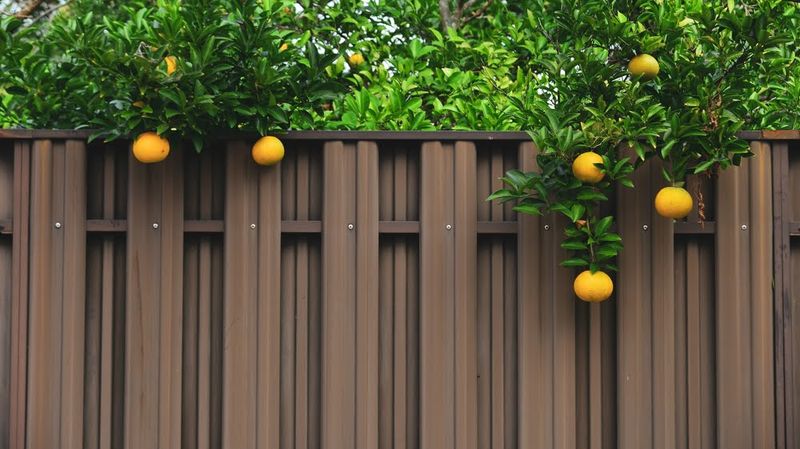
Fruit still attached to a branch and fruit lying on the ground after falling are two distinct situations under California property law, and the rules that may apply to one do not automatically carry over to the other. Homeowners sometimes assume that once fruit lands in their yard, the question is settled.
That assumption is harder to support than it sounds.
The Community Law Center’s Urban Agriculture Law Project notes that the legal status of windfall fruit, fruit that drops onto a neighbor’s property, is not definitively resolved by a current California appellate ruling covering every scenario. The branch-encroachment reasoning that supports an argument about attached fruit does not necessarily extend to fruit that has already separated from the branch and landed on the ground.
Some readers point to common sense: if it fell in my yard, it must be mine. But property law does not always follow common sense, and the sources available for California do not confirm that gravity alone transfers ownership of every piece of fruit.
The Sacramento Bee’s coverage of the topic reflects similar caution, noting that California legal experts are reluctant to state a flat rule for windfall fruit.
The practical takeaway is the same as it is for attached fruit: ask before collecting, even when the fruit is lying in your own yard. Permission from the tree owner costs nothing and removes any dispute about who has the right to what.
Treating fallen fruit as automatically yours, without checking, carries a small but real risk of being wrong about California law in a situation where no clear appellate authority has your back.
Pruning stops at the line—and reasonableness still matters
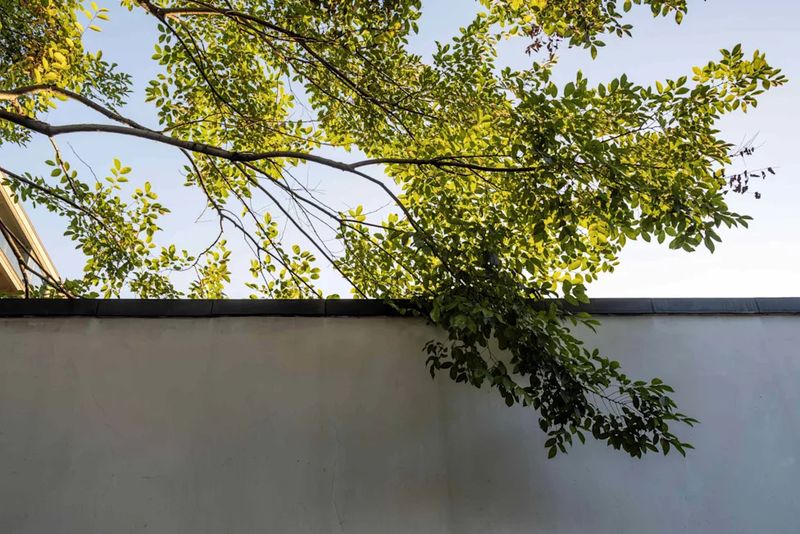
Knowing you have a right to prune encroaching branches is not the same as having a right to prune however you want. California courts have addressed this directly, and the standard they apply is reasonableness, not unlimited self-help.
The recognized limit is the actual property line, and the recognized constraint is avoiding foreseeable harm to the tree’s health, structure, or appearance.
The Court of Appeal’s decision in Booska v. Patel rejected the idea that an adjoining landowner has an unrestricted right to do anything to encroaching roots or branches regardless of the foreseeable consequences to the tree.
A neighbor who cuts back branches in a way that predictably damages the tree, kills major limbs, or destroys the tree’s usefulness is not simply exercising a pruning right. That person is creating a different legal problem.
Crossing the boundary to make a cut is also a separate issue. Bonde v.
Bishop makes clear that the right to remove encroaching growth does not authorize entry onto the neighbor’s property. Pruning must generally happen from your own side of the line, using tools that reach the encroaching portion without requiring you to step over.
If pruning causes serious injury to a neighbor’s tree, California Civil Code section 3346 can come into play. The statute addresses wrongful injury to trees and provides for double damages in cases of casual or mistaken trespass and potentially treble damages for willful conduct.
The key word is wrongful: California jury instruction CACI 1002 reflects that liability depends on the facts and court findings. Lawful pruning of exactly the encroaching portion, done reasonably, is not the target of that statute.
But unreasonable cuts that foreseeably damage or kill the tree can expose you to significant damages, and the UC legal review treats this risk as a real one that homeowners must weigh before picking up a saw.
When does overhanging growth become a real legal problem?
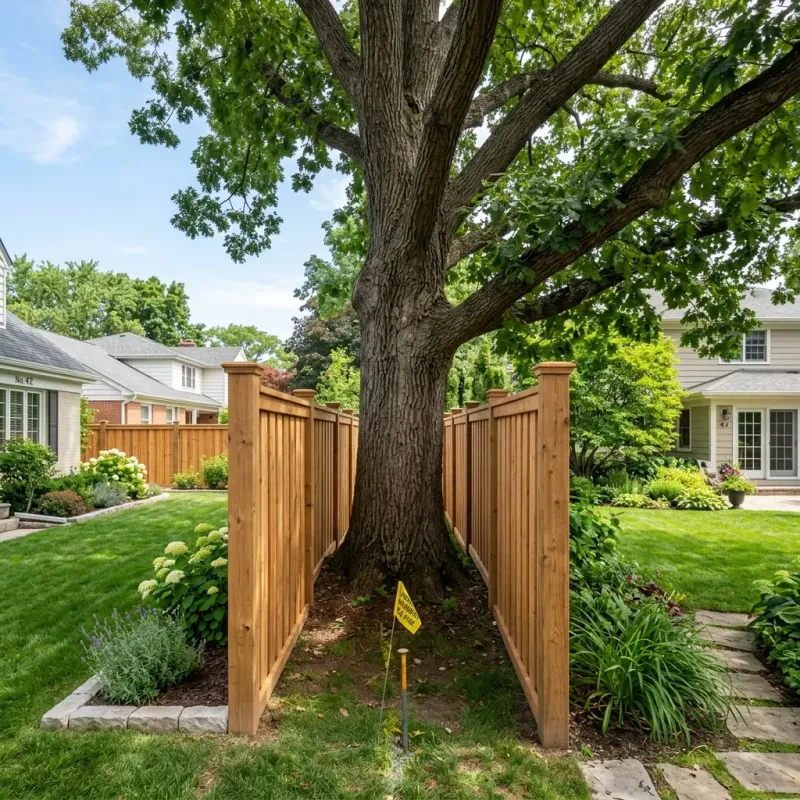
Not every branch that crosses a fence creates a legal dispute worth pursuing. California courts have drawn a meaningful line between ordinary overhang, which is common in established neighborhoods with mature trees, and growth that actually interferes with a neighbor’s health, safety, or property use.
Mere overhang into the airspace above your yard is not automatically an actionable nuisance.
California Civil Code section 3479 defines a nuisance as anything that is injurious to health, offensive to the senses, or an obstruction to the free use of property that interferes with comfortable enjoyment. Applying that standard to a tree requires more than fruit or leaves crossing a line.
Courts have recognized nuisance claims where overhanging growth drops dangerous limbs, causes repeated debris that blocks drains or damages roofing, or creates a substantial and ongoing interference with property use. Bonde v.
Bishop and Booska v. Patel both address nuisance in the context of neighboring trees, and neither suggests that any overhang automatically qualifies.
Local ordinances add another layer of complexity that many homeowners overlook. California has no single statewide law protecting every mature or heritage tree from pruning or removal.
Tree-protection rules are set by cities and counties, and they vary significantly. Berkeley’s Coast Live Oak Ordinance protects native oaks citywide.
Morgan Hill requires permits for tree removal and certain pruning. Los Angeles County has its own oak tree ordinance with separate requirements for protected species.
Before pruning any tree near a boundary, check whether your city or county has a protected-tree list, a heritage-tree designation program, or a permit requirement for pruning above a certain canopy threshold. Ignoring local rules while relying on the general common-law pruning right can result in fines or stop-work orders that have nothing to do with your neighbor’s fruit.
The safest answer is permission, not a test case
Legal uncertainty is uncomfortable, but it does point toward a practical answer. When you are not sure who owns the fruit, when a branch has not been measured against the legal boundary, or when a local ordinance might apply, the lowest-risk move is to ask.
Permission from the tree owner before picking resolves the ownership question in every direction at once.
Start by confirming the actual property line, not just where the fence sits. A licensed surveyor can establish the boundary with enough precision to answer whether the trunk is wholly on one parcel or straddles the line, and that answer changes every rule that follows.
The UC Agriculture and Natural Resources legal review recommends a survey when ownership is genuinely disputed, rather than assuming the fence is correct.
Once you know where the line falls, talk to your neighbor before picking fruit or making any cuts. American Bar Association guidance on tree law and the Community Law Center’s urban fruit gleaning resource both identify permission as the clearest way to avoid trespass and theft disputes, regardless of what the underlying ownership argument might be.
A verbal agreement is better than nothing, and a written note is better still.
For pruning near the boundary, check local ordinances before starting, stay on your own side of the line, and avoid cuts that could foreseeably damage the tree. For substantial work near a large or mature tree, a certified arborist can help you prune correctly and document that the work was reasonable.
If the tree grows near overhead utility lines, stop before you start. The California Public Utilities Commission and Cal/OSHA tree work safety guidance both direct homeowners to contact the utility company first and not attempt work near energized lines under any circumstances.
The practical California rule
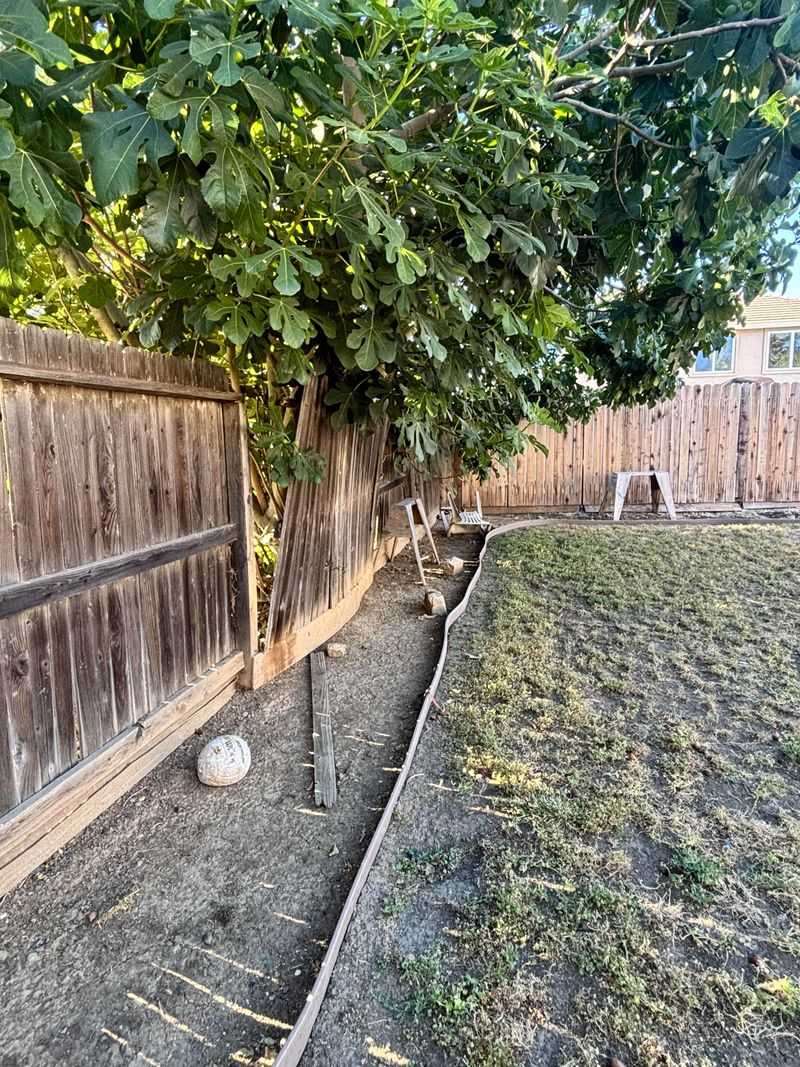
California’s approach to overhanging fruit trees comes down to three separate questions that must be answered in order. First, where does the trunk sit?
A trunk wholly on one parcel generally means that owner holds title to the tree under Civil Code section 833; a straddling trunk creates shared ownership. Second, what does an encroaching branch mean for the neighbor?
Grandona v. Lovdal and the cases that followed treat crossing branches as an encroachment subject to limited, reasonable pruning up to the boundary line, nothing more.
Third, who owns the fruit? Attached fruit over the neighbor’s land raises a genuine but unsettled argument that the landowner beneath the branch may have a claim to it, based on the branch-encroachment framework.
Fallen fruit is a separate and equally unresolved question. Neither scenario has a clear, express California statutory answer or a controlling appellate ruling that covers every situation, as the UC Agriculture and Natural Resources legal review and the Community Law Center’s urban gleaning analysis both acknowledge.
The homeowner who verifies the boundary, talks to the neighbor before picking or cutting, stays on their own side of the line, and checks local ordinances will almost always avoid the disputes that end up in court. California’s tree law rewards patience and conversation far more reliably than it rewards assumptions about who gets the fruit.