
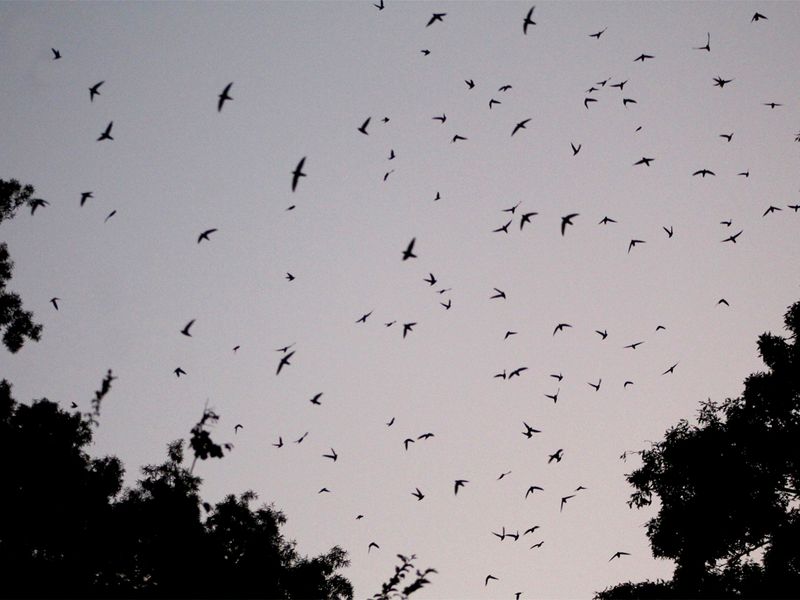
Spotting a hawk gliding in slow circles above your backyard is one of those sights that stops you mid-step. Most homeowners immediately wonder if their yard has become a rodent buffet, but the real explanation is usually more layered than that.
A hawk overhead can mean many things, from riding a warm air current to scouting a neighborhood-wide hunting range, and knowing the difference helps you respond wisely instead of jumping to conclusions.
A circling hawk reveals a usable landscape, not a yard diagnosis
Repeated hawk sightings over a North Carolina yard tend to trigger one confident assumption: the yard must be overrun with rodents. That conclusion is almost always too narrow.
When a hawk keeps appearing overhead, the more accurate read is that the surrounding landscape, not just your property line, offers some combination of accessible prey, useful perches, open hunting corridors, or efficient travel conditions that make the area worth revisiting.
Bird-hunting hawks such as Cooper’s Hawks are a useful starting point. A peer-reviewed Chicago study on urban Accipiters found that these hawks persisted in heavily built landscapes when prey birds were abundant, suggesting that prey concentration across a neighborhood matters more than the specific features of any single yard.
Cornell’s All About Birds similarly notes that Cooper’s Hawks commonly use leafy subdivisions, backyards, and bird feeders as part of a broader hunting range.
For hawks that focus on small mammals, the picture shifts toward open ground and available prey across a wider area. Red-tailed Hawks commonly soar over open country while searching for voles, mice, and rabbits, and a single bird may cover many acres in one outing.
Seeing it loop over your yard does not confirm that your yard holds more prey than your neighbor’s.
A hawk’s repeated presence is a clue worth paying attention to, but it is not a precise diagnosis. Without watching what the bird actually targets, how long it stays, and what kind of cover or open space it uses, the sighting tells you that wildlife activity exists somewhere in the neighborhood, not that your specific garden created an unusually productive hunting ground.
Use species and setting as clues, not proof
Figuring out which hawk you are watching changes what the sighting means, but distant identification is genuinely hard. A broad-winged hawk circling high above an open lawn fits the profile of a soaring buteo more than anything else.
The two buteos most likely to match that description in North Carolina are the Red-tailed Hawk and the Red-shouldered Hawk, and their habitat preferences point in different directions.
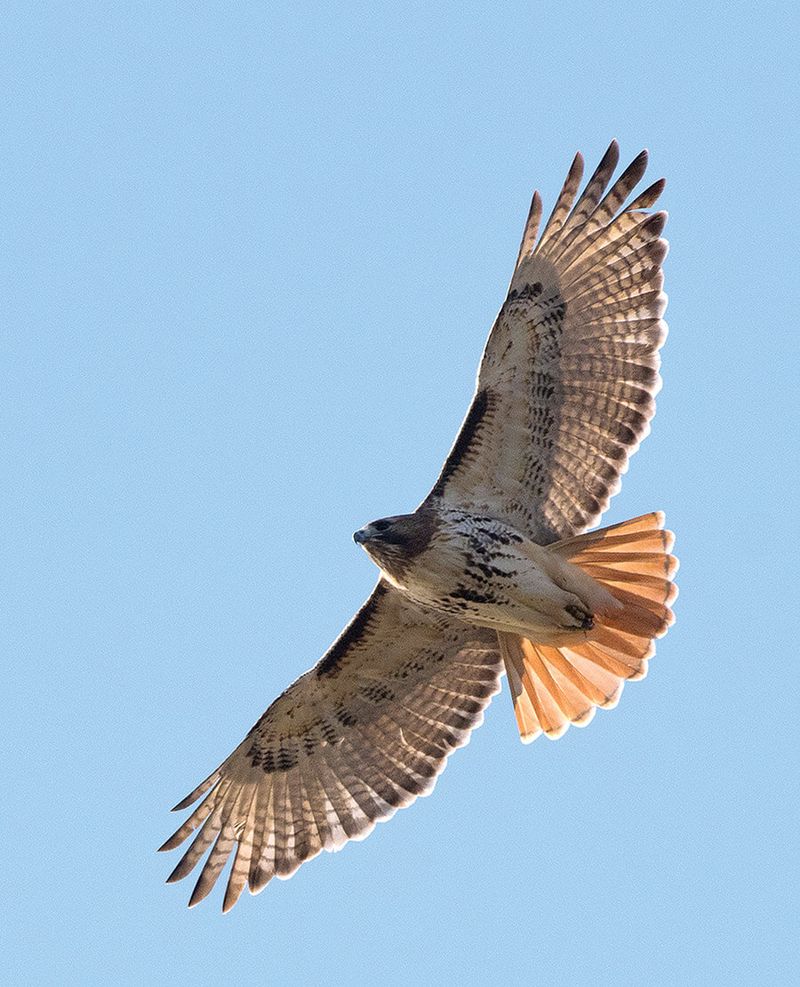
According to the North Carolina Wildlife Resources Commission, Red-tailed Hawks are the most commonly seen large hawks in the state and typically soar over open fields while searching for small animals below. If your yard borders a meadow, a mowed right-of-way, or a large open lawn, a Red-tailed Hawk is a reasonable candidate.
Their brick-red tail is visible on adults but only from above or in good light, so do not count on a single field mark to clinch the ID.
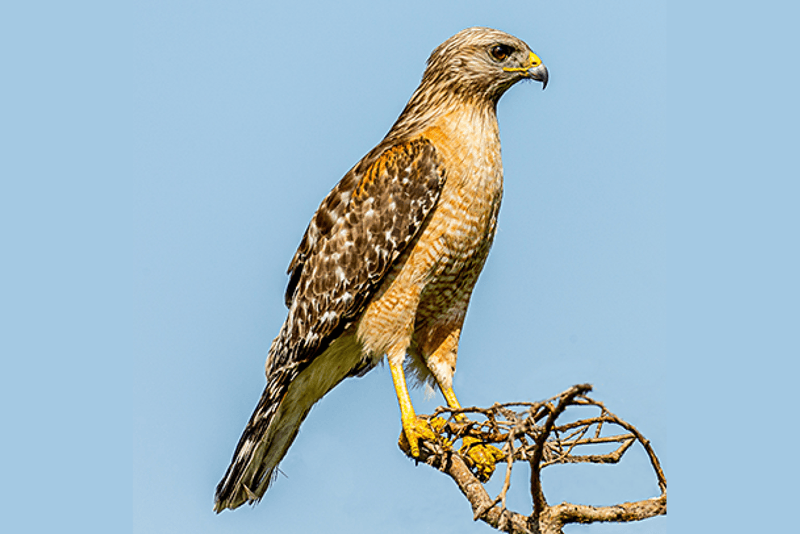
Red-shouldered Hawks follow a different pattern. The NC Wildlife Resources Commission describes this species as common statewide and capable of living in towns and suburbs, but it associates most strongly with mature woods near streams, rivers, swamps, and other wet corridors.
Its banded tail and rusty barring help separate it from a Red-tailed Hawk when the bird is close enough to study.
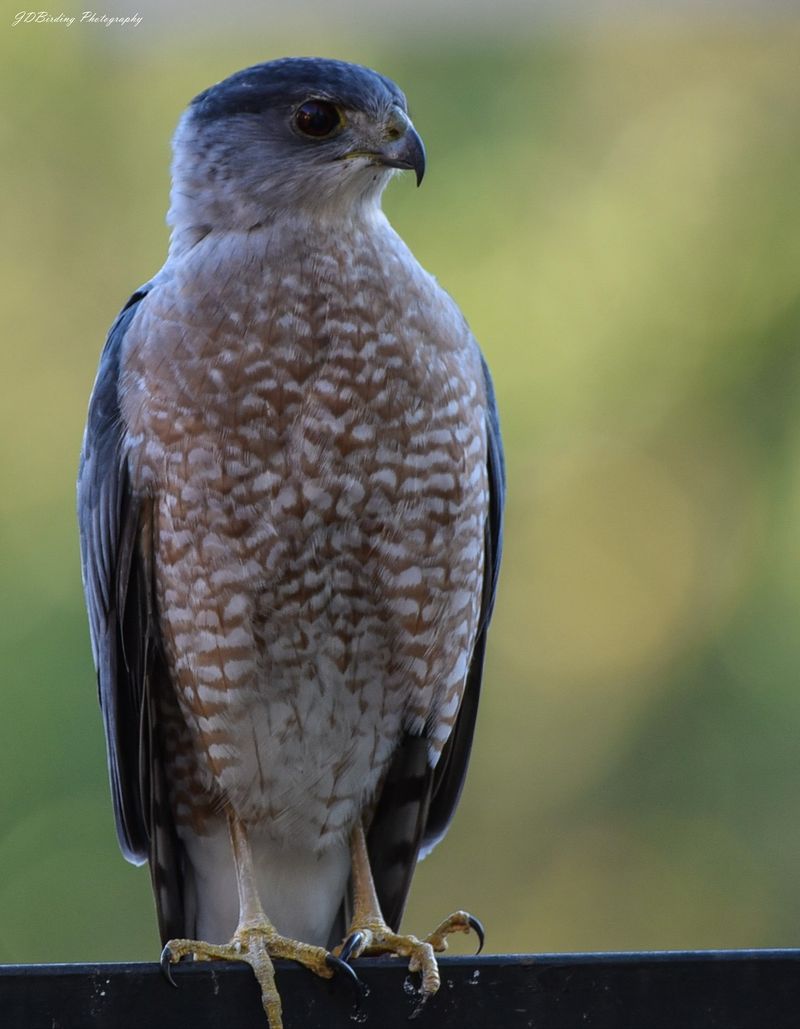
Cooper’s Hawks are the most plausible candidate when the bird is smaller, moves through tree canopy with a flap-flap-glide pattern, or shows up near a feeder. Cornell describes Cooper’s Hawks as a common backyard visitor across much of North America.
Sharp-shinned Hawks look strikingly similar and are sometimes reported at feeders as well, but telling the two apart from a distance is unreliable. A 2022 FeederWatch study found substantial confusion between Cooper’s and Sharp-shinned Hawks in citizen observations, so treat any tentative ID of a smaller Accipiter as just that: tentative.
Comparing size, tail shape, and head projection helps, but habitat and behavior remain the most reliable starting points for a backyard observer.
Feeders can concentrate the prey that attracts a hawk
Bird feeders do not attract hawks directly. What they do is concentrate songbirds, doves, and other small birds in a predictable spot, and that concentration is what a bird-hunting hawk notices.
Cooper’s Hawks mainly eat birds but also take mammals such as mice and squirrels, so a busy feeder can create exactly the kind of reliable prey density that keeps a predator returning to the same address.
Spilled seed adds a second layer. Seed that falls to the ground and sits there can attract mice, voles, and other small rodents, which opens a separate prey pathway for mammal-hunting hawks.
Georgia Extension guidance on bird feeding recommends storing seed in sealed containers and cleaning up spills regularly to reduce the rodent attraction that spilled seed creates around feeders.
None of this means every feeder creates a hawk problem. Most yards with feeders never see a hawk hunting there regularly.
The practical steps are straightforward: store seed in a secure container, sweep or rake spilled seed often, keep feeders clean to limit disease risk among songbirds, and plant or maintain dense shrubs near the feeder so smaller birds have a quick escape route. NC State Extension recommends nearby cover that lets small birds retreat quickly when a predator appears.
A feeder with escape cover nearby is a much safer setup than one placed in the open with nowhere to hide.
If a hawk does show up repeatedly at your feeder, Cornell suggests taking feeders down for a few days to break the hawk’s pattern. That simple pause is usually enough to send the bird elsewhere without permanently altering the yard.
Circling does not establish that a hunt is underway
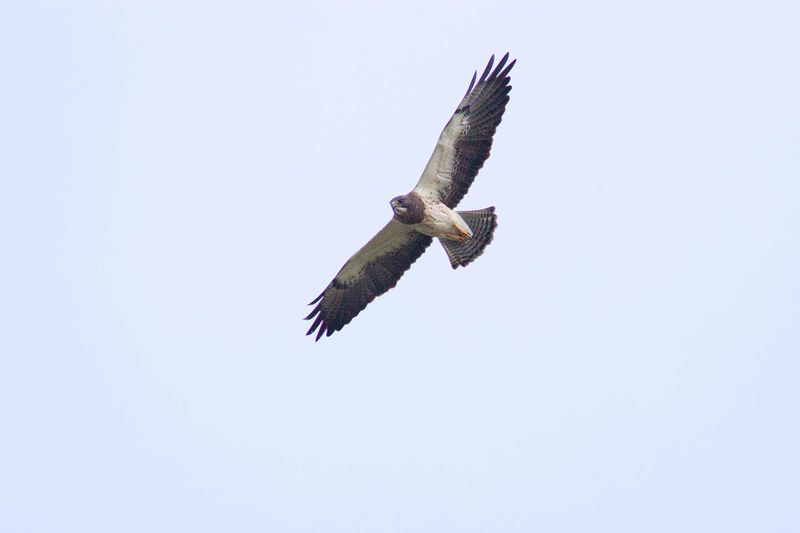
Watching a hawk circle slowly overhead feels like surveillance, but the behavior itself does not confirm that your yard is being hunted. Soaring in wide circles is an energy-efficient way for large hawks to gain altitude and cover ground, and it can happen for reasons that have nothing to do with a prey target below.
Red-tailed Hawks are well-documented soarers. Cornell’s species account describes them regularly soaring over open fields, often in the kind of broad, unhurried circles that homeowners notice from a backyard.
Red-shouldered Hawks may also circle over wooded nesting territories, particularly during the breeding season when pairs call and display near established nest sites.
One reason hawks circle without immediately stooping toward prey is thermal soaring. Warm air rising from sun-heated ground forms invisible columns called thermals, and birds use them to climb with minimal wing effort.
Cornell’s thermal soaring explainer uses Golden Eagles as its primary illustration, but the physics applies broadly to large soaring birds. Thermals are not exclusive to any one species, and a hawk riding one over your yard may simply be gaining altitude before moving on.
Summer adds other possible explanations beyond hunting. Newly fledged young hawks practice flight and may circle clumsily while learning.
Adult hawks may circle to stay within a defended territory, especially near an active nest. NC Wildlife notes that Red-shouldered Hawks can be vocal and conspicuous near nesting areas, which makes them seem more present than they might otherwise be.
A hawk that circles without diving, stooping, or pursuing anything visible is more likely traveling, soaring, or patrolling than actively targeting your yard.
A wildlife-friendly yard can support predators and prey together

Yards planted with native species, mature trees, dense shrubs, and open ground often support a wider range of wildlife than a monoculture lawn, and that range can include both predators and the animals they eat. NC State Extension’s guide to managing urban habitats for birds explains how vegetation structure, plant diversity, and water features shape which species use a yard and how.
The key word is “structure”: a yard that offers dense cover, open foraging areas, and nearby trees creates layered opportunities for many species simultaneously.
The same yard can shelter songbirds in its shrubs while also making some of those birds available to a Cooper’s Hawk passing through the canopy. Open lawn edges give a Red-tailed Hawk a clear sightline for hunting voles and mice, while a wet drainage swale or mature bottomland edge nearby can draw a Red-shouldered Hawk.
The urban Accipiter research found that hawk persistence in built environments tracked prey abundance across the broader neighborhood, not the design choices of any single homeowner.
Hawk presence does not prove that every garden feature is specifically benefiting hawks, or that the yard has achieved some certified ecological threshold. Research on urban green spaces consistently shows that wildlife response depends on a combination of factors: vegetation structure, prey availability, open space, surrounding land use, and nearby corridors.
A hawk may also visit because a feeder concentrates prey, because nearby development has funneled it through your block, or because it is simply passing between territories.
The practical takeaway is that a hawk overhead fits naturally into a yard with good wildlife habitat, but its presence does not guarantee the yard is thriving for every species or that every native animal in the area is benefiting equally. Enjoy the sighting as a sign of broader wildlife activity, and keep your habitat decisions grounded in what you can observe rather than what one bird implies.
Summer nest defense calls for distance, not removal
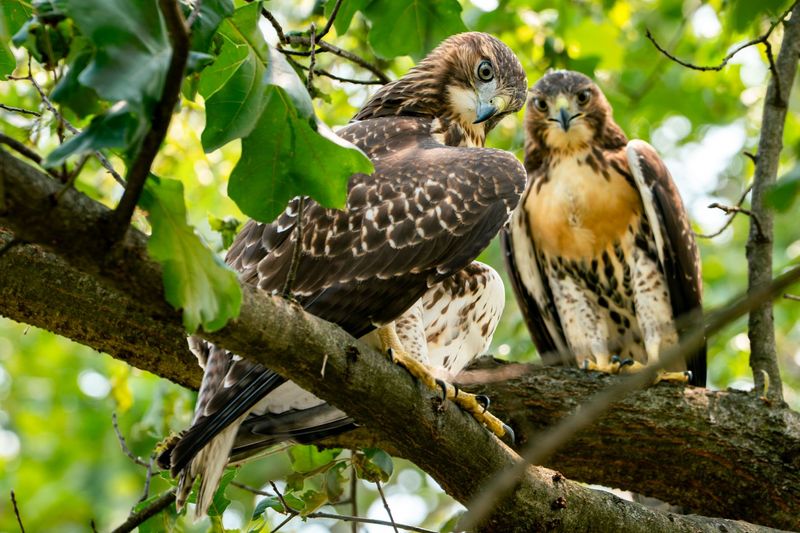
Summer is nesting season for many North Carolina hawks, and a bird that appears aggressive or unusually bold near your yard may be defending eggs or recently fledged young rather than targeting you or your pets. NC Wildlife notes that hawks can swoop toward people when defending nests or young, though serious contact is uncommon.
The right response is straightforward: give the nest and any bird acting defensively plenty of space, and avoid the immediate area until the young have left.
Trimming trees near an active nest, attempting to move the nest, or trying to relocate the bird are all off the table, legally and practically. Native hawks are protected under both state law and the federal Migratory Bird Treaty Act, which makes it illegal to injure, harass, kill, possess, or disturb an active nest.
If a nest is causing a genuine safety problem, contact NC Wildlife or a licensed wildlife professional rather than attempting any intervention yourself.
Concerns about pets deserve a proportionate response. The largest hawks in North Carolina weigh roughly three pounds, which means carrying away an ordinary cat or medium-sized dog is not a realistic risk.
NC Wildlife’s own guidance confirms this. Very small animals, including toy-breed dogs and kittens, could theoretically attract a curious hawk, so supervision outdoors and keeping tiny pets on a leash or within arm’s reach during known hawk activity are sensible habits without being alarmist.
A hawk spotted on the ground is another situation that often prompts unnecessary worry. Hawks regularly land on the ground to eat prey or feed on roadkill, and a bird sitting still in the grass is not automatically hurt or sick.
Contact a licensed raptor rehabilitator only when you observe clear signs of injury, obvious illness, or a situation where the bird faces immediate danger it cannot escape on its own. Watching quietly from a distance first is almost always the right first step.
Reduce conflicts with feeders, poultry, and rodents safely
When a hawk repeatedly hunts at a bird feeder, the most effective and least disruptive fix is to take the feeders down for several days. Cornell recommends this temporary pause to break the hawk’s learned association between your yard and reliable prey.
Audubon offers similar advice, suggesting a longer pause if the hawk lingers. Once the bird moves on, feeders can go back up, ideally closer to dense shrubs that give songbirds a fast escape route.
Feeder management goes beyond the hawk question. Store seed in sealed, rodent-proof containers, clean up spilled seed from the ground regularly, and keep feeder surfaces clean to protect songbirds from disease.
NC State Extension’s urban bird habitat guide recommends dense nearby cover so small birds can retreat quickly if a predator appears, which reduces stress on feeder visitors without requiring you to remove the feeder entirely.
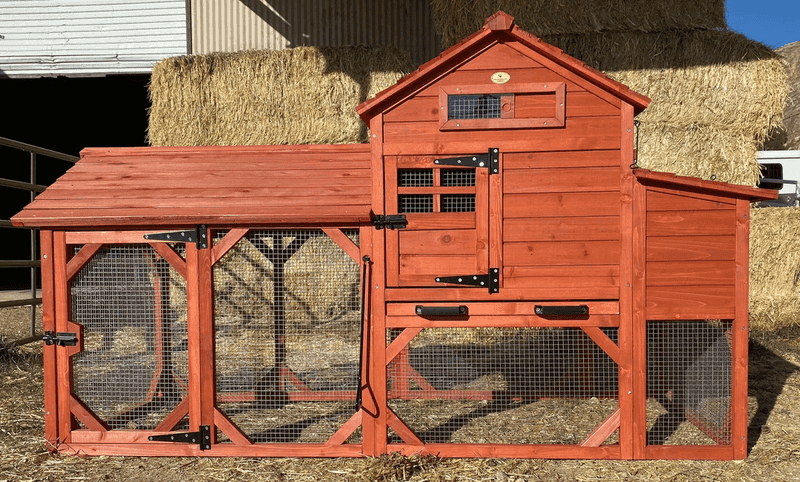
Backyard chickens and other small poultry need a different kind of protection. The right solution is structural: a secure coop, a covered run, or overhead poultry netting that blocks aerial access.
NC Wildlife identifies overhead protection as the most reliable way to shield a backyard flock from aerial predators, and their guidance on Red-shouldered Hawks echoes this approach for smaller livestock. Hardware cloth and tight-fitting latches matter more than any attempt to discourage the hawk itself.
Rodent concerns deserve a careful response. If you suspect elevated mouse or vole activity near feeders or outbuildings, start with sanitation: seal entry points, remove food sources, and store feed in metal containers.
Georgia Extension’s bird-feeding guidance and their vertebrate pest management handbook both warn that toxic rodent baits can cause secondary poisoning in hawks, owls, and other predators that eat poisoned animals. Snap traps and exclusion are safer starting points than any brodifacoum or similar product, and broad habitat destruction, pulling out all your shrubs or dismantling every feeder permanently, is both unnecessary and harmful to the songbirds and other wildlife you likely want to keep around.
Observe first, then choose the smallest effective response
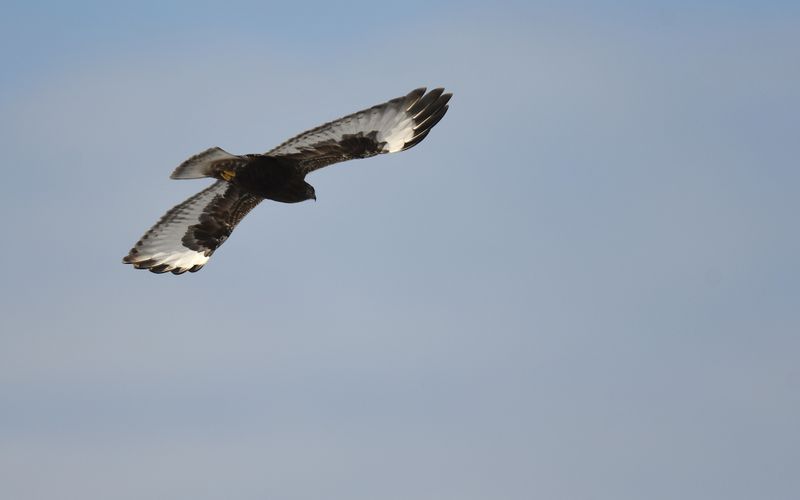
Before reaching for a solution, spend a few minutes watching. Note the hawk’s approximate size relative to a crow or a pigeon, how it moves (soaring in wide circles versus maneuvering through trees), whether it uses perches, whether it appears near the feeder or near open ground, and whether it shows any defensive behavior near a particular tree.
No single observation is conclusive, but a pattern across several sightings tells you much more than one glance.
Repeated circling signals that the surrounding landscape is usable for this bird in some way, not that your yard has a confirmed rodent problem or a certified healthy ecosystem. Keep responses proportionate: start with sanitation and secure storage, add escape cover near feeders, use structural protection for poultry, and avoid rodent poison that could harm the hawk itself.
Cornell’s feeder-hawk guidance and Georgia Extension’s pest management advice both point toward the least invasive fix first.
For serious conflicts, injured birds, or nesting situations that feel unsafe, contact NC Wildlife or a licensed raptor rehabilitator rather than improvising. And resist the temptation to bait or lure a hawk closer for a better photograph.
Audubon’s ethical bird photography guidelines advise against using live or dead animals, meat, decoys, or playback to attract predatory birds, and doing so may also conflict with federal protections under the Migratory Bird Treaty Act. A hawk circling overhead is already putting on a remarkable show; the best seat in the house requires nothing more than patience and a clear view of the sky.