
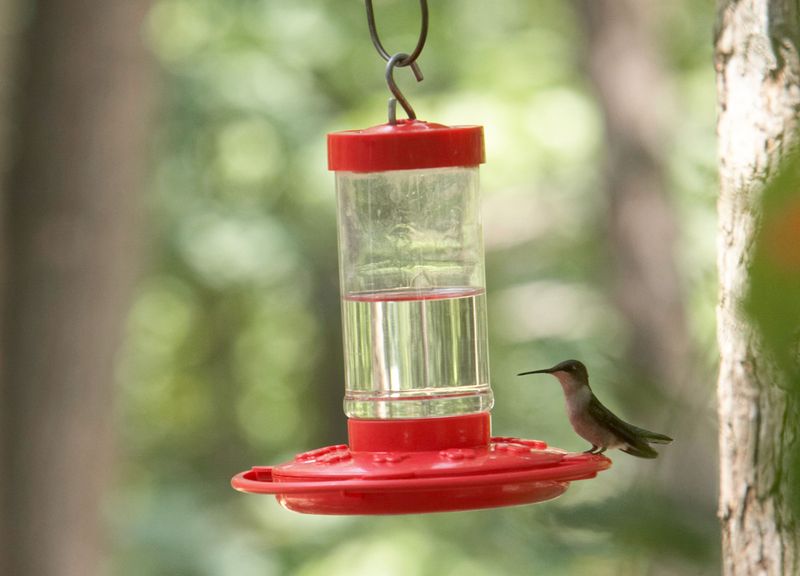
Hanging a hummingbird feeder and then watching it sit empty for days is genuinely frustrating, especially when you did everything the instructions said. The truth is that no single porch, wall, or corner universally repels hummingbirds, but where you hang the feeder is still worth a close look.
Sun, wind, predators, territorial birds, and even the nectar itself can all play a role in keeping your feeder quiet. Working through the possibilities one step at a time gives you the best shot at turning that empty feeder into a regular stop.
An empty feeder does not prove one bad spot
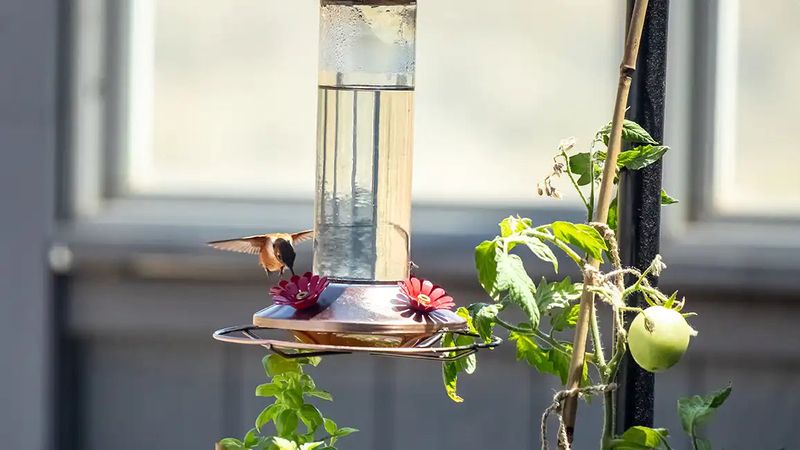
Plenty of gardeners hang a feeder, wait a week, and assume the location drove every bird away. That conclusion skips a long list of other possibilities.
Cornell Lab notes that hummingbird numbers at any feeder can shift because of natural food availability, nest-site competition, neighbors’ feeders, seasonal migration, and annual fluctuations that have nothing to do with where your feeder hangs.
No reliable evidence establishes one universal spot, whether a south-facing wall, a front porch, or a location near a window, that consistently repels hummingbirds across all yards. Placement is one reasonable variable to inspect early, but it is not a diagnosis on its own.
Sun exposure, wind, poor visibility, nearby predators, territorial competition, local species, and simple discovery time all belong in the same checklist.
The most useful starting move is to inspect the feeder’s surroundings before deciding the nectar is fine and the spot is the only culprit. Cornell’s feeder placement guidance points to shade, shelter, and visibility as the first things to assess.
Nectar quality still needs a parallel check at the same time, because a bad recipe or spoiled batch can keep birds away just as effectively as a difficult location.
Choose shade and shelter before the heat damages the nectar
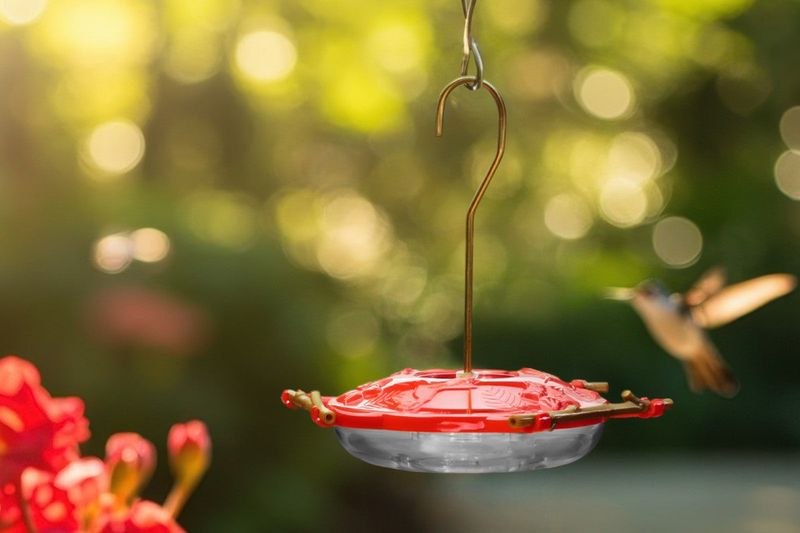
Direct sun is one of the fastest ways to ruin a batch of nectar without realizing it. Heat causes sugar water to ferment and cloud more quickly, and in bottle-style feeders, warming air inside the reservoir can push liquid out through the ports and create drips that attract insects.
Cornell’s feeder placement guidance specifically recommends protecting feeders from direct sun, and that advice matters even more across Florida, Texas, and the Gulf Coast, where summer temperatures regularly push past 90 degrees Fahrenheit for weeks at a time.
A mostly shaded or partially shaded location, under a tree canopy, beneath a covered porch, or on the north or east side of a structure, slows nectar breakdown and reduces how often you need to swap out a fresh batch. That practical benefit alone makes shade worth prioritizing when you choose a spot.
Wind deserves equal attention. A feeder that swings, tilts, or drips in a regular breeze spills nectar onto the ground or hanger, and those wet spots draw ants, bees, and wasps before a hummingbird ever arrives.
Moving to a calmer location, or adding a hook with a slight windbreak nearby, reduces leaks and keeps the feeding ports cleaner between refills. None of this guarantees more hummingbird visits, but it does mean the nectar you put out stays usable longer.
Keep the feeder visible while birds learn its location
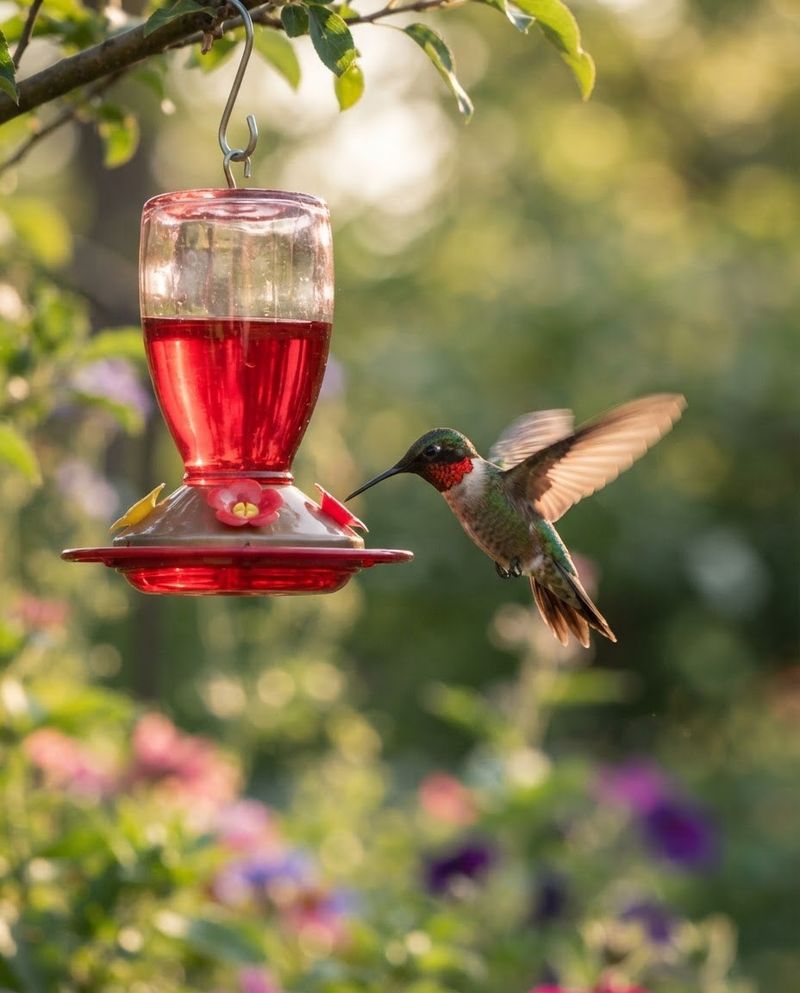
Hummingbirds rely heavily on vision to find food, and a feeder tucked behind a dense shrub or pressed against a wall where it blends into the background may simply go unnoticed for longer than expected. Keeping a new feeder in a location with good sightlines from multiple angles gives passing birds a better chance of spotting it on a first flyby.
Red and orange tubular flowers planted nearby can act as a discovery cue. Texas Parks and Wildlife notes that hummingbirds are drawn to these flower shapes and colors, so pairing a feeder with a nearby patch of salvia, turk’s cap, or coral honeysuckle gives birds a familiar visual target while they are still learning the yard.
These cues can help with initial discovery, but they do not guarantee regular visits once a bird has found the feeder.
Discovery time itself is a factor many gardeners underestimate. Research on migrant and resident hummingbirds using nectar feeders shows that how quickly birds adopt an artificial food source varies with habitat quality and whether other hummingbirds in the area have already established the feeder as a known resource.
A feeder that receives no visits in the first week or two has not necessarily failed. Patience, combined with a visible location and fresh nectar, gives the experiment a fair run.
Give hummingbirds cover without giving cats a launch point
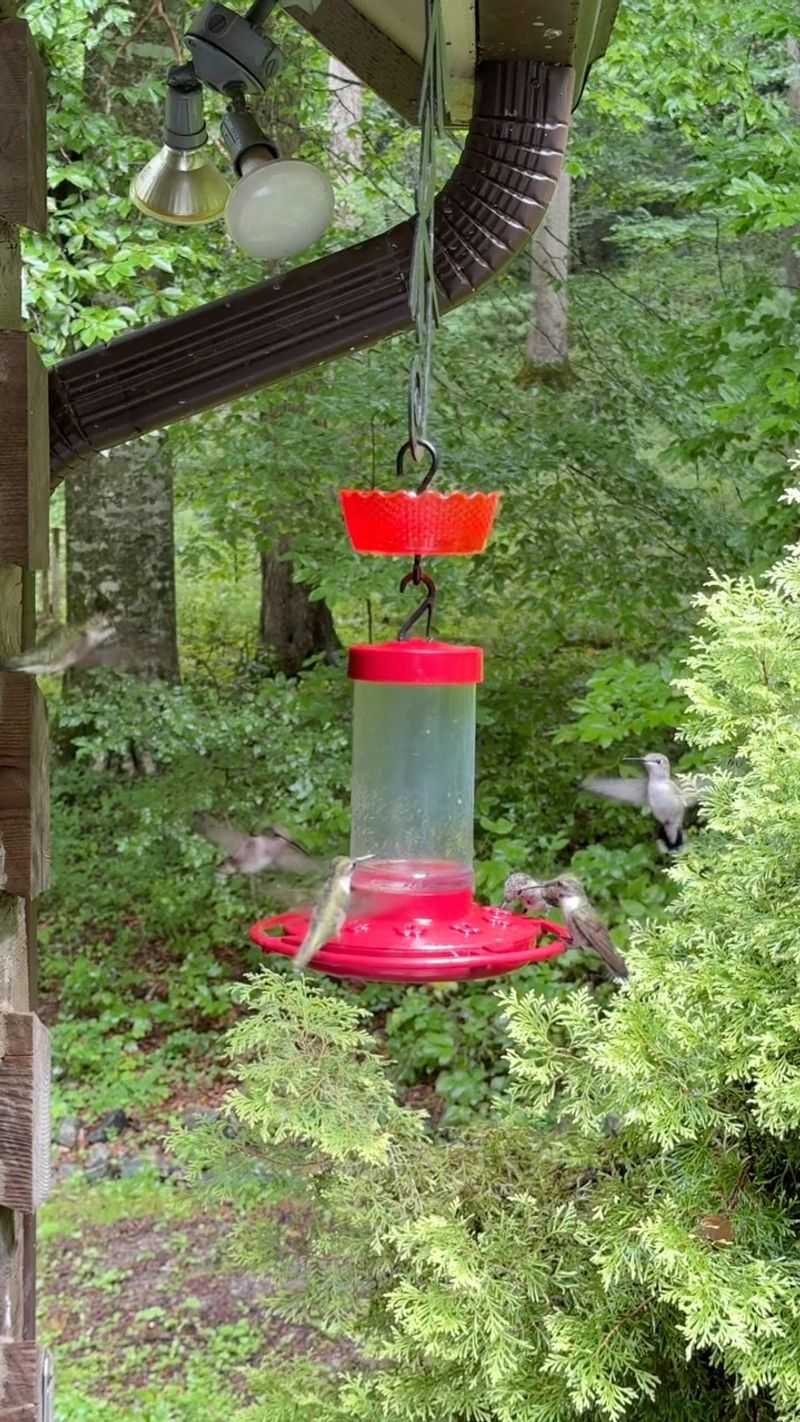
Shrubs, tree branches, and dense plantings serve real functions for hummingbirds. They provide resting perches between visits, shelter from wind and rain, and quick escape routes if a predator appears.
A feeder placed with absolutely no vegetation nearby asks birds to hover in the open with no refuge, which can make some individuals uncomfortable enough to move on after a single pass.
The complication is that the same cover that reassures a hummingbird can give a cat a hidden approach or a low branch to leap from. Cornell’s placement guidance suggests roughly 10 feet from substantial cover as a general starting compromise between refuge and predator access.
That figure comes from broader feeder guidance, not a hummingbird-specific study, so treat it as a reasonable starting point rather than a precise rule you must follow in every yard.
The right answer depends on your yard’s actual layout. A feeder 8 feet from a well-trimmed ornamental shrub with no low branches may be far safer than one 12 feet from a dense thicket where a cat regularly hides.
Project FeederWatch identifies feeder birds as especially vulnerable to cats and recommends keeping cats indoors as the primary safety measure. Assess the whole yard, balance visibility against wind protection, and look at where cats actually patrol before deciding on a final location.
Treat windows and cats as safety hazards, not automatic bird repellents
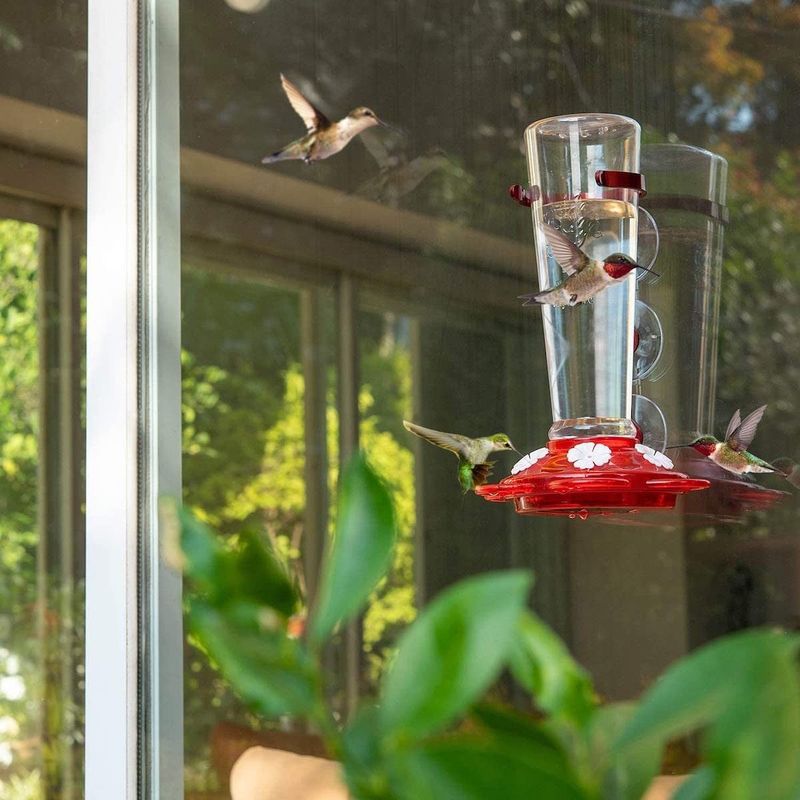
A hummingbird near a window is not a hummingbird in danger of being scared off by the house itself. Hummingbirds regularly use feeders on porches, under eaves, and within a few feet of glass without treating the proximity as a threat.
The real concern with windows is collision risk, not repulsion.
Reflective glass that mirrors sky or foliage is the problem. A bird flying toward what looks like open space can strike the glass at full speed.
Project FeederWatch’s safe-feeding guidance explains the close-or-far approach: placing a feeder within about 3 feet of a window means a bird that startles cannot build up enough speed to cause serious injury, while placing it more than 30 feet away gives birds room to recognize the barrier. The risky middle distance is the range where collisions are most likely to cause harm.
Making the glass itself visible is the most reliable fix. An exterior screen or a dense, repeating pattern of markings spaced no more than about 2 inches apart breaks up the reflection enough to signal a solid surface.
A few decorative decals scattered across the glass do not create a dense enough pattern to work consistently. Ruby-throated Hummingbirds, the species most common across the Eastern and Gulf South, are fast and agile, but glass collisions remain a real hazard.
For cats, height alone is not a solution. Cats climb, leap, and use nearby furniture or fences, so keeping them indoors or physically excluding them from the feeding area is the only dependable protection.
Territorial hummingbirds can hide access problems
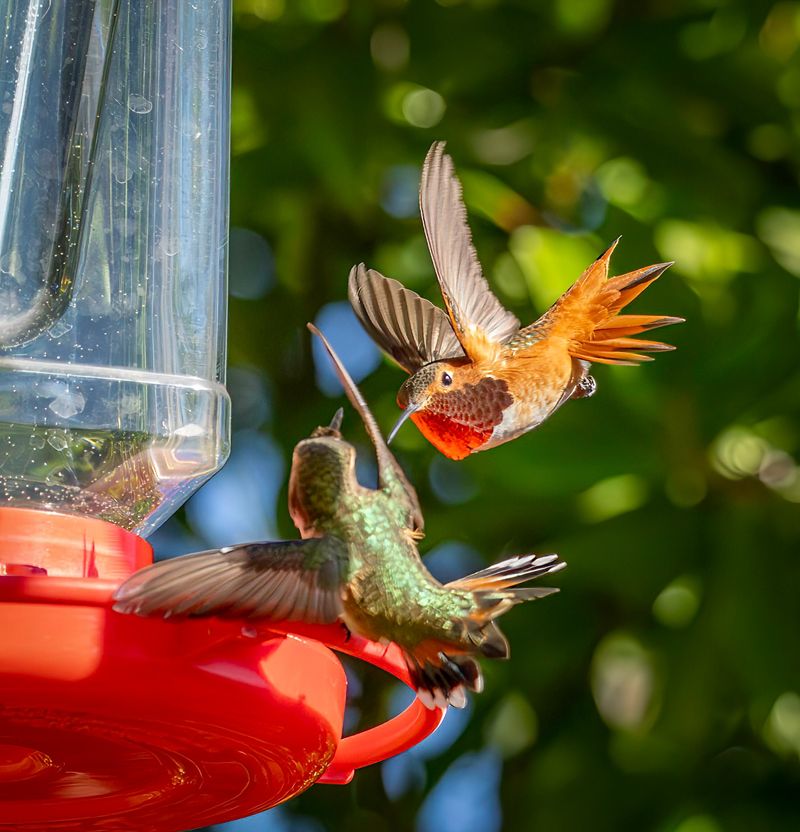
Sometimes the feeder is not truly empty. One bird may be using it regularly while actively chasing away every other hummingbird that approaches.
From inside the house, the result looks identical to a feeder that nobody visits: a quiet feeding station with nectar that sits untouched for long stretches.
Territorial behavior is well documented in hummingbirds, and a single bird, whether a dominant male, a female, or even a juvenile, can defend a food source aggressively enough to limit access for subordinate individuals. Cornell’s hummingbird feeding guidance recommends using several smaller feeders rather than one large feeder, and spacing them so that the birds cannot see one another.
When a defending bird cannot watch all feeders from a single perch, subordinate birds can feed without being immediately spotted and chased.
Adding feeders on opposite sides of the house, or positioning them around a corner so no single vantage point covers all of them, tends to work better than simply moving one feeder a few feet away. Keep realistic expectations about the outcome: spreading feeders around the yard can improve access for birds that were previously excluded, but it does not necessarily bring more hummingbirds into the yard overall.
The total number of birds using your property depends on local habitat and population, not just how many feeders you hang.
Check the nectar, leaks, and cleaning routine
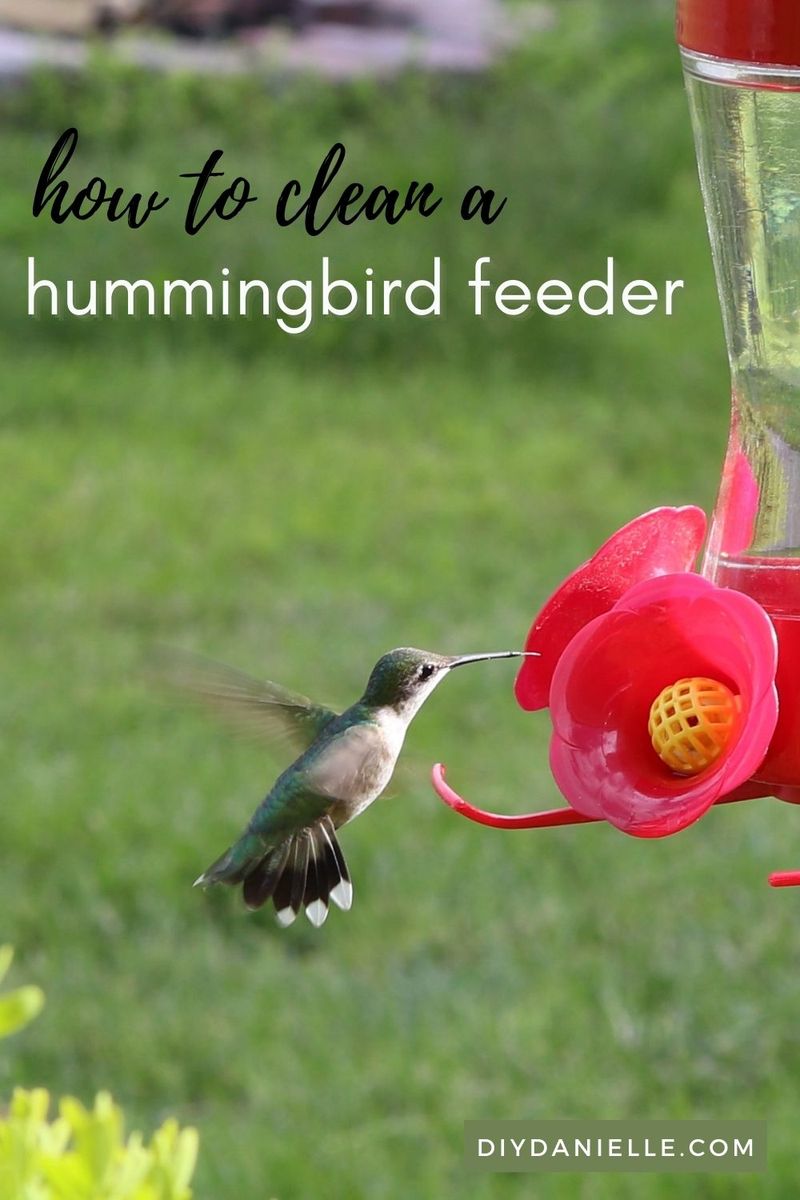
Placement deserves an early inspection, but it should never become a reason to skip checking what is actually inside the feeder. Spoiled nectar, incorrect ingredients, mold, and contaminated ports are genuine reasons hummingbirds stop visiting, and they require their own fixes regardless of where the feeder hangs.
The correct nectar recipe is straightforward: 1 part refined white sugar dissolved in 4 parts water, roughly one quarter cup of sugar per cup of water. Audubon’s hummingbird feeding FAQ is clear that honey, brown sugar, molasses, artificial sweeteners, red food coloring, and other additives do not belong in the mix.
Some of these ferment faster, some can harm birds directly, and red dye adds no benefit when most feeders already include red components.
Hot Southern weather means nectar spoils faster than most people expect. Cornell recommends changing nectar every 3 to 5 days at minimum, and more frequently when temperatures climb above 90 degrees Fahrenheit.
Discard any batch that looks cloudy or smells off immediately, without waiting for the scheduled change. Project FeederWatch recommends cleaning hummingbird feeders every couple of days, ideally each time you refill, and right away when mold appears.
Take the feeder apart completely, scrub all surfaces and ports with a small brush, rinse thoroughly, and let everything dry before refilling.
Leaks and insects go together. A dripping feeder draws ants, bees, and wasps, which can crowd out hummingbirds and contaminate the nectar.
Fix the leak first by tightening parts or replacing worn seals, then use an appropriate ant moat or choose a feeder design that is less accessible to insects. Cornell warns against using oils or sticky substances around feeder ports because these products can soil birds’ feathers and contaminate the nectar supply.
Relocation, leak repairs, and moats are the safe alternatives.
Regional timing and habitat may explain a quiet feeder
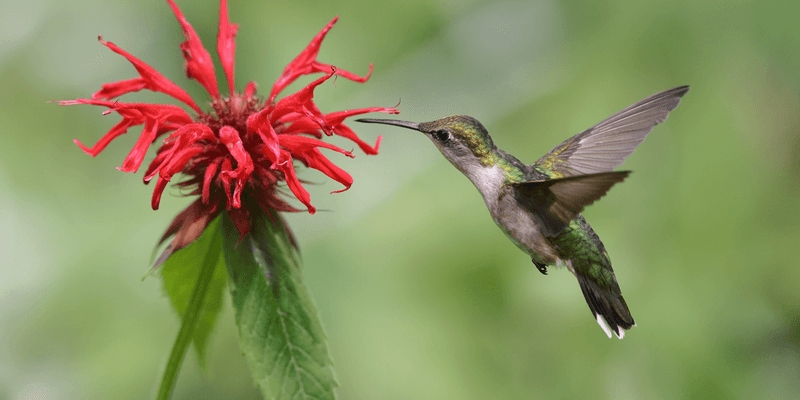
A feeder that sits quiet for days does not automatically mean the location failed or the local hummingbird population has declined. In many cases, the birds simply are not moving through that yard yet, or natural flowers are so abundant that a feeder offers little advantage at that moment.
Cornell notes that annual fluctuations at individual feeders are normal and that a quiet stretch says very little about broader population trends.
Regional timing matters more than many gardeners realize. In Texas, Ruby-throated Hummingbirds are most reliably found in the eastern portion of the state, while Black-chinned Hummingbirds are the common species across much of western and central Texas.
Black-chinned Hummingbirds breed widely across the state and move through in migration, while the Texas coast also receives winter visitors. In Florida and along the Gulf Coast, Ruby-throated Hummingbirds may be present seasonally or, in some locations, year-round.
A feeder that sees no action may simply be set up outside the window when the expected species are not yet moving through.
Beyond timing, hummingbirds need more than sugar water. Audubon’s guide to hummingbird-friendly yards points to native flowering plants, insects, spiders, perches, and water as parts of a complete habitat.
Reducing pesticide use protects the insects hummingbirds eat for protein. Planting native tubular flowers gives birds a reason to stay in the yard between feeder visits.
These improvements build a more welcoming yard over time without promising that a single habitat change will immediately fill the feeder with birds.
Make one careful adjustment and test the whole setup
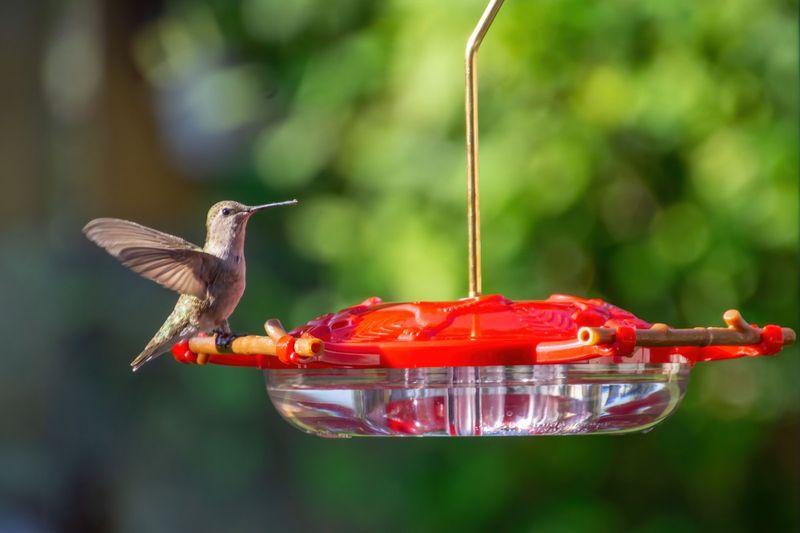
Working through this checklist does not require overhauling the entire yard at once. A single careful relocation, combined with fresh nectar and a clean feeder, gives you a real experiment to evaluate rather than a series of changes you cannot separate from one another.
Move the feeder to a cooler, calmer spot with good visibility, roughly 10 feet from substantial cover as a starting point, while checking that nearby vegetation does not create a cat ambush site. Cornell’s placement guidance and Project FeederWatch’s safe-feeding recommendations both support this kind of structured assessment.
If a window is nearby, apply exterior markings dense enough to break up the reflection, or shift the feeder to within 3 feet of the glass or beyond 30 feet away. Keep cats indoors or exclude them from the area entirely.
Confirm the nectar recipe matches Audubon’s recommended 1-to-4 sugar-and-water ratio, clean the feeder completely, and replace the nectar on the schedule the heat demands. If visits remain absent after a week or two, return to the fuller checklist: local species, migration timing, natural food abundance, territorial behavior, discovery time, and feeder contamination all stay on the table.
A quiet feeder is a starting point for investigation, not proof that one spot scared every hummingbird away for good.