
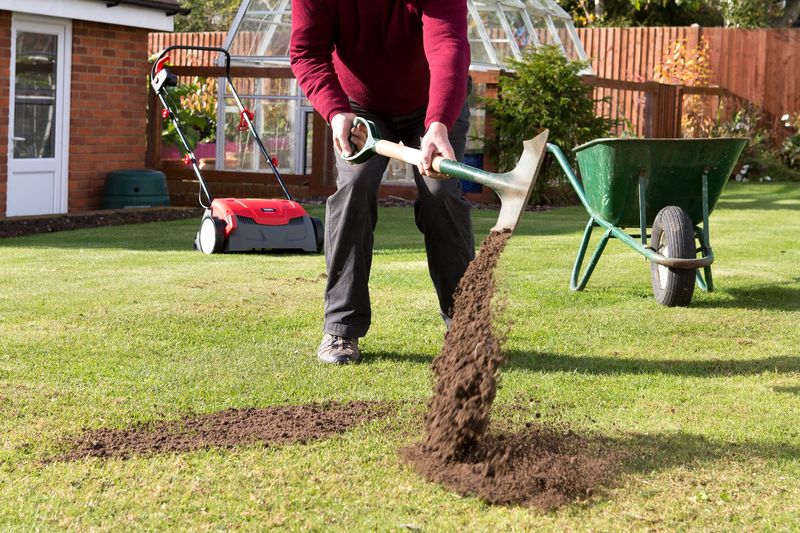
A mildly uneven lawn can make mowing miserable and turn a nice yard into a tripping hazard, but renting a skid steer is rarely the first answer. For shallow hollows, minor ruts, and small surface dips, a low-tech method called topdressing lets you gradually raise low spots by adding thin layers of compatible soil or compost while the grass grows through each one.
The catch is that this approach works for surface-level irregularities, not every kind of unevenness, so knowing what you are actually dealing with before you haul in any material saves a lot of wasted effort.
Decide whether the lawn has a shallow low spot or a deeper failure
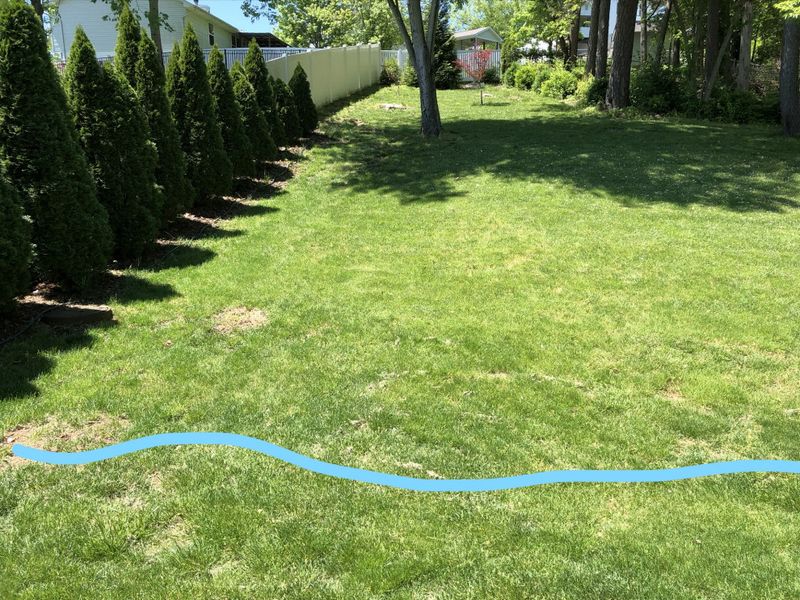
Walking the yard with fresh eyes is the best first step before ordering a single bag of topsoil. Press the sole of your shoe firmly into any area that looks low or feels soft.
A shallow depression that compresses slightly but has healthy, established grass growing through it is a candidate for gradual topdressing. A spot where water sits for hours after rain, where the soil feels rock-hard underfoot, or where the grass is thin or completely absent tells a different story entirely.
Unevenness has many causes, and topdressing addresses only one of them: minor surface irregularities where the grass is intact and the soil below is otherwise sound. University of Maryland Extension notes that a lawn can look rough or uneven because of poor drainage, compacted subsoil, tree roots lifting the surface, buried debris, erosion from downspouts, mole or vole tunnels, or excessive thatch, and that simply covering those symptoms makes them harder to diagnose later.
Large mounds, deep erosion channels, and persistent standing water all need separate attention before any topdressing begins. Oklahoma State University Extension guidance on urban drainage makes clear that water pooling in a yard often points to slope, outlet, or soil problems that no amount of surface material will fix.
The go or no-go decision is straightforward: proceed with gradual topdressing only when the grass is established, the depression is shallow, and water, grade, buried obstructions, or severe turf damage are not driving the problem.
Use thin applications rather than burying the existing lawn
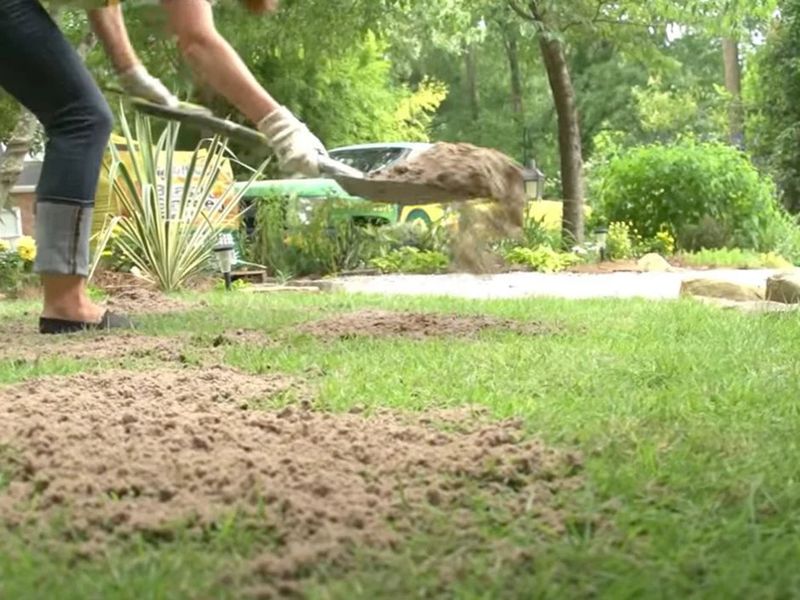
Gradual topdressing works because each thin application settles into the low spots around the grass blades rather than smothering them. As long as the canopy stays visible and the crowns stay exposed, the turf can keep growing upward through the added material.
Over several passes spaced weeks apart, shallow depressions fill in incrementally without the lawn ever being buried.
Cornell Sports Field Management guidance on topdressing recommends no more than about 1/4 inch per application for turf topdressing, and the reasoning is practical: a thin layer integrates with the existing soil profile, while a thick one sits on top of it as a separate zone. That boundary between unlike soils can restrict the movement of water and air downward, which eventually hurts rooting rather than helping it.
Oklahoma State University Extension similarly warns that soil amendments placed on top of existing soil without incorporation can create layering problems, and Colorado State University Extension specifically cautions that topdressing with soil is not a reliable fix for a severely bumpy lawn. What this method does reliably is raise shallow low areas a little at a time.
It does not flatten every high and low point across the yard, and it is not a substitute for grading work where the ground has settled unevenly at a large scale.
Choose material that matches the soil beneath the grass
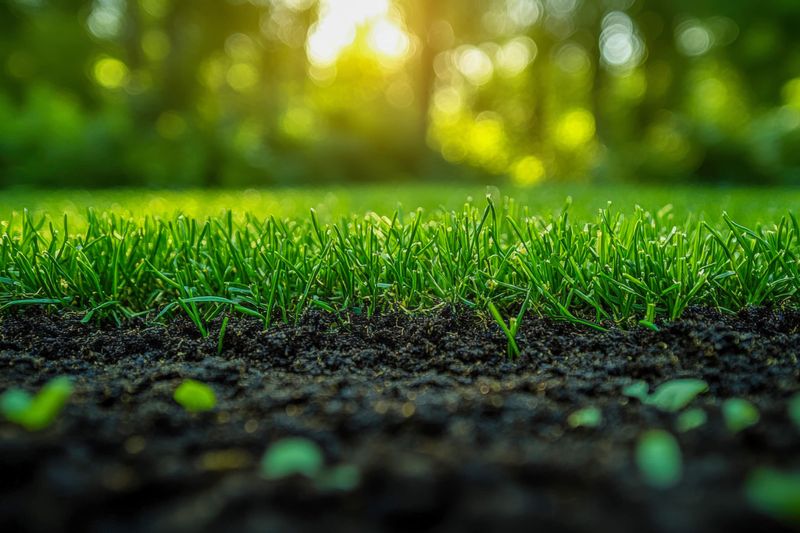
Picking the wrong fill material can create new problems faster than it solves the old ones. The safest choice for most Southern home lawns is topsoil that closely resembles the native soil already under the turf.
If the yard sits on sandy loam, bring in sandy loam. If the native soil is a clay-loam blend, match that texture as closely as possible so water and roots move through the profile without hitting an abrupt change in texture or density.
Clemson Cooperative Extension is direct on the sand question: use sand only when the existing soil is sandy. Spreading coarse sand over a clay or loam lawn does not improve drainage the way many homeowners expect.
Instead, it can create an unfavorable texture at the surface, increase droughtiness, and make rooting more difficult over time. For most Southern yards where the native soil is not predominantly sandy, a compatible topsoil or mature screened compost is the better call.
When compost is the choice, Penn State Extension advises using material that is fully mature and screened fine enough to settle between grass blades. Repeated thick compost applications can build an organic layer at the soil surface that dries out quickly and causes roots to concentrate near the top rather than growing deeper.
Florida homeowners have an additional concern: UF/IFAS guidance on St. Augustinegrass notes that topdressing material should be free of weed seeds and nematodes, which are persistent problems in Florida soils and can spread easily through contaminated fill.
Time the work for active, unstressed turf
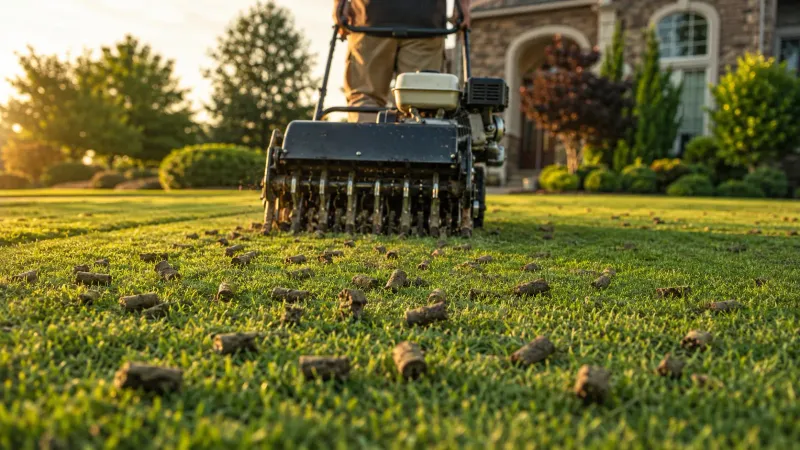
Grass that is actively growing can push upward through a thin layer of added material within days. Grass that is dormant, heat-stressed, drought-stressed, or just beginning to green up after winter cannot do that, and covering it with even a light application of soil puts it under additional strain at exactly the wrong moment.
Timing the work around the turf’s growth cycle is not optional; it is what makes the layering method succeed rather than set the lawn back.
Warm-season grasses common across Florida and the South, including bermudagrass, zoysiagrass, centipedegrass, and St. Augustinegrass, are most responsive to topdressing and aeration during the warm-season growth period. UGA Cooperative Extension’s turfgrass fertility guidance uses a 4-inch soil temperature of at least 65 degrees F and rising as a practical indicator that warm-season turf is actively growing.
That threshold varies by location, elevation, and year, so checking a soil thermometer is more reliable than following a fixed calendar date. UGA’s lawns-in-Georgia species guide identifies May through October as a typical warm-season growth window in Georgia, though Florida lawns often have a longer active period.
Core aeration can be paired with topdressing when compaction is part of what is making the lawn feel rough. Pulling cores opens channels that help the new material settle into the root zone rather than sitting on a sealed surface.
UF/IFAS guidance on soil compaction supports aeration during active growth for Florida warm-season grasses. That said, aeration is not a leveling treatment on its own.
It improves air and water movement through compacted soil, which helps the turf recover, but it does not raise low spots the way topdressing does. UF/IFAS bermudagrass management guidance reinforces that bermudagrass, one of the most common Southern lawn grasses, responds best to cultural practices including aeration when the turf is in full active growth rather than under heat or drought stress.
Spread about a quarter inch and work it into the canopy
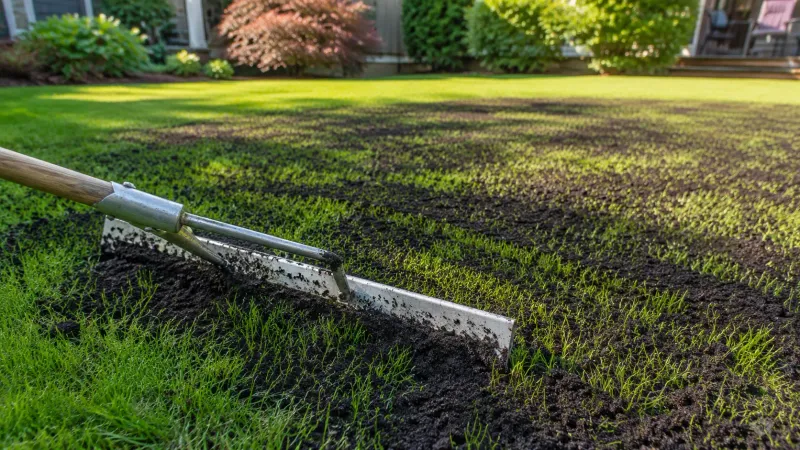
Before spreading anything, mow the lawn at its normal height and clear away any clippings, debris, or thatch that would prevent the material from reaching the soil surface. A clean, open canopy lets the topdressing settle between the blades rather than sitting on top of a mat of organic matter.
If the area has any obvious high spots, lightly scarify or rake those before beginning so you are working with the most even base possible.
The application itself should be thin enough that you can still see the grass through it. Mississippi State Extension’s topdressing guidance describes dragging a mat or a section of chain-link fencing across the surface after spreading to redistribute material from areas where it piled slightly toward the lower spots.
That drag-mat technique is low-tech and effective: it smooths the distribution without requiring any powered equipment and works the material down between the grass blades where it needs to go. University of Maryland Extension notes that shallow ruts can often be filled with roughly 1/4 to 3/4 inch of topsoil or compost without smothering the crown, but emphasizes keeping the grass canopy exposed throughout.
Aim for roughly 1/8 to 1/4 inch per pass as the primary homeowner range. University of Missouri Extension’s lawn maintenance guide describes 1/4 to 1/2 inch as a general topdressing range, with shallow depressions leveled gradually over multiple passes rather than filled in one application.
Concentrate only modestly more material in the lowest areas, rake it level with the surrounding surface, and stop before the grass disappears under the fill. The goal at the end of each pass is a lawn that looks lightly dusted, not buried.
Wait for growth before repeating the small correction
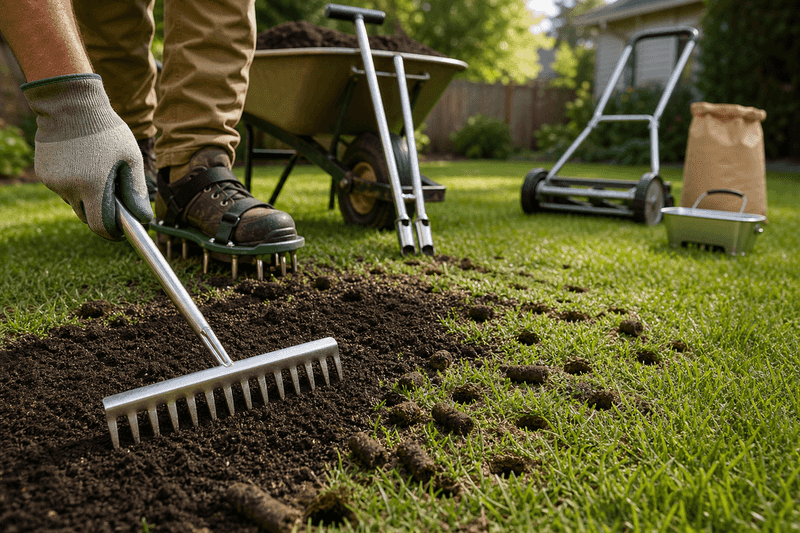
Patience is the part of this method that homeowners most often skip, and skipping it is what turns a helpful repair into a smothered lawn. After each thin application, let the grass grow through the added material completely before adding another layer.
In actively growing warm-season turf during the height of summer, that might take two to four weeks. If the grass has not clearly emerged through the previous pass, adding more material on top compounds the problem rather than correcting it.
The labor and material side of this project deserves an honest look before you start. Cornell’s topdressing guidance notes that applying even 1/4 inch of material over 1,000 square feet requires roughly 0.8 to 1 cubic yard of fill.
A typical suburban lawn of 3,000 to 5,000 square feet means several cubic yards per pass, which adds up quickly in cost, delivery logistics, and manual spreading time. Avoiding heavy machinery does not make this effortless; it just shifts the effort to wheelbarrows, rakes, and repeated trips across the yard.
Bare or thin areas within the lawn need a separate response, not more topdressing. University of Maryland Extension recommends diagnosing the cause of bare patches first, then reseeding, plugging, or sodding after addressing whatever killed or thinned the turf.
Adding soil over dead grass does not revive it. If thin areas remain after the underlying problem is corrected, plugs, sprigs, or sod matched to the existing grass species are the reliable path to a full, even stand.
Stop topdressing any area where the turf becomes buried or shows signs of stress, and do not resume until the grass has fully recovered.
Match compaction, drainage, and grade problems to separate repairs
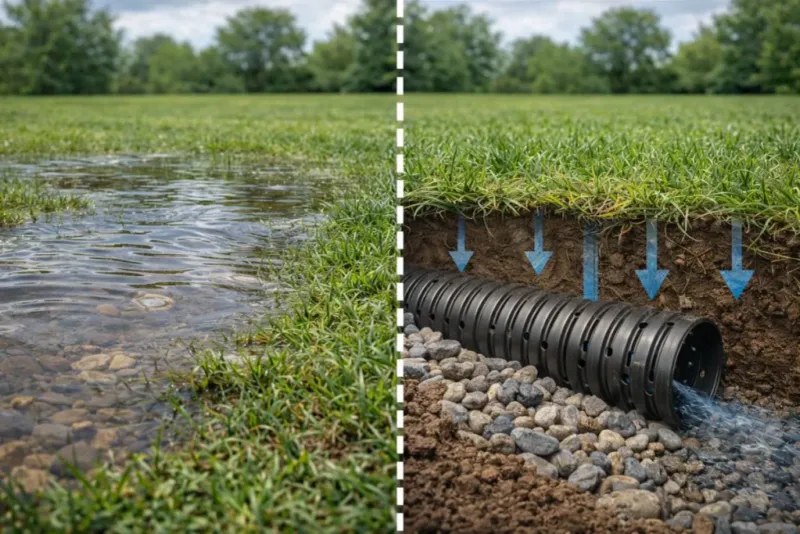
Some lawns look uneven because of problems that no amount of surface material will correct. Compacted soil, persistent standing water, failed grades near structures, and severe turf damage each need a repair matched to the actual cause.
Bundling all of these into one topdressing project leads to wasted material and a yard that still does not drain, root, or grow correctly after the work is done.
Compaction is a soil structure problem, not a surface problem. When soil is compacted, roots cannot penetrate it deeply, water cannot move through it efficiently, and the turf gradually thins.
Core aeration, which removes small plugs of soil to open channels for air, water, and nutrients, is the appropriate first response. UGA Cooperative Extension recommends aerating warm-season lawns while roots are actively growing and soil temperatures are at or above 65 degrees F.
For severely compacted areas, especially in Florida clay or heavily trafficked Texas yards, UF/IFAS soil compaction guidance supports aeration as the primary intervention, sometimes followed by topdressing into the aeration holes.
Persistent standing water is a drainage or grading problem. Oklahoma State University’s urban drainage guidance explains that pooling water typically requires correcting the slope, outlet, or soil conditions, not simply adding fill on top.
Drainage near structures is especially serious: University of Maryland Extension recommends maintaining a 1 to 2 percent grade away from buildings to keep water from working toward foundations. Heavy rolling is not the answer to any of these conditions.
Colorado State University Extension notes that heavy rolling can compact the soil further, potentially making drainage and rooting worse rather than better. Major grade changes or severe turf damage may require removing the existing turf, regrading the soil, and replanting with seed, plugs, or sod after the grade is corrected.
Any project that involves digging, cutting into soil, removing sod over a large area, or installing drainage components requires a call to 811 first. PHMSA’s Call Before You Dig guidance makes clear that contacting 811 before excavation is the step that protects homeowners from striking buried utility lines.
Repeat the modest fix only when the lawn can support it
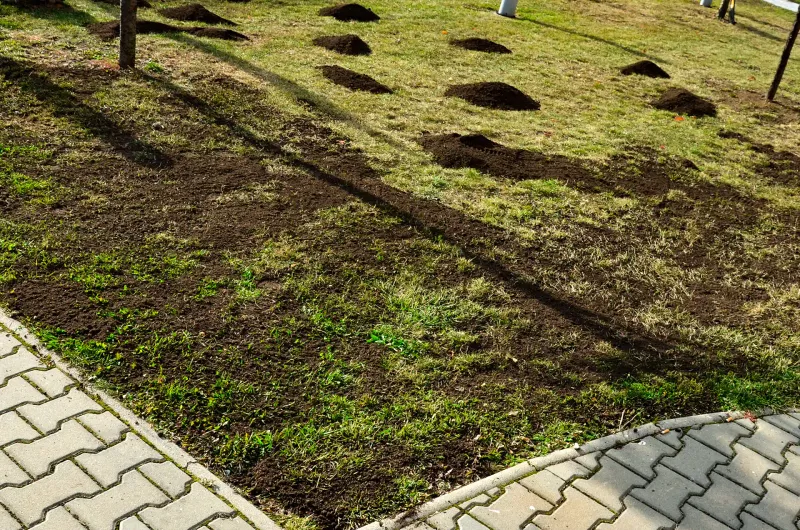
The full sequence for a mildly uneven lawn is straightforward when each step is followed in order: diagnose the unevenness, rule out drainage, compaction, grade, and obstruction problems, select a compatible soil or mature screened compost, and apply a thin layer during active turf growth. Rake or drag it into the canopy, keep the grass visible above the fill, and wait for the turf to grow through before repeating.
Cornell’s topdressing guidance and University of Maryland Extension both support this gradual approach for shallow depressions and minor surface irregularities.
Problems involving standing water, failed grades, compacted subsoil, buried obstructions, or significantly damaged turf require the repair those conditions actually call for, not more topdressing. Colorado State University Extension puts it plainly: gradual topdressing is not a reliable fix for a severely bumpy lawn.
The layering method earns its place as a practical, low-equipment option precisely because it stays within its limits. A yard that is genuinely mildly uneven, with healthy grass and no underlying failures, can improve noticeably over a season of patient, thin applications.