
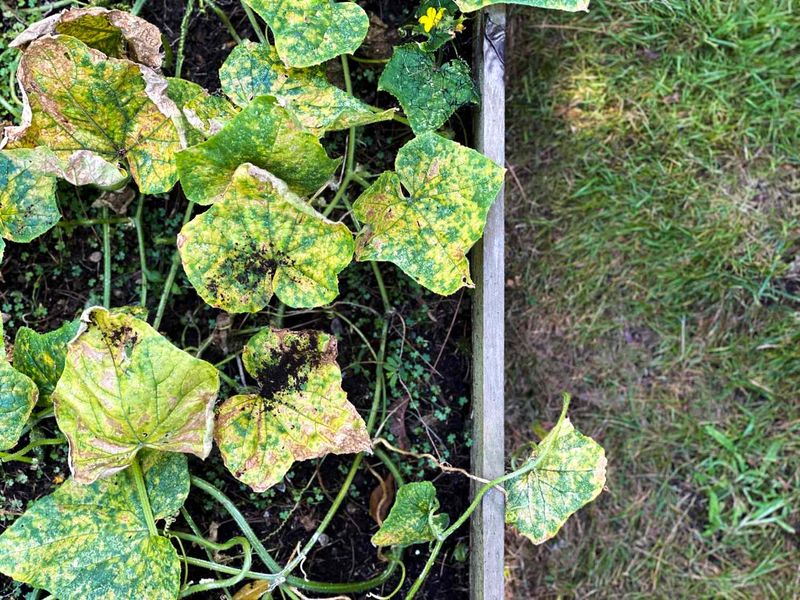
Watching yellow spread across your cucumber vines can feel alarming, especially when it seems to move from plant to plant overnight. The good news is that yellowing leaves are a warning sign, not a death sentence, and catching it early gives you real options.
Before you reach for a spray bottle or a bag of fertilizer, your plant needs you to look closer and figure out what is actually going on.
Yellow leaves signal trouble, not one guaranteed cause
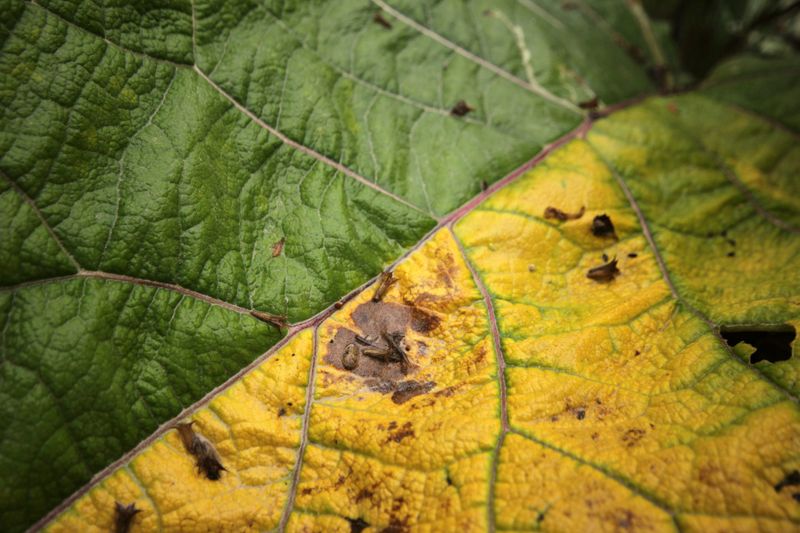
Yellowing cucumber leaves that seem to spread overnight are worth taking seriously, but the color alone cannot tell you what is wrong. University of Minnesota Extension’s cucumber leaf discoloration guide lists downy mildew, bacterial wilt, spider mites, aphids, viruses, and water stress as separate causes that can all produce yellow leaves on the same crop.
Each one has a different fix, and treating for the wrong problem can waste time while the real issue gets worse.
The most useful clues are not in the yellow color itself but in the details around it. Check whether the spots are angular or rounded, whether they are scattered or clustered near veins, and whether the yellowing started on older lower leaves or on young growth near the tips.
Look at both sides of the leaf, not just the top surface, and notice whether the plant is wilting, standing firm, or only drooping during the hottest part of the day.
Soil condition matters just as much as leaf appearance. UGA Extension’s Southeast vegetable troubleshooting guide points out that overwatering, poor drainage, and drought can all produce yellowing that mimics disease.
Check the soil several inches below the surface before drawing any conclusions. The undersides of the leaves and the condition of the soil together give you far more useful evidence than the yellow color alone, and that combined inspection is the foundation of everything that follows.
Downy mildew leaves a fast, angular signature
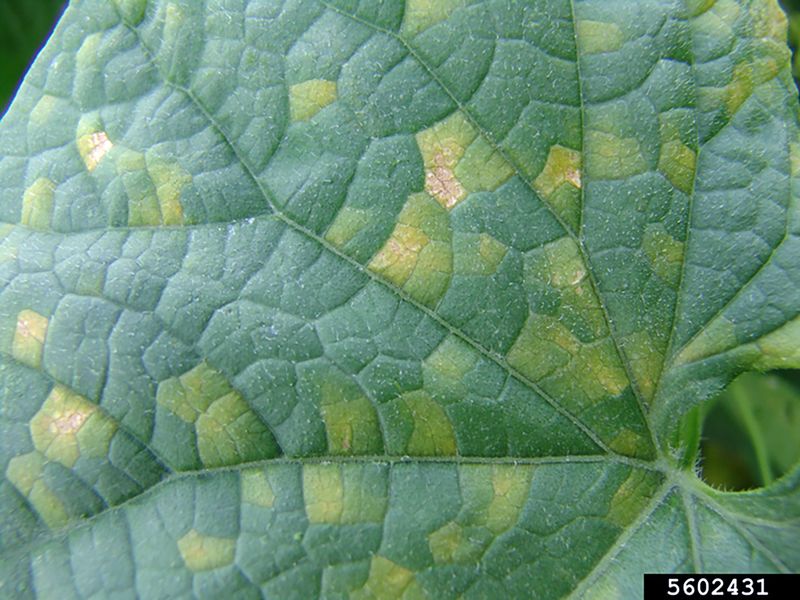
When yellowing spreads quickly across cucumber leaves and the spots have a boxy, angular shape rather than smooth rounded edges, downy mildew deserves a close look. University of Minnesota Extension’s downy mildew resource describes the characteristic pattern: pale yellow or light-green spots on the upper leaf surface that are bounded by the veins, giving them that geometric, angular outline.
The spots can multiply and merge quickly, making the plant look frost-damaged in a short period.
Flip the leaf over when you see those spots. In humid conditions, the underside of an affected leaf often shows dark gray, purple-gray, or velvety growth right beneath the yellow areas on top.
That combination, angular spots above and velvety fuzz below, is a strong clue pointing toward downy mildew, though it is not absolute proof without laboratory confirmation. Wet foliage, high humidity, rain splash, contaminated tools, and airborne spores can all accelerate how fast the disease moves through a planting.
Reducing the conditions that favor spread is the most practical step a home gardener can take right away. Trellis vines to lift leaves off the ground, give plants more room between them for air to move, and switch to drip or root-zone irrigation so foliage stays dry.
Avoid working among wet plants, and clean tools between rows. Do not assume that any general fungicide from the garden center will cure the problem; product effectiveness varies by disease stage, active ingredient, and timing, so confirm what you are dealing with before purchasing anything.
Other diseases change what the yellowing means
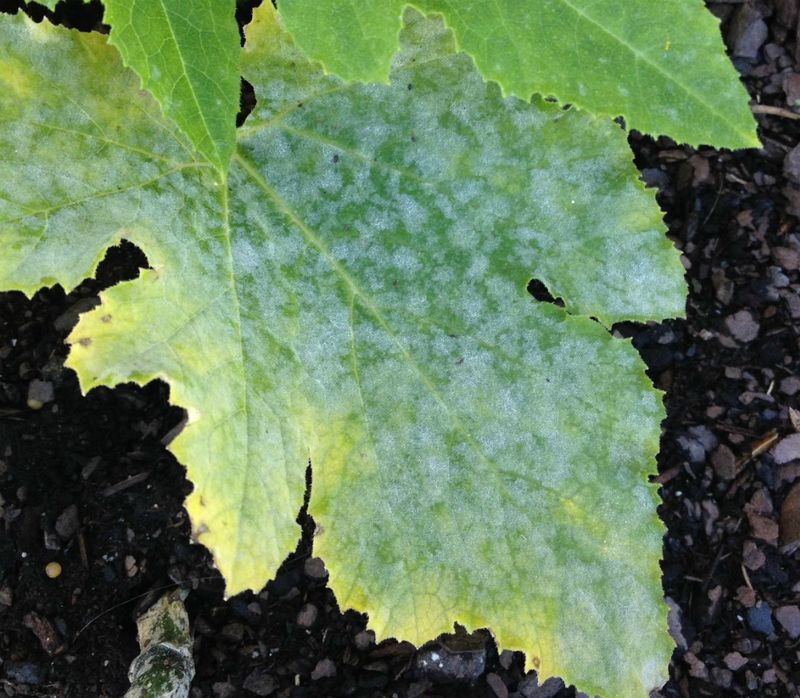
Not every fast-moving yellow problem on cucumbers is downy mildew, and mixing up the diseases leads to the wrong response. Powdery mildew can start with pale yellow leaf spots, but it quickly develops a white, powdery coating on the upper or lower leaf surface that makes it visually distinct from the angular, underside-fuzz pattern of downy mildew.
Extension guidance on powdery mildew of cucurbits notes that it can spread quickly under favorable conditions and tends to weaken plants and reduce fruit production rather than produce the water-soaked angular spotting typical of downy mildew. Improving air movement through spacing, trellising, and weed removal helps reduce favorable conditions for both diseases.
Bacterial wilt follows a different story. The first sign is usually a dull-green appearance combined with wilting during the heat of the day, followed by a recovery overnight when temperatures drop.
Over time the wilting becomes permanent, moving down the vine, and leaf margins may yellow or brown before the tissue dies. Striped and spotted cucumber beetles are commonly associated with transmitting the bacterium responsible.
Minnesota Extension’s bacterial wilt page is clear that no treatment cures an infected plant; removing and disposing of symptomatic plants may reduce the chance that beetles carry the bacterium to neighboring cucurbits.
Viral diseases add another layer of complexity. Mosaic viruses typically cause irregular yellow-and-green mottling, distorted or curled leaves, stunting, and sometimes deformed or mottled fruit rather than the clean angular spotting of downy mildew.
In Texas and Florida, whitefly-transmitted yellowing viruses can mimic nutrient deficiency or water stress, with yellowing between veins that remain green. Texas A&M AgriLife Extension’s cucurbit yellowing virus resource and USU Extension’s cucumber mosaic virus guide both confirm that established viral infections have no curative treatment; removing severely symptomatic plants, controlling weeds that harbor vectors, and selecting resistant varieties where available are the recommended paths forward.
Spraying an insecticide after the virus is already inside the plant will not reverse the symptoms.
Tiny pests can cause yellowing or spread disease
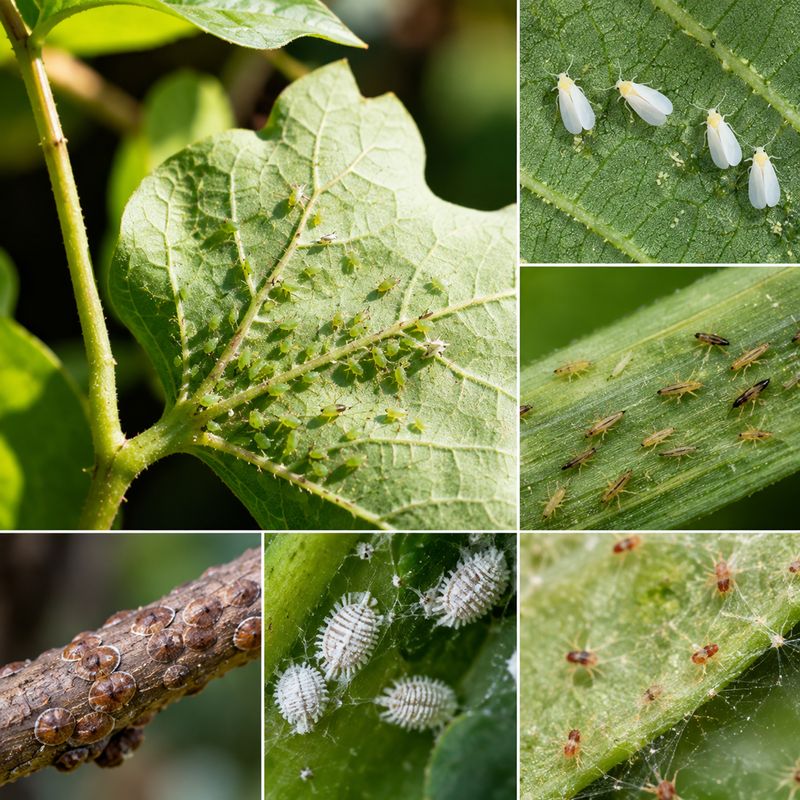
Insects and mites do not spread symptoms the way wind or rain might spread a fungal spore, but they can cause real leaf damage on their own and, in some cases, carry pathogens from one plant to another. Knowing which pest you are looking at changes what you do next.
Fine yellow or pale stippling scattered across a leaf, particularly on the underside, is a classic clue for spider mite feeding. Extension guidance on spider mite management notes that hot, dry weather allows mite populations to build rapidly.
Heavy infestations may also produce fine webbing across the leaf surface. A practical confirmation tool is the white-paper tap test: hold a sheet of white paper under a suspicious leaf, tap the leaf sharply, and look for tiny moving specks on the paper.
UF/IFAS guidance on whiteflies and UGA Extension’s aphid resource both describe how aphids and whiteflies can cause yellowing, curling, wilting, and sticky honeydew deposits through direct feeding injury. Critically, both insects can also transmit cucurbit viruses, so their presence is diagnostically important even when the feeding damage alone looks minor.
Inspect the whole plant, focusing on new growth and leaf undersides where these pests tend to cluster.
Cucumber beetles play a separate but important role. Their presence on a plant that is wilting during the day and recovering at night is a meaningful clue pointing toward bacterial wilt, as described in the bacterial wilt section above.
Spotting beetles is not a catch-all explanation for yellow leaves, but it is information worth recording when you photograph and assess the plant. The UMN cucumber leaf discoloration tool lists insect feeding as a distinct cause separate from disease, reinforcing the value of checking both leaf surfaces carefully before deciding on a response.
The soil and oldest leaves reveal noninfectious stress
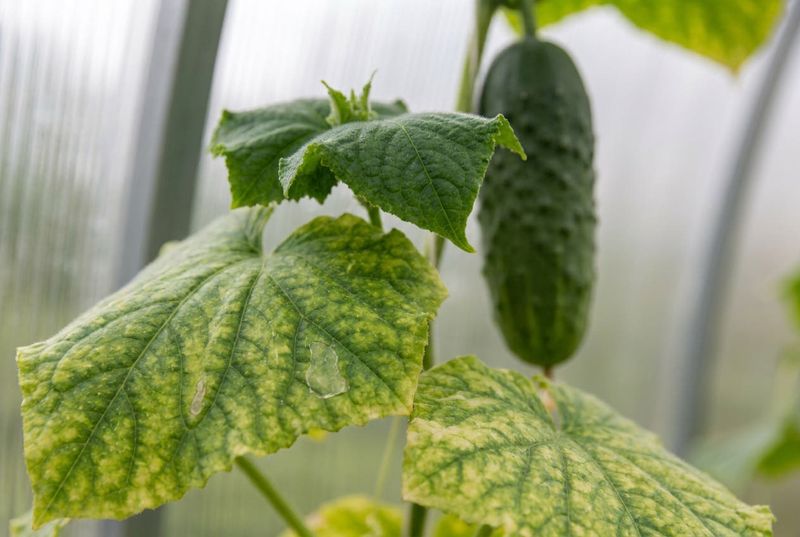
When the yellowing starts on the oldest, lowest leaves rather than on new growth near the tips, noninfectious stress moves up the list of likely explanations. UGA Extension’s guide to nutritional deficiencies in vegetables explains that nitrogen deficiency generally shows up first in older leaves because the plant pulls nitrogen from mature tissue to support new growth.
This pattern is often accompanied by slow or stunted development across the whole plant rather than the rapid angular spread typical of downy mildew.
Sandy soils common in Florida and parts of Texas can lose nutrients quickly after heavy rain or excessive irrigation, so what looks like disease-driven yellowing may actually reflect a nutrient that has leached out of the root zone. UF/IFAS guidance on cucumber production notes that nutrient symptoms can resemble disease stress, making soil testing a safer first step than automatically adding fertilizer.
Applying fertilizer without knowing what is actually deficient can damage roots, burn leaf margins, and add more stress to a plant that may already be struggling.
Water management deserves equal attention. UF/IFAS irrigation guidance and UGA Extension’s watering balance resource both point out that overwatering or poor drainage can produce yellowing, wilting, and root damage, while drought stress can cause leaves to yellow and dry out in a different way.
Push a finger or a trowel several inches below the surface before watering; the goal is consistent moisture without prolonged saturation. Avoid routine overhead irrigation that keeps cucumber foliage wet for long periods, as wet leaves create favorable conditions for fungal diseases on top of any water stress already present.
The UGA Southeast vegetable troubleshooting guide reinforces that drainage confirmation is a necessary step before ruling out a water-related cause.
Inspect first, then make the least risky correction
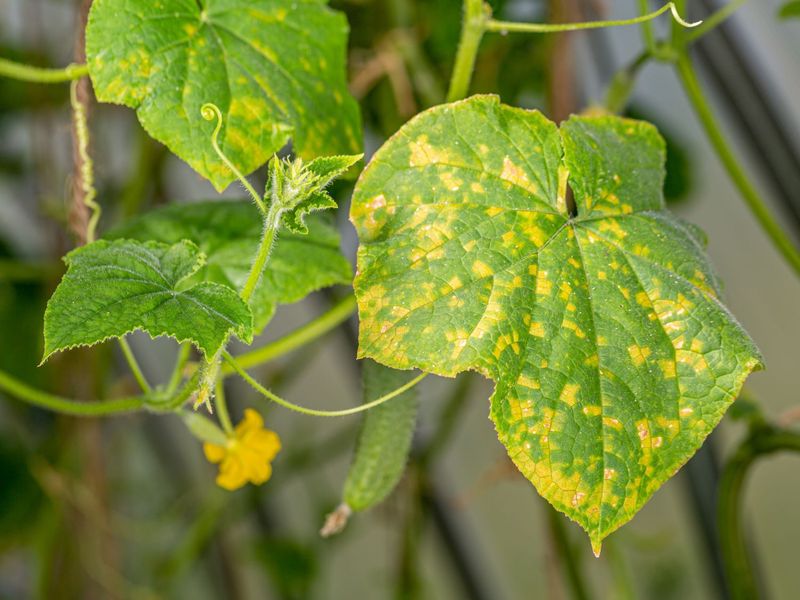
A systematic look at the plant before touching anything else is the single most useful thing a gardener can do when yellowing appears to be spreading. Start by photographing the whole plant from a few feet away, then take close-ups of both the upper and lower surfaces of affected leaves.
UGA Extension’s home garden scouting guide recommends this kind of systematic observation before making any treatment decision, because the pattern you record in those photos often tells you more than memory alone.
As you look, classify what you see rather than just noting that leaves are yellow. Angular spots bounded by veins point one direction; fine stippling points another; irregular mottled patches with green veins point somewhere else entirely.
Record any additional signs: gray or purple fuzz on the underside, white powdery coating, webbing, visible insects, sticky honeydew residue, holes in the leaf tissue, or drooping that resolves by morning. Check the soil several inches down and press around the base of the plant to confirm that water is draining and not pooling.
UF/IFAS plant disease management guidance is consistent on this point: identifying the likely cause before selecting any product is not optional, because treatments are pathogen-specific and applying the wrong one can injure the plant or harm beneficial insects.
Low-risk adjustments are worth making while you gather information. Improve airflow by pruning crowded vines or repositioning a trellis, switch to root-zone watering if you have been using overhead irrigation, and remove any weeds that crowd the base of the plant.
UF/IFAS guidance on pesticide safety warns against reaching for household dish soap or an unlabeled product as a quick fix; always confirm that any product you consider is labeled for the crop, the specific disease or pest, and the site before applying it.
Remove a collapsing plant or send a sample for answers
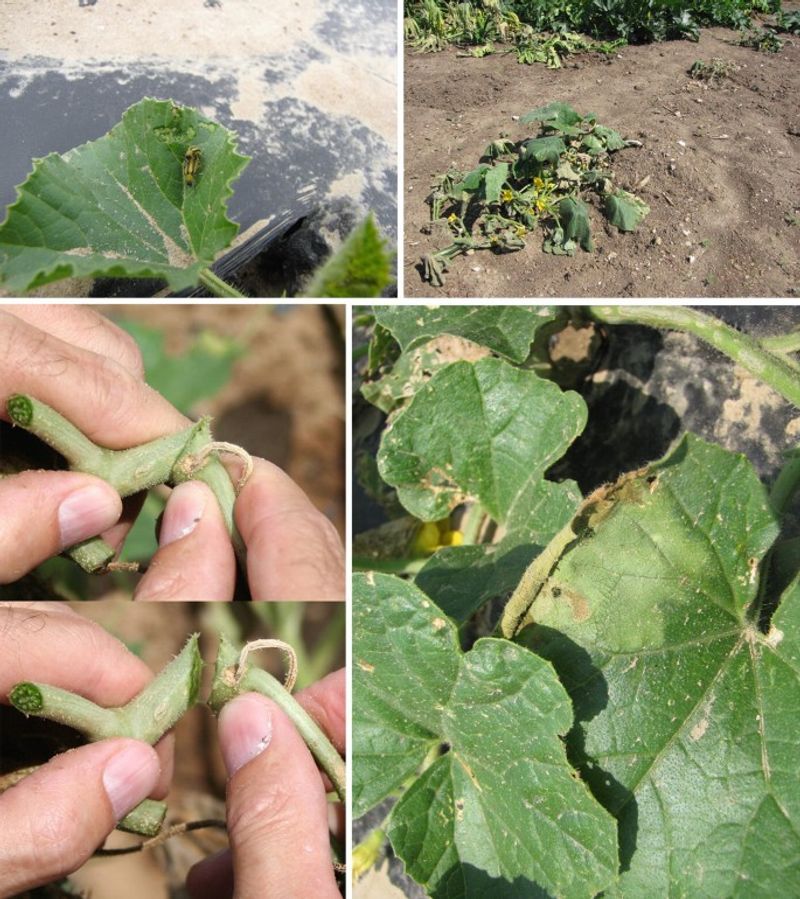
Some plants reach a point where continuing to tend them puts the rest of the garden at greater risk. A cucumber showing the classic bacterial-wilt pattern, daytime wilting that initially recovers overnight but then becomes permanent, with decline moving down the vine, has no curative treatment available.
Minnesota Extension’s bacterial wilt management page recommends removing and disposing of symptomatic plants to reduce the opportunity for cucumber beetles to carry the bacterium to other cucurbits in the area. The same logic applies to plants with clear virus-like symptoms, such as severe mottling, stunting, and deformed fruit, that are declining rapidly.
USU Extension’s cucumber mosaic virus guide confirms there is no curative treatment for an infected plant.
Stripping every yellow leaf from a plant is a different matter entirely. Removing foliage does not cure a systemic bacterial or viral infection and can further stress a plant if too much tissue is taken at once.
Reserve removal for whole plants that are clearly and rapidly declining, not for individual leaves that happen to look bad. UF/IFAS plant disease guidance supports targeted removal rather than blanket stripping.
When the pattern is genuinely unclear after a thorough inspection, a professional diagnosis is the right next step. County Extension offices and state plant-disease diagnostic labs can examine a fresh sample and give you a confirmed answer.
Texas Plant Disease Diagnostic Lab and the UGA specimen submission guide both emphasize that samples should be fresh and include both symptomatic and still-living tissue when possible, because completely dead leaves rarely show the original cause. Contact your local service before mailing anything, since packaging and submission requirements vary by state.
UGA Extension’s plant diagnosis walkthrough explains what to expect from the process and how to give the lab the best chance of identifying the problem accurately.
A quick inspection beats a blind spray
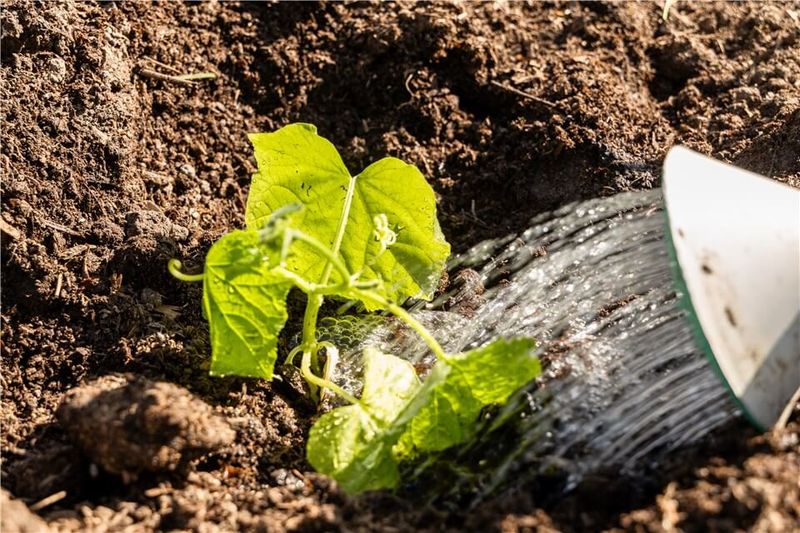
Fast spread makes prompt attention worthwhile, but speed alone is not a reason to guess at a treatment. The response sequence that protects your crop is the same regardless of how quickly the yellowing is moving: inspect both leaf surfaces, check the soil moisture and drainage, note the wilt pattern, and match what you find to the most plausible cause before taking action.
UF/IFAS plant disease management guidance is consistent on this point across every cause covered in this article.
Correcting water and airflow problems carries almost no risk and is worth doing right away regardless of the final diagnosis. Adjusting irrigation, improving spacing, and keeping foliage dry help whether the culprit turns out to be downy mildew, a water imbalance, or a pest infestation.
For anything that does not resolve or that you cannot confidently identify, escalate to a county Extension office or a state diagnostic lab rather than cycling through products on the shelf. Minnesota Extension’s downy mildew resource and every other source cited in this article share the same underlying message: the fastest path to a useful answer runs through observation, not the sprayer.
A careful look at your plant today is worth far more than a hasty treatment you may need to undo tomorrow.