
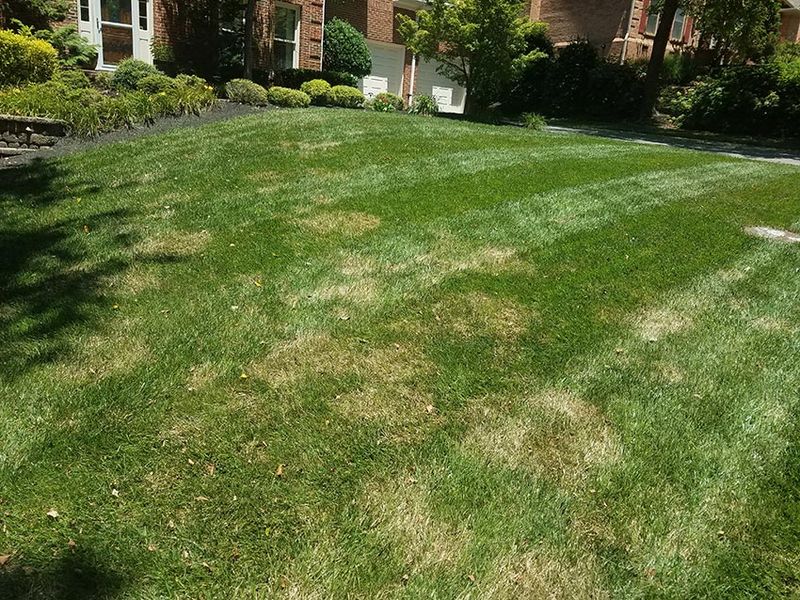
Spotting brown patches spreading across your St. Augustinegrass in July or August is enough to make any homeowner panic. The easy assumption is that the summer heat is frying your lawn, but that explanation can send you in the wrong direction fast.
Brown patches in Southern lawns come from a surprisingly long list of causes, and picking the wrong fix can make things worse. Working through a short inspection process will get you to the right answer far more reliably than guessing.
Brown patches need a diagnosis, not a culprit
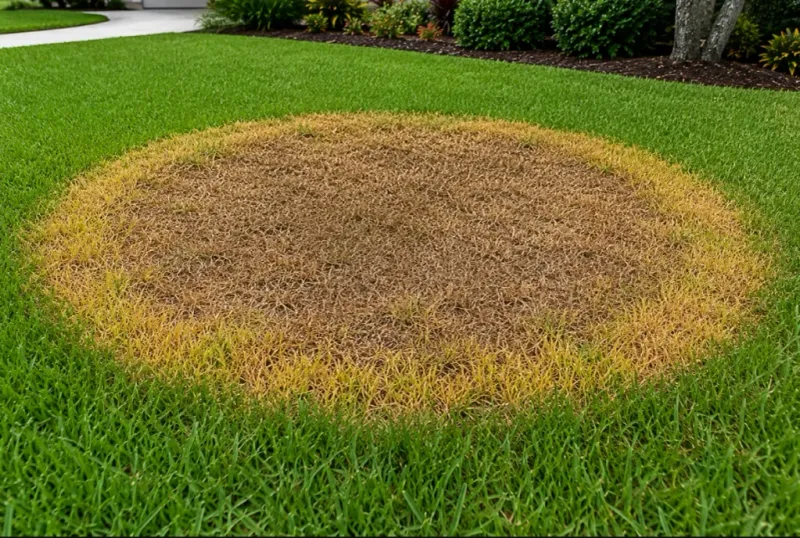
Warm-season grasses like St. Augustinegrass, bermudagrass, and zoysiagrass are built for Southern summers, but that does not make them immune to browning. Heat and drought can directly stress turf, trigger dormancy, or contribute to plant death, yet the season and the color of the grass cannot tell you what went wrong.
UGA Extension’s turfgrass management guidance makes clear that diagnosing brown turf requires looking at multiple factors together rather than defaulting to the most convenient explanation.
Before you reach for a hose, a fertilizer bag, or a spray can, write down what you already know. Note the grass species growing in the affected area, because some problems are strongly tied to specific grasses.
Record the shape and location of the patch: is it circular, irregular, or a straight-edged strip? Is it near a sidewalk, driveway, building, or sprinkler head?
Has the lawn been unusually dry, or has it rained heavily for several days in a row?
Also note your recent watering schedule, any fertilizer or herbicide applications in the past few weeks, and whether pets use the area. UF/IFAS irrigation guidance for Florida lawns emphasizes that overwatering and underwatering can produce symptoms that look nearly identical from a distance.
This article walks through a process for narrowing the possibilities so that any treatment you apply actually matches the problem your lawn has.
When St. Augustinegrass suggests chinch bugs
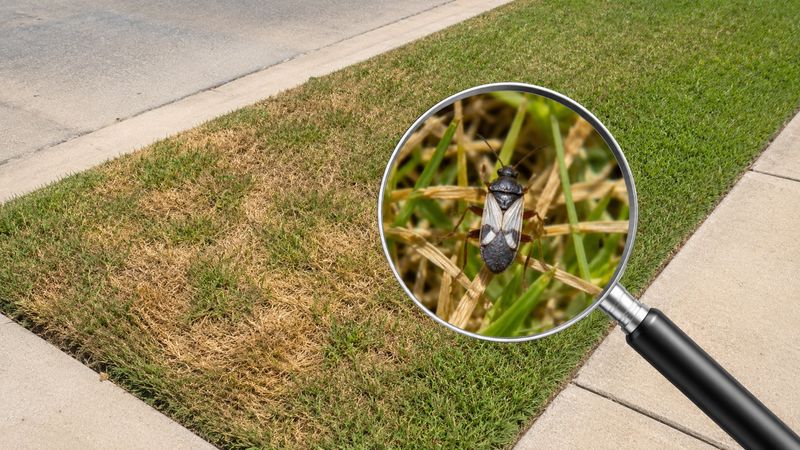
Southern chinch bugs are one of the most important possibilities to check when St. Augustinegrass develops irregular yellow-to-brown patches during hot, dry, sunny weather. These small insects feed by piercing grass stems and drawing out plant juices, and the damage they leave behind expands outward in an uneven pattern that is easy to confuse with drought stress or disease.
Patches often show a yellowing halo at the outer edge where the bugs are actively feeding and the grass is beginning to fail.
Areas near sidewalks, driveways, and building foundations are useful places to start your inspection. These spots tend to dry out faster and stay warmer, which are conditions that favor chinch-bug activity and can make turf more vulnerable.
Texas A&M AgriLife Extension’s chinch-bug guide for St. Augustinegrass identifies these hardscape-adjacent zones as higher-risk settings worth examining first, though the pattern reflects multiple stressors rather than reflected heat alone.
St. Augustinegrass is by far the most seriously affected grass, but southern chinch bugs can also feed on zoysiagrass, bermudagrass, bahiagrass, and centipedegrass. AgriLife’s chinch-bug identification resource and UGA’s biology and management publication both note this broader host range while keeping St. Augustine central to the midsummer damage picture.
Chinch bugs are a strong suspect in the right conditions, but they are one suspect among several, not a guaranteed answer.
Inspect the patch edge for insects
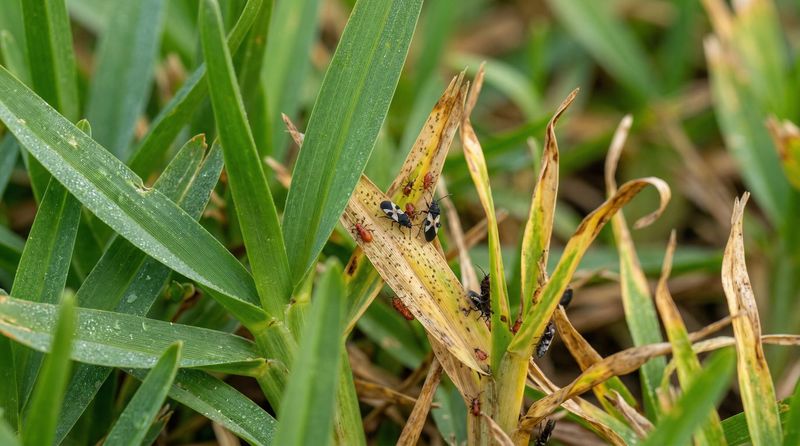
Chinch bugs spend most of their time at the living margin of a damaged area, not in the dead brown center where the grass is already gone. Start your inspection by parting the grass blades at the edge of the patch and looking for small insects: adults are about one-fifth of an inch long with black bodies and white wings folded flat across their backs.
Nymphs are smaller and may appear orange-red with a pale band across the abdomen.
Florida’s standard field method is a bottomless coffee-can test. Push the open end of a large can several inches into the soil at the patch margin so it forms a sealed cylinder, then fill it with water and watch for about five minutes.
Chinch bugs will float to the surface if they are present in that spot. UF/IFAS entomology guidance on chinch bugs and UF/IFAS lawn pest management for St. Augustinegrass both describe this technique as a practical field tool.
Repeat the test in at least three or four locations around the patch, because populations can be unevenly distributed.
Finding insects supports the diagnosis but does not settle it alone. Population size, symptom pattern, grass species, and the presence of other stressors all still matter.
UGA Extension’s chinch-bug monitoring page notes that approximately 20 to 25 chinch bugs per square foot is a commonly used treatment-threshold figure, offered as a monitoring guideline rather than an automatic trigger for pesticide application. A lawn with fewer insects may still have damage from another cause, and a lawn exceeding that number may also have drought or disease contributing to the injury.
Dry soil points toward water stress
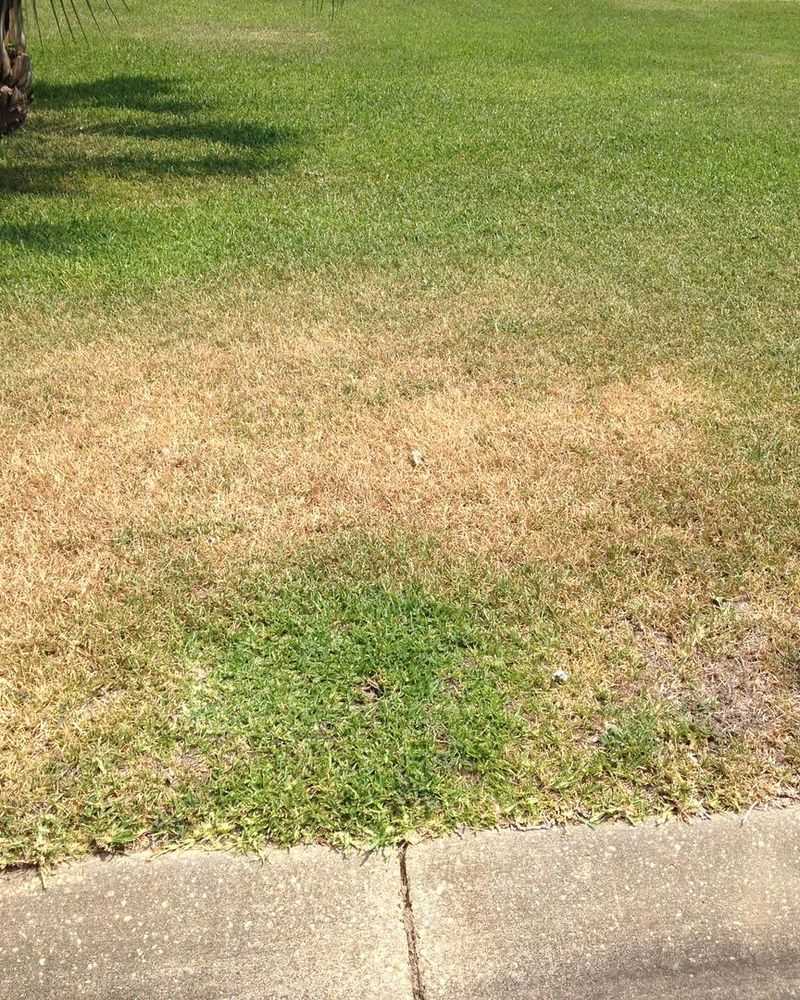
Drought stress and irrigation failure can look almost identical to chinch-bug injury from across the yard. The difference shows up when you get close.
Grass that is genuinely short on water will often show folded or rolled leaf blades, a blue-gray cast instead of the normal green, and wilting that makes the turf look flat. One reliable field clue: walk across the stressed area and look back.
Footprints that stay visible for more than a few seconds indicate the grass lacks the turgor to spring back, which points toward moisture stress rather than insect feeding.
Irrigation equipment deserves a careful check before you assume the lawn is simply not getting enough water. Clogged or tilted sprinkler heads, broken lines, sloped ground that sheds water before it soaks in, and compacted soil that resists infiltration can all create dry pockets that mimic pest damage.
A simple catch-can test, placing identical containers in different zones and running each zone for the same amount of time, can reveal whether some areas are receiving significantly less water than others. UF/IFAS turf management guidance recommends this approach for diagnosing uneven coverage before assuming the lawn needs more total water.
UF/IFAS irrigation guidelines for Florida lawns recommend watering established turf when drought symptoms appear, applying roughly one-half to three-quarters of an inch per irrigation event, and always watering in the early morning so the grass can dry before nightfall. Daily shallow watering is not the solution; it encourages shallow roots, wastes water, and can extend the leaf wetness that some diseases need to spread.
Fix the coverage problem first, then evaluate whether the watering amount is appropriate for current conditions. Texas A&M AgriLife’s bermudagrass management calendar similarly cautions against overwatering during hot periods when grass may already be under heat stress.
Wet conditions change the disease possibilities
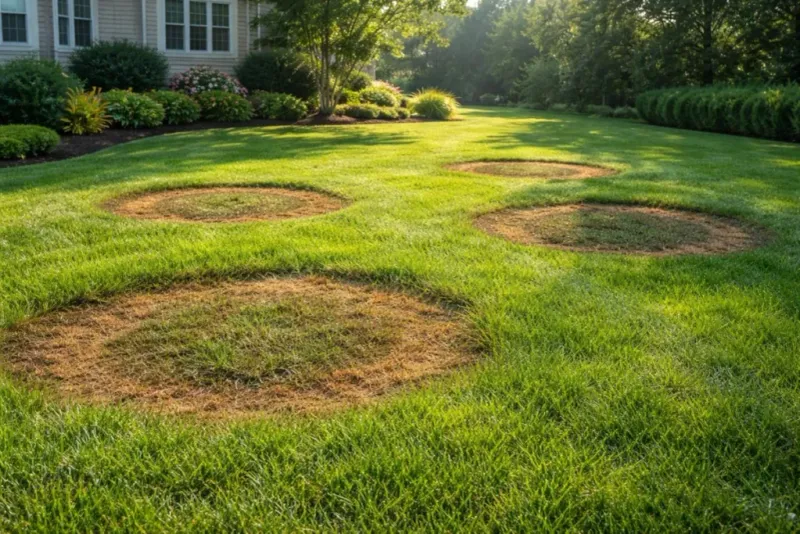
A stretch of heavy rain, high humidity, and warm nights shifts the investigation in a different direction. Fungal diseases become more plausible when the grass has stayed wet for extended periods, and the patch pattern often looks different from insect injury.
Circular or semicircular patches with a somewhat defined border are a common presentation. In the early morning on wet grass, you may also see white or grayish fungal growth at the outer edge of the patch, though this disappears quickly once the sun hits the turf.
Circular patches do not prove fungus on their own. Pet urine, summer patch in cool-season grasses, and other problems can also produce roughly circular damage.
The combination of shape, recent weather, and visible fungal growth gives you better evidence than any single clue alone. UGA Extension’s turfgrass disease quick-reference guide describes brown patch caused by Rhizoctonia solani as affecting both warm- and cool-season grasses, with symptoms that can appear during warm, humid conditions.
The regional terminology matters here. UF/IFAS guidance on Florida large patch distinguishes this disease as primarily a cooler-period problem of warm-season grasses, generally absent during summer in Florida.
Other Rhizoctonia diseases can occur during hot weather, so the terms “brown patch” and “large patch” are not interchangeable without knowing the grass, the region, and the season. Penn State Extension’s brown patch profile notes that prolonged leaf wetness and nighttime watering can increase disease risk, which is one reason early-morning irrigation is consistently recommended over evening watering.
If wet conditions have persisted and the patch pattern fits, consider consulting your local extension office before reaching for a fungicide. Texas A&M’s turfgrass disease and pest control guide reinforces that accurate disease identification is essential before any chemical treatment is applied.
Look for webworms, urine, and chemical injury
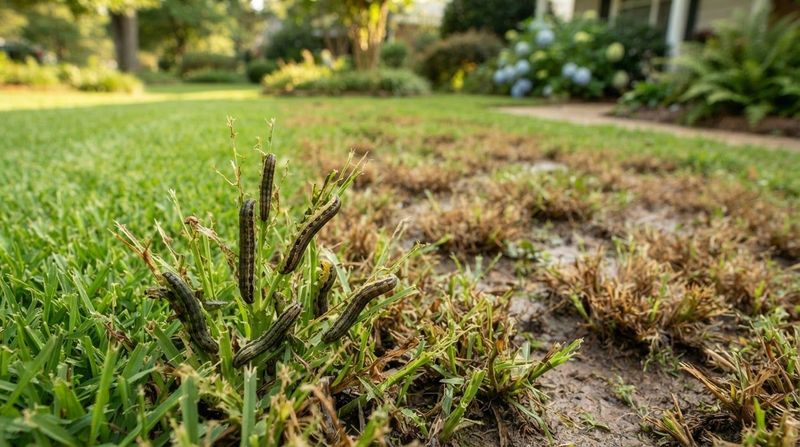
Chinch bugs and fungal disease get most of the attention, but several other problems produce nearly identical symptoms and deserve a spot on your checklist. Sod webworms are a meaningful midsummer possibility across the Gulf South.
Their larvae feed at night by chewing grass blades near the soil surface, leaving behind a ragged, clipped appearance rather than the smooth browning of drought. Look closely at the thatch layer for small green pellets, which are larval droppings, and for silk-lined tunnels just above the soil.
UGA Extension’s sod webworm page notes that larvae can be exposed by mixing a small amount of dish soap with water and pouring it over the suspected area, which irritates the insects and drives them to the surface. Penn State Extension’s sod webworm guide adds that increased bird activity over a patch can be a supporting clue, though it is not diagnostic by itself.
Pet urine leaves a recognizable pattern when you know what to look for: a small, sharply defined dead center surrounded by a ring of noticeably greener, faster-growing grass. The mechanism is concentrated nitrogen deposited in a small area, not urine pH or the dog’s diet, despite common claims to the contrary.
Penn State Extension’s dogs-versus-lawns resource and Utah State Extension’s turf IPM advisory both identify nitrogen concentration as the primary damage factor. Watering the spot promptly after a pet uses it can dilute the nitrogen and reduce injury.
A recent herbicide application is also worth reviewing, especially on St. Augustinegrass. UF/IFAS herbicide injury guidance notes that atrazine and certain other products can damage St. Augustinegrass when applied during warm temperatures, with injury sometimes appearing well after the application date.
UF/IFAS plant pathology resources also flag root damage and mowing stress as additional contributors: cutting grass too short removes too much leaf area at once, reducing the plant’s ability to recover and leaving it more vulnerable to heat, insects, and disease.
Match the response to the confirmed problem
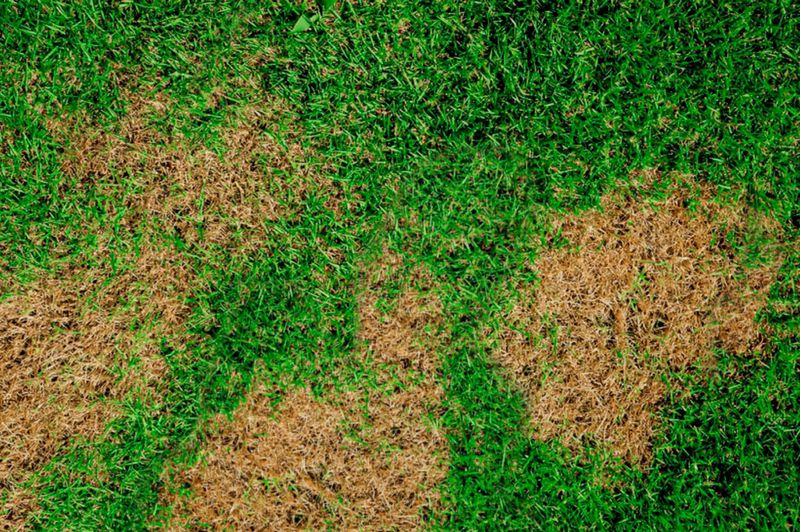
Once your inspection points toward a likely cause, the response should be proportional and specific. Confirmed irrigation problems call for equipment repair and coverage adjustments, not more water on the same broken schedule.
Switch all watering to early morning so grass blades dry before nightfall. UF/IFAS disease management guidance explains that extended leaf wetness from evening or nighttime irrigation can increase the risk of certain fungal diseases, which makes morning timing a sound default regardless of the diagnosis.
Mowing practices matter more than most homeowners realize. UF/IFAS turf management recommendations and Texas A&M AgriLife’s lawn problem guide both advise mowing at the highest recommended height for the grass species and never removing more than one-third of the blade in a single session.
Scalping already-stressed turf removes the leaf area the plant needs to recover and leaves it more exposed to heat and pest pressure.
Extra nitrogen is not a cure for brown patches. UGA Extension’s disease quick-reference guide notes that excess nitrogen can produce lush growth that is more susceptible to brown patch, while AgriLife’s bermudagrass calendar advises against fertilizing during hot, dry periods when moisture is limited.
Pesticides and fungicides follow the same rule: apply them only when you have confirmed the pest or disease, verified the product is labeled for your grass species and the specific problem, and checked relevant thresholds. UF/IFAS fungicide guidance is direct on this point: fungicides are disease-specific, and applying one without a confirmed diagnosis can waste money and miss the actual cause.
If the roots are involved, symptoms persist after correcting a confirmed cultural problem, or you cannot identify the cause after a careful inspection, contact your local extension office or a licensed turf professional for a laboratory diagnosis. UF/IFAS entomology resources also remind homeowners that chinch-bug populations can include natural predators, so treating with a broad insecticide before confirming the pest can harm beneficial insects without solving the problem.
Use a decision rule instead of a one-product cure
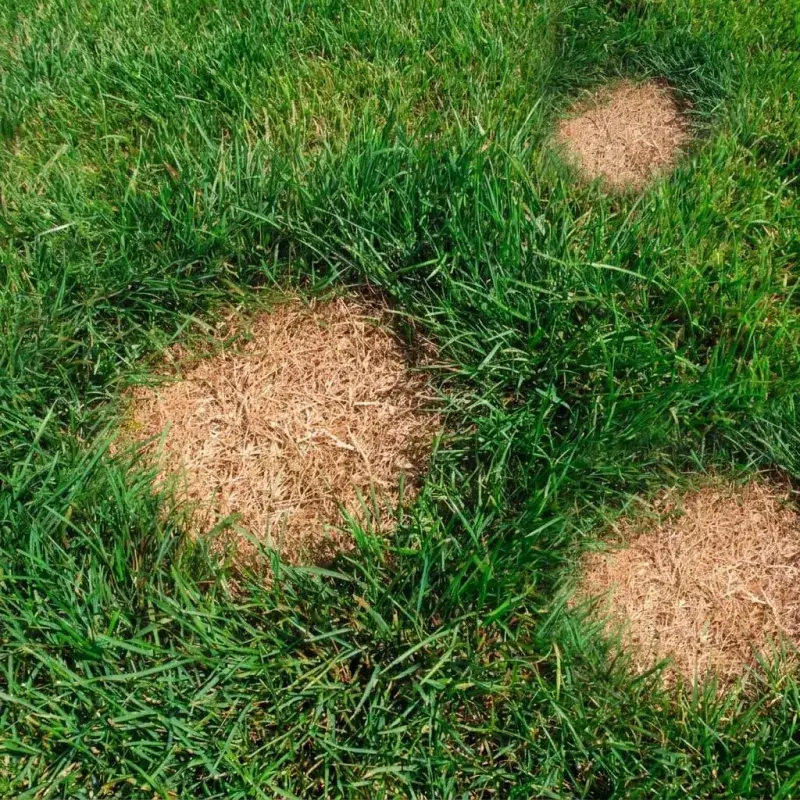
Every brown-patch investigation should follow the same short sequence. Start by identifying the grass species, then map the patch: note its shape, size, location relative to hardscape, and whether it is growing.
Check soil moisture by pushing a screwdriver or probe six inches into the ground; if it slides in easily, the soil is not dry. Run each irrigation zone and watch for gaps, weak heads, or dry spots that a catch-can test can confirm.
Texas A&M AgriLife’s St. Augustinegrass chinch-bug guide and UF/IFAS lawn irrigation guidance both support this step-by-step approach over reactive treatment.
Next, inspect the patch edge for insects using the coffee-can float test, look for clipped blades or frass that suggests webworms, and check for the dead-center-plus-green-ring pattern that points to pet urine. Review any herbicide applications from the past few weeks.
If recent weather has been wet and humid, look for circular patches and early-morning fungal growth before considering a disease cause. UGA’s disease quick-reference and UF/IFAS fungicide guidance both reinforce that treatment should follow a confirmed cause, not a calendar or a color.
Heat may have started the trouble, revealed a hidden problem, or simply made existing stress more visible. What matters is what the grass itself is telling you.