
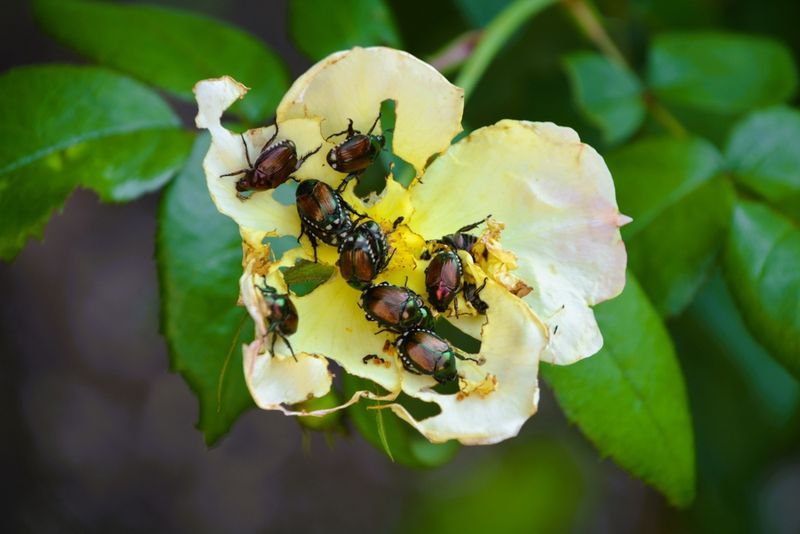
Walking out to find your rose blossoms shredded or your marigolds stripped to bare stems is genuinely alarming, especially when the culprits are still there, gleaming green and copper in the morning sun. Japanese beetles are one of the most destructive garden pests in the eastern and midwestern United States, and a big cluster on one plant can make it feel like the whole yard is under attack. Before you reach for a spray bottle or start blaming your lawn, though, the smarter move is to slow down and figure out what is actually drawing them to your garden. Flower damage is a reason to look more closely at several yard conditions, not proof of one single underlying problem.
Flower damage starts an investigation, not a diagnosis
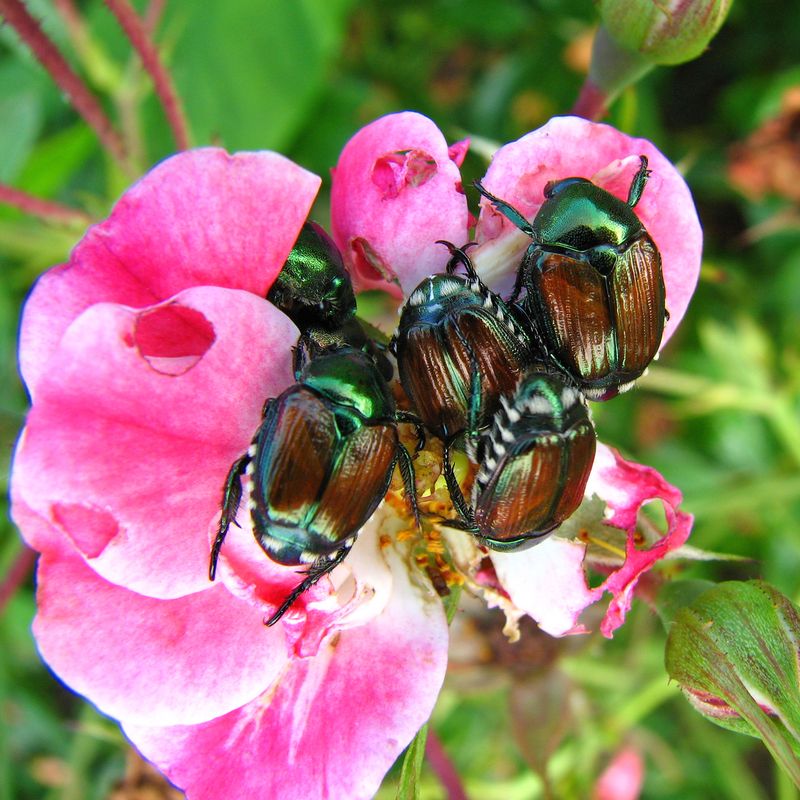
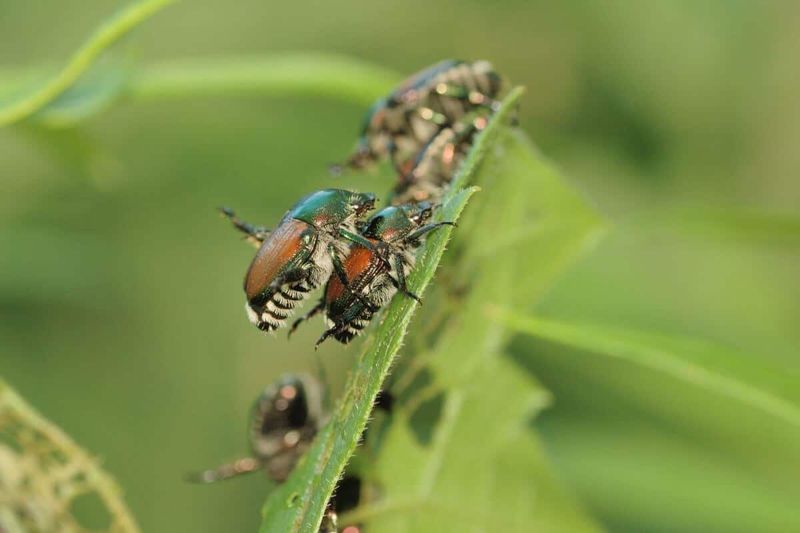
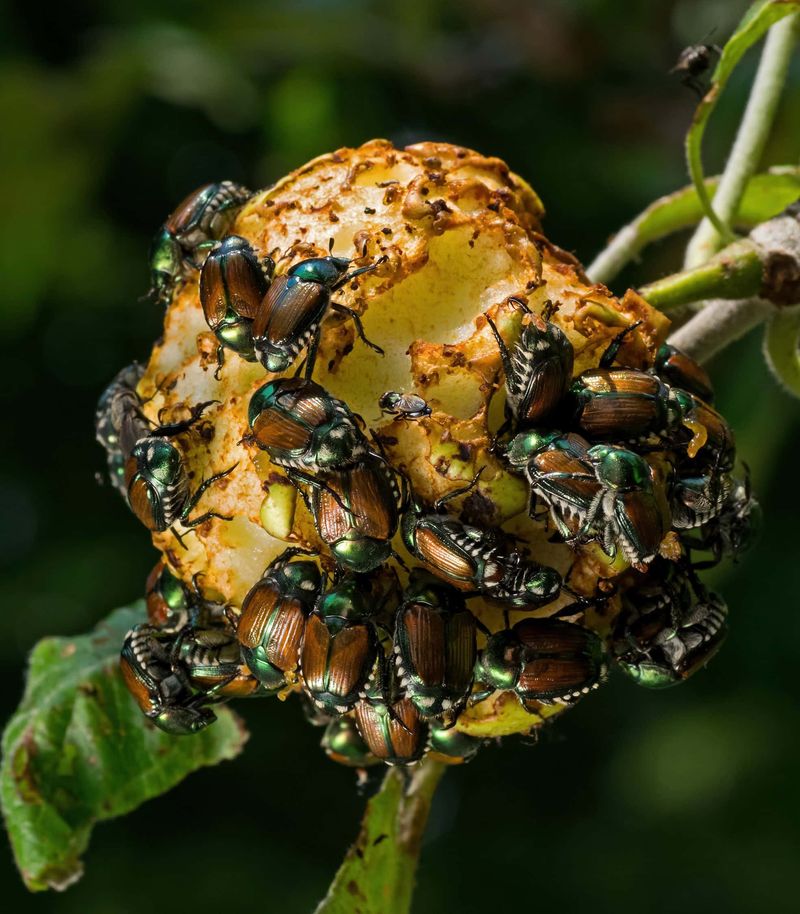
Metallic green bodies, copper-brown wing covers, and a row of small white tufts along each side of the abdomen – those are the field marks of an adult Japanese beetle. Each one is roughly one-third to one-half inch long, and University of Minnesota Extension guidance on Japanese beetles confirms they skeletonize leaves by eating the soft tissue between the veins while also feeding on flowers and fruit. Roses and marigolds rank among their preferred hosts, which helps explain why those plants so often bear the worst damage in a mixed garden.
Finding a crowd of them on one rose bush, though, does not automatically point to a single root cause. A concentrated group may reflect the plant’s own susceptibility, the presence of earlier feeding that is now attracting more beetles, mating and feeding aggregation behavior, heavy regional beetle pressure this season, or adults that flew in from a neighboring lawn, pasture, or golf course several properties away. Any combination of those factors can be operating at once.
Flower damage is the right reason to start a broader yard inspection, but it cannot identify which of those contributors is driving the outbreak or confirm that a lawn infestation is involved. Treating the problem as a single, obvious diagnosis from the start risks wasted effort and missed causes. The flowers are a signal to look further, not a verdict.
Why beetles may cluster around one damaged plant
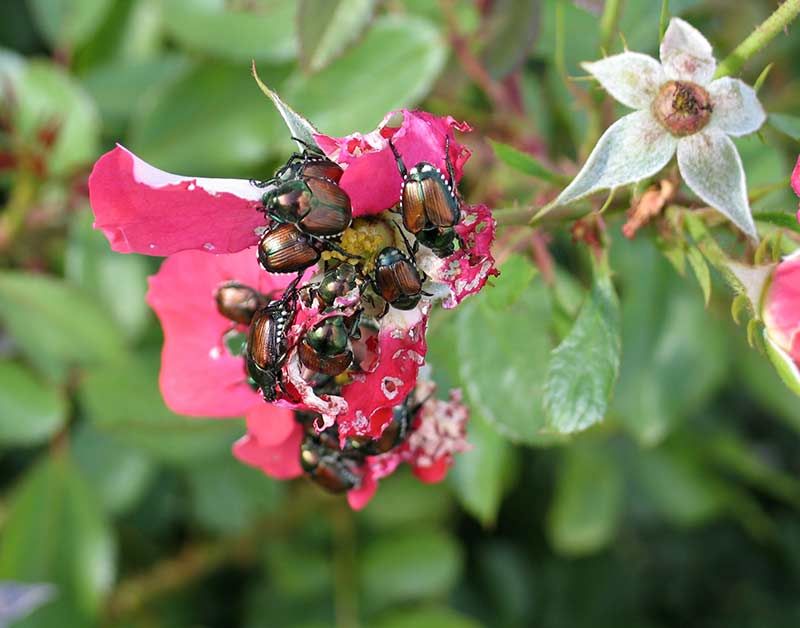
When Japanese beetles begin feeding on a plant, the damaged tissue can release volatile compounds that attract additional beetles to the same spot. Research published in Environmental Entomology on feeding-induced plant volatiles found that these odor signals can contribute to local clustering behavior, helping explain why one rose or marigold in a row takes the heaviest hit while neighbors stay relatively untouched. Adults also naturally gather at active feeding and mating sites, compounding the effect.
That clustering tendency is a possible mechanism for local concentration around a single damaged plant, not a guarantee that the whole neighborhood will be drawn in. The scale of the effect depends on how many beetles are already in the area, how attractive the plant is, and how much damage has already occurred. Regional beetle pressure and the particular susceptibility of your plant variety play a role too.
Knowing this shapes what you do next. Removing beetles promptly, before feeding escalates, makes practical sense because it may reduce both the immediate damage and some of the odor signals that recruit more insects. Stripping every damaged leaf, however, is not a complete control method – it is not recommended by extension authorities as a standalone fix, and aggressively defoliating a plant can add stress on top of the feeding injury. Focus on removing the beetles themselves, not dismantling the plant.
Separate adult beetles from lawn grubs
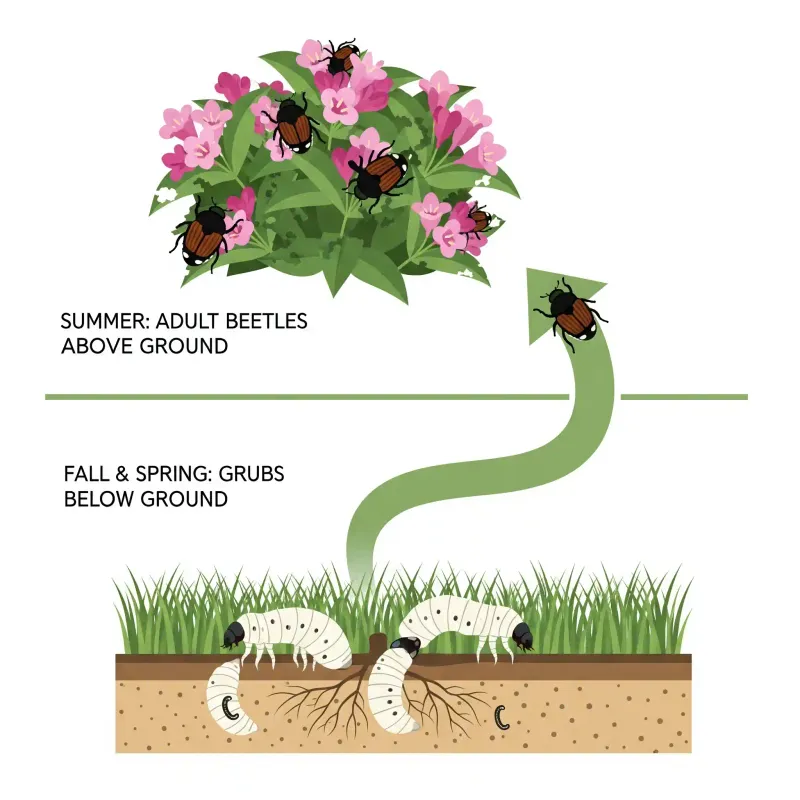
Adult Japanese beetles and their larval grubs are two distinct problems that happen to share a name. Adults spend their active season above ground, chewing foliage, flowers, and fruit on hundreds of host plants. Grubs live below ground and feed primarily on grass roots during their development, which is why confirmed grub damage shows up as turf problems rather than as chewed flowers.
Controlling one stage does not reliably control the other in a typical suburban yard. Minnesota Extension notes that adult beetles are strong fliers capable of traveling considerable distances, so adults feeding on your roses may have originated from a lawn two streets over, a nearby golf course, or an untreated field at the edge of the neighborhood. A lawn that tests clean for grubs can still have adult beetles landing on its garden plants every day.
The reverse is also true: finding grubs in your turf does not prove that those specific beetles are the ones damaging your flowers. Grub damage is a turf-health issue that deserves its own assessment and response. UMN Extension guidance on yard digging and turf damage reinforces that adult feeding on ornamentals and grub feeding on roots are separate concerns requiring separate diagnoses. Treating the lawn may help protect turf from root damage, but it will not reliably stop adult beetles from arriving from outside your property.
Inspect the lawn before you blame it
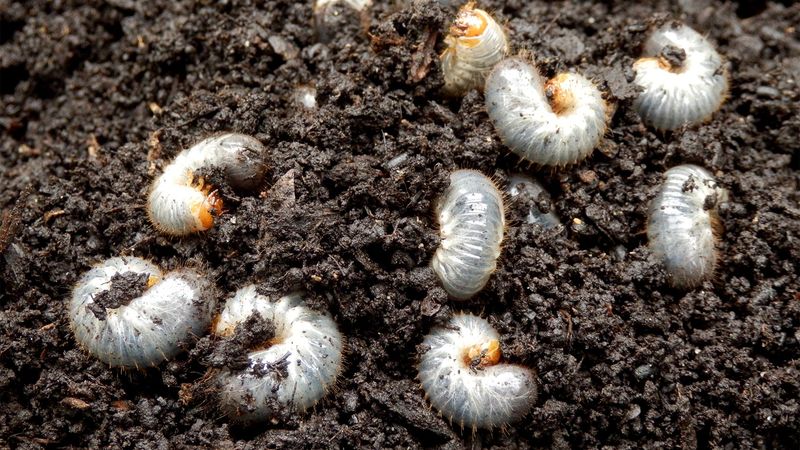
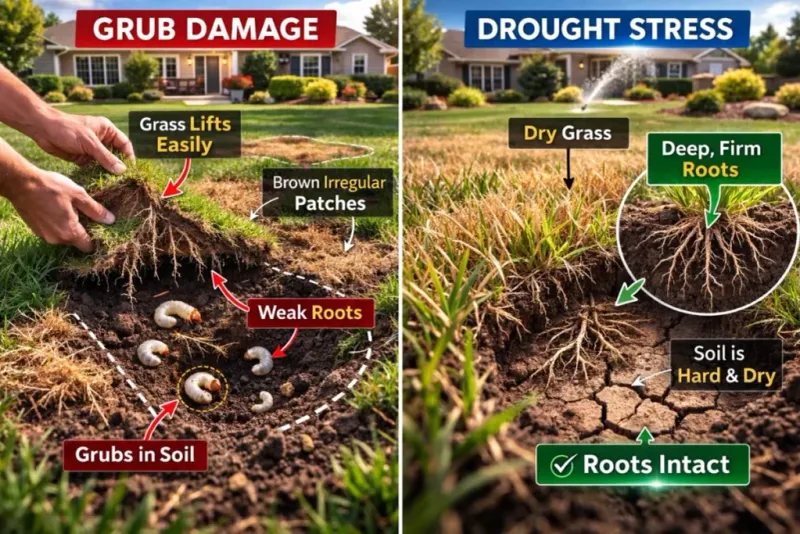
Brown or yellow patches in a lawn are easy to blame on grubs, but drought, fungal disease, soil compaction, and several other turf problems can produce patches that look almost identical. Physical inspection is the only way to know whether grubs are actually responsible, and Penn State Extension’s guide to white grubs in home lawns lays out a straightforward method for checking.
Start by walking the lawn and looking for irregular discolored patches, turf that feels spongy or loose underfoot, or sod that can be peeled back like a loosely attached carpet. If you find any of those signs, dig several one-square-foot samples about two to four inches deep and examine the soil, thatch layer, and root zone for white, C-shaped grubs. Do this in multiple spots, including areas that look healthy, to get a realistic count.
Keep in mind that not every white grub you find is a Japanese beetle larva. Several scarab species produce similar-looking grubs and can cause comparable turf damage. Accurate identification matters because treatment options and timing can differ by species. If you are unsure what you are looking at, your local cooperative extension office can help with identification or point you toward a diagnostic service.
UMN Extension also emphasizes that physical inspection, not patch appearance alone, is the appropriate decision point between monitoring and considering any treatment.
Protect valuable flowers with low-risk steps first
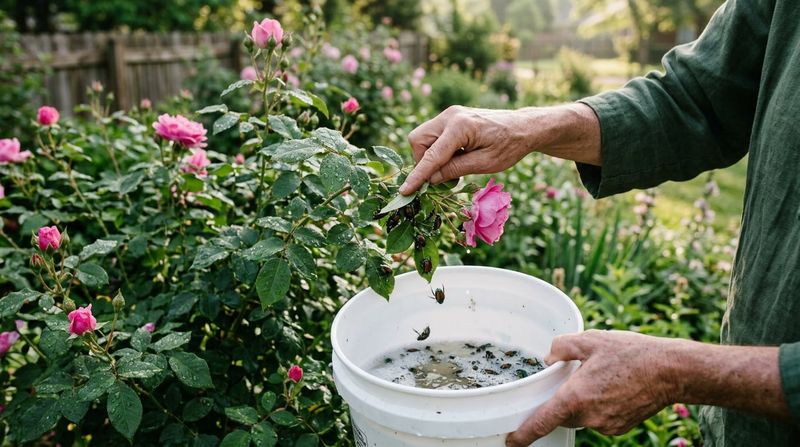
For most home gardeners dealing with an isolated or manageable infestation, the first line of defense does not need to come from a spray can. UMN Extension recommends checking plants at least once a day during active beetle season and handpicking or knocking beetles into a container of soapy water. Morning and evening are the best times to do this because cooler temperatures make beetles sluggish and less likely to fly off before you reach them.
Healthy, established roses and shrubs can often tolerate leaf feeding better than young, newly planted, or already-stressed specimens, though beetles can still ruin individual blooms even on an otherwise sturdy plant. Vegetables and fruit-bearing plants may be more vulnerable since feeding can reduce yield. Catching beetles early and consistently gives plants a better chance of recovering before the peak of beetle season passes.
Fine insect netting is a practical option for small, high-value plants that you want to protect more completely. Drape it loosely and secure the edges so beetles cannot find a gap. One important exception: do not cover flowering fruit crops that still need bees and other pollinators to set fruit. Colorado State University Extension guidance on Japanese beetles suggests waiting until pollination is complete before netting those plants, or choosing a different protective approach for them entirely.
Good plant care – adequate water, appropriate fertilization, and avoiding unnecessary stress – also helps plants recover from feeding damage more readily.
Treat confirmed grub damage as a turf problem
Once physical inspection confirms that grubs are present and causing turf damage, the question becomes whether the population is large enough to justify intervention. Penn State Extension notes that five to ten grubs per square foot is sometimes used as a rough range for considering curative treatment, while Minnesota Extension suggests that healthy turf may tolerate up to about ten per square foot. Those figures are starting points, not universal rules. Turf condition, grass species, grub identity, the degree of visible damage, and local extension recommendations all factor into whether treatment is actually warranted.
Some supportive practices can improve the turf’s ability to withstand moderate grub pressure. Mowing at a higher height encourages deeper root development, giving the grass more reserves to draw on when roots are damaged. Colorado State Extension points out that drier soil conditions during the egg-laying and early-hatching period can reduce grub survival, because eggs and young grubs are sensitive to moisture loss. That said, if damaged turf is actively trying to regrow roots, watering may still be necessary to support recovery.
Timing matters significantly for any chemical treatment. Spring applications are generally a poor choice because overwintered grubs are older, deeper, and harder to reach. Preventive products are typically timed before adult emergence and egg laying, while curative products target young, actively feeding grubs later in summer. UMN Extension is clear that lawn treatment may reduce beetles emerging locally but cannot stop adults from flying in from surrounding properties – so protecting turf from root damage is the primary goal of grub control, not eliminating flower damage.
Avoid fixes that waste effort or raise risks
Japanese beetle lure traps are widely sold and look like an obvious solution, but Colorado State University Extension cautions that they tend to attract more beetles toward the trap area than they actually capture, which can increase feeding damage on nearby plants. Traps have a legitimate role in large-scale monitoring programs, but placing one near your rose bed or vegetable garden is likely to make the problem worse rather than better.
Improvised sprays made from household dish soap are another popular but unreliable option. Penn State Extension explains that insecticidal soap products are formulated for small, soft-bodied insects and are not effective against adult Japanese beetles. Homemade dish-soap mixtures can also burn or injure foliage, adding plant stress to an already difficult situation. On the biological-control side, current university guidance does not support milky spore as a dependable cure – UMN Extension reports that commercial milky-spore products have not shown reliable benefit in recent university trials.
Neem and pyrethrin-based products sometimes appear on “organic” control lists, but organic does not mean risk-free. Both may require repeated applications to have any effect, and pyrethrins are toxic to bees and many beneficial insects on contact. If a chemical control is genuinely needed after other options have been exhausted, the product must be labeled for the specific pest, plant, and site. EPA pesticide safety guidance requires avoiding windy or rainy conditions, keeping children and pets away as the label directs, and preventing drift or runoff.
Several effective adult and grub insecticides – including pyrethroids, carbaryl, and some neonicotinoids – can harm bees and ground-nesting insects, so EPA pollinator protection resources and label restrictions should be reviewed before treating around open flowers or flowering weeds in the turf.
Match the response to what the evidence shows
A practical decision sequence keeps the response proportionate. Remove visible adults from valuable plants first, using handpicking and soapy water as the starting point. Then inspect the turf only when symptoms – loose sod, root damage, confirmed grub counts – actually justify it. If inspection reveals a grub population above the rough threshold for your turf condition and local guidance, treat according to product label directions and recommendations from your cooperative extension office.
UMN Extension and Penn State Extension both reinforce that a lawn free of grubs does not guarantee beetle-free flowers, and a lawn with grubs does not prove the adults in your garden came from that turf. Those two facts together mean that neither a clean lawn nor a treated one is a complete solution on its own.
A beetle outbreak is most usefully read as information: which plants in your yard are most attractive, whether your turf can support grub survival, and how much regional beetle pressure exists this season. Treating it as one automatic diagnosis and one automatic fix tends to produce frustration. Treating it as a set of separate, inspectable conditions tends to produce answers you can actually act on. The beetles are telling you something worth hearing – just not necessarily the one thing the first glance suggests.