
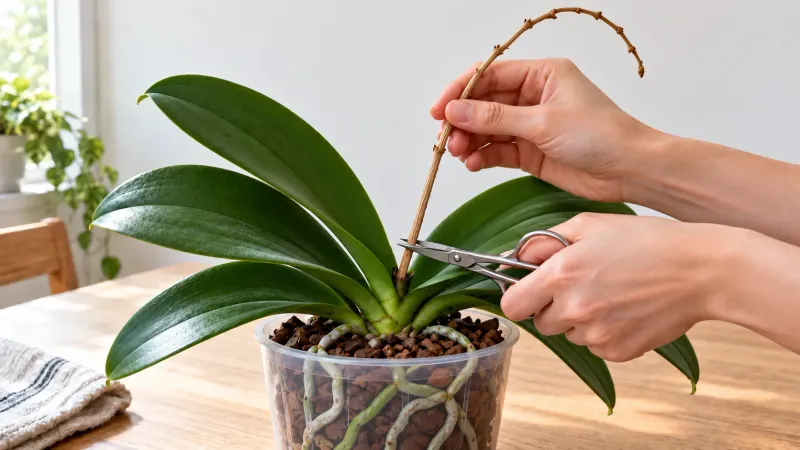
A moth orchid can send up a second round of flowers from the same spike when you cut it in the right spot. The trick is leaving a healthy node on the stem that can grow a side branch.
It does not happen every time, and timing varies, so a little know-how helps. Here is how to look at your plant, make a careful cut, and decide whether trimming is even the best move.
This method is mainly for Phalaenopsis
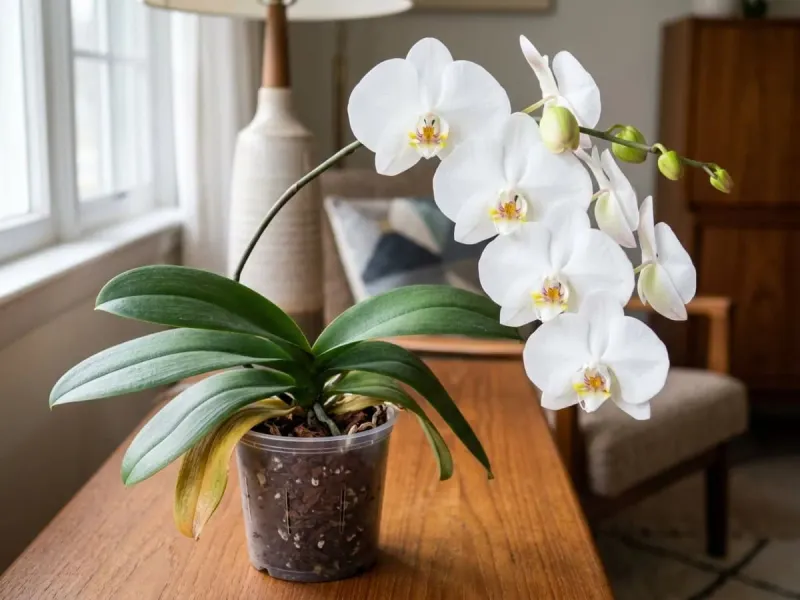
Moth orchids, known as Phalaenopsis, are the plants this advice is built around. They have broad, flat, leathery leaves and long arching spikes with rounded flowers.
Before you pick up any pruners, make sure that is what you own.
Plant type matters because orchids do not all behave the same way. According to the American Orchid Society, most orchid genera bloom once per spike, and the old spike is then removed at its base.
Some other types can rebloom from old spikes too, so check the care needs of your specific orchid rather than assuming.
Next, look at how the plant is doing. Firm green leaves and healthy roots are good signs, and a green spike gives you something to work with.
Iowa State Extension offers guidance for growing orchids indoors. If the plant looks weak or the spike is turning brown, keeping the spike may not be worth it.
Unused nodes can grow a side branch
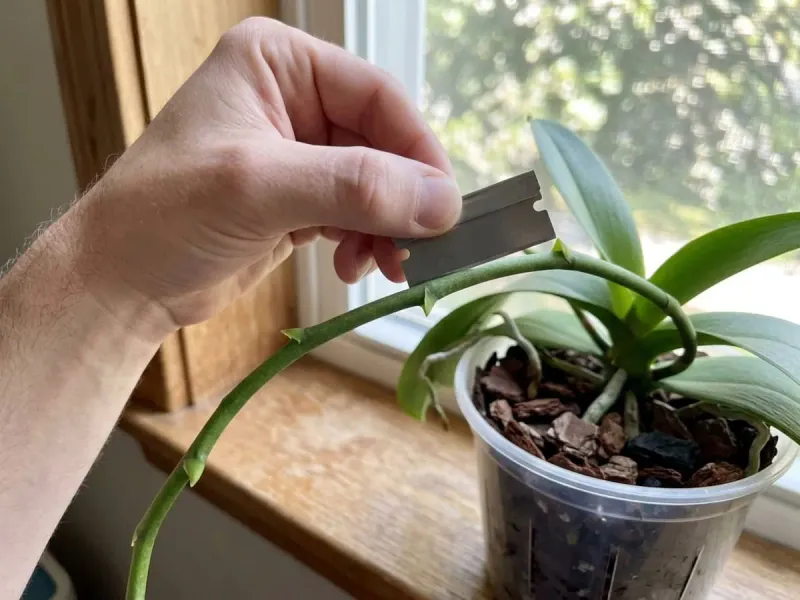
Once the last flower drops, take a close look at the spike. Along the stem you will see small raised joints called nodes.
Many are covered by a thin, triangular bract that looks like a tiny scale.
Those nodes are possible growth points. On a green spike, an unused viable node may produce a side branch with more flowers, or sometimes a keiki, which is a small plantlet.
The American Orchid Society describes these options when explaining where to cut a finished spike.
A node is a chance, not a promise. Some stay dormant, and the plant may decide to rest instead.
Plump, green tissue under the bract is a better sign than a shriveled, dry one, but even a good-looking node may never wake up.
Make the cut above a viable node
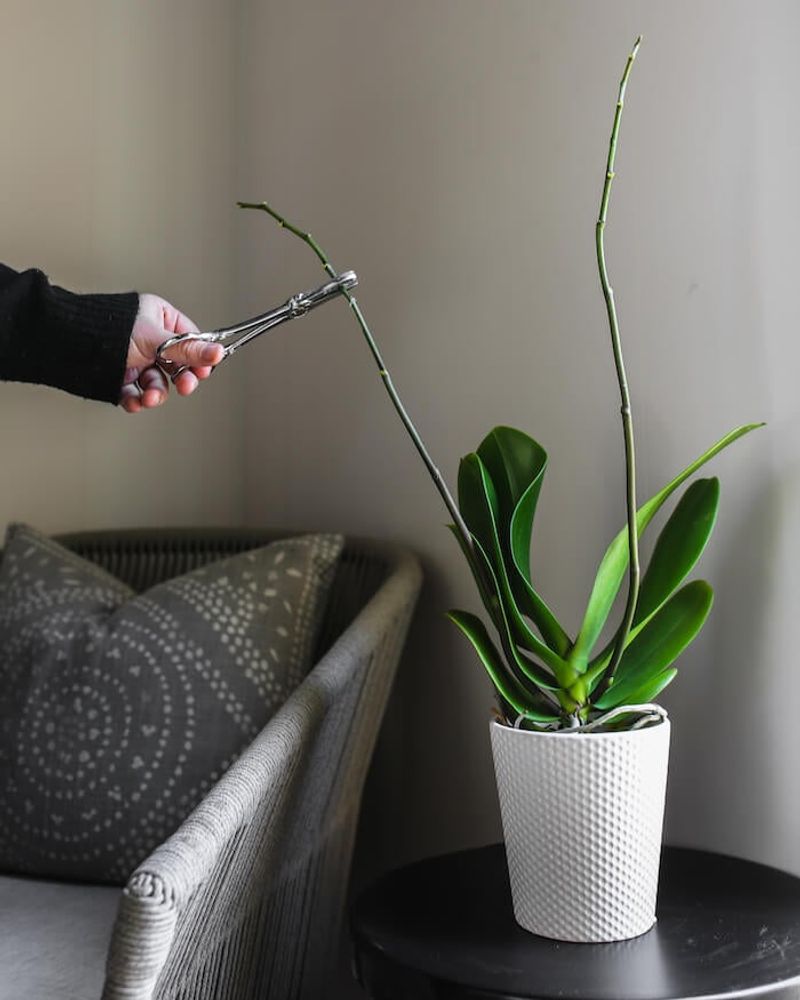
Cutting a green spike means choosing a spot that leaves viable nodes below the cut. Gardeners get different advice on exactly where.
The American Orchid Society suggests cutting above an unused node, often the second unused one.
North Carolina State Extension describes cutting just above the first node below the faded flowers. Neither placement is a universal rule.
Pick a viable node, leave healthy ones below, and accept that results may differ.
Use a sharp, sterile cutting tool so the cut is clean. Iowa State Extension recommends sterilizing pruners between plants to reduce the chance of spreading disease.
Wipe the blades with rubbing alcohol before you start and again before moving to the next orchid.
A good cut cannot make up for a plant’s health, genetics, light, or temperature. It only leaves the door open.
A second flush may take weeks, or may not come
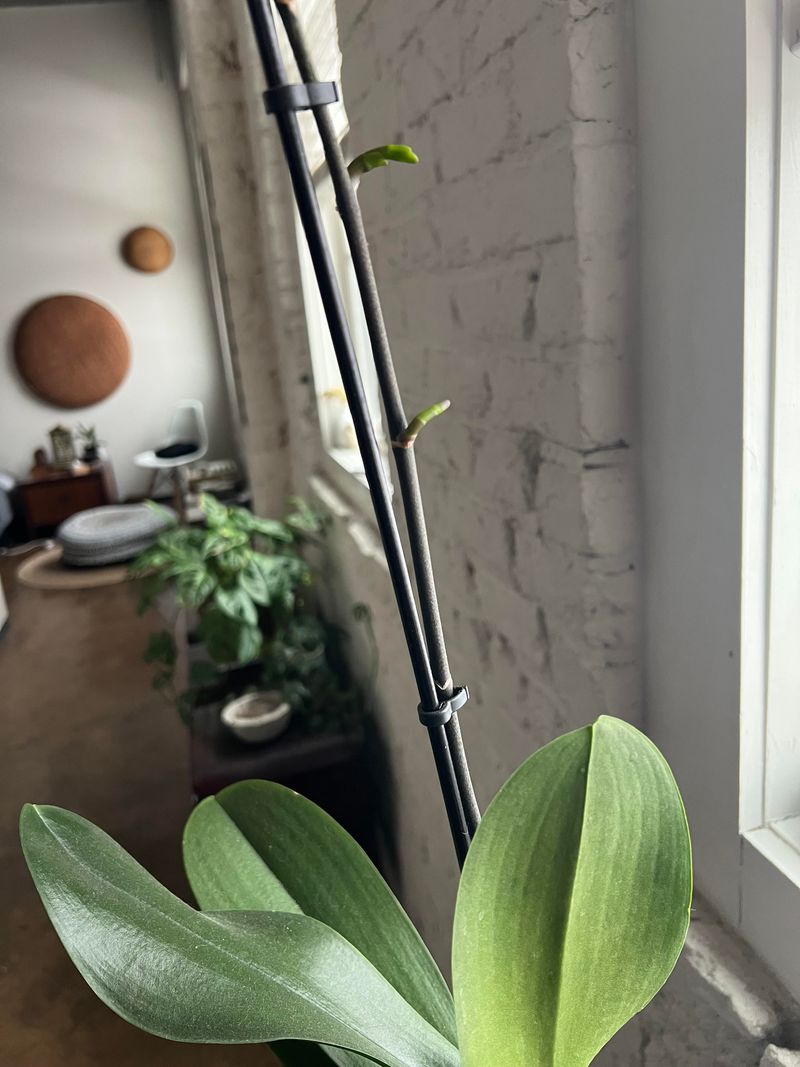
If a branch does form, it often shows as a small bump or tiny green shoot at the node. Flowers can follow, and sources give roughly 8 to 12 weeks as a possible timeframe.
Iowa State Extension says blooms may appear in that window, but adds that it is not guaranteed.
Treat that number as an estimate, not a shortcut. Some plants take longer, and some never branch at all.
Smithsonian Gardens also gives Phalaenopsis care guidance that fits this kind of waiting game.
Genetics play a part, too. Rutgers Extension notes that genetics affect whether a Phalaenopsis reblooms from an old stem.
If yours does not, it is not a sign you did something wrong.
A new flower spike follows different conditions
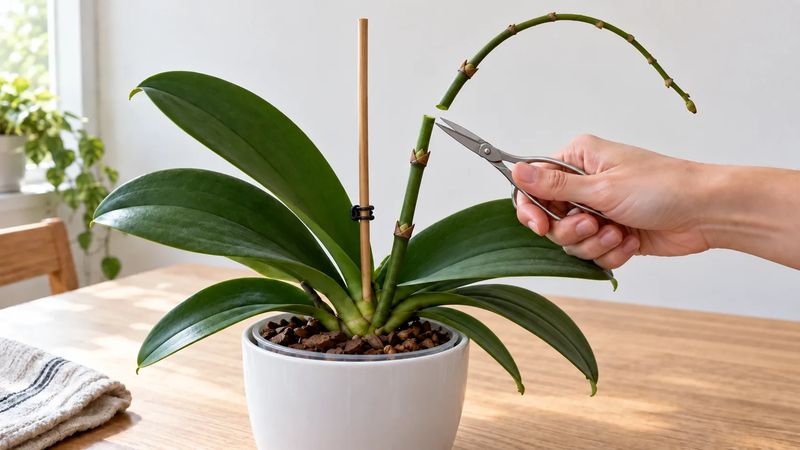
A branch on an old spike is not the same as a brand-new flower spike. A branch grows from a node on the stem you kept.
A new spike pushes up from the base of the plant, usually between the leaves, and pruning alone is not what causes it.
Light and temperature both influence Phalaenopsis flowering. Maryland Extension names low light as a common reason plants fail to flower.
It also says cooler fall nights can help set buds.
Do not count on cool nights alone, though. A study in the Journal of Experimental Botany found that daytime temperature, not nighttime temperature, controlled flowering under its studied conditions.
So if you want a new spike, think about bright but indirect light and steady, suitable temperatures, and give the plant time.
When to remove the spike instead
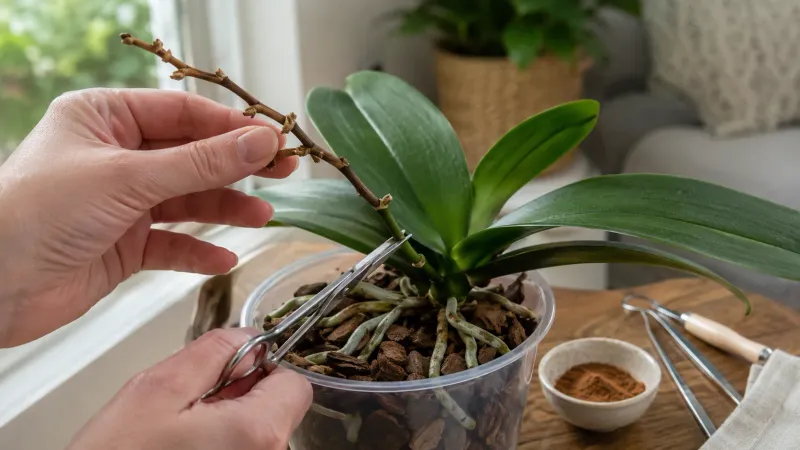
Sometimes the best cut is the lowest one. If the spike is brown, dried, or dead-looking, remove it near the base.
Its nodes will not be much help for another flush.
The American Orchid Society and Iowa State Extension both advise basal removal in those cases. Cut close to the bottom with a sharp, sterile tool.
A weak or stressed plant may do better with a rest. A second flush may be smaller or weaker, and growing it uses energy the plant could spend rebuilding leaves and roots.
Limp leaves, few roots, or a plant that struggled through its first bloom are good reasons to skip the gamble.
Letting it recover may set it up for a stronger bloom cycle later.
Choose the cut that fits the plant
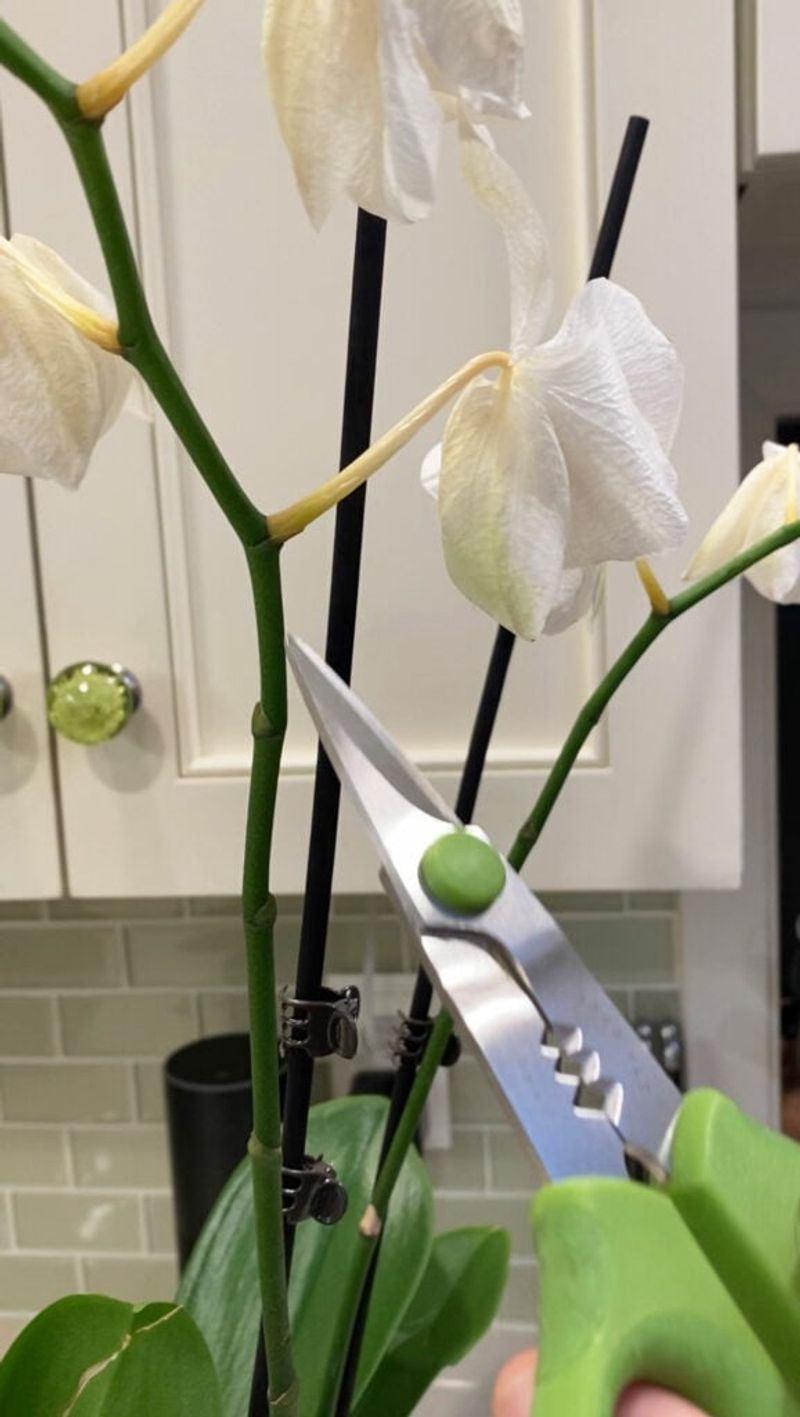
Start by confirming you have a Phalaenopsis. Then check that the plant looks strong and the spike is green.
If both are true, cut above a viable node, knowing a branch may not form, as the American Orchid Society and Iowa State Extension both make clear.
If the spike is dead, or the plant is struggling, cutting at the base and letting it recover is sound care too.
An orchid rarely follows a schedule, so the best cut is the one that suits the plant in front of you.