
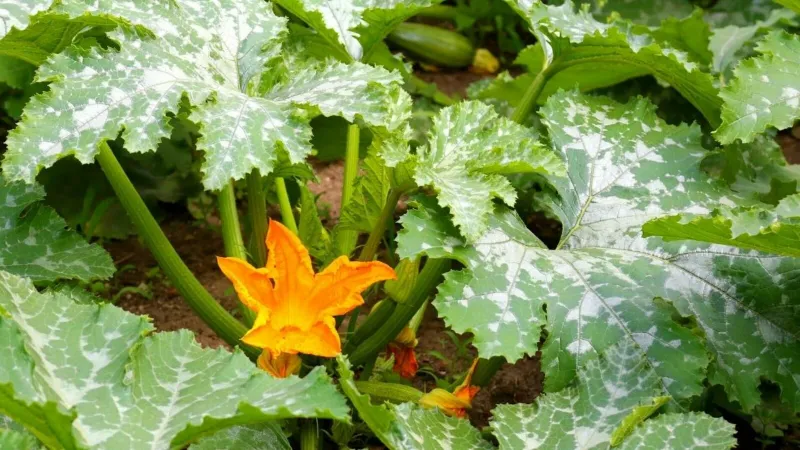
Seeing silvery or mottled patches on your zucchini leaves can send a gardener straight to the pesticide shelf, but the cause is not always what it seems. Some zucchini varieties naturally grow leaves with smooth gray or white blotches, and treating a healthy plant for a pest it does not have can do more harm than good.
Before you act, a quick look at the whole plant, including the undersides of leaves and nearby stems, will tell you far more than the leaf color alone.
Silver mottling may be normal zucchini coloration
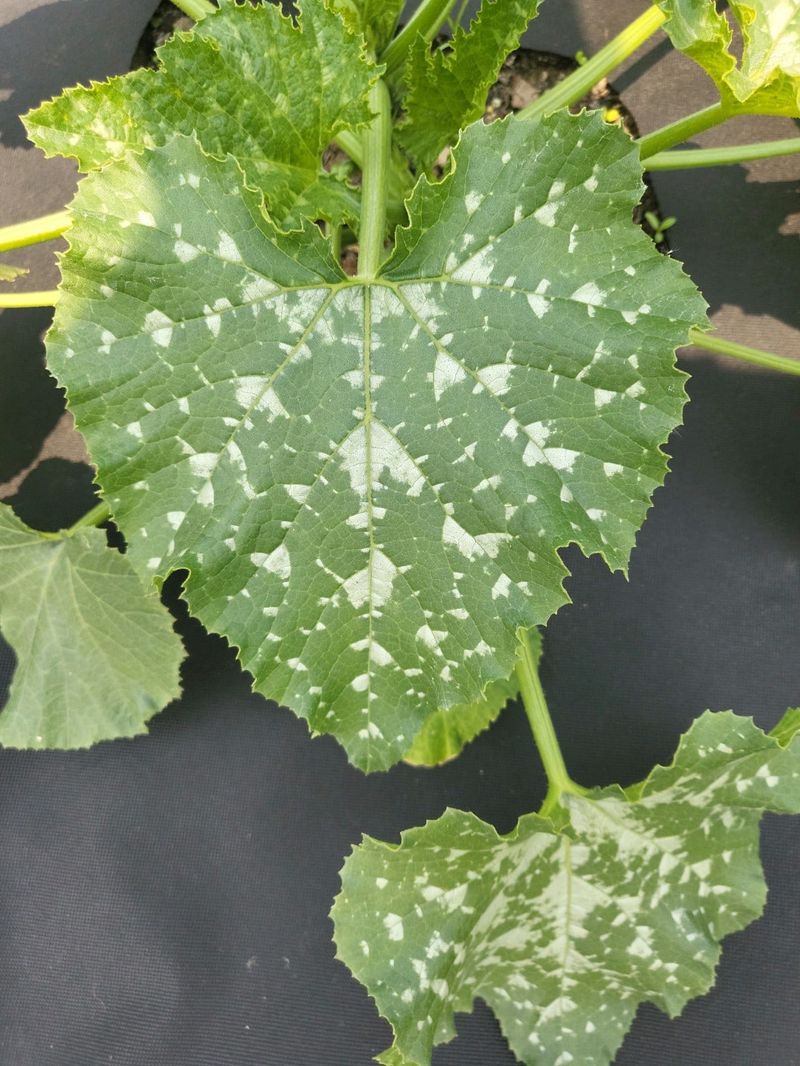
Before assuming something has gone wrong with your zucchini, take a closer look at the pattern on the leaves. University of Maryland Extension guidance on common squash problems specifically identifies smooth gray or silver blotches without any powdery residue as normal color variation in some zucchini varieties.
If the pattern on your plant is consistent from leaf to leaf, does not include fine pinprick dots, and the plant shows no wilting, distortion, or general decline, there is a real chance you are simply looking at the natural look of that cultivar.
Normal coloration tends to appear as angular, almost painted-looking patches that follow the leaf veins or fan out across the blade. The key distinction is smoothness: the patches blend into the surrounding green rather than appearing as clusters of tiny wounds or a uniform, bleached-out sheen across the whole leaf surface.
No insects, webbing, sticky residue, or distorted new growth accompanies it.
Reaching for a spray product under these conditions is unnecessary and potentially harmful to the plant, pollinators visiting the flowers, and beneficial insects nearby. Confirm that the pattern is consistent with normal growth before moving on to pest inspection.
If the plant is otherwise producing well and the foliage looks structurally sound, the silver you are seeing may simply be the variety doing what it naturally does.
Squash bugs cause yellow-to-brown feeding injury
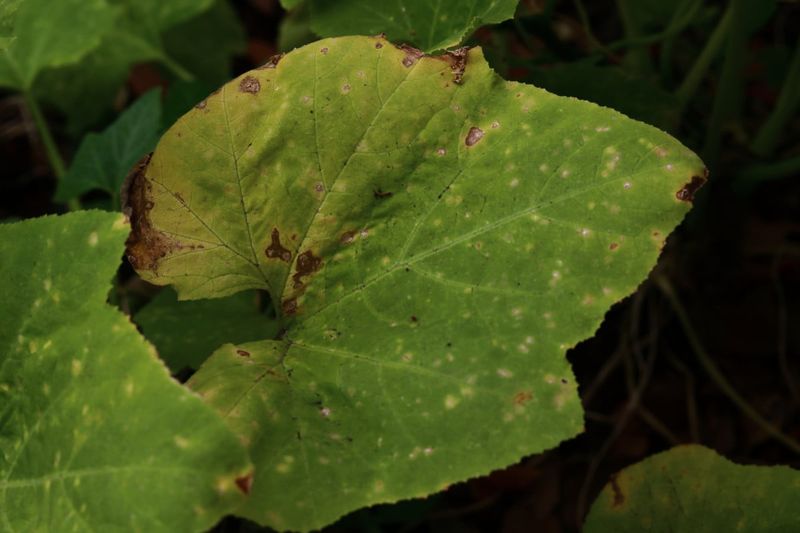
Squash bugs do real damage, but their signature injury looks very different from a clean silvery wash. Feeding starts as small yellow or yellow-green specks scattered across the leaf surface.
Over time, those specks turn brown, and under a heavy infestation the affected tissue can yellow broadly, scorch at the edges, blacken, and eventually become crisp and papery.
UC IPM’s squash bug profile describes this progressive injury pattern and notes that heavy feeding can disrupt water and nutrient movement through the plant, sometimes leading to a collapse called Anasa wilt. The wilt mechanism is not fully settled, but the effect, rapid wilting that does not recover with watering, is a recognizable sign that feeding has become severe.
Note that no confirmed salivary toxin has been established; the disruption appears to be physical rather than chemical.
Larger, vigorous zucchini plants may tolerate a modest level of squash-bug feeding without collapsing, while smaller or already-stressed plants tend to decline faster. Susceptibility also varies among cucurbit species and cultivars, so outcomes are not uniform across every garden.
The practical takeaway is straightforward: if you see smooth, clean silver patches with no yellow or brown speckling and no sign of plant stress, squash bugs are probably not the explanation. Match the injury pattern, not just the presence of bugs, before deciding on a response.
Inspect the plant for squash-bug evidence
A thorough inspection takes about five minutes and gives you far more reliable information than the leaf color alone. Start at the base of the plant and work outward, checking the crown, main stems, and leaf axils where the leaf stem meets the vine.
Then flip individual leaves and scan the undersides carefully, especially on older leaves closer to the soil.
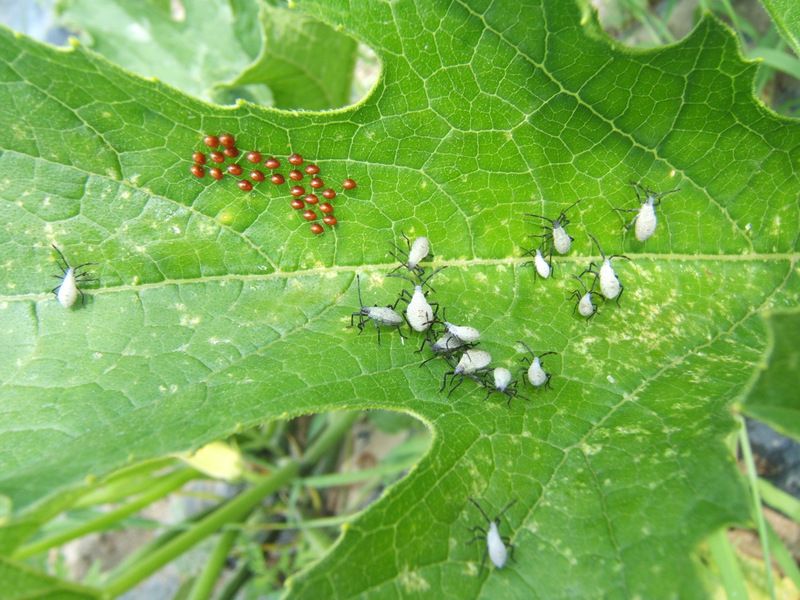
University of Florida IFAS guidance on squash bugs describes adults as flattened, gray-brown insects roughly half an inch long with a shield-like body. Nymphs are smaller and wingless; early instars appear pale greenish-gray and darken as they age.
Eggs are bronze, copper, or reddish-brown, laid in neat clusters, most often on leaf undersides but sometimes on stems. Finding eggs is often the first sign that a population is establishing.
In Florida and other warm Southern states, squash bugs can complete several generations in a single crop season, making late-summer activity plausible. That said, finding the insects during an inspection does not automatically mean they caused the silver pattern you noticed first.
The connection requires matching the insects with the characteristic yellow-to-brown feeding injury and any signs of plant stress. Presence alone is not proof of causation, so use what you find to build a fuller picture rather than jumping straight to treatment.
Compare whiteflies, spider mites, and viruses
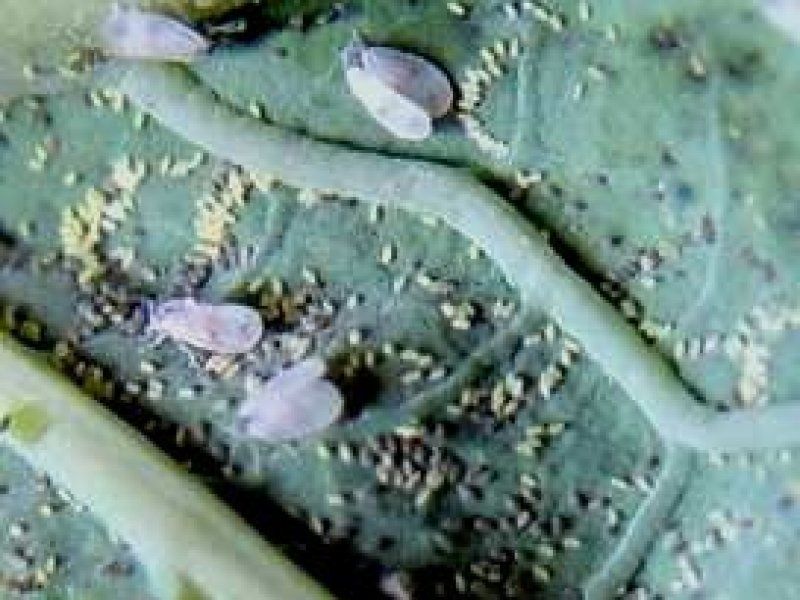
When foliage genuinely looks pale or silver rather than speckled with yellow or brown, three other causes deserve serious consideration before squash bugs get the blame. The most relevant for Florida and Gulf Coast gardens is squash silverleaf disorder, caused by feeding from immature silverleaf or sweetpotato whiteflies.
UF IFAS information on squash silverleaf disorder explains that the nymphs trigger a structural change in the leaf that produces a uniform pale or silvery sheen, often starting on younger leaves. Check the undersides for tiny, flat, scale-like immature whiteflies; shake the plant gently and watch for adults rising in a white cloud.
Honeydew and sooty mold are additional clues.
Spider mites are a separate possibility, particularly during hot, dry stretches that are common in Southern summers. Their feeding produces fine pale stippling, a texture of tiny pale pinpricks rather than smooth patches, and twospotted spider mite activity increases sharply in hot, dry conditions.
Look for fine webbing on leaf undersides and along stems. The stippling pattern is distinctly different from both the smooth blotches of normal zucchini coloration and the uniform sheen of silverleaf disorder.
Virus symptoms add a third layer of complexity. Mosaic viruses can cause irregular light-and-dark green or yellow patterns alongside distortion, puckering, curling, stunted growth, or malformed fruit.
Cornell’s cucurbit virus disease factsheets note that visual symptoms alone cannot reliably identify the specific virus involved. If the new growth looks twisted or the fruit is oddly shaped, virus is worth considering, but a lab test is needed for confirmation.
Whiteflies can also transmit cucurbit viruses, so their presence adds urgency to identification.
Use physical controls for a small squash-bug infestation
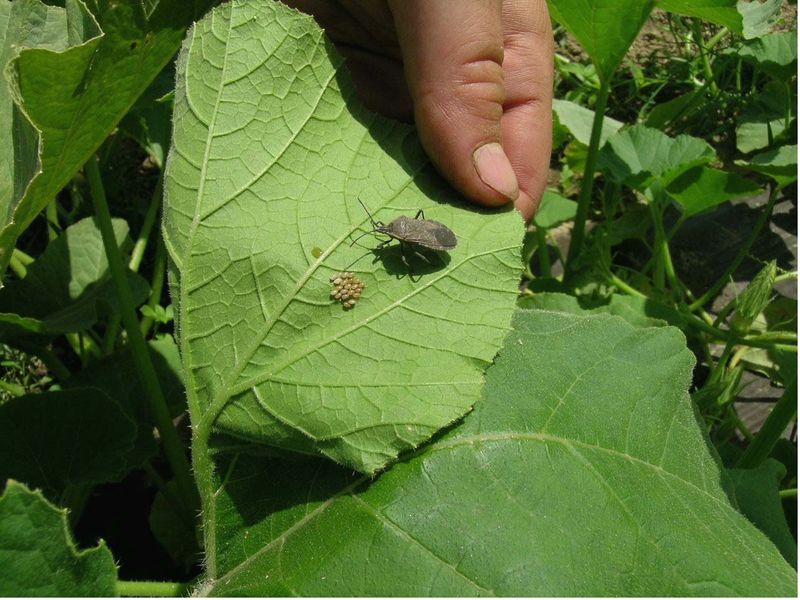
Once you have confirmed a small infestation by matching the insects with yellow-to-brown feeding injury, physical removal is the lowest-risk first response. Hand-pick adults and nymphs directly into a bucket of soapy water, which kills them on contact.
Egg clusters on leaf undersides can be scraped off with a butter knife or old credit card and dropped into the same bucket, or the leaf section can be cut away entirely if the plant can spare it. Repeat this process every two to three days, because new eggs hatch continuously during warm weather.
University of Maryland Extension’s squash bug management page and Colorado State Extension’s home garden guide both suggest placing boards or pieces of cardboard on the soil near the base of plants overnight. Squash bugs gather under them for shelter, making morning collection much easier than chasing individuals across leaves.
Row covers placed over transplants early in the season can delay colonization and prevent egg-laying, but they require careful management once flowering begins. UC IPM’s cucurbit squash bug page notes that covers must be removed or opened when flowers are open so that bees and native squash bees can reach the blooms for pollination.
Without pollination, fruit will not set regardless of how well the pest is controlled. Physical controls work well for genuinely small infestations, but a larger population spread across multiple plants may need additional strategies beyond hand removal alone.
Treat pesticides as a labeled last-resort decision
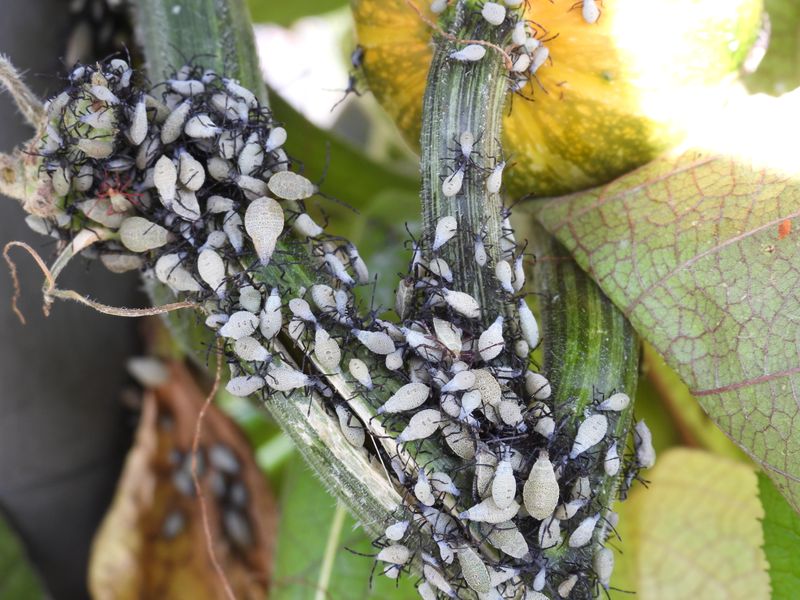
When physical controls are not keeping pace with the infestation, a labeled insecticide may become necessary, but the decision requires more care than simply choosing a product. Young nymphs are generally easier to affect than fully developed adults, so timing an application when egg clusters have recently hatched gives you a better starting point.
Contact products require thorough coverage of leaf undersides, stem bases, and other hiding spots where squash bugs congregate, not just a light pass over the top of the foliage.
Product selection starts and ends with the label. UF IFAS squash bug guidance and University of Nevada Extension’s pest management publication both emphasize that product availability and legal use vary by state, and the label is the binding document for the specific crop and pest.
Never assume that a product registered for one cucurbit is automatically cleared for zucchini.
Heat and drought stress increase the risk of foliage injury from oils and soaps. UF IFAS guidance on soaps and pest management warns that household dish soap is not a safe substitute for commercial insecticidal soap; it can burn foliage, particularly in heat, humidity, or full sun.
Even labeled soaps and horticultural oils should be tested on a small area first and applied only when conditions match what the label specifies.
Pollinator protection is non-negotiable on a flowering zucchini plant. EPA pollinator protection guidance notes that labels may include bloom restrictions or time-of-day restrictions that override general advice.
NC State Extension’s guide to squash bees explains that native squash bees are essential pollinators for squash crops. Evening application is not automatically safe because pesticide residues can persist into the following morning when bees are actively foraging.
Follow the label’s specific language on bloom timing and pollinator precautions rather than relying on general rules.
Reduce squash-bug carryover after harvest
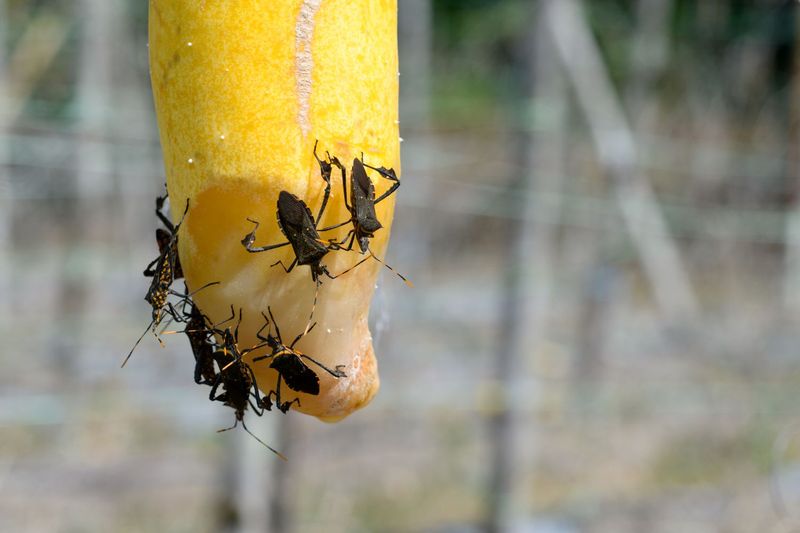
Once the season winds down and production slows, clearing the garden bed promptly is one of the most useful things you can do for next year’s crop. UC IPM’s squash bug resource notes that squash bugs overwinter as adults in plant debris, leaf litter, and sheltered spots near the garden.
Removing declining vines, stems, and fallen leaves after harvest reduces the number of adults that can survive to colonize next season’s planting.
That said, sanitation is a reduction strategy, not a guarantee. UF IFAS squash bug guidance points out that adults can fly in from surrounding areas, so a clean bed will not keep bugs out entirely.
Combine debris removal with crop rotation when space allows, and plan to start inspections early in the next growing season before populations build.
The clearest rule to carry forward from this whole process: match the symptom pattern and inspect the plant before treating silver mottling. A smooth, consistent silvery blotch on a healthy plant is often just the variety showing its natural colors.