
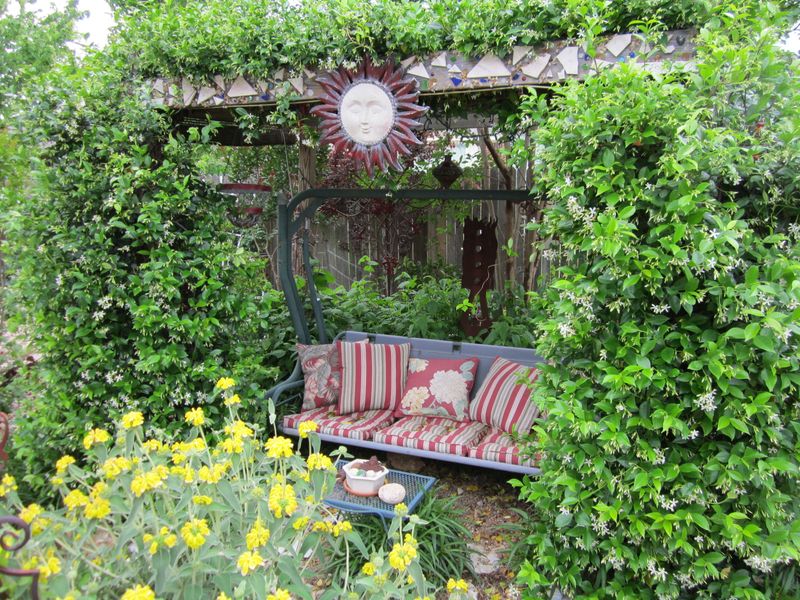
A single vine trained near your front walkway can turn an ordinary stroll to the door into something worth pausing for. Star jasmine, known botanically as Trachelospermum jasminoides, produces creamy-white flowers with an intense fragrance that stops people mid-step during its late-spring bloom. Getting that experience reliably in Texas takes more than dropping a plant in the ground next to the door handle. The right variety, the right spot, and a little seasonal maintenance make all the difference.
Choose star jasmine for a seasonal fragrance welcome
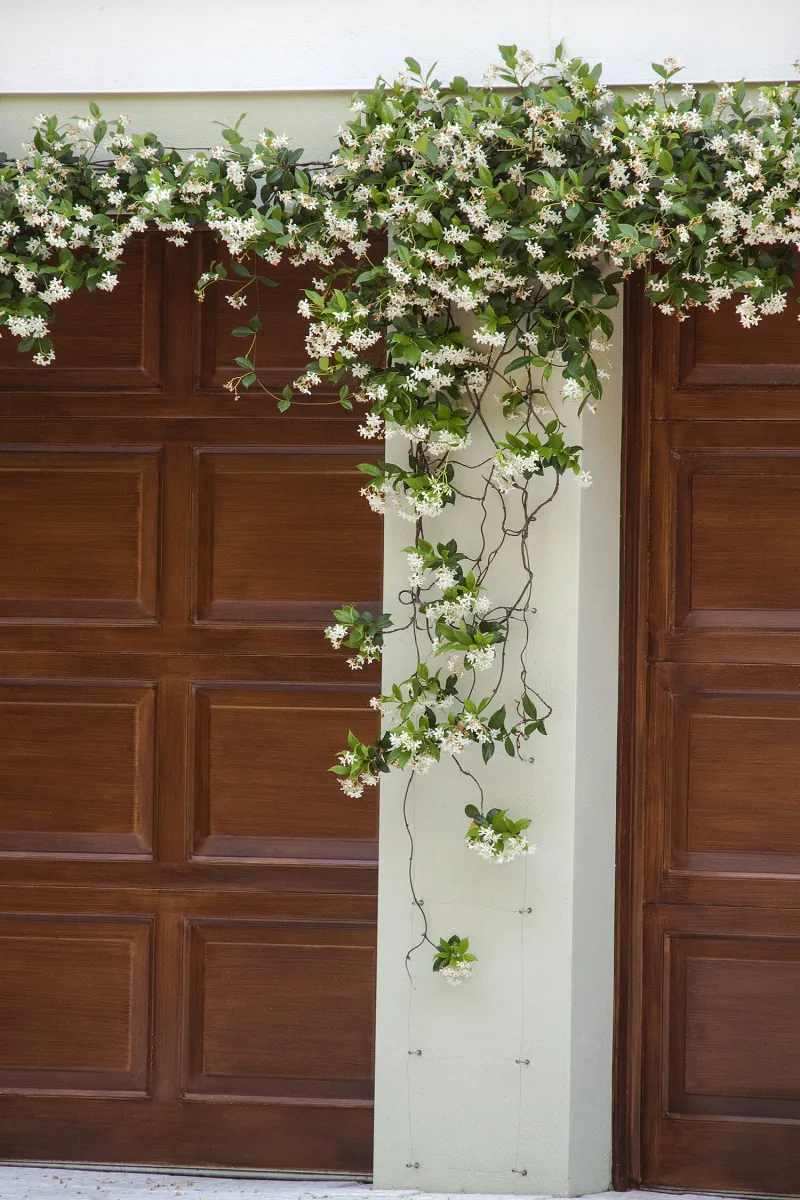
Star jasmine, Trachelospermum jasminoides, is the vine behind that sweet, head-turning fragrance you may have noticed on a Texas spring evening. Also sold as Confederate jasmine, it is an evergreen twining vine native to China and Japan, not a true jasmine in the genus Jasminum, even though garden centers often shelve it alongside them. Knowing the correct name matters when you are shopping, because other plants share the jasmine label but behave very differently.
The flowers are creamy white, pinwheel-shaped, and highly fragrant. North Carolina Extension’s plant profile for star jasmine describes the bloom period as primarily late spring, with sporadic additional flowering through summer, and notes that the flowers are attractive to bees. That seasonal window is real and worth planning around, but the vine will not perfume your entry every month of the year.
The honest promise here is a managed planting near the entry that can make the approach to your door noticeably more inviting during bloom. Whether any individual visitor registers the scent depends on how close they walk, the weather that day, and their own sensitivity. A vine pressed flat against the door frame is not the goal. A well-supported plant placed along the walkway approach, with room to breathe and grow, gives the fragrance the best chance to reach people as they arrive.
Star jasmine is an evergreen, so it keeps its glossy green leaves through most Texas winters, which adds year-round structure even when the flowers are finished. The fragrance is the seasonal reward; the foliage is the permanent backdrop.
Put the flowers where people pass close enough to smell them
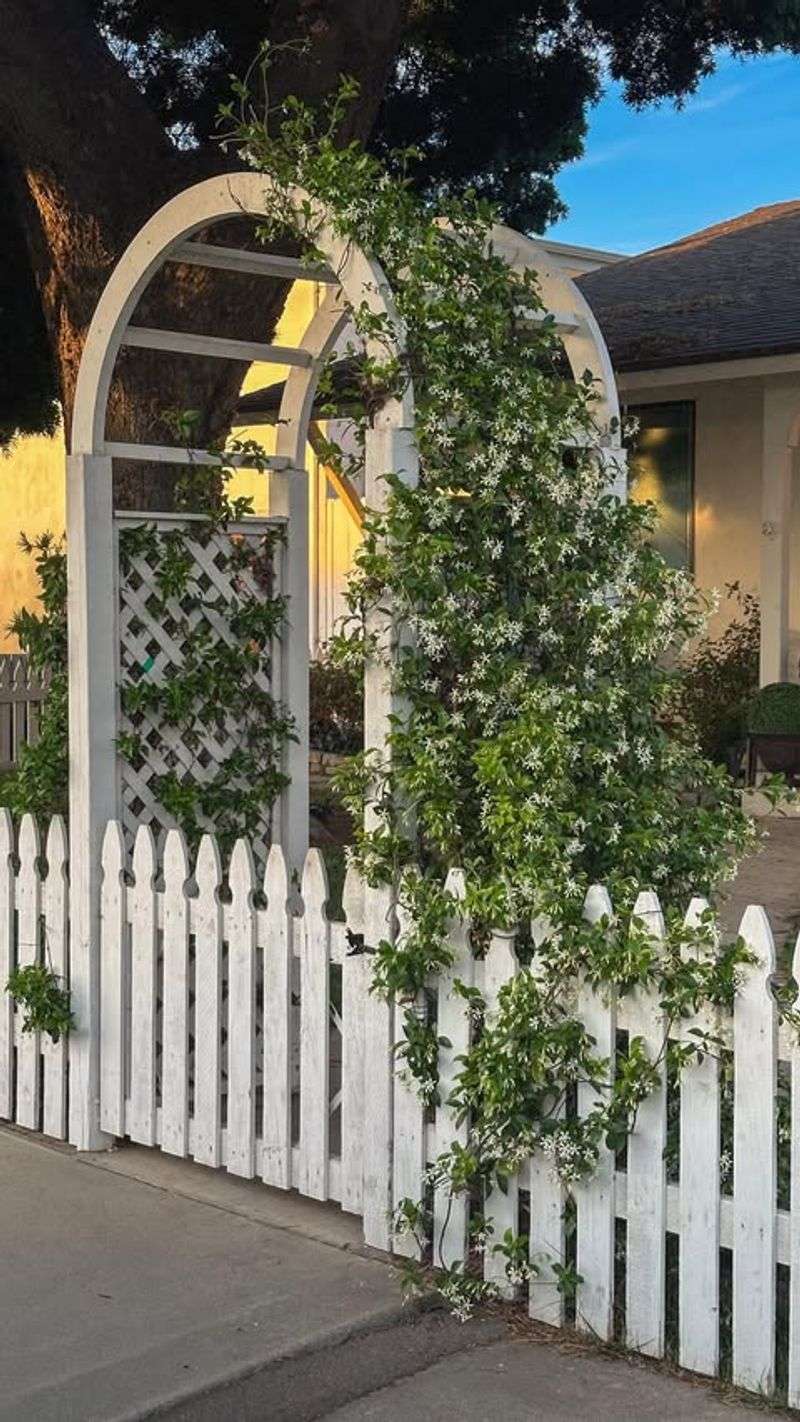
Fragrance works best at close range, and a front walkway is one of the few places in a landscape where every arriving guest passes within arm’s reach of whatever you plant there. That proximity is the whole strategic case for placing star jasmine near an entry path rather than tucking it along a back fence.
North Carolina Extension specifically recommends planting star jasmine near walkways and patios so that people can smell the flowers as they pass. A porch approach, an arbor framing the gate, a trellis beside the front steps, or a fence panel running parallel to the path all put the blooms within reach during that late-spring window when the vine is at its most fragrant.
Proximity improves the opportunity to notice the scent, but it does not guarantee a universal result. Individual scent sensitivity varies widely. On a still, humid Texas evening the fragrance can feel almost overwhelming; on a breezy afternoon or outside of bloom season, a visitor may not notice anything at all. Describing this planting as a “seasonal fragrance welcome” is accurate.
Describing it as a year-round perfume wall is not.
The placement decision also shapes maintenance. A vine running along a walkway edge on its own trellis is easy to prune back from the path without disturbing the house structure. A vine that starts at the door and wanders upward is much harder to manage once it reaches the eaves. Choose the spot with the end result in mind, not just the planting-day picture.
Check your Texas conditions before you plant
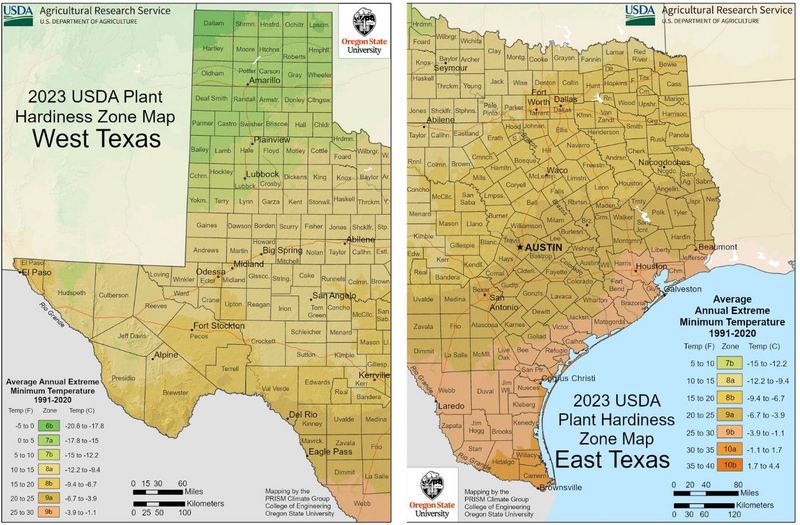
Texas is not one climate. The Panhandle can see temperatures well below zero in a hard winter, while the Rio Grande Valley rarely dips below freezing. The Gulf Coast deals with salt air, humidity, and periodic flooding. The Hill Country has thin, rocky limestone soil.
Treating “Texas” as a single growing environment is one of the most common mistakes gardeners make when they bring home a plant that looked great at the nursery.
The 2023 USDA Plant Hardiness Zone Map divides the state into multiple zones and is designed to help gardeners determine whether a perennial plant is likely to survive local winter extremes. Look up your ZIP code before purchasing star jasmine, especially if you garden in North Texas, West Texas, or the Panhandle where cold snaps can be severe and unpredictable.
Texas A&M’s Earth-Kind plant selection guide lists Confederate jasmine as an evergreen vine with fragrant white spring flowers adapted to several Texas regions. That is useful confirmation, but the guide does not establish that the plant performs equally well in every corner of the state. “Adapted to several regions” and “thrives everywhere in Texas” are not the same claim.
Beyond winter hardiness, consider your summer heat load, soil drainage, and local water restrictions. Star jasmine prefers well-drained soil, and Texas clay or caliche can slow establishment significantly without soil amendment. Municipal watering restrictions in many Texas cities also affect how much supplemental irrigation you can realistically provide during the critical first growing season. Factor those local realities in before you dig the hole.
Give the vine a dedicated support and enough clearance
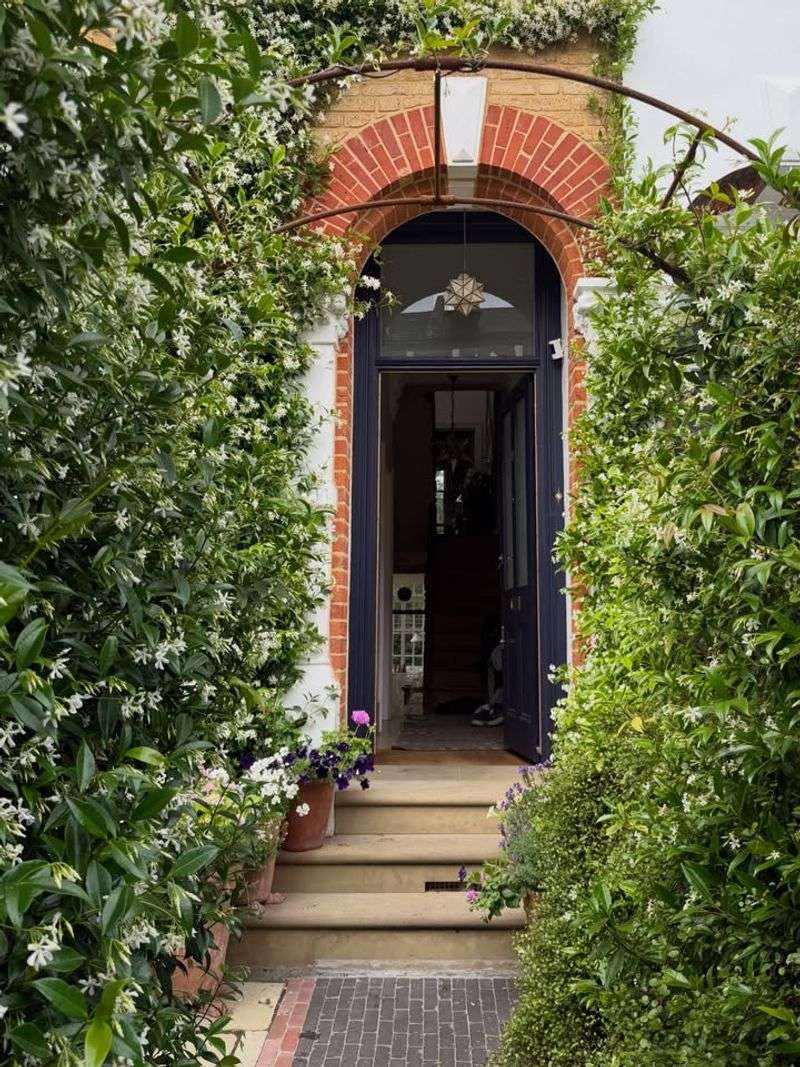
One of the most common surprises with star jasmine is how large it eventually gets. Those tidy little gallon pots at the nursery give no hint that the vine can climb to roughly 20 feet when given a proper support. A plant that starts as a modest accent beside the door can, within a few seasons, be working its way into the gutters or pressing against the siding if no one intervenes.
The solution is not to avoid the plant. The solution is to give it a dedicated structure with enough room to grow and enough clearance from the house to keep maintenance straightforward. A sturdy trellis anchored a foot or more away from the wall, a freestanding arbor framing the walkway, or a section of fence running parallel to the entry path all give the vine something to climb without directing it toward the roofline. North Carolina Extension notes star jasmine’s substantial mature size and the ongoing need for pruning to keep it in bounds.
When you position the support, think through several practical clearances at once. The door needs to swing fully open without catching vines. The walkway needs to stay wide enough for two people to pass comfortably. Gutters, eaves, window frames, and door hardware should all sit outside the vine’s projected growth path.
A University of Georgia Extension discussion of Confederate jasmine warns that unmanaged vines can grow into eaves, soffits, fascia, and other structural elements. That is a maintenance problem, not an inevitable outcome, and it is entirely preventable with the right setup from the start.
Airflow matters too, especially in humid Texas summers. A vine packed tightly against a wall with no circulation can hold moisture against the siding and invite fungal issues. Leave breathing room, and the vine will reward you with better foliage health and easier management for years to come.
Use bright light and careful watering during establishment
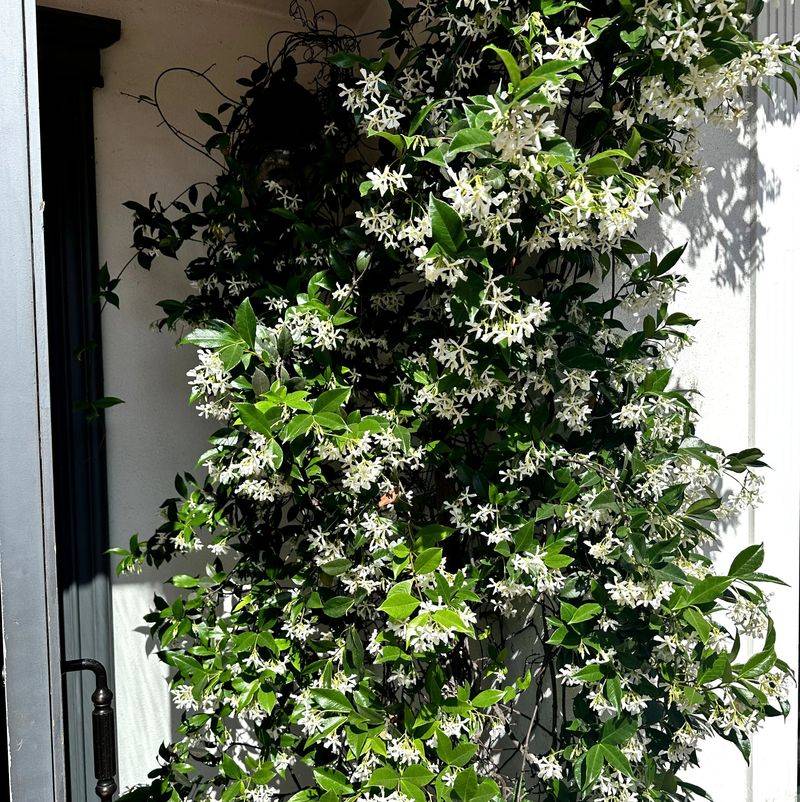
Star jasmine flowers best in full sun to part shade, and the two conditions are not equivalent. A vine in full sun along a south- or east-facing entry typically produces a heavier flush of blooms in late spring than one tucked under a porch overhang in permanent shade. Excessive shade leads to thin, leggy growth and noticeably fewer flowers, which defeats the purpose of planting a fragrant vine near the door.
Before the plant can perform well, it has to survive establishment, and that is where many Texas gardeners lose new plants. North Carolina Extension recommends fertile, well-drained soil with even moisture while roots develop. In Texas clay or caliche, that often means amending the planting bed with compost to improve drainage and water retention at the same time.
Texas AgriLife’s Earth-Kind guidance on efficient water use identifies mulching and consistent irrigation as especially important for newly planted landscape plants. A 3- to 4-inch layer of mulch around the base slows evaporation, moderates soil temperature during triple-digit Texas summers, and reduces how often you need to water. Pull the mulch back a few inches from the stem to prevent rot at the crown.
The Texas AgriLife watering guide for landscapes advises more frequent irrigation for newly planted woody plants, then a gradual reduction as roots spread and anchor in. Overwatering is just as damaging as neglect. Soggy soil around a newly planted star jasmine can cause root rot before the vine ever has a chance to establish. The goal is consistently moist, not waterlogged, especially during the first Texas summer after planting.
Once established, star jasmine develops meaningful drought tolerance, but that status takes at least one full growing season to reach and sometimes two in difficult soils. Treat the establishment phase as a commitment, not an afterthought.
Prune after flowering to protect the entry route
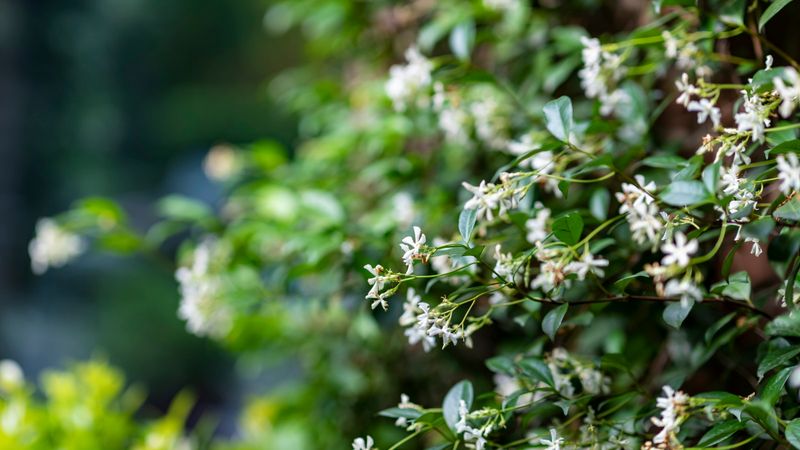
Pruning star jasmine is not optional maintenance. For a vine growing near a front entry, it is the task that keeps the whole planting working as intended. Without regular cutting back, the vine will eventually reach the gutters, shade the doorway, narrow the walkway, or press against window frames in ways that create real repair headaches.
The timing is straightforward: prune after the main late-spring flowering finishes. Cutting before bloom removes the flower buds you planted the vine to produce. Cutting after bloom gives the plant the entire growing season to push new growth and set buds for the following spring. North Carolina Extension’s care guidance for star jasmine specifically recommends post-flowering pruning and includes an important practical note: broken stems produce sticky white latex, so clean your pruning tools thoroughly after each session to avoid gumming up the blades.
When you prune, think directionally. The goal is not just to shorten the vine but to redirect its energy away from the door, gutters, roofline, and any window trim it has started to approach. Tie new growth back onto the trellis or arbor as it emerges so the structure, not the house, carries the vine’s weight. A University of Georgia Extension discussion of Confederate jasmine management reinforces that unmanaged growth into structural elements is a maintenance problem that consistent pruning prevents.
Vigorous growth is a feature of a healthy star jasmine, not a sign that something has gone wrong. A vine that pushes hard after pruning is doing exactly what it is supposed to do. The gardener’s job is to stay one step ahead of it each season, which on a well-placed trellis near an entry takes a couple of hours once a year and keeps the fragrance experience intact without turning the front door into an obstacle course.
Verify the plant before relying on its safety profile
Garden centers sometimes group plants by common name rather than by genus, and the jasmine section of a Texas nursery can hold several completely different species side by side. Buying the wrong one is an easy mistake, and in at least one case it carries a real safety risk.
The ASPCA lists Trachelospermum jasminoides as non-toxic to dogs, cats, and horses. That listing applies specifically to the identified species with white pinwheel flowers. It does not extend to every plant sold under a jasmine or jessamine label, and it should not be treated as a blanket clearance for the entire category.
The vine most likely to cause confusion in Texas is Carolina jessamine, Gelsemium sempervirens, which produces fragrant yellow trumpet-shaped flowers and occurs naturally in East Texas. It is a beautiful vine with a long Texas gardening history, but North Carolina Extension’s profile for Carolina jessamine clearly identifies it as poisonous if ingested. Children and pets that chew on the foliage or flowers are at serious risk. The flower color alone is a quick field check: star jasmine is white, Carolina jessamine is yellow.
Do not rely on the common name to distinguish them.
A third plant worth knowing is gardenia, Gardenia jasminoides, sometimes called cape jasmine. North Carolina Extension’s gardenia profile describes it as a shrub rather than a climbing vine, with its own soil and moisture requirements that differ significantly from star jasmine. If the nursery tag says jasmine but the plant is clearly a compact shrub with large, waxy white flowers and no twining stems, you are looking at a gardenia, not the vine discussed here.
The practical rule is simple: check the scientific name on the label, confirm the flower color, and look at the growth habit before you buy. A twining vine with small white pinwheel flowers and glossy evergreen leaves is the plant you want. Anything else deserves a closer look before it goes in the ground near a door where children and pets will have regular access.
Build a managed invitation, not a guaranteed scent wall
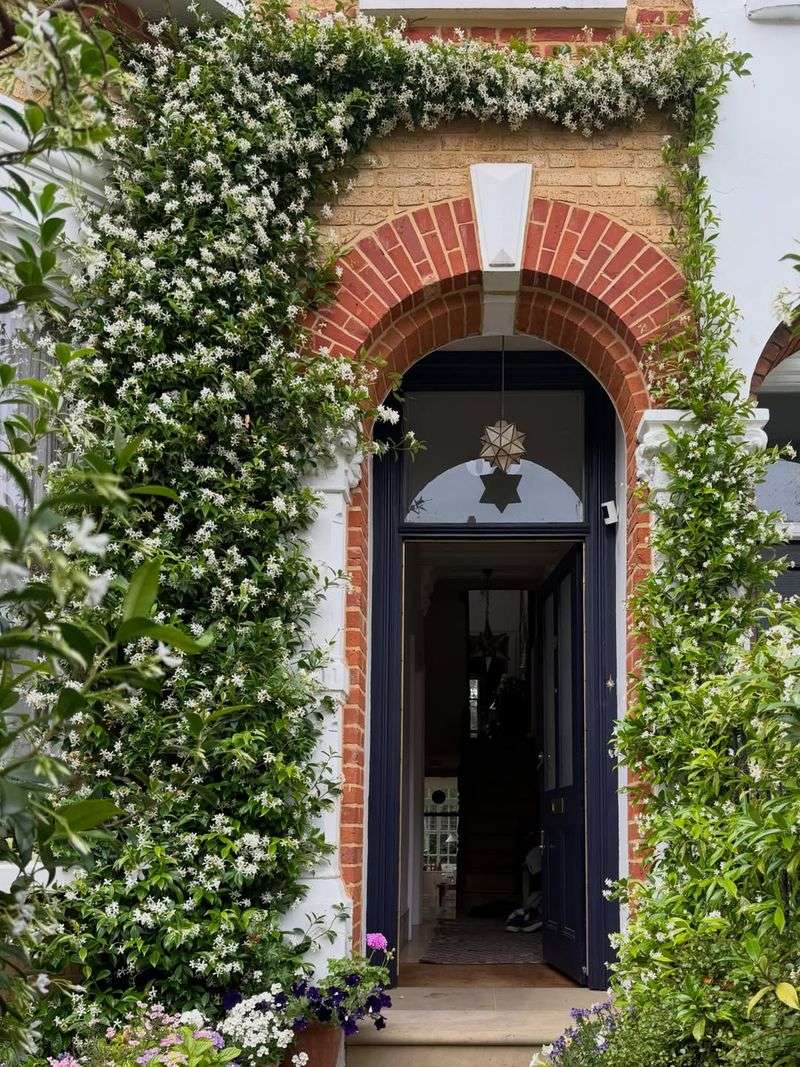
Putting this all together comes down to a short checklist before you ever buy a plant. Confirm the scientific name is Trachelospermum jasminoides, verify that your local hardiness zone and soil conditions suit it, and pick a spot near the walkway rather than flush against the house. A sturdy trellis or arbor positioned with clearance from the door, gutters, and siding gives the vine a place to grow without creating a future repair project.
Water the new planting consistently through its first Texas summer, use mulch to hold soil moisture, and plan to prune once the late-spring bloom finishes each year. North Carolina Extension’s star jasmine profile and Texas AgriLife’s Earth-Kind watering guidance together cover the core of what the plant needs to perform well.
The reward is a seasonal fragrance experience along the approach to your door, most reliably in late spring, that many visitors will notice as they walk up. That is a genuinely pleasant thing to give a front entry. A well-tended vine on a good support is one of the simplest upgrades a Texas front yard can make, and the fragrance does the rest of the talking.