
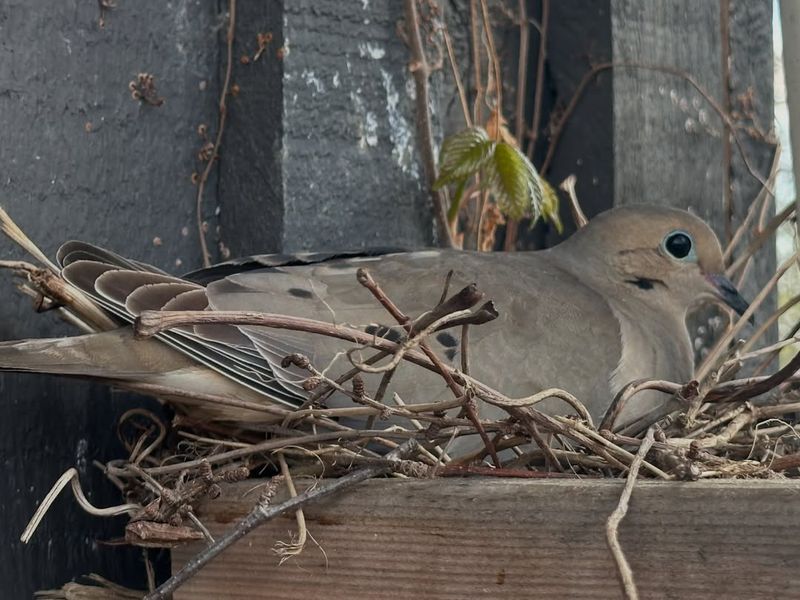
Finding a Mourning Dove nest tucked into a backyard shrub or balanced on a porch beam can stop a California homeowner in their tracks. The soft cooing, the compact bundle of twigs, the two small white eggs – it feels like a reward for something you did right. Before you start crediting your planting choices, though, the full picture is a little more nuanced, and understanding it will actually help you protect the nest and improve your yard in ways that matter.
The nest is a small vote for one useful part of your yard
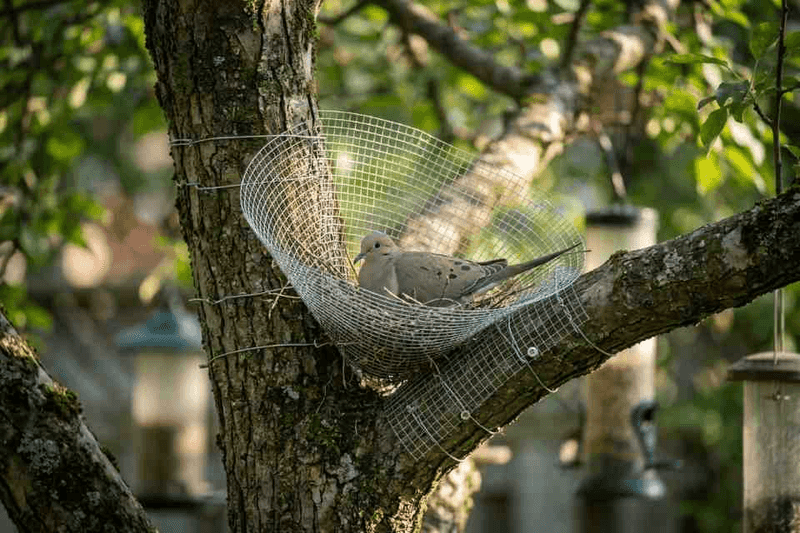
Spotting a Mourning Dove nest on your property feels like a pat on the back from nature. Before accepting that compliment too broadly, though, it helps to understand exactly what the nest is telling you – and what it is not.
What the nest confirms is straightforward: one bird, at one moment, surveyed the available options and decided that a single spot in your yard was workable. That spot offered something immediately useful, whether a stable platform, a bit of overhead cover, or a location where foot traffic was manageable enough. According to Cornell Lab’s Mourning Dove life history, the species uses a wide range of habitats including suburbs, roadsides, woodland edges, farmland, and backyards, placing a suburban nest firmly within normal behavior rather than exceptional circumstance.
That context matters because the nest is evidence about one corner of your yard, not a grade for the whole landscape. The dove was not evaluating your irrigation schedule, your plant palette, your pesticide habits, or whether your garden reflects California native-plant best practices. It found a usable site in a human-influenced setting and used it.
Recognizing this distinction keeps the nest in proper perspective. A single nesting attempt does not establish that the yard is ecologically thriving, water-wise, or compliant with any particular guideline. NestWatch guidance from the Cornell Lab encourages homeowners to welcome nesting birds while staying clear of the nest, which is useful advice precisely because the bird’s presence is fragile and context-dependent. Treating the nest as a modest, localized signal – rather than a sweeping endorsement – sets you up to respond in ways that actually help the bird and improve the yard over time.
Why an ordinary California yard can work for a Mourning Dove
Mourning Doves are not fussy about addresses. Across California, they turn up in manicured front yards, weedy back corners, drought-tolerant landscapes, conventional turf gardens, and on structures that have nothing to do with deliberate habitat design. Understanding why helps explain why the presence of a nest in your yard carries only a limited ecological message.
The species is a habitat generalist. Cornell Lab’s life history profile describes Mourning Doves as birds of open and semi-open country, comfortable in suburbs, along roadsides, at woodland edges, and in agricultural areas. They feed primarily on seeds, foraging on the ground across a wide range of settings. That ground-feeding habit means they can find food in many ordinary California yards without the homeowner having planted anything specific for them.
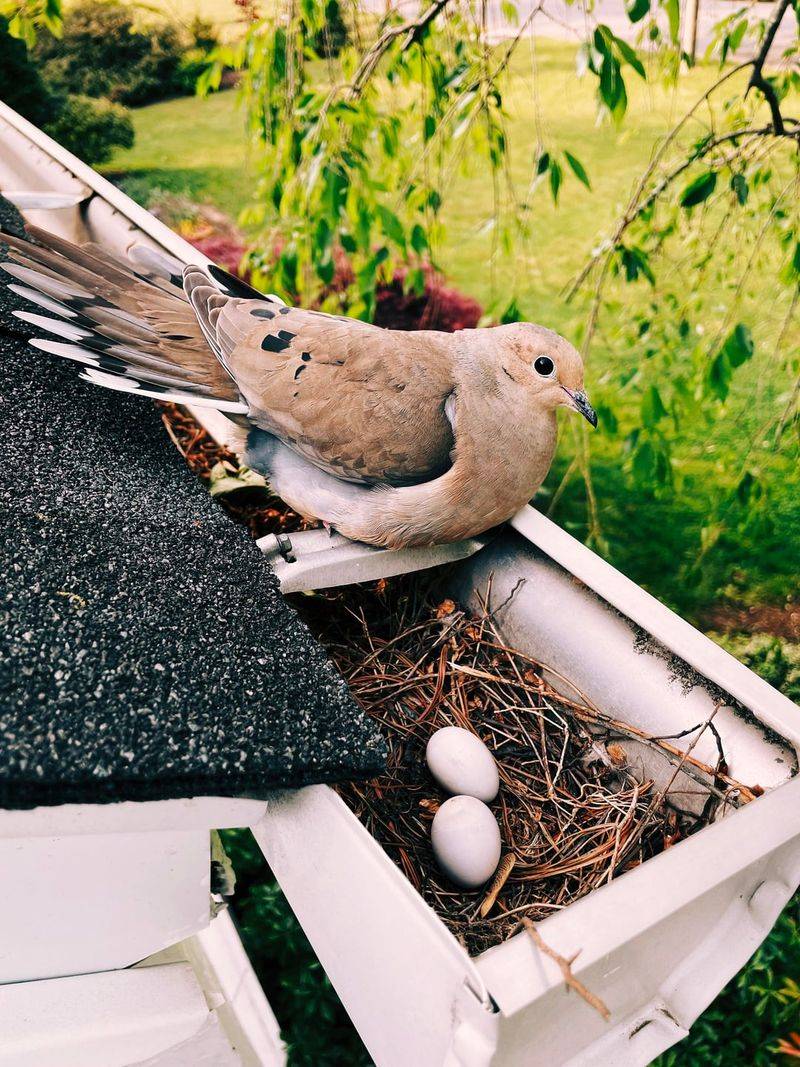
Nest placement is equally flexible. Mourning Doves use trees and shrubs when available, but they also nest directly on the ground – especially in western states – as well as on gutters, eaves, ledges, porch beams, abandoned equipment, and hanging planters. A dense ornamental shrub, a sheltered roof edge, or a potted plant on a second-story balcony can meet the bird’s minimum requirements just as well as a carefully chosen native tree.
This flexibility is why Mourning Doves are not considered indicator species for high-quality California native habitat. Their comfort in human-altered environments is a feature of the species, not a reflection of what any particular homeowner planted or avoided planting. A yard that supports one nesting pair could be a model of water-wise native gardening or an entirely conventional suburban lot with a few mature ornamentals – the dove cannot tell you which one you have, and one nest cannot tell you either.
The practical takeaway is reassuring rather than deflating: you do not need to have done anything extraordinary to attract a Mourning Dove. The bird found something workable, and that is enough for it to try.
What the dove may have noticed—and what you cannot infer
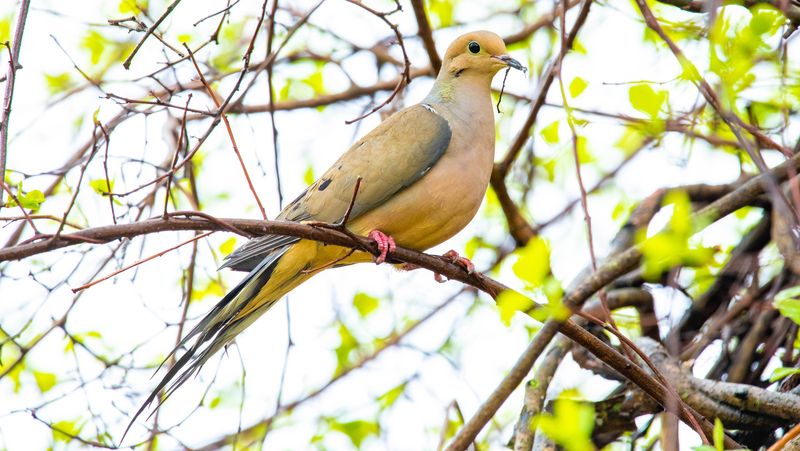
Once a nest appears, it is natural to walk the yard and try to reverse-engineer the dove’s decision. That kind of observation is worthwhile, but the conclusions it can support are narrower than they might seem.
Look at the immediate surroundings of the nest site. A few features stand out as plausible contributors: a stable, flat-ish surface or fork in a branch that could hold the bird’s loose twig platform; some overhead or lateral cover that reduces exposure; nearby ground space where the bird can forage; and a location where human movement is predictable rather than sudden and unpredictable. These are the kinds of immediate conditions a dove responds to, and noticing them in your yard is a reasonable observation.
What you cannot reliably infer is more extensive. Mourning Doves feed mainly on seeds and forage on the ground across a broad range of settings, so the presence of seed-producing plants nearby is a possibility worth noting, but not a certainty that those plants drove the nesting decision. Cornell Lab’s Mourning Dove profile makes clear that the species tolerates a wide variety of vegetation types, which means the specific plants in your yard are difficult to credit or blame.
Similarly, UC Agriculture and Natural Resources guidance on bird-friendly gardens recommends layered vegetation, native and seed-producing plants, and clean water as general improvements for yard birds – but that guidance describes what tends to support birds broadly, not what caused this particular dove to choose this particular spot. A hanging planter on a bare concrete patio can host a Mourning Dove nest just as readily as a carefully layered native garden.
The honest read is this: you can observe what the nest site offers and take note of it. You cannot work backward from one nest to conclude that your garden is native, water-wise, pesticide-free, or especially well-designed. The dove made a site-level decision, not a landscape-level endorsement.
A nest is not the same thing as a successful brood
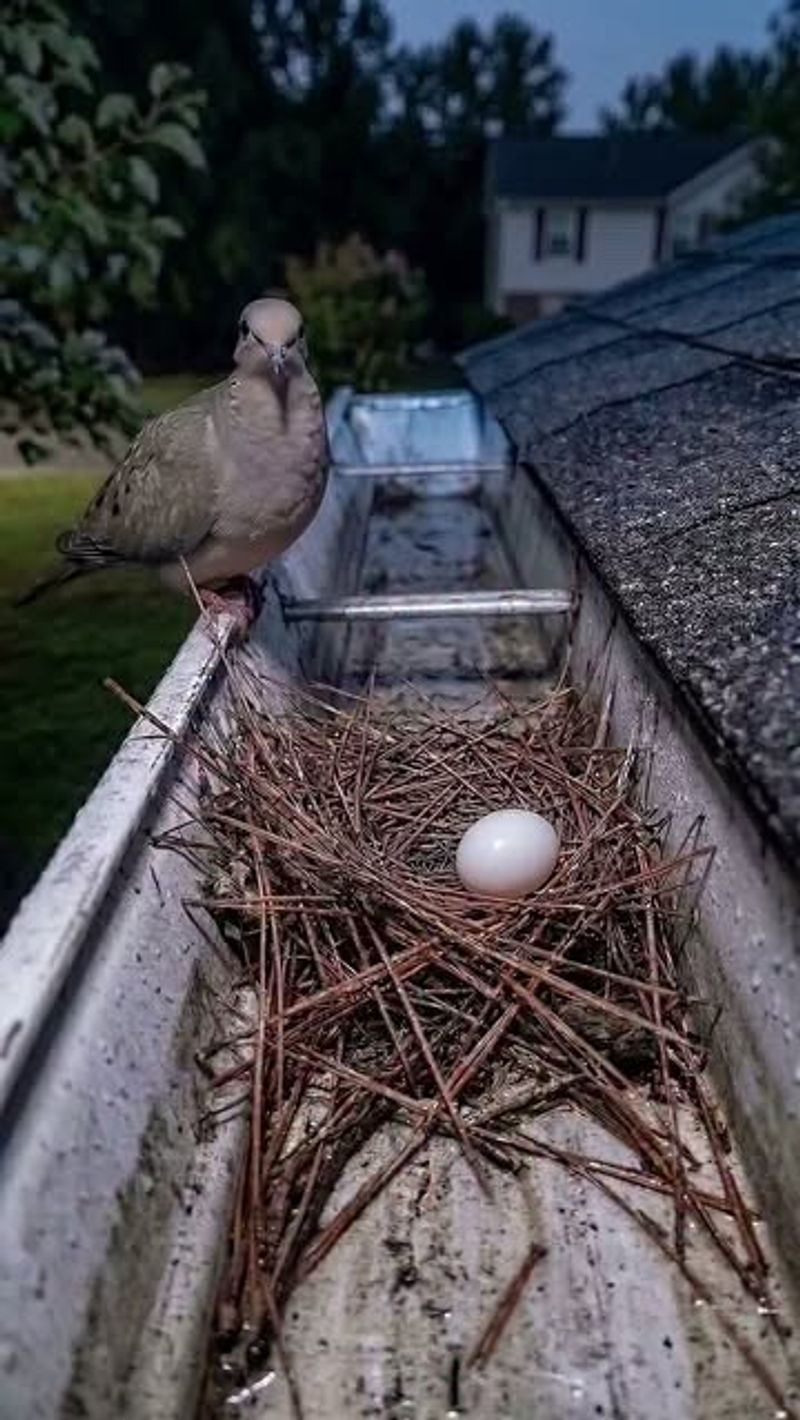
Watching a pair of Mourning Doves settle into a nest can feel like the beginning of a guaranteed success story. Biologically, though, choosing a site and successfully raising young are two separate events, and a lot can happen between them.
The nest itself offers little physical protection. Cornell Lab’s Bird Academy resource on nest design explains that Mourning Dove nests are notably flimsy platforms of loosely arranged twigs and grass – structures that provide minimal insulation and limited concealment. Eggs and nestlings are exposed to California’s variable weather and to predators that can reach an open platform nest without much difficulty.
The timeline is compact but vulnerable. A typical clutch holds two white eggs, which incubate for roughly 14 days. Nestlings spend approximately 12 to 15 days in the nest before they are ready to leave. During that entire period, the nest is subject to the full range of threats that an open, lightly built platform attracts.
Research on urban Mourning Dove nesting puts the risk in concrete terms. A study of Mourning Dove nesting ecology in an urban landscape found that only 26.6% of monitored nests successfully fledged at least one young. That figure comes from one study’s monitored population and should not be applied as a universal prediction for every California yard. What it does illustrate is that a nest appearing in your yard is the beginning of a process with real uncertainty, not a foregone conclusion.
One consoling aspect of Mourning Dove biology is that pairs can attempt multiple broods in a single season, sometimes raising two or three clutches between late winter and early fall in California’s mild climate. A failed first attempt does not necessarily end the season for a pair. Even so, protecting an active nest matters precisely because each attempt is genuinely uncertain, and the bird’s modest platform construction leaves little margin for additional disturbance from the surrounding yard.
How should you behave around an active nest?
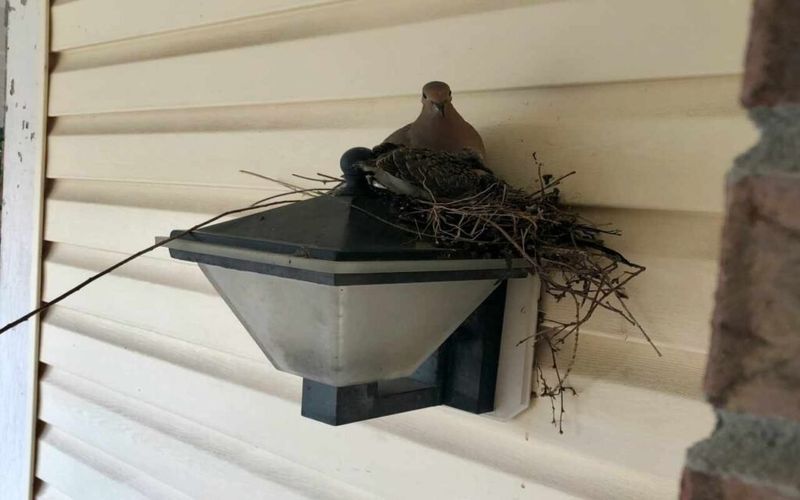
Once you know an active nest is in your yard, the single most useful thing you can do is give it room. That sounds simple, but it runs against several common instincts – the urge to check on progress, to tidy up the area, or to handle a maintenance task you had already planned.
Audubon’s practical guidance on unexpected nests is direct: once birds are actively using a nest, leave it alone. That means pausing pruning on the branch or shrub hosting the nest, leaving a container planter in place even if it is inconveniently located, holding off on gutter cleaning or eave maintenance if the nest is nearby, skipping pressure-washing on that side of the house, and avoiding pesticide application in the immediate area. None of these tasks are forbidden forever – they just need to wait until the nest is no longer active.
A common source of anxiety is the sight of an empty nest. Adults leave regularly to forage, and they may also stay away from the nest deliberately when humans are standing close by, returning only after the area is quiet again. Audubon’s Kenn Kaufman explains that nest abandonment has multiple causes and cannot be reliably diagnosed from a brief observation of adults being absent. Seeing the nest unattended for an hour, or even a few hours, does not mean the birds have given up.
Observation from a distance is the right approach throughout the nesting cycle. Binoculars work well for checking on progress without approaching the nest. Cornell Lab notes that incubation runs about 14 days and nestlings remain in the nest for roughly 12 to 15 days, giving you a rough sense of the timeline – though actual timing varies, and the nest should be treated as active until you observe that the young birds have clearly departed on their own.
Resist the temptation to place food or water directly beside the nest to help the family along. Adding resources immediately adjacent to an active nest can increase foot traffic from other animals, raise contamination risk, and draw predators closer. The best support you can offer is simply staying back and keeping the surrounding area calm.
Protecting the nest includes knowing where the rules apply
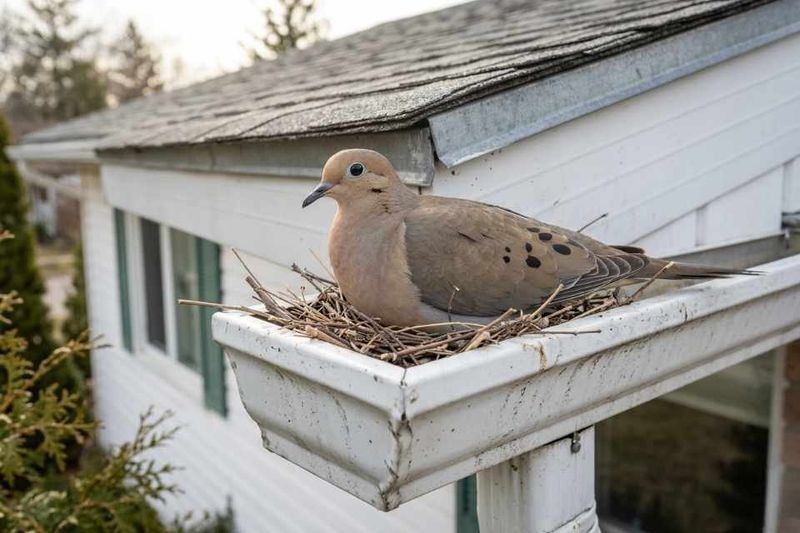
Bird nests carry legal weight in California, and it is worth understanding the framework clearly rather than relying on simplified summaries that can lead to mistakes in either direction.
At the state level, California Fish and Game Code Section 3503 makes it unlawful to take, possess, or needlessly destroy the nest or eggs of any bird, subject to the exceptions written into the law. The word “needlessly” carries meaning: the statute addresses destruction without adequate justification, not every incidental disturbance. Even so, deliberately removing or damaging an active nest – one containing viable eggs or dependent chicks – puts a homeowner in legally uncertain territory.
At the federal level, the Migratory Bird Treaty Act prohibits certain conduct involving covered migratory birds, including their nests, eggs, and young. Mourning Doves are among the species covered by the Act. The MBTA is not a blanket rule that treats every nest or every incidental disturbance as automatically unlawful, but it does establish meaningful federal restrictions on intentional harm to covered birds and their active nest contents.
A practical distinction runs through both frameworks: agency guidance differentiates active nests containing viable eggs or dependent chicks from inactive nests that have been vacated. U.S. Fish and Wildlife Service guidance on nest contents addresses this distinction in more detail and is worth consulting when questions arise about repairs, removal, or relocation. An empty, vacated nest occupies a different legal position than one actively in use, but the line between the two is not always obvious to a homeowner without experience.
If you face a repair, a construction project, a pest-control situation, or any other circumstance that puts an active nest at risk, consult current agency guidance or contact a qualified wildlife professional rather than improvising. Rules can vary by jurisdiction, circumstances matter, and the cost of getting it wrong – for the bird and potentially for the homeowner – is real.
A more bird-friendly yard still has to fit California realities
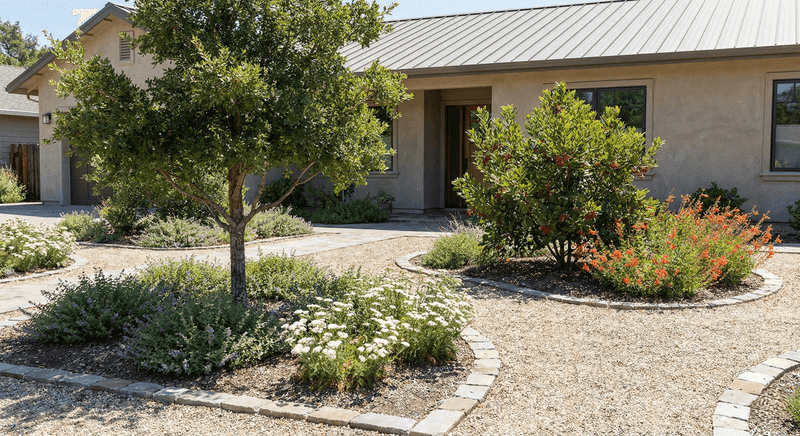
After the nesting period ends and the birds have moved on, the yard is yours to work with again. That window is a good time to think about modest improvements that genuinely support yard birds over the long term – with a clear understanding of what California’s climate, water rules, and fire regulations require.
UC Agriculture and Natural Resources guidance on bird-friendly gardens points toward a few concrete features: layered vegetation that provides ground cover, shrub-level shelter, and canopy perches; plants that produce seeds or berries; leaf litter or woody material in areas where it can remain safely; and a clean, shallow water source. For birdbaths, the recommendation is roughly one to three inches of water depth with a textured or secure surface so birds can grip it. Noncirculating water should be refreshed every one or two days to prevent mosquito breeding and keep the water clean. Place the bath near vegetation for quick cover, but not so close that it sits directly beneath dense branches where predators could crouch.
Pesticide reduction is another meaningful step. UC IPM’s guidance on keeping California waterways clean advises favoring nonchemical methods or least-toxic products where possible, noting that some garden chemicals can reach local waterways and affect aquatic life. Reducing broad pesticide use near foraging areas is sensible for yard birds generally, since ground-feeding species like Mourning Doves pick up seeds from treated surfaces.
All of these improvements need to be weighed against California’s defensible-space requirements. CAL FIRE’s defensible space guidance requires homeowners in applicable areas to remove dead vegetation, maintain spacing between shrubs, and create vertical separation between ground-level fuels and tree canopies. Local jurisdictions can impose standards that are stricter than the state baseline. A yard that stacks dense shrubs or leaves dead material in place for wildlife cover may conflict directly with those requirements in a fire-prone location.
The workable path is to plan habitat improvements and fire-safety maintenance together rather than treating them as opposites. Native, low-water plants that are properly spaced and kept free of dead material can satisfy both goals. When in doubt about how to balance the two, a UC Cooperative Extension master gardener or a local fire agency representative can help you find an approach that fits your specific zone and parcel.
Let the dove’s verdict stay modest—and useful
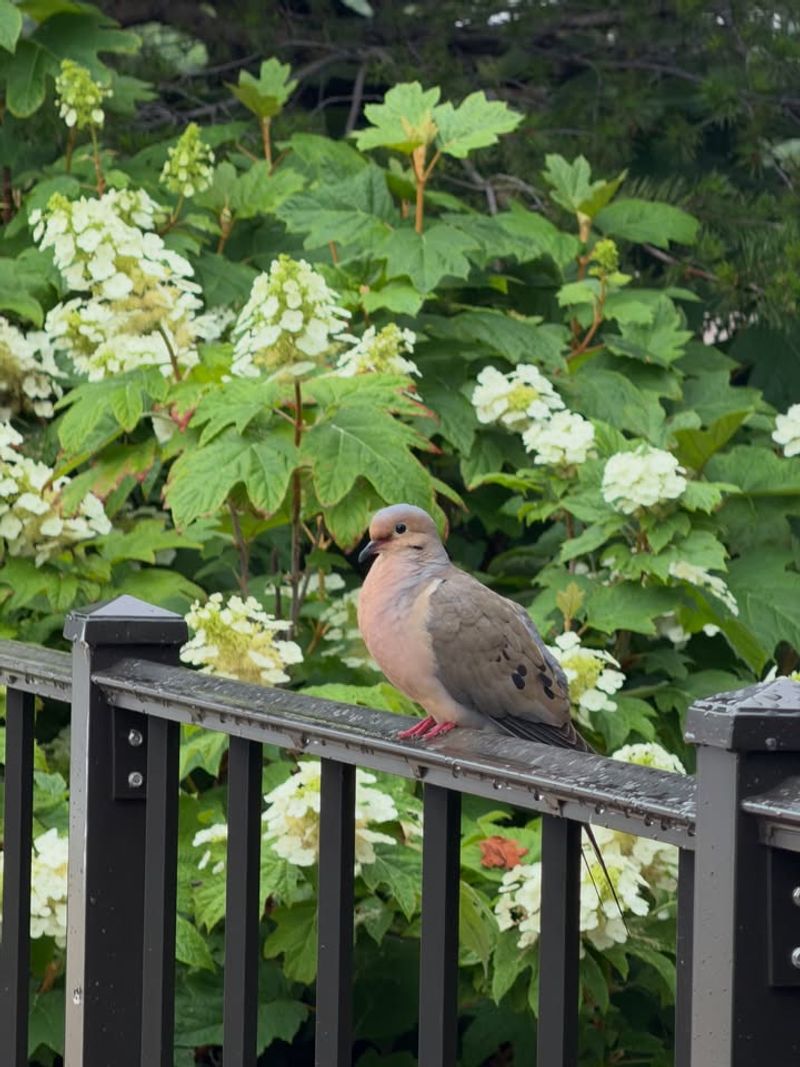
A Mourning Dove nest is a real and pleasant thing to find in a California yard. What it tells you, accurately interpreted, is that one corner of the yard offered something an adaptable, generalist bird could use at a particular moment. That is a modest signal, and keeping it modest is what makes it genuinely useful.
The nest is not a certificate of ecological achievement. Mourning Doves nest across the full range of California suburban settings, from carefully tended native gardens to entirely conventional lots, so one nest cannot confirm that your yard is native, water-wise, pesticide-free, or fire-safe. Accepting that limit honestly leaves room for the improvements that can actually make a difference.
While the nest is active, quiet protection is the right response: stay back, pause nearby maintenance, and let the birds work through their roughly four-week cycle without added disturbance. After the nest is vacated, UC ANR’s bird-friendly garden guidance and CAL FIRE’s defensible-space requirements can work together to shape improvements that support wildlife without creating fire risk.
The dove chose a spot. You get to decide what the rest of the yard becomes.