
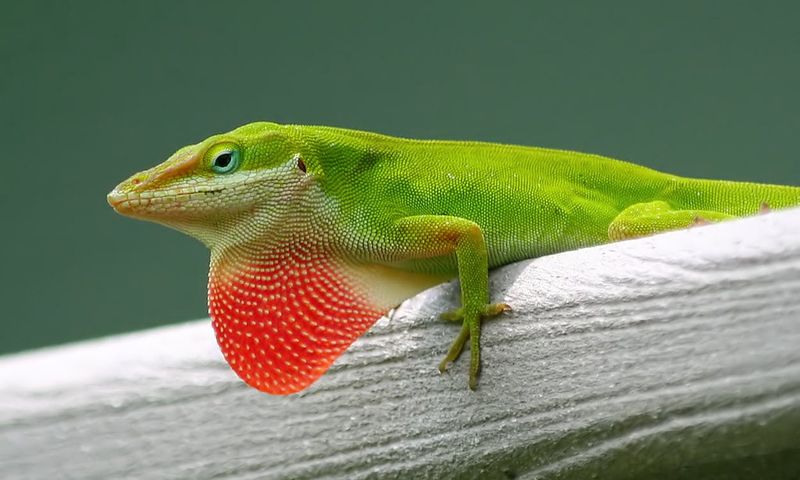
Spot a slender little lizard doing push-ups on your backyard fence and you might wonder whether it is quietly thinning out your mosquito and cricket population. Green anoles are real insect-eaters native to parts of Texas, and they are worth knowing and protecting. What the science actually shows, though, is more nuanced than the idea of a free lizard pest crew working the fence line all summer.
Green anoles occur in parts of Central Texas, not everywhere
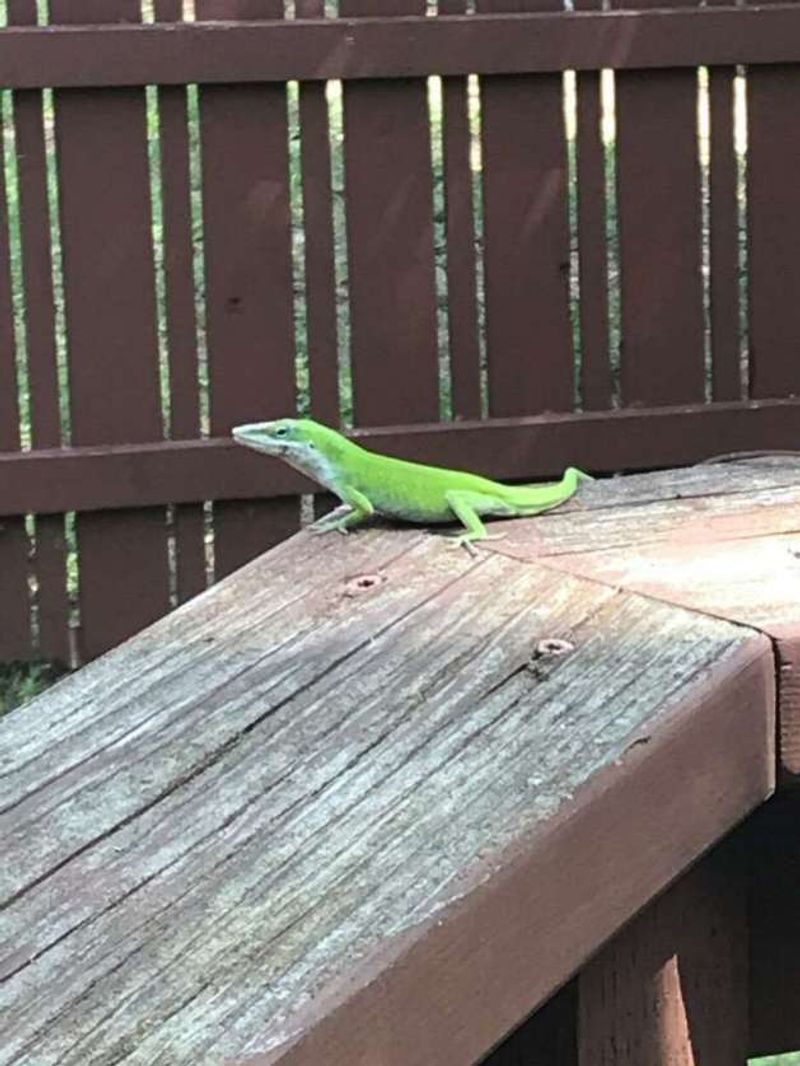
Anolis carolinensis, the green anole, is a small native lizard that sometimes gets called a chameleon because it can shift from vivid green to brown or grayish-brown depending on temperature, stress, or activity level. That color change is where the comparison ends. According to Texas Parks and Wildlife Department, green anoles are not true chameleons, and color alone is not a reliable way to confirm what you are looking at. Males also display a pink or reddish dewlap, the fan-shaped throat patch they extend during territorial displays or courtship.
Knowing the species matters because Texas has both native green anoles and introduced brown anoles from Cuba and the Caribbean, which have been spreading across the state. Brown anoles tend to be stockier, stay lower to the ground, and compete with native green anoles for food and space. If the lizard on your fence is always brown, never shows green coloring, and has a patterned back with a pale midline stripe, it may be an invasive brown anole rather than a native.
Geographically, TPWD places green anoles throughout the eastern third of Texas. That range does include portions of Central Texas, particularly areas closer to the Piney Woods and the Post Oak Savanna, but it does not mean the species is equally abundant from Austin to the Hill Country and west of the Balcones Escarpment. A study examining green anoles in Gonzales County confirmed their presence in that part of the state, yet that single location does not establish uniform numbers across the broader Central Texas region. If you are seeing one regularly in your yard, you are likely in or near a suitable part of their range, but neighbors a few miles west may rarely encounter them at all.
Anoles eat many small arthropods—but they do not promise pest control
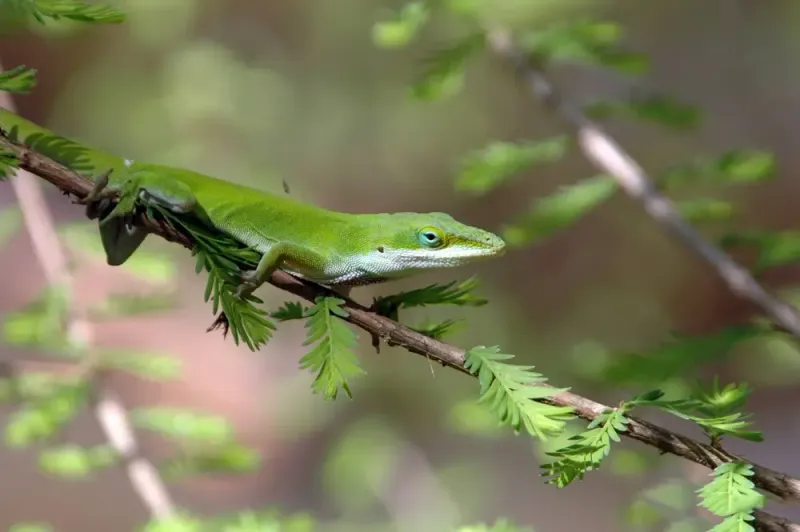
Green anoles are opportunistic hunters that scan from a perch and dart after whatever small prey moves within range. Their menu, described in detail by Animal Diversity Web, covers beetles, flies, spiders, moths, grasshoppers, and other small arthropods. A yard with layered vegetation and healthy insect activity gives an anole plenty to work with, which is part of why they show up in gardens and along fence lines near shrubs.
Captive anoles will also eat crickets readily. Research published in the ILAR Journal on green anole husbandry confirms that crickets are a practical captive food source, but what happens in a laboratory setting says nothing reliable about how many nuisance crickets a wild lizard removes from your patio or garage threshold. The prey an anole chooses outdoors depends on what is available, accessible, and the right size at the right moment, not on which insects are bothering you most.
Mosquitoes are plausible prey for an anole near standing water. A 2025 field observation in Montgomery County, Texas, documented green anoles near a gravid mosquito trap, suggesting that adult mosquitoes concentrated around a trap may attract foraging lizards. That is a single observational note, not a controlled test showing that anole presence reduced mosquito numbers. The honest read is that anoles may eat some mosquitoes when they encounter them, not that they will target the species biting you by the birdbath.
Treating an anole as a dependable pest-control service sets up a false expectation. The species is a generalist, its prey choices shift with season and opportunity, and no residential field study has measured a noticeable drop in mosquito or cricket pressure tied to anole density. Supporting native anoles is still worthwhile, just not as a replacement for targeted pest management.
A fence sighting points to nearby habitat, not a lizard patrol
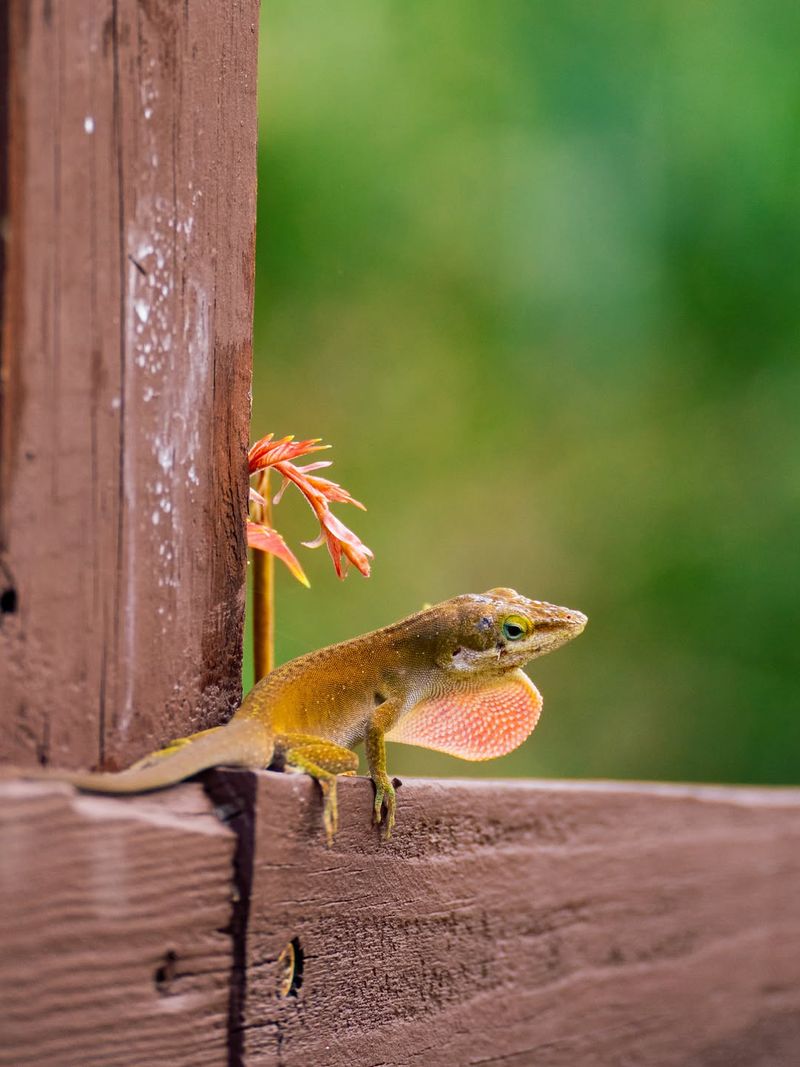
Watching an anole do push-ups on a fence board is one of the more satisfying backyard wildlife moments in Central Texas, but the fence itself is probably not what drew the lizard there. Fences are elevated, sun-warmed, and easy to scan from, which makes them convenient resting and display spots. What actually supports an anole population is what surrounds the fence: shrubs, small trees, leaf litter, patches of shade, and the insects those plants attract.
TPWD describes green anoles as using trees, shrubs, vines, walls, and fences as structural features, with the lizards moving between them depending on temperature, light, and activity. A fence that runs along a bare, sun-baked lawn with no adjacent planting gives an anole a perch but not much else. One bordered by native shrubs, climbing plants, or a row of small trees offers perching, cover from predators, shade for thermoregulation, and access to the insects living in that vegetation.
A U.S. Forest Service study of habitat selection by green anoles in eastern Texas found that anole abundance was estimated at roughly 16 times higher in a shrub-dense plot compared to a more open one, and that lizards consistently selected perch shrubs that were larger than average. That kind of data speaks to the importance of vegetative structure, not to a patrol radius or a mapped hunting territory along your fence line.
A single anole on a fence board could mean a healthy nearby habitat, or it could be a transient individual passing through. Either way, the fence sighting is more useful as a prompt to look at what is growing alongside it than as a measure of how many insects the lizard is removing from your yard.
Create a layered fence line that anoles can use
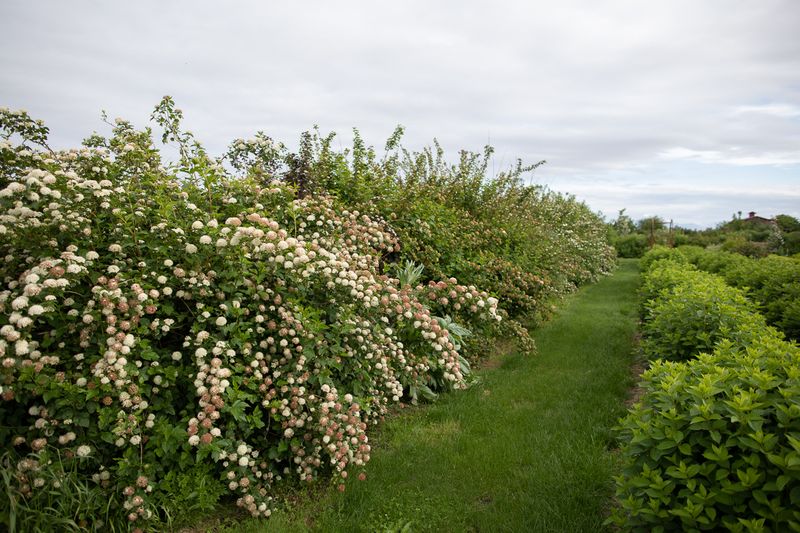
Practical habitat support for green anoles comes down to one core idea: give them structure at multiple heights. A bare fence with mown grass on both sides offers almost nothing. Add a mid-sized native shrub, a small tree with overhanging branches, or a trellis with a climbing vine and you create the layered environment these lizards use for perching, hunting, hiding from predators, and regulating body temperature across a hot Texas day.
TPWD’s Creating a Texas Wildscape guide recommends layering native trees, shrubs, and groundcover to support a range of wildlife, and that same principle applies directly to anole habitat. Native species suited to Central Texas conditions, such as agarita, yaupon holly, turk’s cap, or native beautyberry, provide the dense branching structure that anoles prefer while also attracting the insects those lizards feed on. Retaining some leaf litter or mulch beneath shrubs keeps moisture in the soil and supports the small invertebrates that make up a healthy food base.
The eastern Texas field study on anole habitat selection showed that lizards favored larger shrubs with more complex structure, so size and density matter more than simply having any plant present. A single small ornamental near a fence is better than nothing, but a grouped planting of varying heights gives anoles the kind of cover they reliably seek out.
One honest caveat: richer vegetation supports more insects generally, not just the ones an anole might eat. A greener, shadier fence line may have more total arthropod activity, not less. That is a fair trade for a more functional yard ecosystem, but it means habitat improvements are not a shortcut to a bug-free summer.
Leave wild anoles undisturbed. Capturing, relocating, hand-feeding, or attempting to stock your yard with lizards is not supported by the research and can stress or injure the animals. The best interaction is no interference at all.
Start mosquito control with standing-water removal
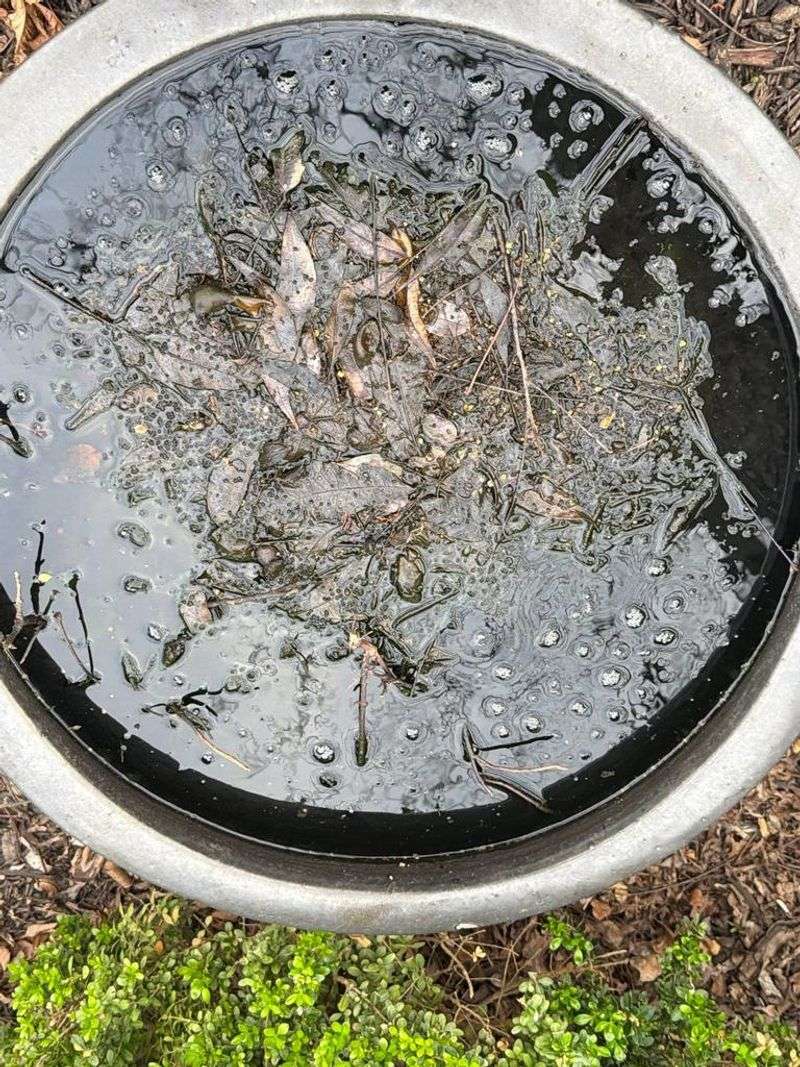
No amount of lizard activity substitutes for removing the water where mosquitoes breed. Female mosquitoes lay eggs in standing water, and under summer conditions common across Central Texas, larvae can develop into biting adults in roughly seven days. That timeline means a forgotten saucer under a potted plant, a low spot in a tarp, or a birdbath left unchanged for a week can quietly produce a fresh wave of mosquitoes regardless of what is hunting on your fence.
CDC guidance on home mosquito control recommends a weekly inspection and elimination routine: tip out, scrub, drain, or cover every container that collects water. The list of common culprits is longer than most people expect. Buckets, planters, birdbaths, children’s toys, old tires, trash can lids, pet water dishes, decorative pots without drainage holes, and the corrugated plastic sleeves around downspouts all hold enough water to serve as breeding sites. The scrubbing step matters because mosquito eggs can cling to container walls and survive a simple dump-and-refill.
Birdbaths and decorative water features deserve specific attention. Both can support anoles drinking or hunting nearby, and both can breed mosquitoes if left unmanaged. Change birdbath water at least twice a week and scrub the basin, or use a small recirculating pump to keep the water moving. Texas A&M AgriLife Extension’s backyard mosquito control guidance identifies standing water as the central target for residential control, ahead of spraying or biological solutions.
For containers or water features that genuinely cannot be drained or covered, a labeled biological larvicide is the appropriate option. Products containing Bacillus thuringiensis israelensis (Bti) or methoprene are examples used for mosquito larvae in standing water. Read the product label carefully and apply only as directed for the specific water type and volume. These are targeted tools for contained water, not a reason to skip weekly inspection or to treat the entire yard.
Anoles are not a disease-prevention measure. Mosquitoes in Texas can transmit West Nile virus, and integrated mosquito management depends on combining source reduction, screens, repellents, and community-level control, not on any single predator.
Reduce pesticide harm without expecting a bug-free yard

Chasing a completely insect-free yard is both unrealistic and counterproductive if your goal includes supporting native wildlife. Research from Trinity University examining green anoles across land-use types found that female anoles in more natural plots had better body condition than those in disturbed areas, and that natural plots supported greater arthropod biomass overall. Removing all leaf litter, pulling every ground-level shrub, and stripping away cover in pursuit of a tidy yard reduces the food base and shelter that anoles depend on.
That same research point carries an honest implication: a yard with more natural structure tends to support more insects in total, not fewer. Encouraging anole habitat does not come with a guarantee of fewer bugs around the patio. The payoff is a more balanced, functional ecosystem rather than a sterile outdoor space.
Broad pesticide applications create a different problem. The EPA’s guidance on reducing pesticide impacts on wildlife recommends treating only specific problem areas when a pest threshold is actually reached, choosing the least-toxic effective product, and following label instructions precisely. Spraying the entire yard with a residual insecticide to reduce mosquitoes or crickets can kill the beneficial insects that anoles eat, reduce overall prey availability, and expose lizards directly to chemical residues through skin contact and ingestion of affected prey.
Some research on Anolis lizards in agricultural settings, reviewed in a study on anoles as potential biocontrol agents, links intensive land management and chemical use with reduced anole activity. That connection does not translate into a simple rule that stopping all spraying will bring lizards back to a specific yard, but it does support the practical habit of reserving pesticide applications for confirmed, targeted problems rather than routine broad coverage.
The reasonable approach is to treat specific pest outbreaks with the right tool, keep applications limited to affected areas, and let the rest of the yard maintain the layered, living structure that supports the full range of organisms using it.
Let green anoles contribute without relying on them
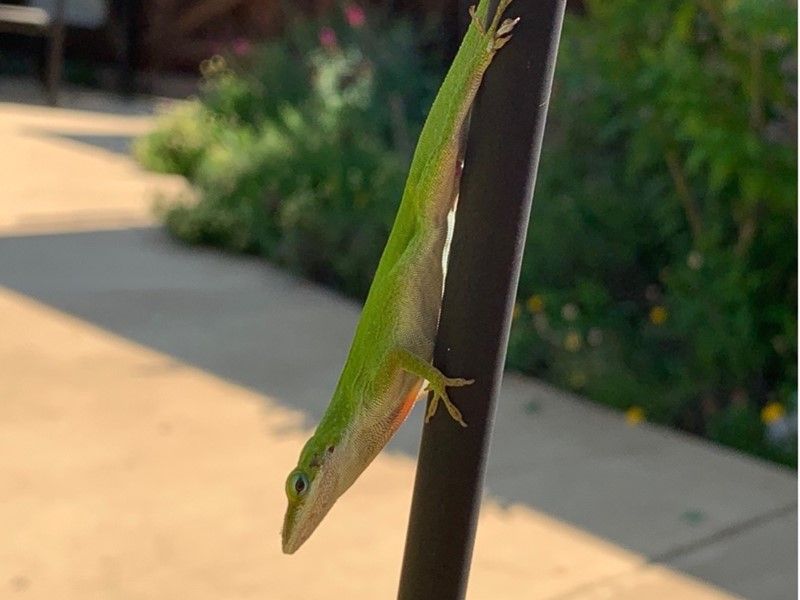
A green anole in your yard is a sign that the habitat is doing something right: there is enough structure, shade, moisture, and prey to support a native predator. Protect that habitat, leave the lizard alone, and the ecological benefit takes care of itself. According to TPWD’s green anole profile, these are native Texas lizards worth observing and protecting, not animals to capture, relocate, or manage actively.
Measure your mosquito situation by your water-source management routine, not by how many anoles you spot on the fence. Integrated mosquito management relies on eliminating breeding sites, using screens and repellents, and coordinating with community-level controls when needed. An anole may eat a mosquito that wanders into range, but that is supplemental predation in a system that requires active human management to stay safe.
Green anoles are not a tested residential pest-control service. They are native lizards doing what native lizards do, and a yard that supports them is a yard with healthier ecological function. That is a genuine, worthwhile outcome, even without a measurable drop in bites.