
Watching a crop of half-grown figs shrivel up and hit the ground during an August heat wave is one of the more discouraging sights in a Central Texas garden. The good news is that a dropped fig is a clue worth following, not a verdict on the whole season. Understanding what might be going wrong under the soil surface can help you protect whatever fruit is still on the tree and give the next flush a better shot. This guide walks through the most likely causes, the right way to check your tree, and the steps that actually help.
A shriveled fig is a clue to investigate, not a diagnosis
Figs that stop swelling, turn soft before they color up, and fall to the ground in late summer are sending a signal worth reading carefully. The symptom is real, but the cause behind it is not always obvious from looking at the fruit alone. Several very different problems can produce the same result, so the first job is to look at the whole picture rather than jump to a fix.
UC IPM guidance on fig drop lists improper soil moisture as one of the most common reasons developing figs fall early, but it draws a clear line between two opposite extremes: soil that stays too dry and soil that stays too wet. Both can stress a tree enough to abort fruit. Knowing which situation you have matters before you reach for the hose.
Cultivar tendency is another factor the fruit itself cannot reveal. Georgia Extension’s home garden fig guide notes that certain varieties are more prone to dropping fruit in hot weather regardless of how carefully the tree is watered. Excessive nitrogen in the soil can push a tree toward lush foliage and away from ripening fruit, producing losses that look identical to moisture stress from the outside.
Pests and diseases round out the list of possibilities. The Texas A&M Plant Disease Handbook documents fig mosaic, fig rust, and root-knot nematodes as problems that can cause early defoliation and fruit loss in Texas trees. Treating the root zone for drought when the real culprit is a fungal disease or nematode infestation will not help the tree and may delay a proper fix. Start by inspecting the tree, the leaves, and the soil before deciding what kind of problem you are actually dealing with.
August heat can amplify water stress before figs ripen
Triple-digit August temperatures do not cause fruit drop on their own, but they raise the stakes for anything already going wrong in the root zone. When the air is hot and dry, a fig tree pulls water from the soil faster than it would during a mild week. If the root zone cannot keep up with that demand, the tree begins to conserve resources, and developing fruit is often the first thing it sacrifices.
Research published in Scientia Horticulturae found that water stress in fig trees measurably reduces photosynthesis, raises leaf temperature, and triggers leaf abscission. When researchers rewatered stressed plants, photosynthetic function and new leaf growth did recover, but the study does not show that fruit already damaged or dropped was restored. That distinction matters for how you think about rescue watering: it can support the tree going forward, but it cannot undo losses that have already happened.
Erratic moisture may be just as hard on a developing fig as sustained drought. A root zone that swings from bone dry to flooded and back again puts the tree through repeated stress cycles, each one carrying the risk of fruit abortion. The goal is stable, consistent moisture rather than a single emergency soaking followed by neglect.
Texas A&M AgriLife’s EarthKind water-use guidance reinforces this point by emphasizing that plants need moisture replenished according to actual soil condition and weather, not a fixed calendar. One thorough watering on a hot August afternoon improves conditions in that moment, but the tree will need consistent follow-through as temperatures stay high. Treating the problem as a one-time event rather than an ongoing management task is one of the most common reasons a partial recovery stalls out.
Variety affects second-crop potential, but conditions decide the outcome
Before putting effort into a rescue plan, it helps to know what your particular tree is actually capable of doing in late summer. Not every fig variety responds the same way to August stress, and not every variety has a realistic path to a second crop even when conditions improve.
Texas A&M AgriLife Extension’s fig production guide identifies Alma, Celeste, and Texas Everbearing as standard varieties for Texas. Texas Everbearing, which is closely associated with Brown Turkey, Ramsey, and the Everbearing name, ripens over an extended period from June through August and is specifically described as capable of producing fruit on new growth after winter injury. That characteristic gives it a meaningful advantage when early-season fruit is lost to stress or cold.
NC State Extension’s profile of Texas Everbearing fig and Arizona Cooperative Extension’s common fig guide both document that some fig types can set two crops, with a later flush developing on current-season wood. This pattern is well established for Brown Turkey and Texas Everbearing types, but should not be assumed for every variety in your yard.
Celeste is a different story. Georgia Extension’s home garden fig publication notes that Celeste can drop fruit prematurely in hot weather even when the tree receives appropriate care. Improving irrigation may reduce losses, but it may not eliminate them entirely for this variety. A Celeste grower who follows every watering recommendation correctly and still loses fruit in August is not necessarily doing something wrong.
Even for varieties with genuine second-crop potential, that potential is not a promise. The amount of current-season growth already on the tree, any winter injury the tree sustained, the tree’s overall age and health, and how many weeks of warm weather remain all factor into whether later fruit actually develops and ripens. Variety is the starting point, not the whole answer.
Test the soil before you water the tree
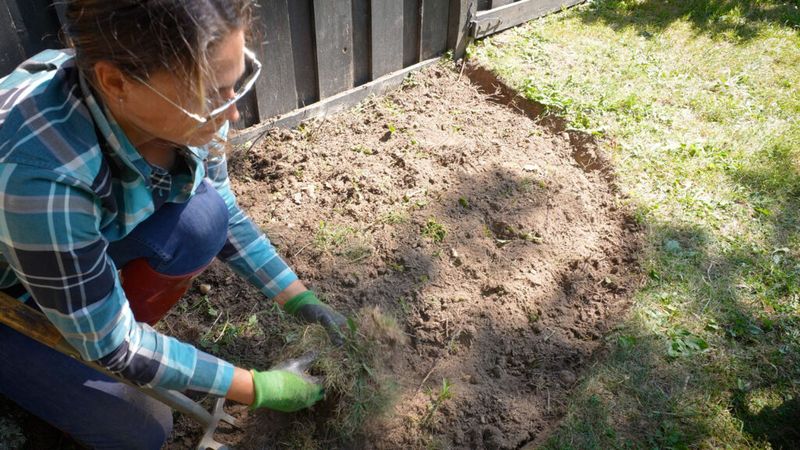
Reaching for the hose the moment you see a fig on the ground is an understandable reaction, but watering without checking the soil first can either miss the actual problem or make it worse. The surface layer of Central Texas soil can look and feel bone dry while the root zone a few inches down still holds adequate moisture. The opposite is also true: soil can appear normal at the surface while staying waterlogged deeper down, especially in heavy clay.
Texas A&M’s EarthKind irrigation guidance advises against relying on a fixed watering calendar and recommends checking the actual soil condition to decide when plants need water. Push a finger, a screwdriver, or a soil probe several inches into the ground beneath the canopy edge, where the active roots are doing most of their work. If the soil at that depth feels dry and crumbly, the tree likely needs water. If it feels cool and holds together with moisture, the root zone may not be as depleted as the fallen figs suggest.
When you do water, the goal is to wet the soil to roughly 5 to 6 inches deep. Shallow sprinkling that wets only the top inch or two encourages roots to stay near the surface where they are most vulnerable to heat and drying. Arizona Cooperative Extension’s fig-growing guide recommends using a soil probe to judge moisture need and applying water across the full area beneath the canopy rather than pooling it at the trunk.
Central Texas soil varies enormously from one property to the next. Texas A&M AgriLife’s home vegetable gardening guide acknowledges the range from heavy clay to shallow rocky soils to sand, each of which holds and drains water at a different rate. A fixed gallons-per-tree prescription cannot account for those differences, plus tree size, recent rainfall, and what your irrigation system actually delivers. Soil inspection replaces guesswork with a real answer every time you check.
Use a slow soak and mulch to protect living fruit
Once you have confirmed the root zone is genuinely dry, the response is slow and deliberate rather than fast and heavy. Running a hose at full blast near the trunk for a few minutes delivers water to the wrong place at the wrong speed. Fig roots extend well beyond the base of the tree, following the spread of the canopy outward to the drip line and sometimes beyond. Water applied only at the trunk may never reach the bulk of the root system doing the work.
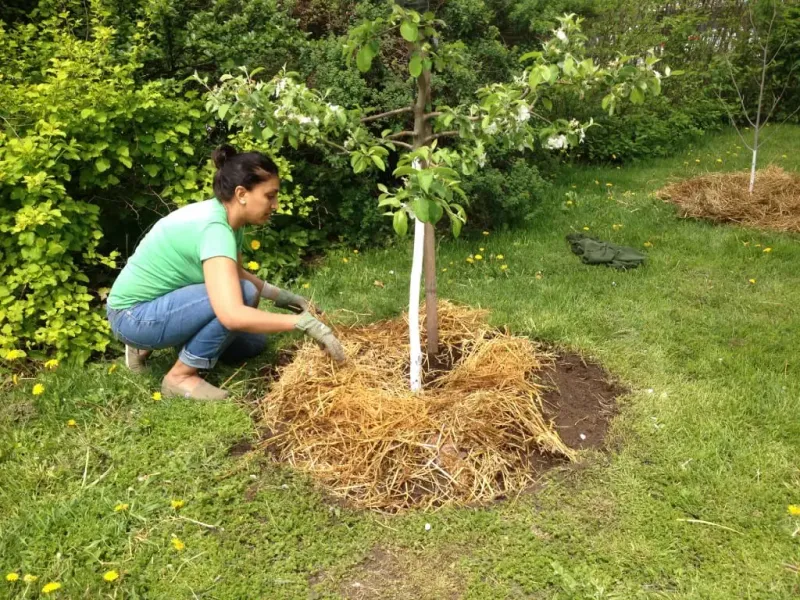
Apply water across the entire area beneath the canopy, moving the hose or soaker slowly to let the soil absorb rather than run off. Georgia Extension’s fig guide recommends supplemental watering during dry, hot periods before ripening, and Texas A&M’s EarthKind guidance pairs that approach with organic mulch to reduce evaporation and keep roots from cooking in the summer heat. After watering, check the soil again the next day to see how quickly moisture is moving through your particular soil type, then use that information to set your next watering interval rather than picking an arbitrary schedule.
Mulch is not optional in a Central Texas August. Texas A&M AgriLife’s June newsletter guidance describes a roughly 3 to 4 inch layer of organic mulch as appropriate for established landscape beds. Spread it across the root zone in a wide ring, but keep it pulled back a few inches from the trunk itself so moisture does not accumulate against the bark and invite rot or disease.
Pull any grass or weeds growing beneath the canopy while you are out there. Competing vegetation draws from the same limited moisture supply the fig tree needs most right now. Arizona Cooperative Extension includes this step in its fig-care sequence, and it costs nothing but a few minutes of work.
After correcting the watering and adding mulch, watch the tree rather than the ground. Leaves that stay upright and turgid through the afternoon heat are a positive sign. Figs that continue to enlarge over the following days suggest conditions are improving. Figs that have already shriveled will not recover, and dropped fruit will not reattach, but protecting what remains on the tree is a worthwhile and realistic goal.
Avoid rescue steps that damage roots or fruiting wood
Some of the most tempting responses to a stressed fig tree can quietly make the situation worse. Three in particular come up often enough to address directly: watering too shallowly too often, keeping the soil perpetually saturated, and reaching for fertilizer or pruning shears when fruit drops.
Daily light sprinkling feels proactive, but it often fails to wet the soil more than an inch or two deep. Roots that stay near the surface because that is where the moisture is become more vulnerable to heat fluctuations, not less. Texas A&M’s EarthKind water guidance specifically cautions against this pattern and recommends thorough, less frequent irrigation that genuinely reaches the active root zone. On the opposite extreme, keeping the soil constantly saturated cuts off the oxygen supply roots need to function.
Waterlogged conditions can produce browning, wilting, and leaf drop that look remarkably like drought stress, sending a worried gardener into a cycle of adding more water to a problem already caused by too much of it.
Fertilizer is another instinctive reach after a frustrating fruit loss. Heavy nitrogen applied now can push the tree into a flush of lush new leaves and vigorous shoots at the expense of fruit production. UC IPM’s fig drop guidance and Georgia Extension’s fig publication both identify excessive nitrogen as a contributor to fruit drop and poor fruit development, not a corrective for it.
Hard pruning carries its own risk during this period. Arizona Cooperative Extension’s fig guide notes that varieties like Texas Everbearing and Brown Turkey produce their later crop on current-season wood. Cutting back that new growth now removes the very shoots that might carry fruit through the rest of the season. Leave the green growth alone, focus on moisture management, and save any structural pruning for the dormant season when the tree is not trying to ripen fruit.
Know when fig drop points beyond watering
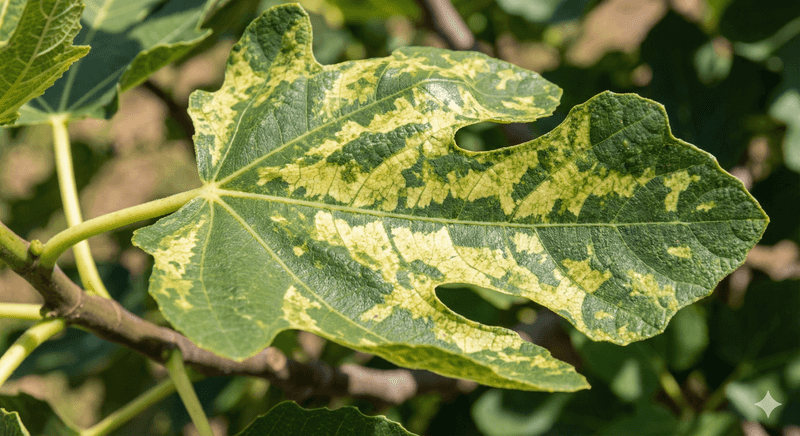
Moisture management addresses one category of fig drop, but the tree sometimes signals something else entirely. Paying attention to what the leaves look like alongside the fruit can point you toward a very different kind of problem.
The Texas A&M Plant Disease Handbook documents several conditions that cause premature defoliation and fruit loss in Texas fig trees. Fig mosaic virus produces mottled, distorted, or discolored leaves that may yellow and drop well before fall. Fig rust creates rust-colored or orange spots on the undersides of leaves and can cause significant defoliation during humid summer periods. Root-knot nematodes attack the root system underground, producing galls that disrupt water and nutrient uptake in ways that mimic drought stress at the canopy level.
Texas A&M AgriLife’s fig production guide lists these problems as documented concerns for Texas growers. If fruit drop comes with severe yellowing, mottled or deformed foliage, extensive rust spots, widespread leaf loss, holes in fruit, larvae, or a sour smell from developing figs, adding more water is unlikely to help and may compound a drainage or root-health issue.
Georgia Extension adds that Celeste in particular may drop fruit during hot weather as a cultivar characteristic, separate from any disease or watering problem. If your tree is a Celeste and the leaves look healthy, the drop may be a trait of the variety rather than a correctable condition.
One misconception worth correcting: common figs grown in Texas do not require pollination by a fig wasp to set fruit. UC IPM’s fig drop guide clarifies this directly, and Texas A&M confirms that only common figs are typically grown in Texas. Missing wasp pollination is not a credible explanation for fruit drop on standard Texas varieties, so that line of reasoning should not drive your response.
Give remaining figs a better chance without promising a harvest
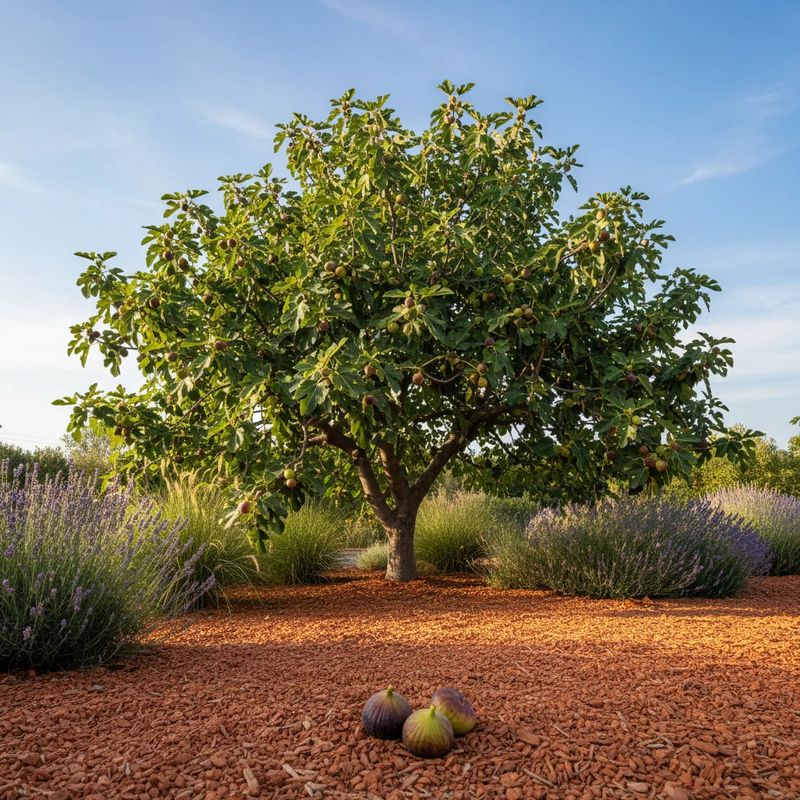
The practical path forward comes down to a short sequence of honest steps. Check the soil several inches below the surface before watering. If it is dry, apply a slow, thorough soak across the full root zone beneath the canopy, then repeat only when the soil tells you it is needed again. Spread organic mulch in a wide ring to slow evaporation and buffer root-zone temperature through the rest of August.
Leave current-season growth intact so that varieties like Texas Everbearing and Brown Turkey retain the wood that can carry later fruit.
These steps, supported by Texas A&M AgriLife’s irrigation guidance and Texas A&M’s fig production research, may improve conditions for fruit still on the tree and support new growth going forward. They cannot restore figs that have already shriveled, recover dropped fruit, or guarantee a second harvest. The physiology research on rewatered fig trees confirms that recovery supports future function, not past losses.
Use your cultivar identity and leaf symptoms to decide whether the tree needs a different kind of attention altogether. A fig tree that is well watered, well mulched, and still dropping fruit with mottled leaves or rust spots is asking for a diagnosis, not another soaking. The best thing August heat reveals is not always what you expected to find.