
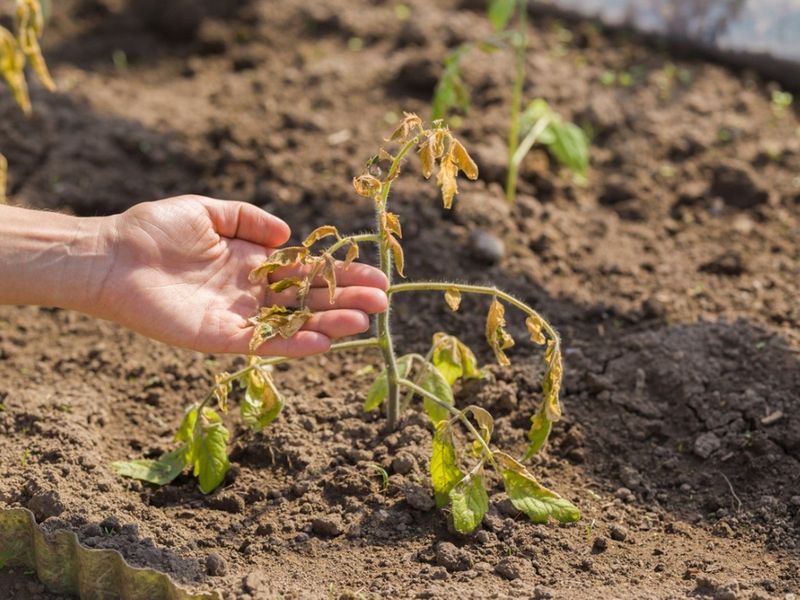
Watching your tomato plants droop in the afternoon heat can send any gardener into a panic, but that familiar slump followed by an overnight recovery is telling you something specific. The pattern points to a short-term water-balance problem, not a dying plant, and understanding what is behind it can save you from making the situation worse.
Knowing when to water, when to hold off, and when to look closer is the difference between a productive late-summer harvest and a crop that slowly declines.
That afternoon slump is often a heat-stress signal
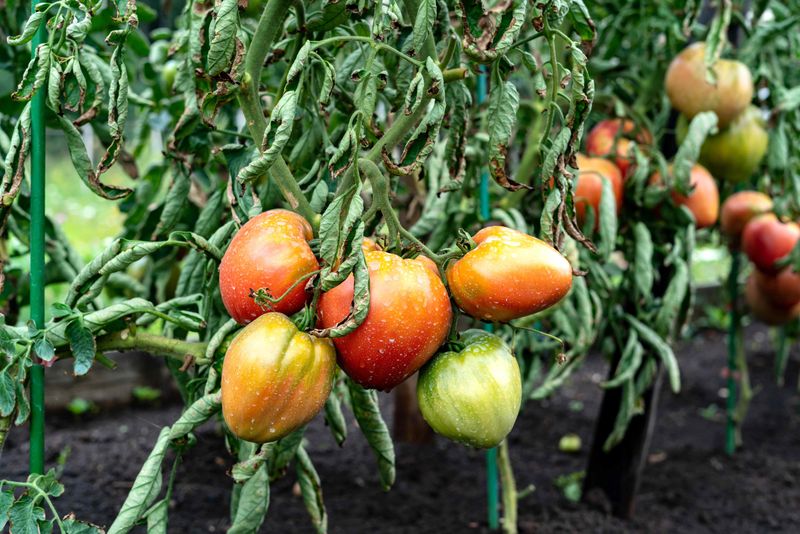
Seeing your tomato plants droop in the heat of the afternoon is alarming the first time it happens, but the pattern itself carries useful information. Oregon State Extension heat-stress guidance identifies wilting during the hottest part of the day followed by recovery in the evening or early morning as a recognizable heat-stress pattern, not an automatic sign of a plant in crisis.
What is happening is a short-term mismatch: the leaves are losing water faster than the roots can send it upward. When temperatures climb and the sun beats down through long Southern afternoons, that gap between supply and demand can widen even when the surrounding soil holds plenty of moisture.
UF/IFAS guidance on tomato production notes that excessive heat can cause wilting even in hydrated plants, which is why leaf posture alone is not a reliable watering trigger.
The overnight recovery is genuinely reassuring, but treat it as a clue rather than a clean bill of health. A plant that bounces back by morning and otherwise grows vigorously is behaving differently from one whose wilt deepens day by day.
Recovery narrows the possibilities, but the root zone still needs checking before you decide what to do next.
Why leaves can wilt while the soil is still moist
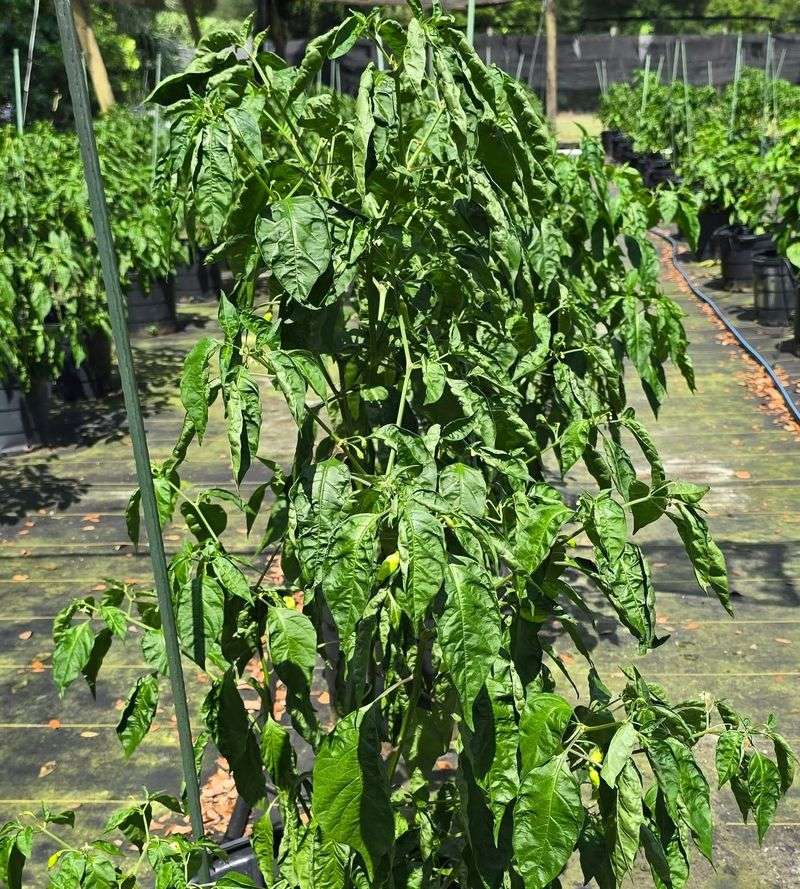
Soil moisture and leaf moisture are not the same thing, and on a hot, bright, windy afternoon they can diverge quickly. Research on tomato water relations shows that high vapor-pressure deficit, the atmospheric condition where hot, dry air pulls moisture aggressively from plant surfaces, can create a significant mismatch between water loss from leaves and water delivery from roots, causing leaf dehydration even when the soil remains adequately moist.
Think of it this way: the leaves are like a faucet left open, and the roots are the supply line. On a 95-degree afternoon with low humidity and a steady breeze, the faucet is running faster than the pipe can fill it.
The plant responds by letting leaves droop, which reduces the surface area exposed to sun and slows water loss. It is a survival behavior, not a distress call for more water.
Late-summer conditions in Southern gardens push this dynamic to its limit. Extended stretches of triple-digit heat indexes, intense afternoon sun, and reflected heat from fences, pavement, or walls all amplify the demand side of the equation.
The same mechanism operates in gardens anywhere summers get hot, though Southern heat waves, lower humidity in parts of Texas, and high humidity combined with high temperatures in Florida create particularly intense conditions. Adding water when the soil is already moist will not close that gap and may create a new problem entirely.
Check the root zone before you reach for the hose
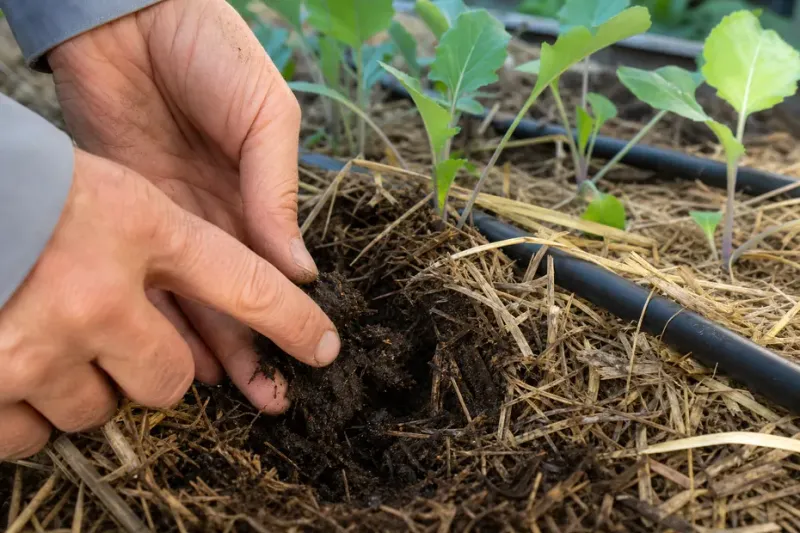
Before watering, take sixty seconds to check what is actually happening underground. Push your finger or a wooden dowel four to six inches into the soil near the base of the plant, ideally in the morning or evening when air temperatures are lower.
UF/IFAS advises checking plants during cooler parts of the day precisely because afternoon heat can cause wilting in plants that are not water-stressed, making midday leaf posture a misleading guide.
What you are feeling for is the moisture several inches down, where the active roots live. Soil that feels dry and crumbly at that depth genuinely needs water.
Soil that feels cool and damp, or that sticks together when you squeeze a handful, is not calling for more. UGA Extension’s watering guidance frames this as the Goldilocks problem: too dry and roots suffer, too wet and roots suffocate.
Containers and very sandy beds need more frequent checks than heavier garden soils. University of Minnesota container-plant guidance notes that potting media can dry out rapidly during heat waves, sometimes within a single day.
Texas A&M EarthKind guidance similarly emphasizes that soil texture strongly affects how quickly water moves through and how often irrigation is needed, with sandy profiles holding far less reserve than loam or clay.
Give a dry tomato a deep, targeted drink
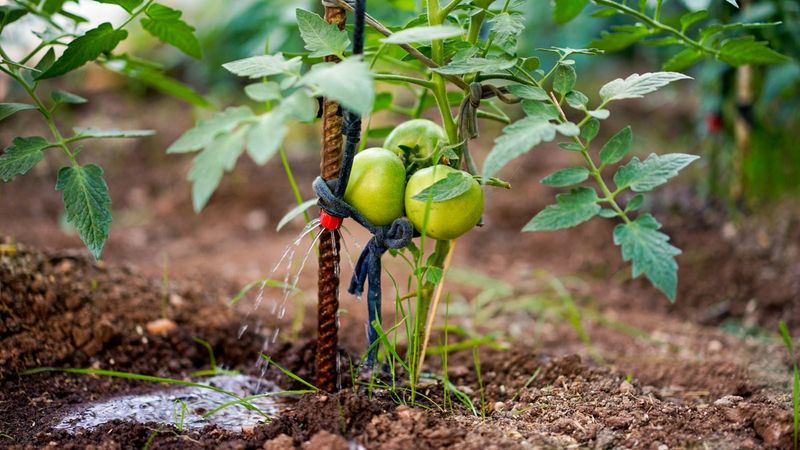
When the root zone comes up dry, water thoroughly and direct every drop to the soil, not the leaves. One or two long, slow soakings per week generally serve tomatoes better than brief daily sprinkling because deep watering encourages roots to grow downward where soil temperatures are more stable and moisture lasts longer.
UGA’s Georgia Homegrown Tomatoes guide recommends approximately 1 to 2 inches of water per week as a starting reference, with the understanding that actual need shifts with rainfall, soil type, plant size, fruit load, and whether the plant is growing in a container or raised bed.
Texas A&M tomato production guidance reinforces that irrigation frequency must increase during high-90s heat and low-humidity stretches, conditions common across much of Texas in late summer. A plant carrying a heavy fruit load also draws more water than a younger plant just setting blossoms, so the weekly guideline is a starting point, not a fixed rule.
Morning is the preferred time to water because it gives roots access to moisture before the hottest hours arrive and allows any water that splashes onto foliage to dry before nightfall. Oregon State Extension watering basics support this timing for most situations.
That said, if a plant is genuinely wilted and the soil is dry in the middle of the afternoon, water it. Waiting until the next morning to correct a dry root zone can cause real harm, and a targeted drink at the base of the plant is far less risky than leaving roots without moisture overnight.
More water is not always the rescue
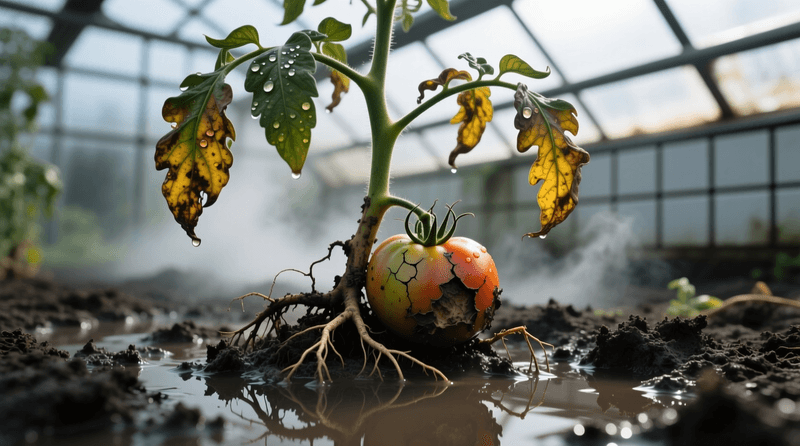
Responding to every afternoon droop with a fresh round of watering can quietly turn a heat-stress problem into a root problem. Soil that stays constantly wet holds less oxygen, and tomato roots need oxygen just as much as they need water.
UGA’s disease management guide for home vegetable gardens links chronically saturated soil to root and crown rot, conditions that produce wilting, yellowing, and collapse that can look almost identical to underwatering from above.
UGA Fulton County Extension drainage guidance points out that poor drainage compounds the problem, particularly in low spots or heavy clay areas where water pools after rain. Adding more water to an already saturated bed accelerates root damage rather than relieving it.
Two practical tools work together to reduce how often you need to water and how much water evaporates before roots can use it. Drip irrigation or a soaker hose delivers water directly to the root zone without wetting foliage, reducing both evaporation loss and the prolonged leaf wetness that encourages foliar disease.
Texas A&M tomato guidance and UGA’s tomato publication both recommend drip or soaker systems for established plants over overhead sprinkling. Pair that with roughly 2 to 3 inches of organic mulch spread around the base of each plant, kept an inch or two away from direct contact with the stem, and you slow evaporation, moderate soil temperature, and reduce the frequency of the moisture checks that drive the whole decision.
Lower the heat load and protect the crop
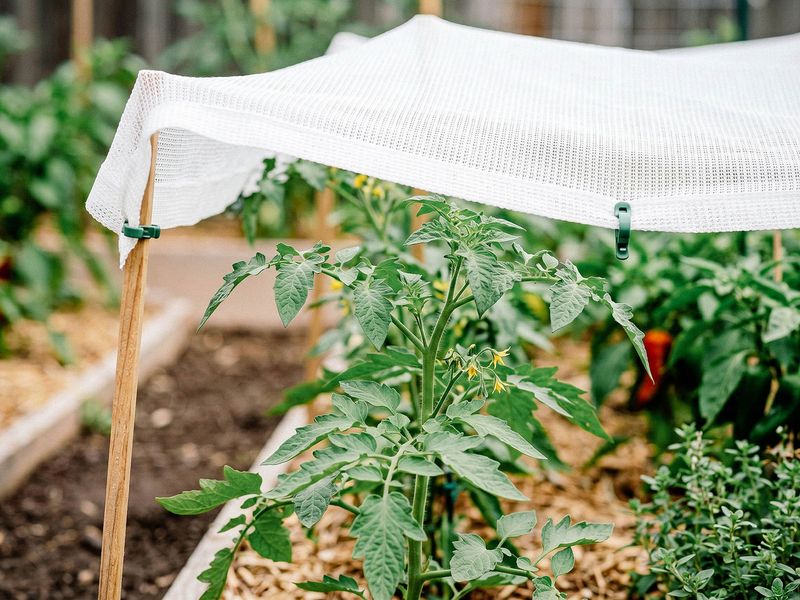
Once the moisture decision is settled, reducing the heat load on the plant gives it a better chance of holding up through the worst afternoon hours. Temporary shade cloth, positioned to block the most intense afternoon sun, can meaningfully lower leaf temperatures for container plants or those growing near walls, fences, or pavement that radiate stored heat.
University of Minnesota yard and garden heat guidance presents temporary afternoon shade as a practical heat-management option, particularly for plants in exposed or reflected-heat situations.
Shade is a supplement to adequate moisture, not a substitute for it. A shaded plant with dry roots will still suffer.
The goal is to stack several modest advantages: early-morning watering so roots have moisture reserves before peak heat, mulch to slow evaporation and cool the root zone, and shade to reduce the intensity of the water demand during the hours when the atmosphere is pulling hardest.
Even when a plant rebounds each morning, sustained heat can quietly take a toll on the harvest. University of Minnesota guidance on heat effects in the vegetable garden explains that high temperatures can reduce pollination success, increase blossom drop, slow fruit development, and contribute to sunscald or uneven ripening.
Penn State Extension’s tomato heat-stress resource adds that pollen viability drops when nighttime temperatures stay above roughly 75 degrees Fahrenheit, which can reduce fruit set even when the plant looks healthy at sunrise. Managing heat load is therefore as much about protecting the crop as it is about protecting the plant.
When the pattern points to more than heat
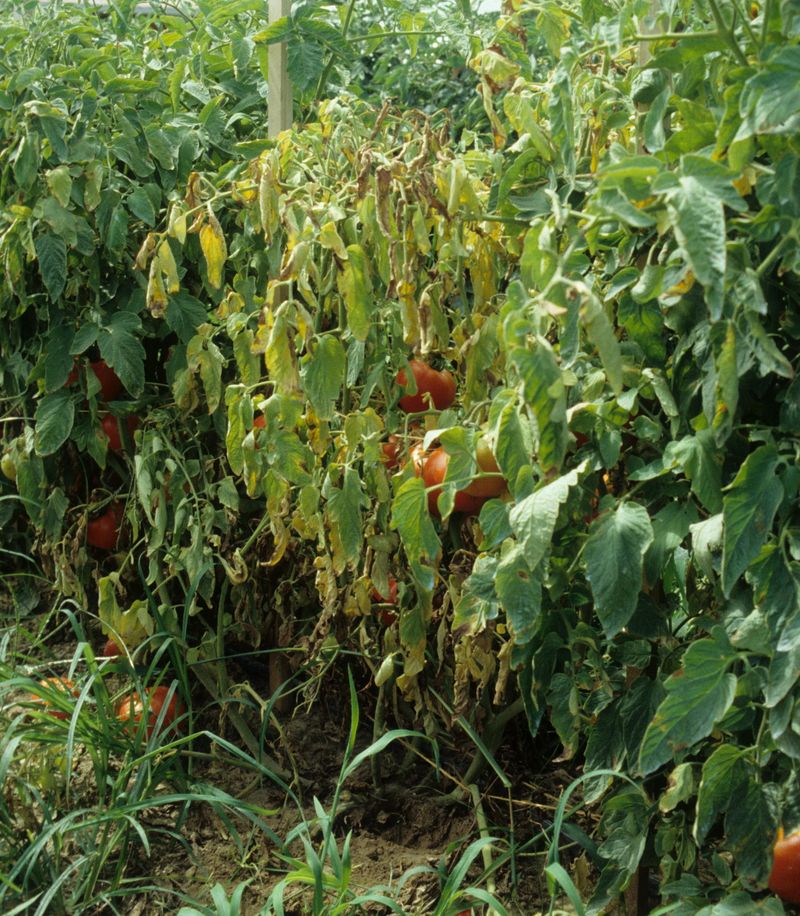
The reassuring daily cycle has limits. A plant that droops in the afternoon but stands firm by morning is behaving differently from one that stays wilted into the next day, and that difference matters.
Utah State University’s wilt identification guide notes that Fusarium and Verticillium wilts can begin as daytime wilting with nighttime recovery before progressing to permanent collapse, which means overnight recovery does not rule those diseases out.
Watch for any of these signs over several consecutive days: wilt that is still present when you check the plant in the morning; yellowing or browning that starts on the lower leaves and moves upward; only one branch or one side of the plant declining while the rest looks normal; stunted or slowed growth; brown, discolored tissue inside the stem when you cut it lengthwise near the base; or dark, wet-looking lesions at the soil line. University of Minnesota’s tomato wilt diagnostic tool and UGA’s disease identification bulletin both list these as indicators that require a broader investigation.
Florida gardeners working in warm, sandy soil should also check the roots directly. UF/IFAS guidance on root-knot nematodes in vegetables identifies root galls, small knotted swellings on the root system, as a key diagnostic clue for nematode damage, which can cause midday wilting even when soil moisture is adequate.
In parts of Texas where irrigation water or soil carries excess salts, Texas A&M’s vegetable growers irrigation chapter explains that salinity can create physiological drought: the soil looks wet, but roots cannot absorb water normally. If any of these warning signs appear, get an accurate diagnosis before applying any pesticide, fungicide, fertilizer, calcium product, or soil drench.
Some wilt diseases have no curative treatment once established, and applying products without a confirmed cause can delay the right response.
Use the morning recovery as a clue, not a verdict
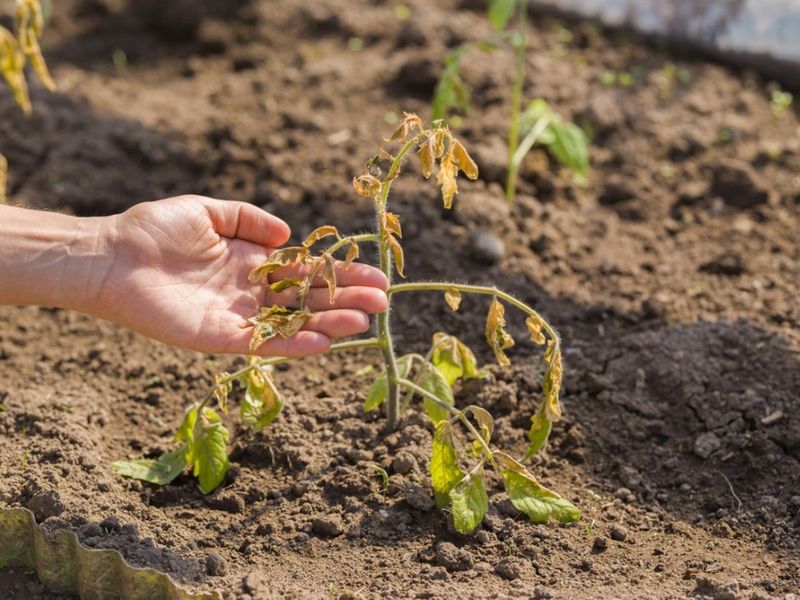
A clear action sequence makes the daily pattern manageable. When you see afternoon wilting, note the time and check whether the plant is standing upright again by the following morning.
If it has recovered, go out and check the root zone moisture before noon, several inches down, away from the stem. Oregon State Extension heat-wave guidance supports this observe-then-check sequence as the practical first step before any watering decision.
Water deeply at the base only if the soil is genuinely dry at root depth. If the soil is moist, hold off and focus instead on mulch, delivery method, and any shade options available for the hottest exposure.
Track the pattern over several days. USU’s wilt guide reminds gardeners that a worsening or persistent pattern is the signal to look beyond heat and water balance for a cause.
Afternoon-only wilt that resolves by morning is often a reversible response to a heat-and-water-demand mismatch, and many plants come through it with a good harvest intact. The recovery tells you the plant is coping; the morning soil check tells you whether it needs help doing so.