
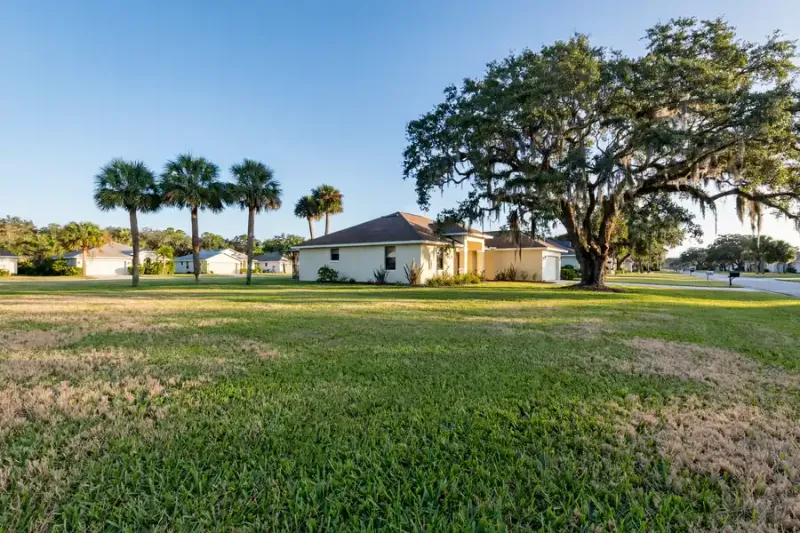
Many Texas homeowners keep treating their St. Augustine lawn like it is still July, and that habit can set the grass up for trouble by spring. Watering on a summer schedule, feeding a sleeping lawn, and cutting it very short are all borrowed from northern lawn advice.
Each one can add stress or raise disease risk when the grass is slowing down. Here is how to adjust, and how to tell what you are really looking at when brown spots show up.
Adjust irrigation as St. Augustine slows
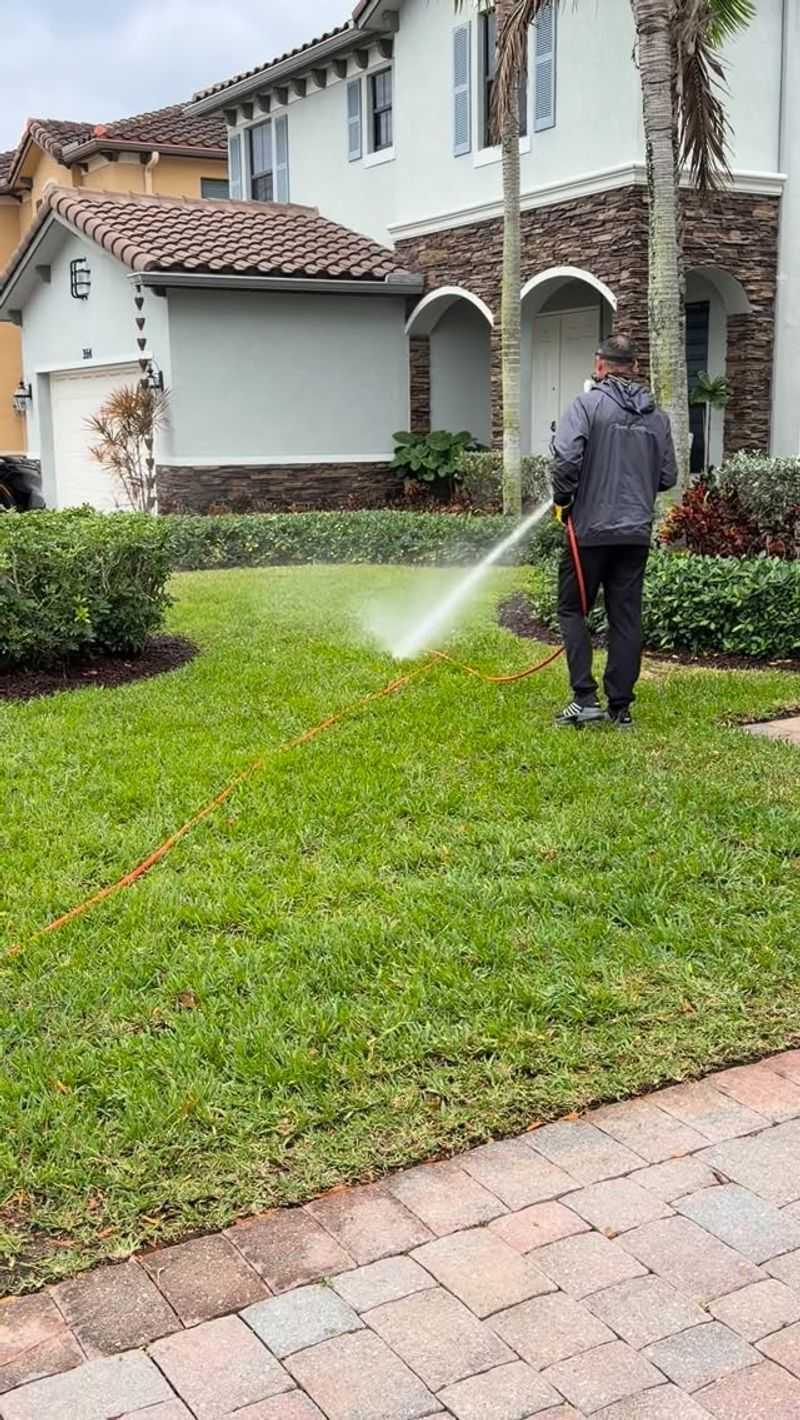
Sprinklers that run on a fixed summer timer are the habit most likely to cause trouble once the grass slows down. A lawn that is not actively growing uses far less water, so the same schedule soaks soil that has little use for it.
Texas A&M AgriLife guidance advises turning off automatic irrigation in winter when turf is not actively growing.
Spring and fall call for a different approach. Instead of a timer, water by hand only when the lawn shows it needs it.
Too much water in those transition seasons wastes money and can make St. Augustine more susceptible to large patch, a fungal disease that is most active then.
That does not make winter overwatering a proven, stand-alone cause of brown patches. Whether disease shows up depends on weather, soil, and local conditions.
Soggy ground just makes the odds worse.
Turning the system off also does not mean never watering. AgriLife notes that dormant St. Augustine may need an occasional drink during warm, dry, windy weather.
A week of dry wind and mild afternoons can pull moisture from the soil even when the grass looks asleep.
Before you water, check recent rain, how the soil feels a few inches down, and whether the grass is growing. A simple screwdriver pushed into the ground tells you a lot.
If it slides in easily, skip the hose. If the soil is dusty and hard, give a light, targeted watering by hand.
Wait to fertilize until the lawn is growing
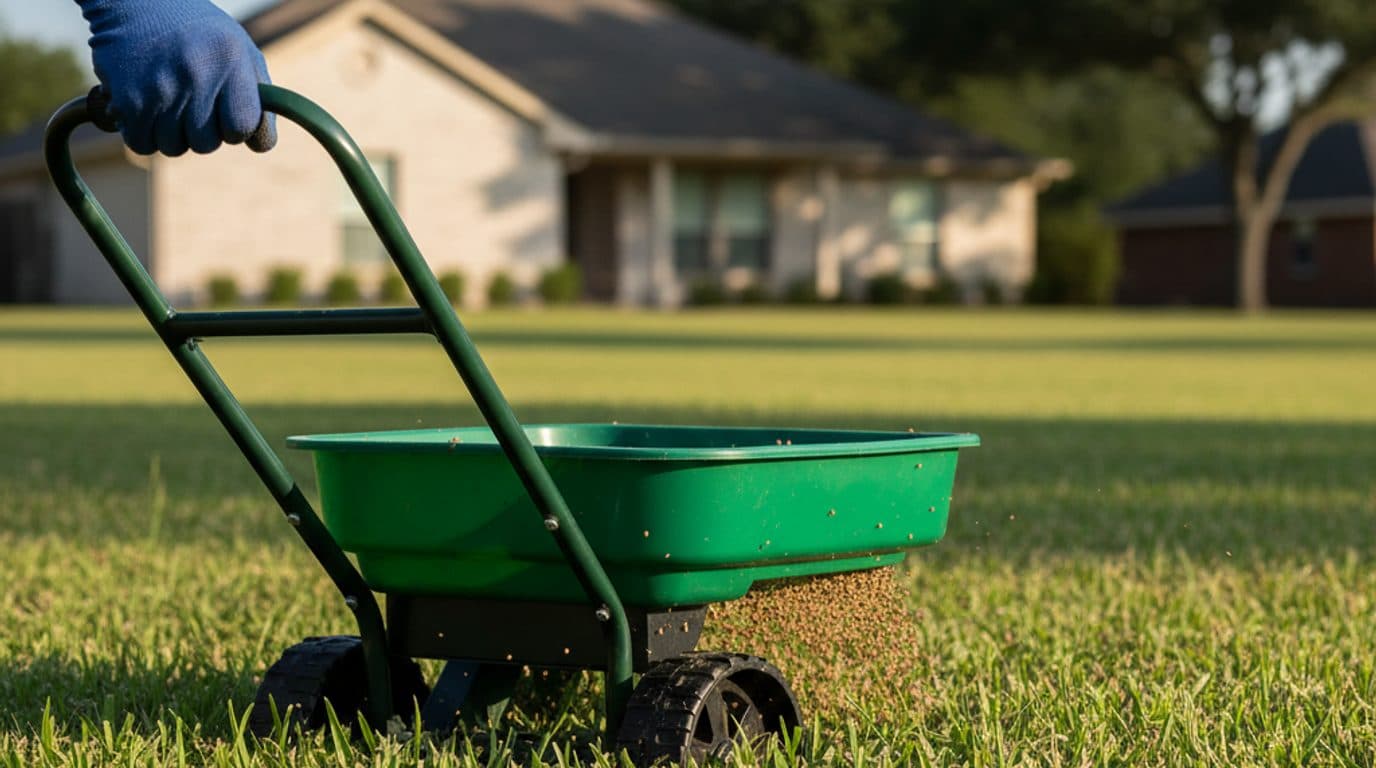
Northern lawn calendars often push a feeding in late fall or very early spring. St. Augustine in Texas runs on its own clock.
Fertilizer works when the grass is actively growing, not when you want to see green on a tan lawn.
The AgriLife management guide says to wait until the lawn has been mowed at least twice in spring before the first nitrogen application. It also says the final application should typically come at least 4 to 6 weeks before your county’s historic first frost.
Avoid feeding dormant turf altogether.
Why the caution? Nitrogen pushes soft, leafy growth.
Late in the season that growth can be hit by cold, and the guide warns that late nitrogen can raise winter-kill and disease risk. Lush, tender grass in cool, damp weather is also the kind of setting where large patch can thrive.
None of this guarantees spring patches. Plenty of lawns get a late feeding and come through fine.
But the benefit is small and the risk is real, so it is a poor trade.
A practical example: if your neighbor fertilizes in November and their lawn looks fine, that is not a green light for yours. Soil, drainage, and weather differ from yard to yard.
Count your spring mowings, mark your county’s first frost date on the calendar, and work backward from there.
Avoid cutting St. Augustine too short

When a lawn looks brown and shaggy in late winter, it is tempting to buzz it down to the dirt and start fresh. That habit comes from cool-season lawn advice and from the idea of removing thatch.
St. Augustine does not respond well to it.
AgriLife’s management guide gives a general mowing range of 2 to 4 inches. It also advises never removing more than one-third of the canopy in a single mowing.
It cautions against routine spring scalping as a way to get rid of thatch.
The reason has to do with how the grass spreads. St. Augustine moves across the yard on above-ground runners called stolons.
Scalping can injure those stems, and substantial damage to them can slow recovery when growth resumes.
Mowing alone does not explain every dead spot, and winter mowing by itself is not a proven cause of brown patches. A scalped lawn is simply a stressed lawn, with less leaf to feed itself and more exposed stems.
If you need to bring down tall growth, do it in steps. Cut off a third, wait a few days, then lower the blade a notch if needed.
Keep the blade sharp, too. Torn grass tips look ragged and can add to the overall stress.
Signs that can point to large patch
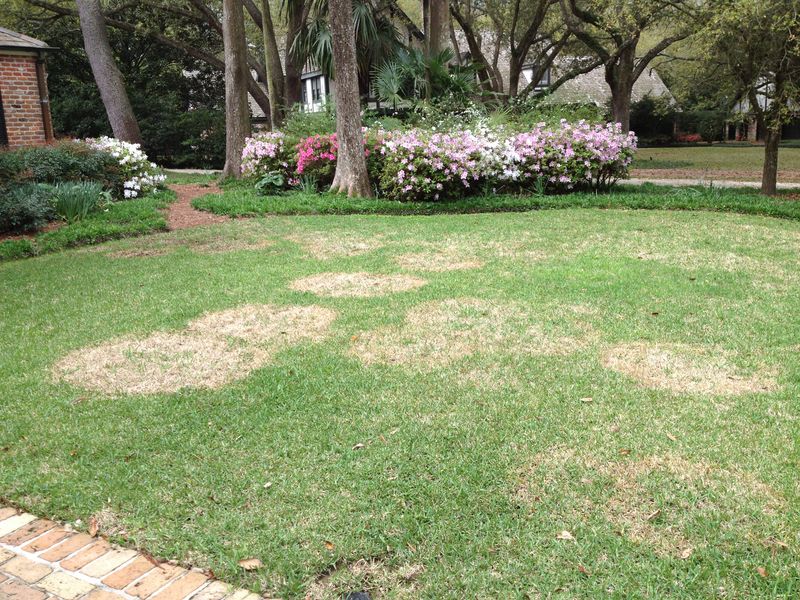
Large patch is the name for a fungal disease caused by Rhizoctonia solani, and it affects St. Augustine. You may hear people call it brown patch.
That nickname causes confusion because the same fungus causes brown patch in cool-season grasses, and Texas sources sometimes use the term loosely for St. Augustine symptoms.
According to Texas A&M’s large patch guide, the disease is most active in spring and fall. The patches can be circular or irregular.
Edges often look yellow to orange, and affected shoots may pull easily from their sheaths.
Those are clues, not a diagnosis. A patch that fits the description makes large patch plausible, nothing more.
Timing also varies. Damage may show up in spring or fall, and weather and local conditions shape when and how it looks.
Plenty of other things can leave a lawn brown. AgriLife lists gray leaf spot and take-all root rot among St. Augustine diseases, and chinch bugs and white grubs among common insect pests.
Environmental injury and plain dormancy can also look similar.
Take-all root rot is the one most often mistaken for large patch, as AgriLife’s take-all root rot publication explains. A photo or the color of a patch alone may not settle the question.
Before you decide, look closely. Check the shape of the patch, tug on the leaves, inspect the roots and soil, and think about recent weather and watering.
If you are unsure, your county AgriLife Extension office can help you sort it out.
Improve lawn conditions before considering treatment
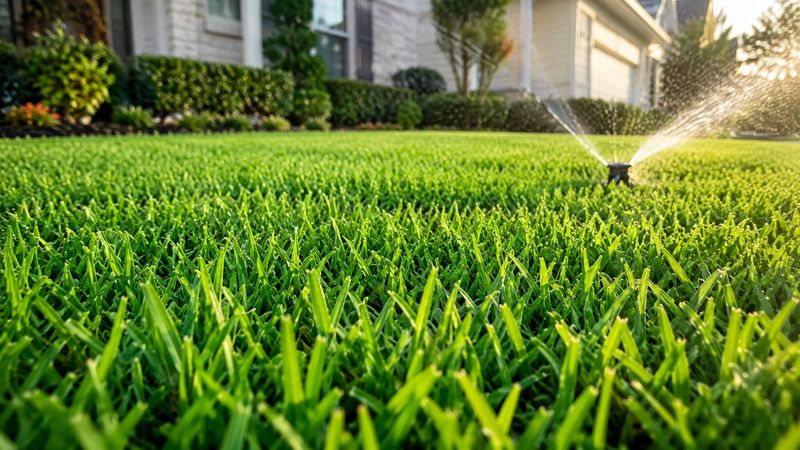
If large patch seems plausible, the first moves are about the site, not a bottle. AgriLife’s large patch guidance points to adequate drainage, avoiding excess moisture, appropriate mowing height, and balanced fertility.
Start by walking the yard after a rain. Look for puddles, spots that stay soggy, and downspouts that dump onto the lawn.
Redirecting runoff or fixing a low spot can do more than any product. Then check the sprinkler system for overlap or heads that keep one corner wet.
Next, look at mowing and feeding. Keep the grass in the 2 to 4 inch range described in AgriLife’s management guide, and avoid heavy nitrogen when the disease is active.
Balanced fertility means feeding for steady growth, not a burst of lush leaves.
Fungicides are not a substitute for fixing these problems. If the site stays wet and the care stays the same, the trouble can return even after a treatment.
If you still consider a fungicide, first confirm the likely disease, since several St. Augustine problems look alike. Then use only a product labeled for that disease and for your type of lawn and location, and follow the label directions.
A local Extension office can help you confirm what you are dealing with.
Let local conditions guide your expectations

Good lawn care in winter mostly comes down to restraint: water to match growth and weather, hold off on untimely nitrogen, and keep the mower blade up. When spring discoloration appears, look first and decide later.
Large patch may show up in spring or fall, and Texas does not run on one calendar. As AgriLife’s lawn calendar notes, some warm-season turf in southern Texas may not go fully dormant.
Your lawn answers to your weather, so let it set the pace.