
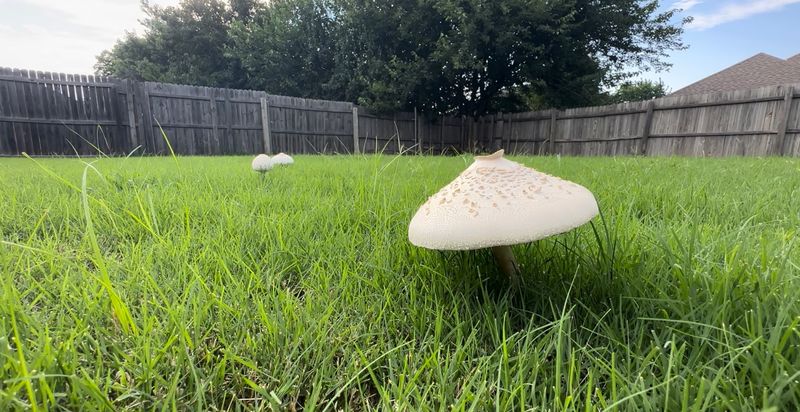
Stepping outside after a summer rain in Florida or Texas and finding a cluster of white mushrooms dotting the grass can feel like your yard is trying to send a message. It is, but the message is more limited than most people expect.
Those mushrooms point to moisture and decomposing organic material somewhere in, beneath, or around your turf, not to a specific soil quality or a lawn in crisis. Understanding what they actually mean helps you respond calmly, inspect the right things, and skip the unnecessary treatments.
The limited lawn clue behind sudden white mushrooms
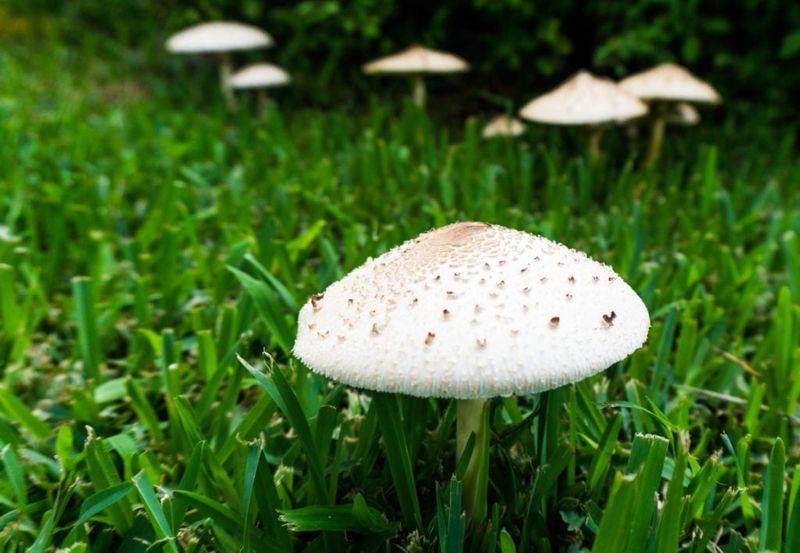
Mushrooms showing up in your lawn after a rainstorm are not a diagnosis. They are a signal, and a narrow one at that.
What they reliably indicate is that a fungus is fruiting because the conditions are favorable: moisture is present, and organic material is decomposing somewhere in, beneath, or around the turf. That combination triggers the fungus to push up the visible structure you see above the grass.
What mushrooms cannot tell you is whether your soil is fertile, healthy, poorly drained, compacted, or diseased. Those conclusions require a soil test, a drainage assessment, and a look at your irrigation habits, not a glance at a mushroom cap.
University of Minnesota Extension guidance on lawn mushrooms confirms that common triggers include recent heavy rain, excessive irrigation, buried wood or roots, thatch buildup, leaf litter, and other decaying material.
A stretch of wet summer weather in a Southern yard can produce mushrooms even when the lawn is otherwise in perfectly good shape. The fungi were already there, living quietly underground.
Rain just gave them the cue to fruit. So before assuming something is wrong with your soil or your grass, recognize that the mushrooms may be responding to last week’s thunderstorm more than to any lasting condition in the ground below.
Rain and irrigation bring the fungus into view

Every mushroom you see in the yard is only the tip of the fungal iceberg. The part that actually does the work, a web of thread-like structures called mycelium, stays hidden underground or inside whatever organic material the fungus is breaking down.
The mushroom itself is simply the reproductive structure, the part the fungus produces to release spores. UC Statewide IPM guidance on nuisance lawn fungi explains that the mycelium remains in the soil or organic matter, so physical removal of the mushroom cap does not usually eliminate the fungus below.
Heavy rain or excessive irrigation accelerates decomposition and creates the wet environment that encourages fungi to produce fruiting bodies. In Florida and Texas, where summer storms can dump inches of rain in a short window, mushrooms can appear almost overnight and seem to multiply across the lawn.
That rapid appearance often alarms homeowners, but it reflects a biological response to wet conditions rather than a sudden change in soil quality.
Knocking mushrooms over, raking them up, or pulling them out by hand is a reasonable first step. Removal improves the look of the lawn and reduces the chance that children or pets will encounter the fruiting bodies.
Just keep in mind that the mycelium underneath is unaffected, and new mushrooms may reappear if moisture and organic material remain available.
Look in, beneath, and around the turf for organic material
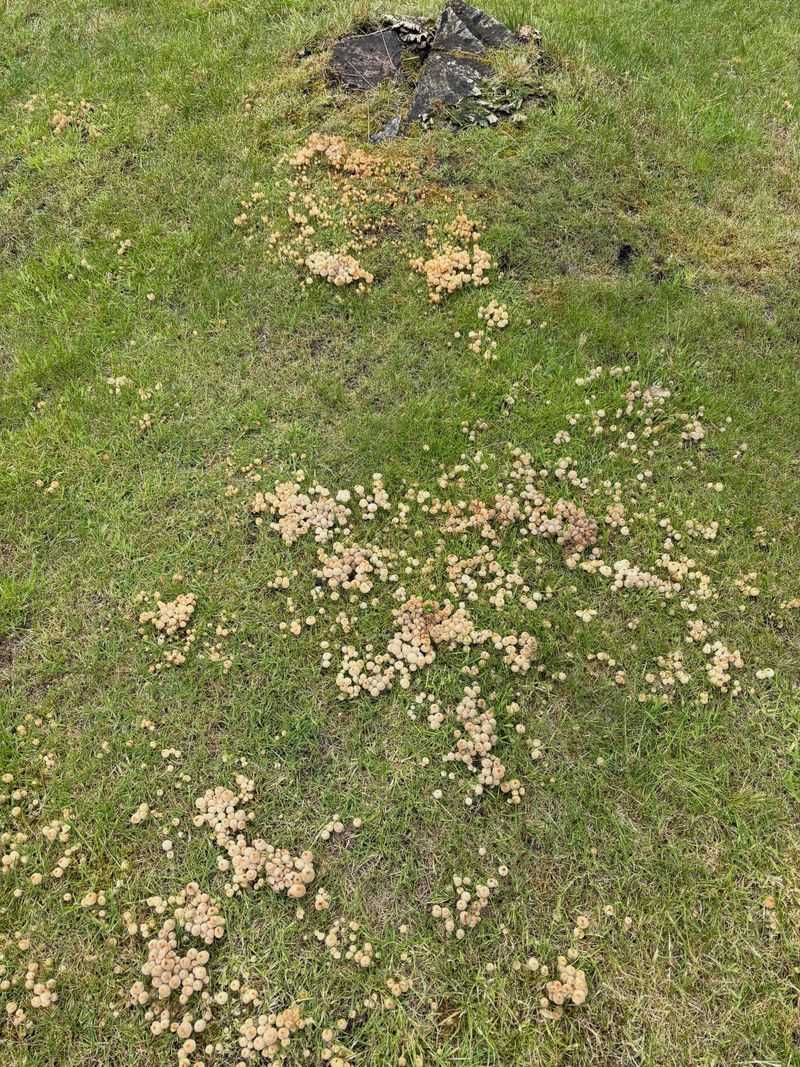
When mushrooms keep appearing in the same general area of the lawn, the next logical step is to look for what the fungus is eating. Organic material is the fuel, and it can come from several sources.
Old mulch piled near a bed edge, a buried piece of lumber from a long-ago fence post, a decaying tree stump left below the surface after a removal, leaf litter that has worked its way under the grass, or even concentrated animal waste can all provide enough food to sustain a fungus through multiple fruiting cycles.
UF/IFAS research on fairy rings in Florida lawns specifically connects mushroom activity to buried organic material such as lumber, stumps, and logs. Buried roots from a removed tree are one possibility, but they are not the only one.
Thatch, the layer of undecomposed plant material that builds up between the soil surface and living grass, can also feed fungal activity when it accumulates too thickly. Inspecting recurring mushroom spots with a hand trowel to check for buried debris is a practical way to confirm what is underneath.
Grass clippings are often blamed for thatch and mushrooms, but that connection is frequently overstated. Oklahoma State University Extension thatch guidance notes that properly mown clippings decompose readily and contribute little to thatch buildup.
Excessive thatch is mostly made up of undecomposed stems, stolons, rhizomes, and roots rather than clippings. Raking away surface debris, inspecting old mulch at the lawn’s edges, and investigating buried wood are more productive starting points than blaming clippings.
Scattered mushrooms usually need simple cleanup
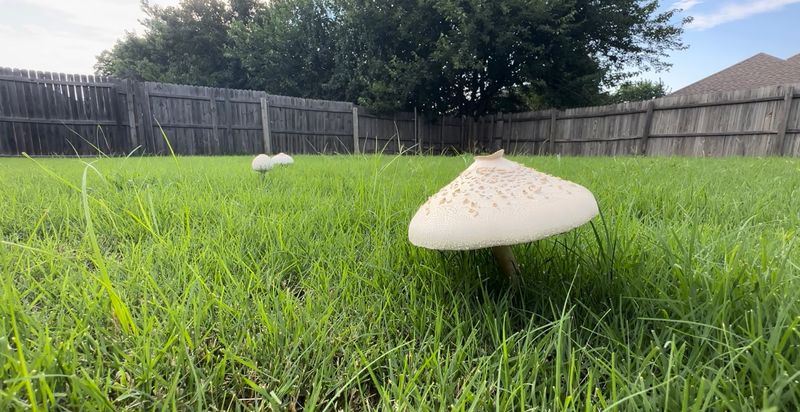
Finding a handful of scattered white mushrooms across a lawn that otherwise looks healthy and green is a low-stakes situation for most homeowners. The grass is not necessarily in danger, and the mushrooms are not a sign that a serious problem is developing underground.
The most practical first response is physical removal: knock them over with a rake, collect them by hand while wearing gloves, and dispose of them in a yard waste bag. University of Minnesota Extension recommends this approach for nuisance mushrooms when the turf itself looks normal, noting that removal reduces exposure without requiring any chemical treatment.
After cleanup, turn your attention to watering habits. Mushrooms thrive in wet conditions, so excess irrigation is worth reviewing before assuming a deeper problem exists.
Check whether your irrigation system is running more than current rainfall warrants. During naturally rainy periods in Florida and Texas, automated systems should be adjusted or paused so the soil is not staying wet longer than the grass actually needs.
University of Georgia Extension mushroom guidance also points to excess moisture as a key driver.
Reducing unnecessary watering during wet spells is the goal, not cutting water off entirely. Drought-stressing the turf creates a different set of problems.
Let rainfall do the work when it is sufficient, and return to a schedule that fits your specific turf species, soil type, and local conditions once the rainy period passes.
Fairy-ring patterns can signal a turf problem
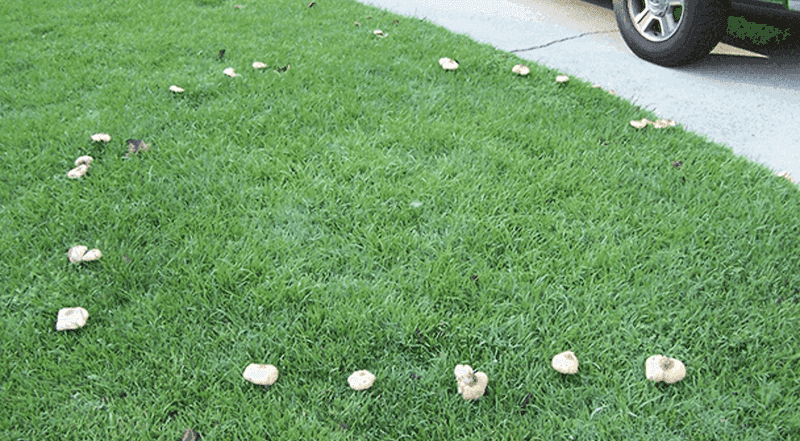
A single cluster of mushrooms scattered randomly across the lawn is a different situation from mushrooms that appear in a clear arc or circle. That circular pattern is the signature of a fairy ring, and it deserves a closer look at the grass itself, not just the mushrooms.
Fairy rings are not defined by a single set of symptoms. UF/IFAS fairy ring research describes multiple symptom types: some rings produce mushrooms alone with no visible turf change, some show a band of noticeably greener grass, and some develop a zone of dead or declining turf.
Florida’s summer rainy season is a particularly active period for fairy ring activity, and all warm-season turfgrasses used in Southern lawns can be affected.
The reason some rings cause turf damage is related to what the fungal mycelium does to the soil structure. In certain cases, the mycelium becomes so dense that it creates a water-repelling layer in the soil, preventing irrigation and rainfall from reaching grass roots.
Grass in that zone can decline or die even when surrounding turf looks fine. Not every ring reaches this stage, and many remain cosmetic, but a ring accompanied by dead or stressed grass is a reason to investigate further rather than simply mow over it.
UC IPM guidance on lawn fungi notes that cultural practices are generally more practical for home lawns than fungicide applications, and that severe cases may require removal of affected soil and turf. When a ring is actively damaging grass, extension-supported or professional diagnosis is a more reliable path than guessing at a treatment.
Inspect moisture, drainage, thatch, and compaction before treating
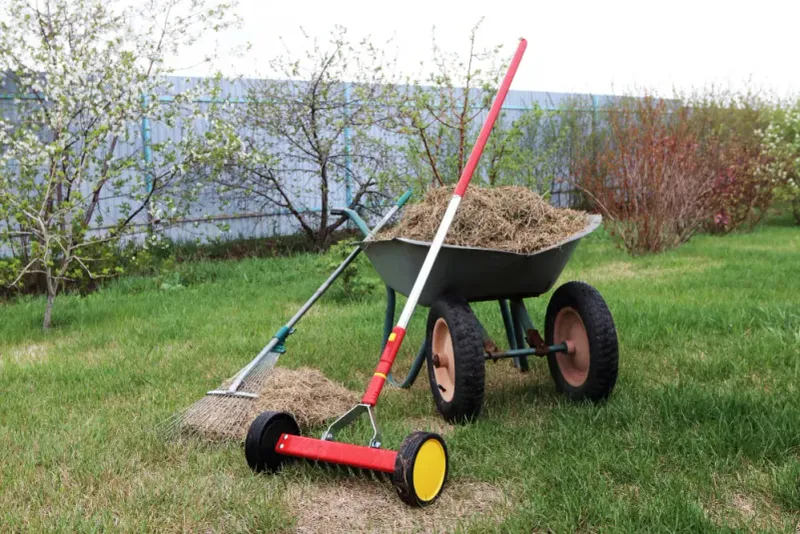
Before reaching for any product, work through a short diagnostic sequence that addresses the most common contributors to lawn mushrooms. Start with recent rainfall and irrigation.
If the lawn has received heavy rain in the past week or two, and the irrigation system has been running on its usual schedule, the soil may simply be wetter than normal for an extended stretch. Reviewing your irrigation controller settings and comparing run times to actual rainfall is a practical first step.
Texas A&M AgriLife guidance on irrigation auditing offers a framework for evaluating whether a system is applying water efficiently and matching actual turf needs, which vary by turf species, soil type, shade, and local conditions.
Next, look for drainage issues. Standing water after rain, soggy low spots, or areas where water consistently pools can keep the soil wet enough to sustain fungal fruiting well past the rain event itself.
Check thatch depth by cutting a small plug of turf with a knife: more than about half an inch of the spongy, undecomposed layer between the soil and living grass can trap moisture and feed fungal activity. OSU Extension thatch guidance explains how thatch accumulation develops and when dethatching is warranted.
Soil compaction can reduce water penetration and keep the surface zone wetter than it should be. Aeration may help in those specific cases by opening channels for water and air movement, but it does not remove the fungus or its mycelium.
UMN Extension frames aeration as a possible aid when compaction contributes to the problem, not a universal fix. Conclusions about soil nutrients or pH should come from a soil test, not from mushroom presence.
White color cannot establish safety
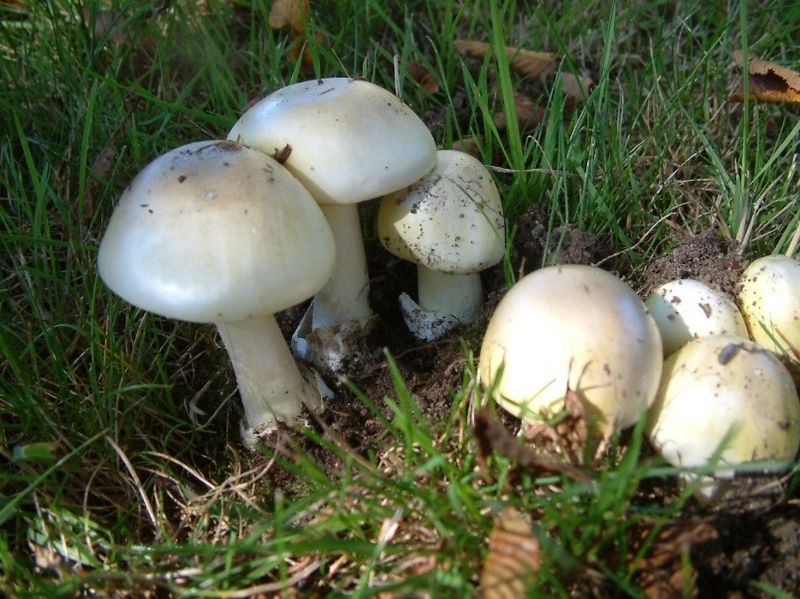
Calling a mushroom “white” describes how it looks, not what it is. Many completely unrelated fungal species share a white or pale cream appearance, and color alone provides no reliable information about whether a mushroom is harmless, edible, or toxic.
UC IPM is direct on this point: visual characteristics such as color and size cannot identify a mushroom’s species or safety. Wild mushroom identification requires expert knowledge, and even experienced foragers can make dangerous mistakes with look-alike species.
Children and pets are at particular risk because they are more likely to pick up or mouth unknown objects in the yard. ASPCA guidance on mushroom toxicosis in pets notes that while many wild mushrooms are nontoxic, some can cause severe gastrointestinal distress, neurologic effects, liver damage, kidney damage, or death in animals.
Keeping pets away from unknown lawn mushrooms is not an overreaction. Remove or fence off mushrooms in areas where children play or pets roam.
If a child or pet has ingested or possibly ingested a lawn mushroom, do not wait for symptoms to appear. CDC data on accidental poisonous mushroom ingestions underscores that outcomes can be serious and that prompt medical or veterinary attention matters.
Contact Poison Control at 1-800-222-1222 for people, or reach an emergency veterinarian immediately for pets. Home observation is not an adequate substitute for professional guidance after a suspected ingestion.
Use the mushroom as a clue, not a verdict
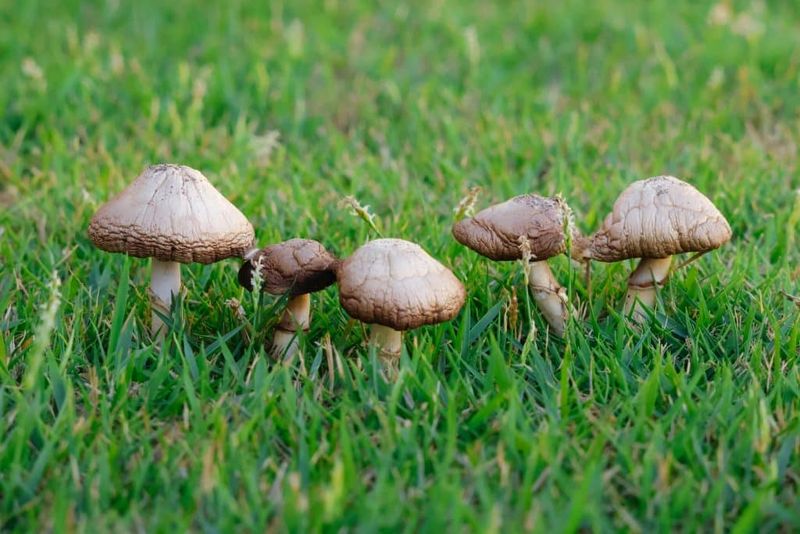
Ordinary scattered mushrooms in a lawn that is otherwise green and growing well usually reflect a temporary combination of moisture and decomposing organic material. That combination does not require an emergency response.
Remove the visible fruiting bodies for appearance and safety, review your irrigation schedule, and look for obvious organic debris in the area where mushrooms keep appearing. Those three steps address the most common situations without involving fertilizers, fungicides, or expensive treatments that are unlikely to help and may cause other problems.
The calculus changes when mushrooms appear in a clear arc or circle, when the turf inside or near the pattern is declining, or when standing water and poor drainage are consistently present. Those details move the situation from a nuisance observation to a diagnostic puzzle worth solving with help.
University of Minnesota Extension and UC IPM both recommend cultural management and professional or extension-supported diagnosis before considering chemical options, and that guidance applies especially in Southern yards where turf species, soil types, and local water restrictions vary widely.
A mushroom is a good prompt to pay closer attention to what is happening at ground level. It is not, by itself, a verdict on your soil or your lawn’s future.
The difference between a nuisance and a real problem usually shows up in the grass, not in the cap.