
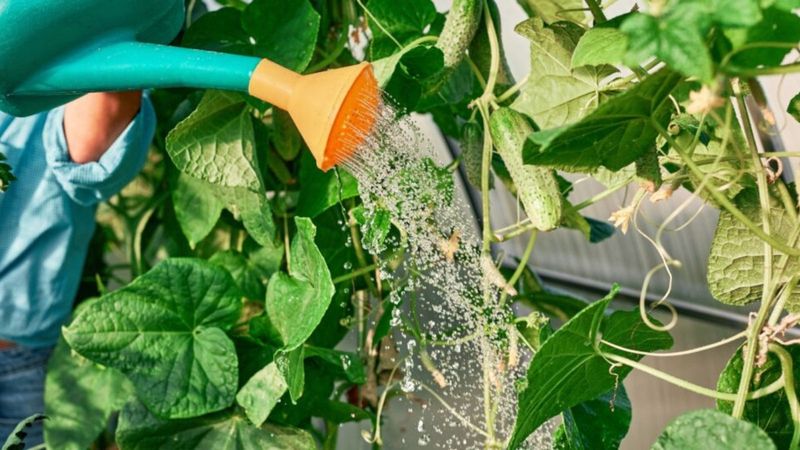
You planted cucumbers, the vines took off like they owned the garden, and then you bit into the first fruit and got a mouthful of something that tasted more like medicine than a salad ingredient. That frustrating gap between vigorous growth and bitter fruit is more common than you might think, especially in Southern gardens where summer heat never really lets up.
Fluctuating soil moisture is one of the more frequent contributors, but it is rarely the only explanation, and figuring out which problem you are actually dealing with makes all the difference in how you fix it.
Lush vines do not prove the fruit avoided stress
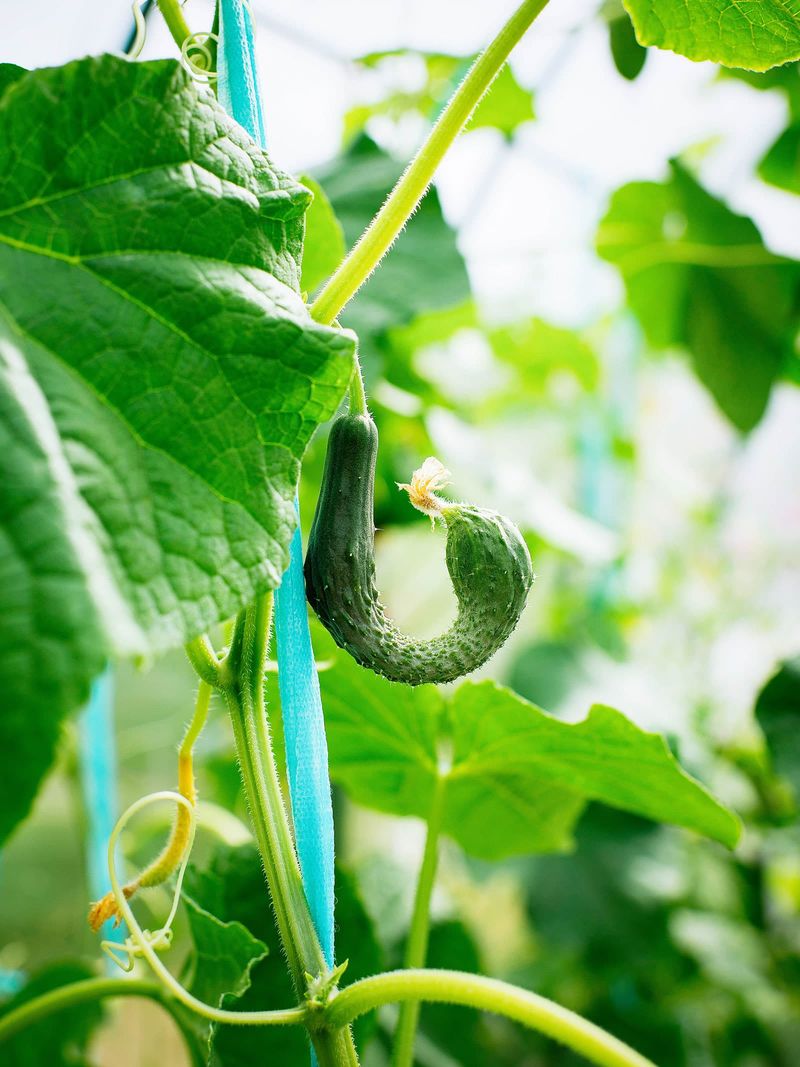
Thick, sprawling cucumber vines feel like a success story, and in some ways they are. Foliage growth and fruit development draw on different resources at different times, though, so a plant can push out impressive leaves while the developing fruit quietly experiences heat, drought, or irregular moisture at the root level.
Vigorous top growth tells you the plant is photosynthesizing well, not that every fruit is developing under ideal conditions.
The disconnect happens because cucumbers prioritize vegetative growth early in the season. Once flowering and fruit set begin, the plant’s water and nutrient demands shift, and any stress during those stages can affect fruit quality even when the canopy still looks lush.
Utah State University Extension notes that flowering, fruit sizing, and ripening are the periods when cucurbits are most sensitive to water availability.
Southern gardeners face an additional layer of difficulty because high summer temperatures can stress fruit tissue even when irrigation appears adequate. Alabama Cooperative Extension identifies heat alongside low or inconsistent moisture as a contributing stress factor in bitter cucumbers.
Treat the combination of fast vines and bitter fruit as a clue that something went wrong during fruit development, and start troubleshooting from there rather than assuming you know the cause.
What makes a cucumber turn bitter?
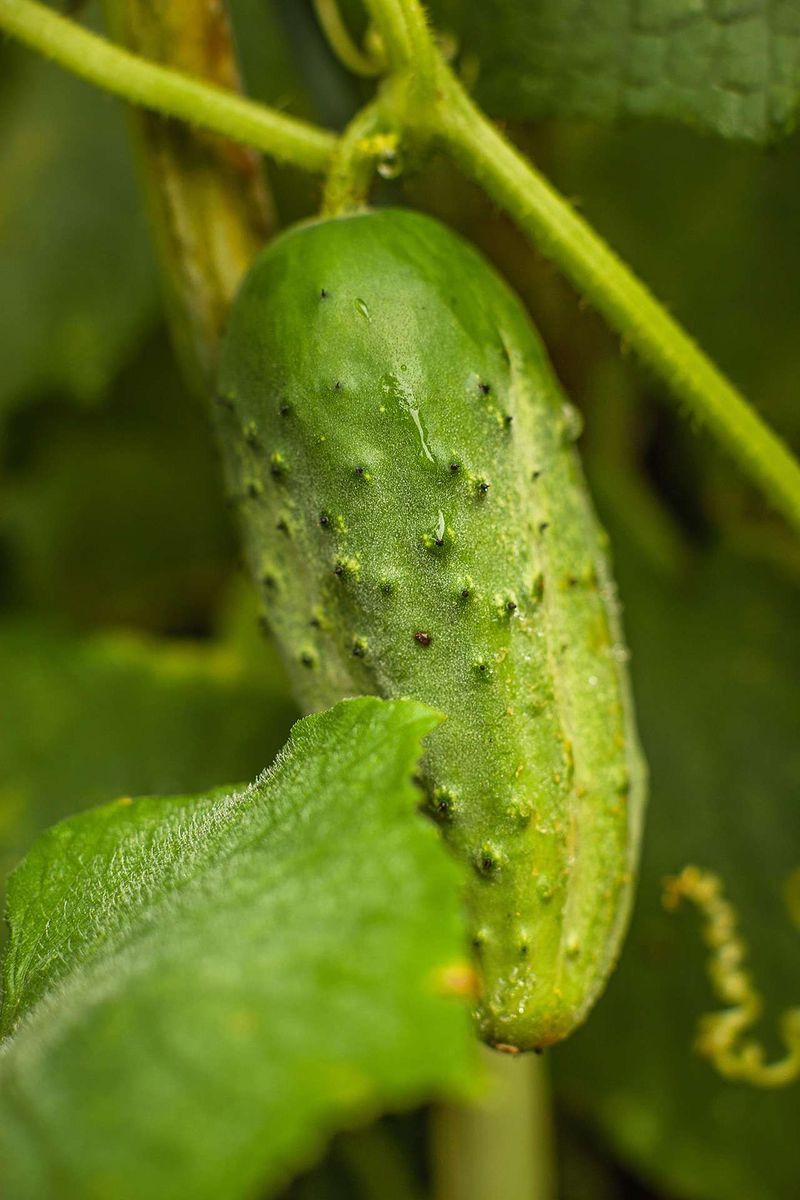
Cucumbers naturally produce a group of chemical compounds called cucurbitacins, and these are responsible for the bitter flavor you sometimes encounter. The concentration of cucurbitacins varies considerably depending on the cultivar you planted, which part of the plant you are tasting, and the growing conditions the plant experienced.
Published research on cucurbitacin distribution in cucurbits confirms that these compounds occur naturally across the plant and are not an abnormal contamination.
Leaves, stems, and roots tend to carry higher concentrations than the fruit itself under normal conditions. When heat, drought, or irregular moisture places the plant under stress, cucurbitacin levels in the fruit can rise.
University of Minnesota Extension explains that bitterness often concentrates near the stem end of the fruit and just beneath the skin, which matters when you are deciding what to do with a mildly bitter cucumber.
Knowing where bitterness tends to sit helps you distinguish two very different situations. A cucumber that tastes slightly off near the stem end is a different quality problem from one that is intensely and uniformly bitter from end to end.
Iowa State University Extension points out that mild, localized bitterness can sometimes be addressed by trimming and peeling, while severe bitterness throughout the fruit calls for a different response entirely. That distinction matters for both quality and safety, and it comes up again later in this article.
The watering problem is usually a dry-to-wet swing
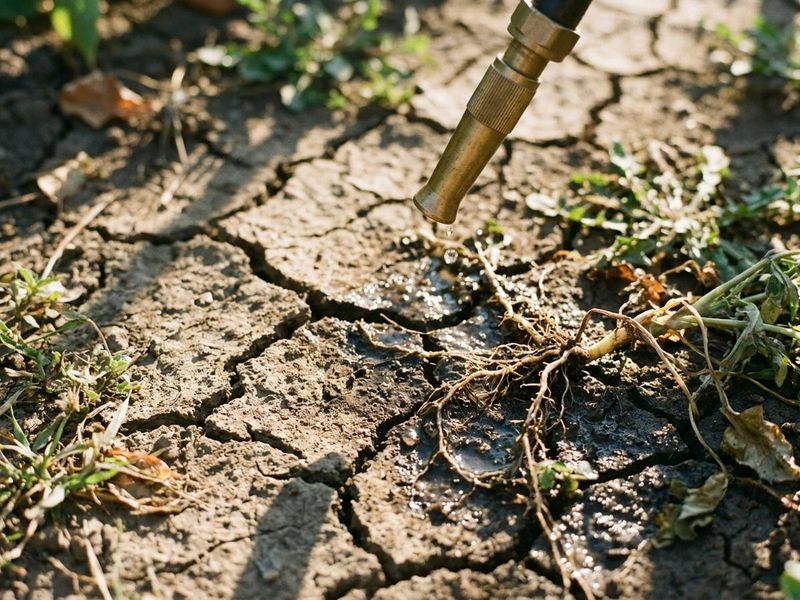
Among all the watering mistakes that contribute to bitter cucumbers, the most common pattern is not simply too little water or too much, but an irregular cycle where soil dries out considerably and then receives a heavy soaking. That kind of moisture swing disrupts the plant’s ability to manage cucurbitacins during fruit development.
Utah State University Extension identifies this dry-to-wet fluctuation as a contributing factor in bitter cucumber fruit, and the pattern is especially easy to fall into during Florida and Texas summers when a week of scorching heat is followed by a sudden afternoon thunderstorm.
You may have heard that overwatering causes bitterness, but that framing is too simple. Applying too much water at once can reduce the oxygen available in the soil, promote root disease, and create the kind of inconsistent root-zone conditions that stress fruit quality.
The problem is not water volume in isolation; it is the inconsistency. University of Florida IFAS guidance emphasizes that the goal for cucumbers is steady root-zone moisture rather than alternating flood and drought cycles.
Utah State’s vegetable irrigation guide identifies flowering, fruit sizing, and ripening as the periods when cucurbits need the most reliable water supply. Missing that window by letting the soil get notably dry before a heavy application is where the quality problem often begins.
Aim to keep the root zone evenly moist throughout those stages, and let soil conditions rather than a fixed calendar guide when you water.
Water deeply instead of sprinkling lightly every day
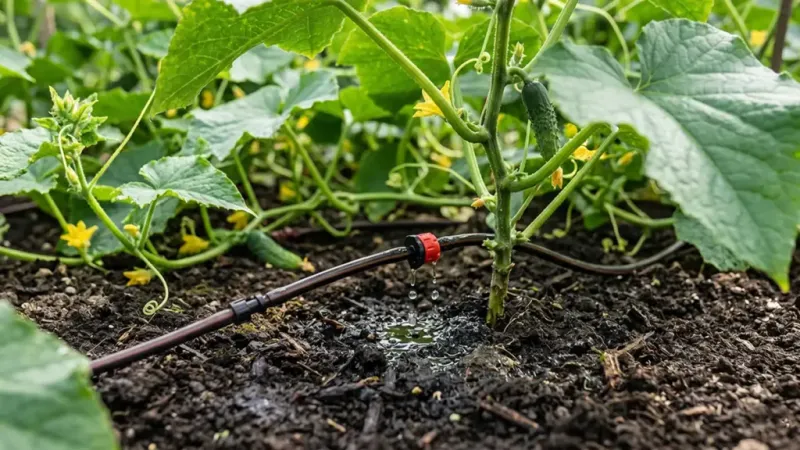
Reaching for the hose every morning and giving the plants a quick spray feels responsible, but light daily watering often does more harm than good. Shallow, frequent applications keep the top inch or two of soil moist while the deeper root zone stays dry.
Over time, roots follow the moisture and stay near the surface, leaving the plant less able to cope when the upper soil layer heats up or dries out quickly. University of Florida IFAS irrigation guidance cautions against this pattern, noting that thorough watering that penetrates the root zone is preferable to frequent shallow applications.
A practical starting range for cucumbers is roughly 1 to 2 inches of total water per week, counting any rainfall that actually reaches the soil. Utah State University Extension gives that 1-to-2-inch range as a general guideline, while Oklahoma State University Extension suggests approximately 1 to 1.5 inches per week during hot conditions.
Treat these as starting points, not fixed rules. Sandy Florida soils, containers, strong winds, and heavy fruit loads all speed up moisture loss and may push you toward more frequent watering.
The better method is to check soil moisture before you water. Push a finger or a probe 3 to 4 inches into the soil near the base of the plant.
If it still feels moist at that depth, hold off. When it feels dry, water slowly and thoroughly until you have moistened the root zone.
University of Georgia Extension reinforces this approach, recommending irrigation that penetrates deeply rather than surface-level wetting. Excess water that puddles or runs off is not helping the root zone and can leach nutrients away from where the plant needs them.
Mulch and soil-level irrigation steady the root zone
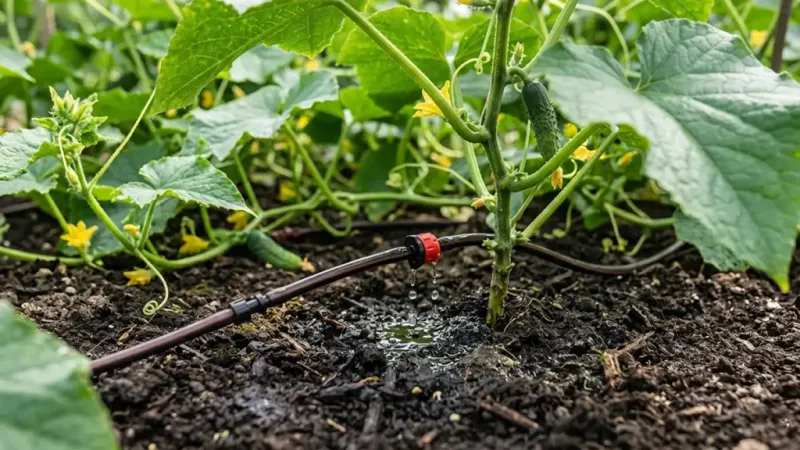
Mulch is one of the most straightforward tools for keeping soil moisture even between waterings, and it costs very little effort once it is down. A 2-to-3-inch layer of straw, wood chips, or shredded leaves slows evaporation, keeps soil temperatures more stable, and reduces the hard dry-to-wet cycles that can push cucurbitacin levels up in developing fruit.
University of Georgia Extension recommends mulch for cucumbers specifically because it conserves moisture, suppresses weeds, reduces soil compaction from watering, and keeps developing fruit from contacting the soil surface directly.
Drip irrigation or microirrigation is worth considering wherever it is practical to set up, particularly in Florida and Texas gardens where summer heat is relentless. Delivering water directly to the soil rather than broadcasting it overhead keeps foliage drier, which reduces the conditions that favor foliar disease.
Utah State’s cucurbit irrigation guidance favors drip systems for exactly this reason, and overhead irrigation during flowering can also interfere with bee activity at a time when pollination directly affects fruit set and shape.
Southern gardeners working with sandy soils, raised beds, or container plantings need to check moisture more frequently than gardeners in heavier clay or well-amended ground. University of Florida IFAS guidance for Florida vegetable production notes that sandy soils drain and dry faster, often requiring more frequent irrigation cycles.
Texas A&M AgriLife Extension similarly treats cucumbers as a relatively high-water-demand crop with seasonal variation. Adjust your schedule based on what the soil is actually telling you, not a fixed number of days.
Late picking can cause bitterness even with good irrigation
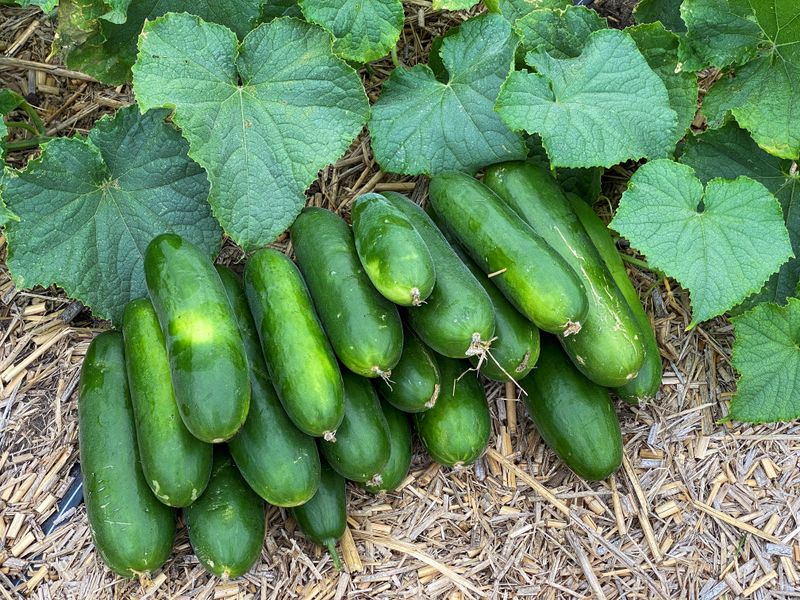
Before you overhaul your entire watering routine, check whether the bitterness might have a simpler explanation: the cucumbers were left on the vine too long. Overmature fruit develops bitterness as seeds enlarge, flesh becomes watery, and the cucumber swells beyond its intended size.
That process happens independently of irrigation, so changing how you water will not solve a harvest-timing problem. Washington State University Extension lists delayed picking as a direct cause of bitter, low-quality cucumbers.
Overmaturity signs to watch for include fruit that has grown noticeably larger than the variety’s expected size, skin that has shifted from deep green toward yellow or pale green, a noticeably soft or spongy feel when you squeeze it gently, and seeds that feel large or hard when you cut the fruit open. University of Florida IFAS Northwest District horticulture guidance emphasizes that cucumbers should be harvested while still firm and immature, well before yellowing begins.
University of Georgia Extension and Iowa State University Extension both recommend checking vines daily or every two to three days during peak production and picking every cucumber that has reached full size for its variety. Leaving even one overmature fruit on the vine signals the plant to slow new fruit production, so frequent picking helps on two fronts.
Timely harvesting is a separate fix from irrigation management, and both matter.
Persistent bitterness may point beyond irrigation
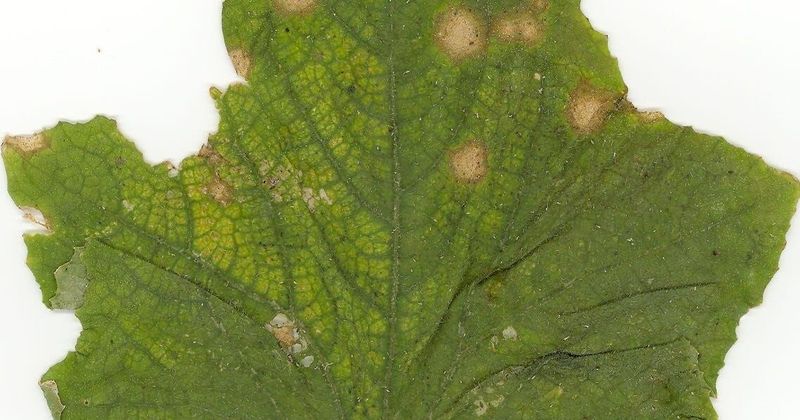
When you have steadied your watering schedule, added mulch, and started harvesting on time but the bitterness keeps showing up, the problem likely goes beyond moisture management. Cultivar genetics are one of the strongest influences on cucurbitacin production.
Some cucumber varieties are simply bred to produce more of these compounds than others, and no amount of careful irrigation will fully override that tendency. University of Minnesota Extension recommends trying a variety specifically labeled as bitter-free, nonbitter, or burpless if bitterness persists after other adjustments.
Keep in mind that even low-bitterness cultivars can produce off-flavor fruit when exposed to severe heat or prolonged drought, so a variety switch is not a guaranteed fix in extreme Southern summers. Other contributors worth investigating include disease, insect feeding injury, and nutrient deficiencies, any of which can stress the plant in ways that affect fruit quality.
University of Maryland Extension’s guide to common cucumber problems lists several diseases and pests that can affect fruit development without being immediately obvious from the outside.
Misshapen or pointed fruit is sometimes used as a clue, but shape alone is not diagnostic. Poor pollination, water stress, nutrient problems, or mechanical obstruction from a trellis wire can all produce pointed or curved fruit.
Utah State University Extension confirms that shape irregularities have multiple possible causes. One more thing worth setting aside: planting cucumbers near squash, melons, or watermelons does not make current-season cucumber fruit bitter.
Cross-pollination affects seed genetics, not the taste of the fruit you are harvesting this year. Look at the whole plant environment before drawing conclusions from taste alone.
Handle strongly bitter cucumbers with caution
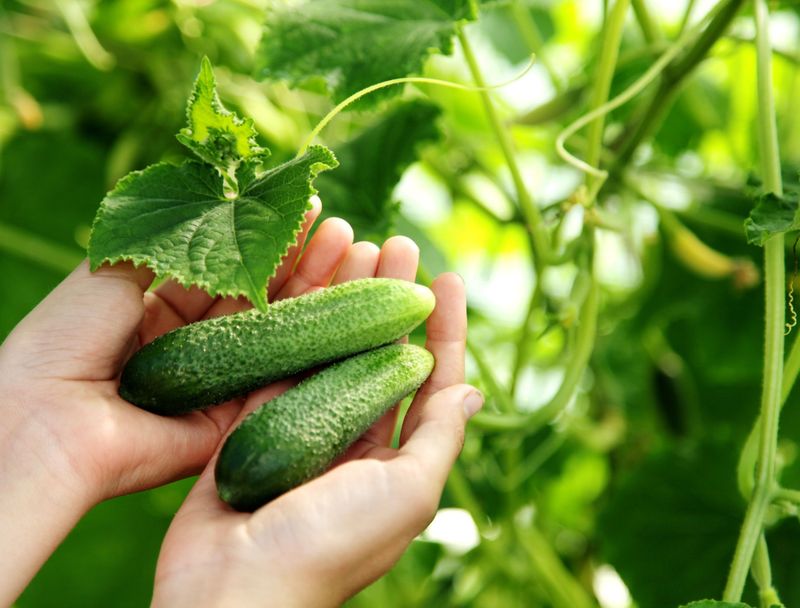
Mild bitterness near the stem end is a quality issue, and there is a reasonable way to address it. Cutting off the stem end generously and peeling the skin removes the areas where cucurbitacins tend to concentrate most heavily.
Oklahoma State University Extension suggests this approach for mildly bitter cucumbers as a practical quality remedy. Treat it as exactly that, a way to salvage a mildly off cucumber, not a guarantee that every bitter fruit is safe to eat.
Strongly or uniformly bitter cucumbers are a different situation. If a cucumber tastes intensely bitter from the first bite, spit it out and discard the fruit.
Poison Control guidance on toxic squash syndrome makes clear that high-cucurbitacin cucurbits have caused gastrointestinal illness, and the homegrown origin of the fruit does not change that risk. Modern cultivated cucumber varieties rarely reach dangerous cucurbitacin levels, but the possibility is real enough to take seriously when bitterness is extreme.
Cooking does not reliably neutralize cucurbitacins, so do not assume that heating or pickling a strongly bitter cucumber makes it safe. FDA information on cucurbit poisoning supports treating intense bitterness as a reason to discard the fruit rather than work around it.
When in doubt, throw it out.
Use the next harvest to test your correction
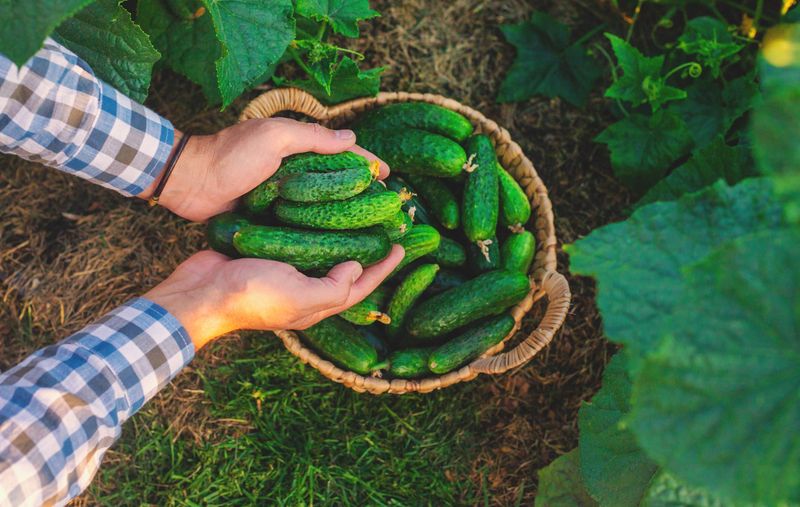
Put the corrections into practice and then watch the next flush of fruit rather than judging results from the cucumbers already on the vine. Check root-zone moisture before each watering, water thoroughly when the soil is dry a few inches down, and adjust frequency for your soil type and the current heat level.
Add mulch if you have not already, and switch to drip or soil-level irrigation if overhead watering has been your default.
Alabama Cooperative Extension notes that later fruit may sometimes return to normal after stress is corrected, while Texas A&M AgriLife Extension offers a more cautious view, warning that subsequent fruit may remain bitter in some cases. Neither outcome is guaranteed, which means the next harvest is genuinely a test rather than a sure result.
If bitterness continues after two or three rounds of careful management, review your cultivar choice and inspect the plant for disease, pests, or fertility problems before adding more water. The goal is steady root-zone moisture, not simply a higher volume of irrigation.
More water applied unevenly creates the same problem you started with. Consistent moisture, timely picking, and the right variety for your conditions are the combination most likely to put a good-tasting cucumber in your basket.