
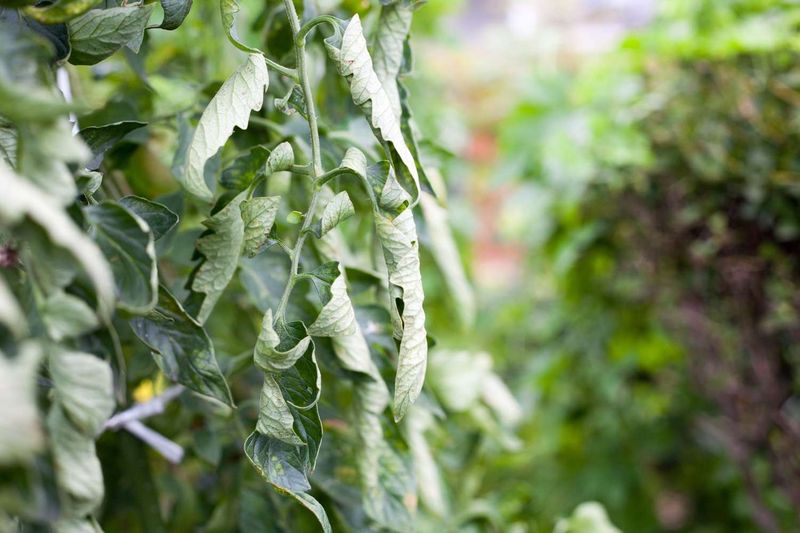
Walking out to your tomato plants and finding curled leaves can send your stomach straight to the floor, especially when everything still looks green and healthy. The good news is that curling alone, on an otherwise vigorous plant, is one of the less alarming things a tomato can do in summer heat.
Still, heat is not always the whole story, and a few quick checks can tell you whether this is a minor stress response or something that needs a closer look.
Green, curled leaves often reflect stress—not a dying tomato
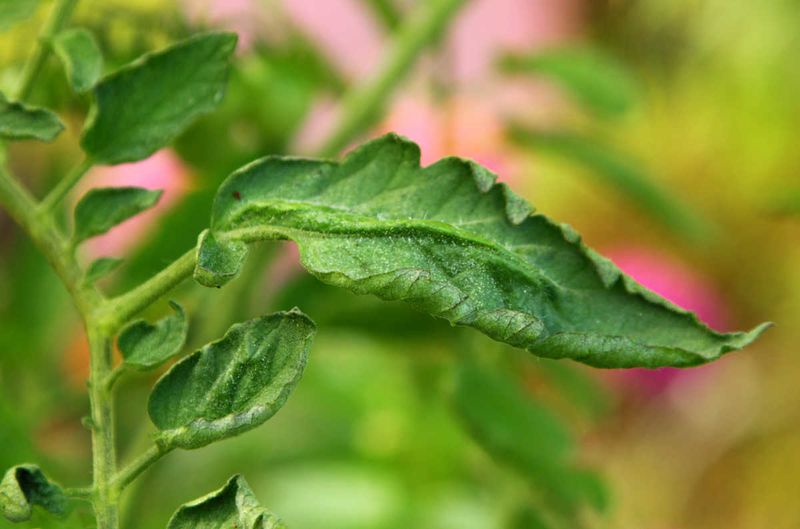
Curled leaves on a tomato plant that is otherwise deep green, flowering, and putting on new growth most often point to a condition called physiological leaf roll. Oklahoma State University Extension describes physiological leaf roll as a non-infectious response associated with environmental stresses including heat, moisture imbalance, prolonged wet soil, severe pruning, and root disturbance.
Older, lower leaves are typically the first to curl, and affected leaves may feel firm or leathery to the touch.
Mild cases generally do not reduce yield or fruit quality, which is a meaningful reassurance when summer temperatures in Florida and Texas are pushing triple digits. The curl pattern that fits this picture is upward or inward rolling on a plant that continues growing normally, with no mottling, yellowing, wilting, dieback, or stunted new growth appearing alongside it.
Even so, green color alone cannot confirm the diagnosis. Texas A&M AgriLife Extension notes that several different problems can produce similar-looking curled leaves, so the responsible move is to assess the whole plant before drawing conclusions.
Think of the green color and continued vigor as a useful starting clue, not a final answer.
Heat may trigger leaf roll, but it does not prove the cause
Hot, dry weather is one recognized trigger for physiological leaf roll, and that connection is why so many gardeners in the South immediately blame the heat. Texas A&M AgriLife Extension’s guide on leaf twist and curl acknowledges that the exact cause of tomato leaf roll is not fully known, which means presenting a single neat explanation – like the plant closing its pores to save water – goes further than the evidence supports.
Oklahoma State Extension adds that prolonged wet soil, not just drought, can also trigger the response, along with severe pruning, root disturbance, and variety susceptibility. Some tomato varieties simply roll more readily than others under the same conditions.
That range of possible triggers matters because it changes what you do next.
Before applying any treatment, take a few minutes to review the past week or two: Has the weather been unusually hot and dry, or has rain kept the soil saturated? Did you recently prune heavily, transplant, or disturb the roots?
Texas A&M’s tomato production guidance supports working through those questions as part of a practical diagnosis rather than treating heat as the automatic culprit. The goal is to match the condition to what actually happened in your garden.
Check the soil before you add more water
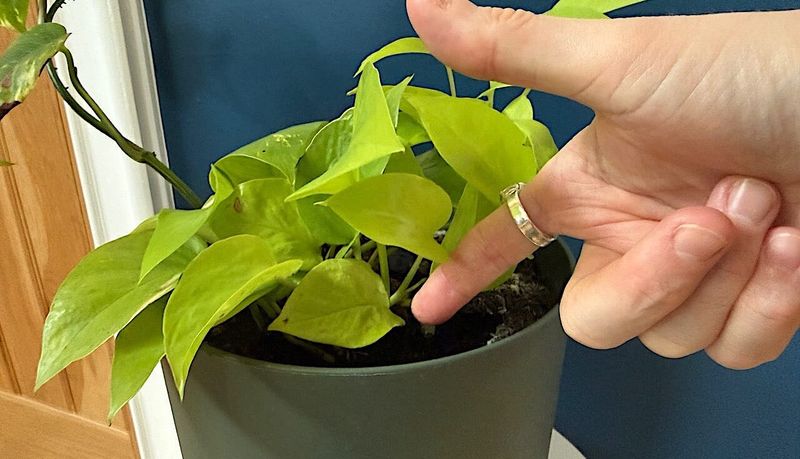
Curled leaves do not automatically mean the plant is thirsty. Pushing your finger or a wooden dowel several inches into the soil near the root zone gives you far more reliable information than the leaves alone.
If the soil feels moist at that depth, adding more water may actually worsen the situation, especially if drainage is slow or the soil has been saturated for days.
University of Minnesota Extension offers approximately 1 inch of rain or irrigation per week as a general benchmark, while University of Georgia Cooperative Extension suggests roughly 1 to 2 inches depending on soil type and weather. Both figures are starting points, not rigid rules.
Sandy soils drain fast and may need more frequent attention; clay soils hold water longer and can become waterlogged with too much input.
Container plants dry out faster than in-ground beds, and a large plant in full sun during a heat wave will use water more quickly than a younger plant in spring. UGA’s Clarke County Extension newsletter reinforces that consistent moisture – not constant saturation and not repeated drying out – is what tomatoes need.
Shallow daily watering that never reaches the deeper roots can leave a plant struggling even when the surface looks wet.
Deep watering and mulch steady the root zone
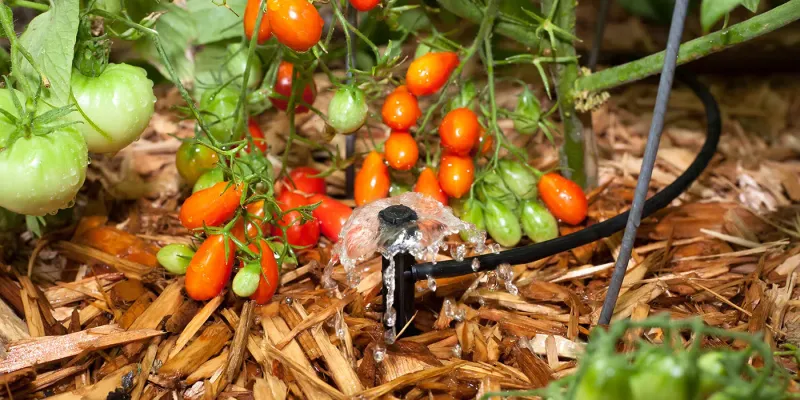
Once you confirm the soil actually needs water, the method matters as much as the amount. Delivering water directly to the root zone – through drip irrigation, a soaker hose, or slow and careful hand watering at the base – gets moisture where the plant can use it without keeping foliage wet.
University of Minnesota Extension recommends avoiding routine overhead watering because wet leaves increase the risk of foliar disease, a concern that is especially relevant during warm, humid Southern summers.
After watering, check the soil again in a day or two rather than repeating the same dose on a fixed schedule. UGA Extension’s tomato production guide and their home vegetable gardening bulletin both support consistent moisture management over automatic routines.
The goal is stable root conditions, not a predetermined gallon count.
A few inches of clean organic mulch spread around the plant – but kept away from direct contact with the stem – can make a real difference in holding that moisture and moderating soil temperature between waterings. Camden County UGA Extension notes that mulch is one of the more effective and underused tools for summer tomato care.
Straw, shredded leaves, or wood chips all work well; just avoid piling mulch against the main stem, which can hold moisture against the tissue and invite rot.
Protect flowers and fruit during the heat wave
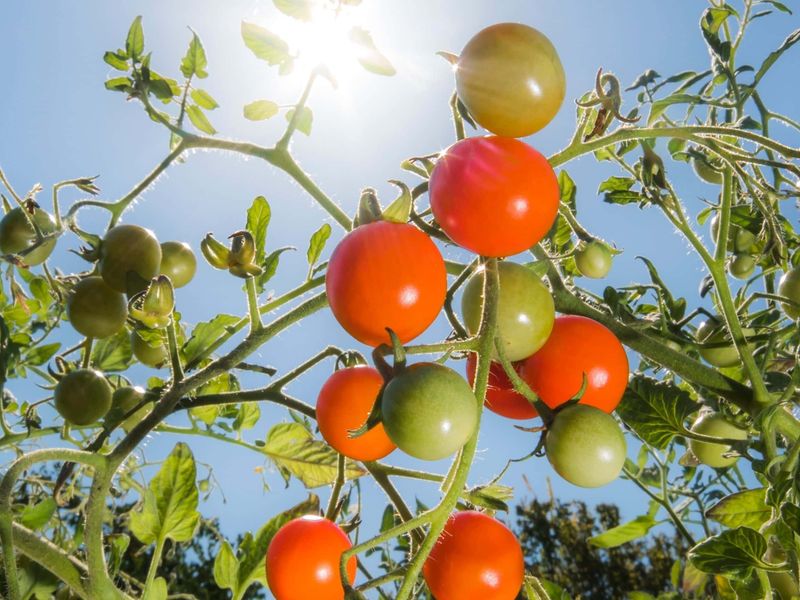
Leaf appearance and crop performance are separate concerns, and a plant can look green and relatively normal while still struggling to set fruit. Texas A&M’s tomato production overview and UGA’s tomato production guide both note that daytime temperatures consistently above roughly 90 to 95 degrees Fahrenheit, combined with warm nights, can impair pollination, cause blossoms to drop before fruit forms, and slow overall fruit set.
These temperature thresholds concern flowering and fruiting specifically, not a definitive threshold for when leaf curl starts or stops.
For plants that are actively flowering during a heat wave, University of Maryland Extension’s guide on vegetable pollination suggests that temporary afternoon shade using 30% shade cloth may help reduce heat load on flowers. That is a reasonable option to try, not a guaranteed fix.
Shade that is too heavy or used too long can reduce the photosynthesis that drives plant growth and fruit development, so the tradeoff is worth monitoring.
Avoid removing large amounts of foliage during a heat wave. Oklahoma State Extension notes that heavy pruning can worsen leaf roll and increase sun exposure on fruit and stems that were previously sheltered by the canopy.
Stripping away protective leaves to “help” a stressed plant often creates more problems than it solves when temperatures are already extreme.
Compare old and new growth to spot warning signs
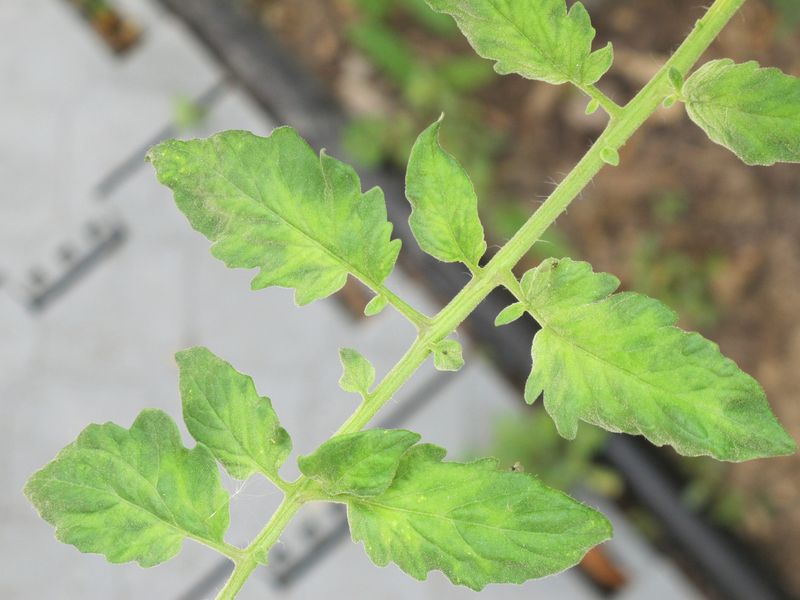
Scanning the whole plant from bottom to top takes less than two minutes and gives you the most useful diagnostic information available. Physiological leaf roll tends to show up on older, lower leaves while the newest growth at the top of the plant remains normal-looking, green, and properly shaped.
That pattern, on a plant that is still flowering and producing, fits the stress-response picture described by University of Minnesota Extension’s tomato leaf curl diagnostic tool.
A different picture emerges when new growth shows cupping, yellowing, mottling, reduced leaf size, stunted internodes, or flower and fruit drop alongside the curl. Those signs warrant closer attention because they can indicate tomato yellow leaf curl virus, which is transmitted in Florida primarily by silverleaf whiteflies.
UF/IFAS Extension’s tomato yellow leaf curl virus fact sheet explains that symptoms are not unique to this virus and that suspected viral infections should be confirmed through laboratory testing rather than diagnosed from visual appearance alone. Green foliage does not rule the virus out, especially in early infection.
While checking new growth, also look under leaves and around the growing tips for aphids. These small, soft-bodied insects can cause curling, distortion, and stunting, particularly on young tissue.
UF/IFAS whitefly management guidance and UC IPM’s tomato pest resources both support a thorough visual inspection of the whole plant before drawing any conclusion about cause.
Twisted new growth may signal herbicide injury or another problem
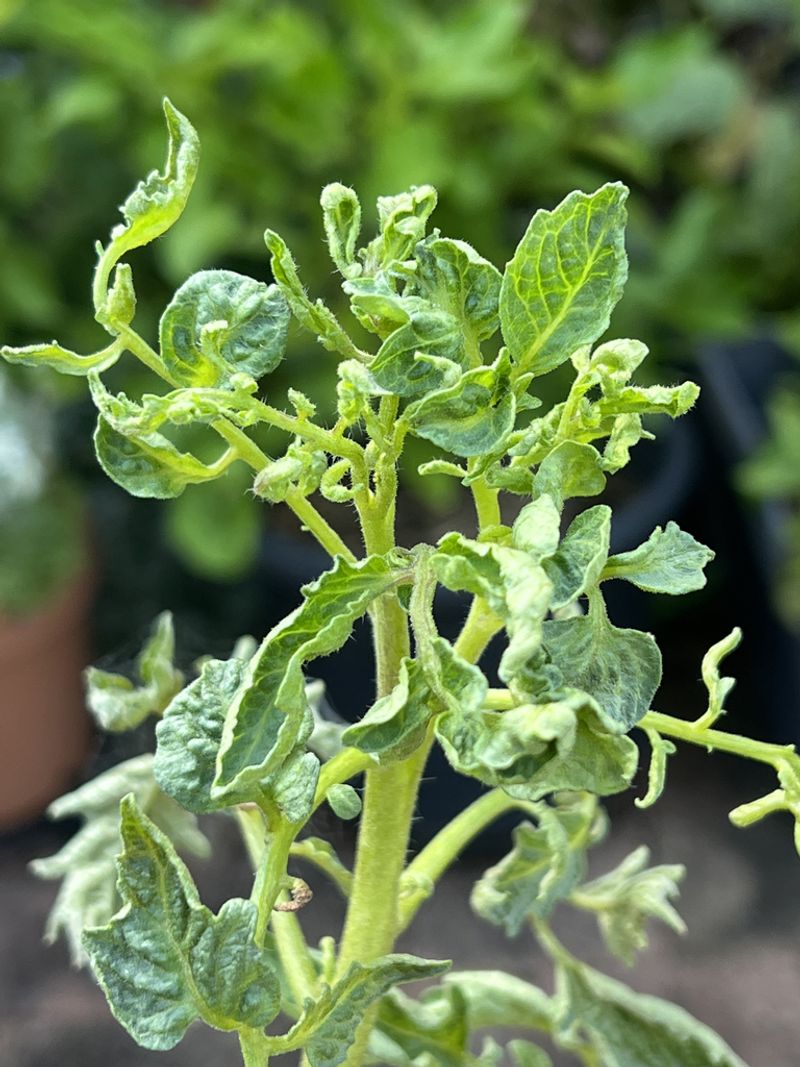
When the oldest leaves on a plant are curling but the newest growth looks completely normal, the stress-response explanation holds up well. The concern shifts when the newest leaves are the ones looking wrong.
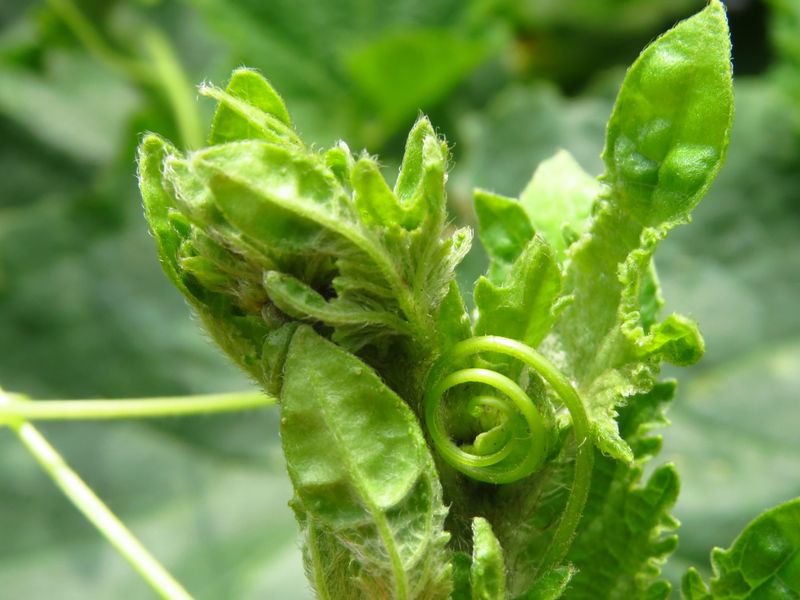
Twisted, cupped, unusually narrow, thick-veined, bleached, browned, or severely distorted new growth is a different pattern, and it warrants a different line of investigation.
Texas A&M’s leaf twist and curl publication lists herbicide exposure – including drift from lawn herbicides like 2,4-D, dicamba, and glyphosate – as a possible cause of distorted new growth in tomatoes. UC IPM’s herbicide phytotoxicity resource notes that tomatoes can be injured at very low herbicide concentrations.
Clues that may increase suspicion of herbicide involvement include several nearby plants showing similar distortion, or one side of the plant looking noticeably worse than the other – possibly the side closest to a lawn or field that was recently sprayed.
These clues raise suspicion but do not establish the cause on their own. University of Minnesota Extension’s vegetable IPM blog supports careful observation and documentation before taking action.
Avoid applying a spray treatment based on a guess – especially during extreme heat. UF/IFAS guidance on pesticide use specifically advises against applying horticultural oil when outdoor temperatures exceed 90 degrees Fahrenheit, and product labels should always be followed for any pesticide application.
Judge improvement by the next leaves, not the old curl
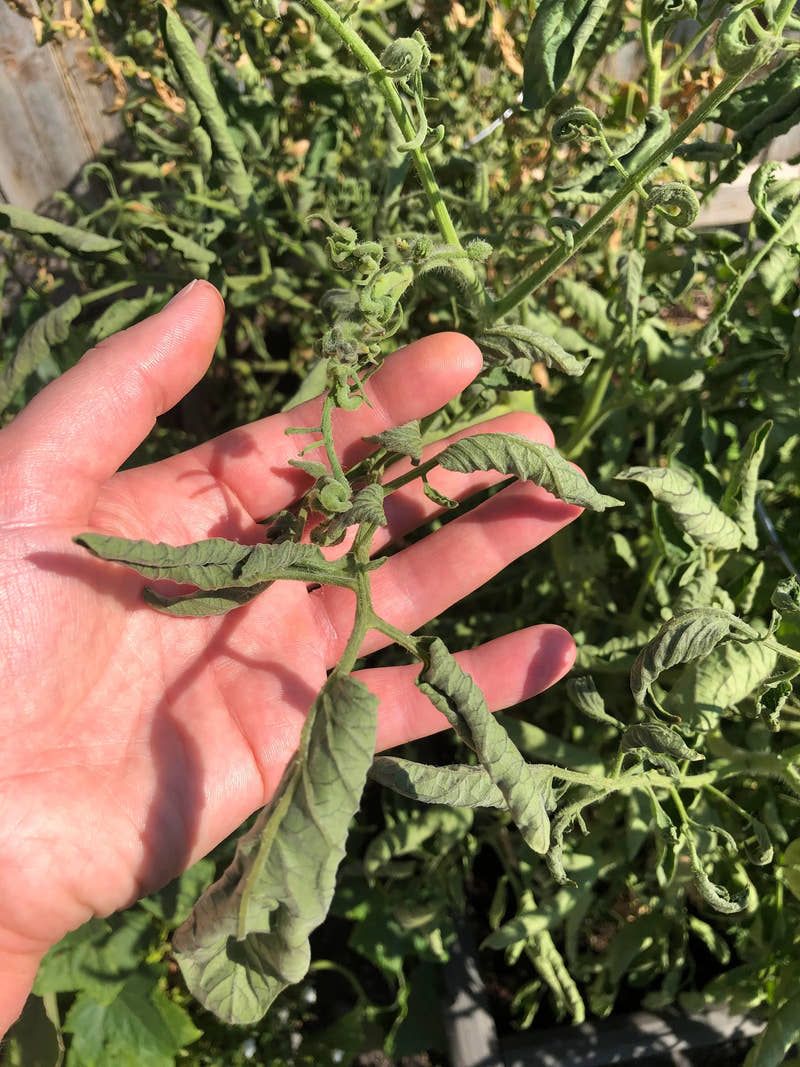
Previously curled leaves may not return to their original shape even after conditions improve, and waiting for them to flatten is not a reliable way to measure whether your intervention worked. Oklahoma State Extension describes affected plants as continuing normal growth despite persistent leaf roll, which means new growth, turgor, flowering, and fruit development are far better indicators than the appearance of older leaves.
A few days after adjusting your watering and checking the root zone, look at the newest leaves emerging at the top of the plant. Normal shape, color, and size in that new growth – combined with flowers continuing to open and fruit continuing to size up – supports the conclusion that the plant is moving through a stress response.
University of Maryland Extension’s common tomato problems resource reinforces using overall plant health and new tissue as the measure of recovery.
If the new growth is distorted, the plant is stunted, yellowing is spreading, or insects or a clear exposure pattern are present, further diagnosis is the right next step – not an automatic application of calcium, Epsom salts, or pesticide. Oklahoma State’s home tomato growing guide and UGA Extension’s watering practices article both caution against adding amendments or treatments without evidence of the specific problem they address.
The steadiest tomato plants grow from steady conditions – consistent soil moisture, protected roots, and a gardener who watches first and reaches for a product second.