
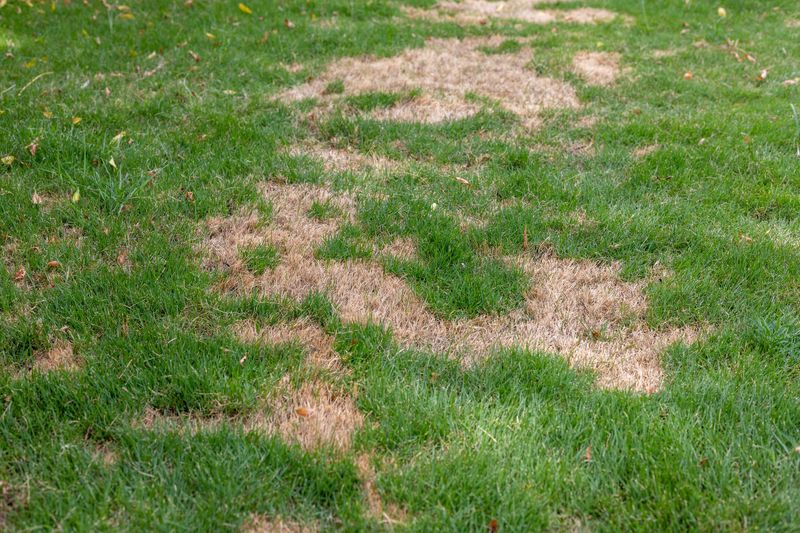
Walking out to check your lawn and finding patches of brown, crunchy grass is one of the most frustrating sights of late summer. Most homeowners immediately blame the heat, grab the hose, and start watering – but that reflex can sometimes make things worse.
Brown grass in July or August can come from a surprising range of causes, including uneven sprinkler coverage, insects, fungal disease, compacted soil, or even your dog. Learning to read the pattern before you treat can save your lawn, your water bill, and your time.
The Browning Pattern Narrows the Possibilities
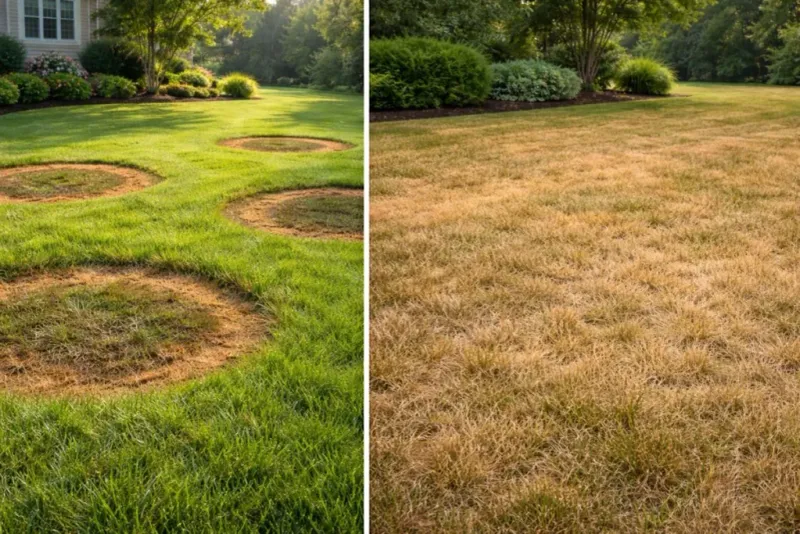
Grabbing the hose the moment you spot brown grass is a natural reaction, but stepping back and studying the pattern first tells you far more. A lawn that turns uniformly tan during a long stretch of hot, rainless weather is behaving differently from one with scattered, irregular, or sharply defined patches appearing in specific spots.
Uniform browning across the whole lawn during an extended dry spell can point to drought stress or natural dormancy, depending on the grass you are growing. Texas A&M AgriLife Extension guidance on bermudagrass notes that bermudagrass can enter drought dormancy and resume growth after sufficient moisture returns – so a tan bermuda lawn is not automatically a dying one.
Cool-season grasses such as tall fescue or Kentucky bluegrass, however, are more vulnerable to prolonged Southern heat and may suffer permanent thinning rather than a clean dormancy.
Irregular patches tell a different story. Expanding, circular, ringed, or isolated brown areas are more consistent with irrigation problems, insect feeding, fungal disease, soil issues, or localized damage from salt or pet urine.
University of Florida IFAS guidance on bermudagrass points to folded blades, a blue-gray color, and footprints that linger as early drought-stress signals worth noting before assuming a worse cause.
Heat is still a legitimate factor: it increases water loss and can weaken turf, making it more vulnerable when other stressors are also present. But a sprinkler system that appears to be running normally does not guarantee that every corner of the lawn is receiving even coverage.
Pattern reading is triage, not a final verdict – it simply tells you where to look next.
Audit the Sprinklers Before You Treat the Grass
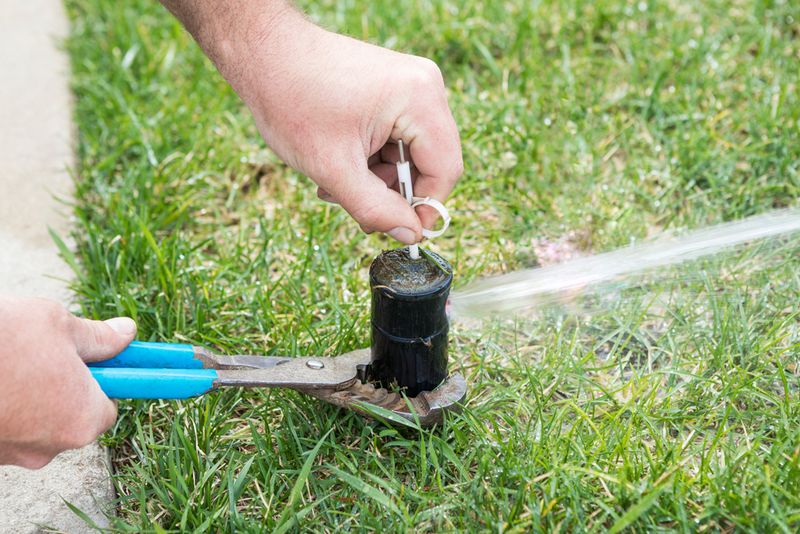
When brown patches appear in specific zones while the rest of the lawn stays green, the sprinkler system is one of the first places to investigate. A system that runs on a schedule can still leave dry zones if even one head is tilted, clogged, blocked by overgrown plants, sitting too low, or failing to rotate properly.
Colorado State University Extension’s lawn irrigation audit tutorial recommends a straightforward catch-can test: place five to ten identical straight-sided containers – tuna cans or deli cups work well – across one sprinkler zone. Run the system for a set period, then measure and compare the water collected in each container.
Significant differences between containers reveal uneven distribution that a timer setting cannot fix.
After the catch-can test, walk the zone while the system runs and look for heads that spray in only one direction, pop up partway, or send a tight stream instead of a fan. Tree roots can crack irrigation lines or shift head positions over time, and design limitations in older systems sometimes leave the edges of a zone consistently dry.
A useful visual clue is the “green donut”: lush grass immediately around a sprinkler head with browning farther away suggests the head is not throwing water far enough to reach the outer turf. Runtime alone cannot tell you whether the lawn received adequate water.
Confirming coverage with a physical audit is a more reliable first step than simply increasing the run time or adding extra watering days.
Use Turf Stress Signs to Guide Watering
Heat raises the rate at which grass loses moisture through its leaves, and when water leaving the plant outpaces what roots can pull from the soil, stress sets in quickly. Recognizing the early signs lets you water when the grass actually needs it rather than on a fixed schedule that may not match real conditions.
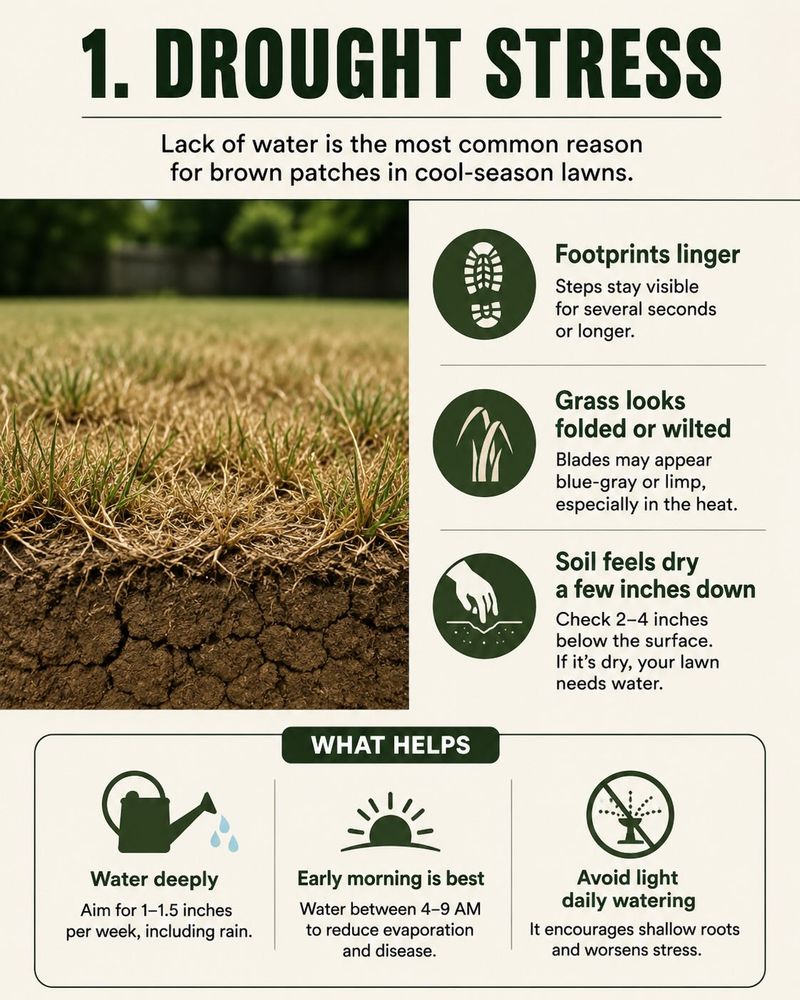
Three reliable drought-stress signals to look for are blades that fold or roll inward along their length, a blue-gray or dull steel cast replacing the normal green color, and footprints that remain visible in the turf for several minutes after you walk across it. Healthy, well-hydrated grass springs back; stressed grass stays flat.
When those signs are absent and the soil feels moist a few inches down, adding more water may cause more harm than the drought itself.
Deep, less-frequent irrigation generally builds stronger roots than daily light sprinkling, but the right amount varies considerably by grass species, soil type, slope, shade, rainfall, and local water restrictions. UF/IFAS watering guidance for Florida lawns recommends applying roughly one-half to three-quarters inch per irrigation session as a regional reference, while Texas A&M’s bermudagrass calendar uses approximately one inch per week as a benchmark adjusted for rainfall and evapotranspiration.
Neither figure is a universal prescription.
Morning watering is worth choosing when possible. It reduces evaporation compared with watering during peak heat, and it gives grass blades time to dry before nightfall.
Wet foliage that stays damp through warm, humid nights creates conditions that can favor fungal disease. Automatic evening irrigation in humid Southern summers is worth reconsidering, especially if brown patches with unusual shapes are already appearing.
Mowing and Soil Conditions Can Intensify Stress
Mowing a lawn shorter than the grass type can handle is one of the fastest ways to reduce its ability to tolerate heat, dry spells, and pest pressure. Leaf blades capture sunlight for photosynthesis and shade the soil, slowing moisture loss.
Remove too much at once and the plant has to spend energy regrowing instead of deepening roots.
Staying within the recommended height range for your specific grass matters more than picking a single number. UF/IFAS homeowner lawn-care guidance lists approximate ranges of 3.5 to 4 inches for standard St. Augustinegrass, 1 to 2 inches for bermudagrass and centipedegrass, and about 2 inches for many coarse zoysiagrass cultivars.
Cultivar-specific recommendations from your local extension office can sharpen those ranges further. The one-third rule applies regardless of species: never remove more than one-third of the blade in a single mowing, even if the grass has grown tall between cuts.
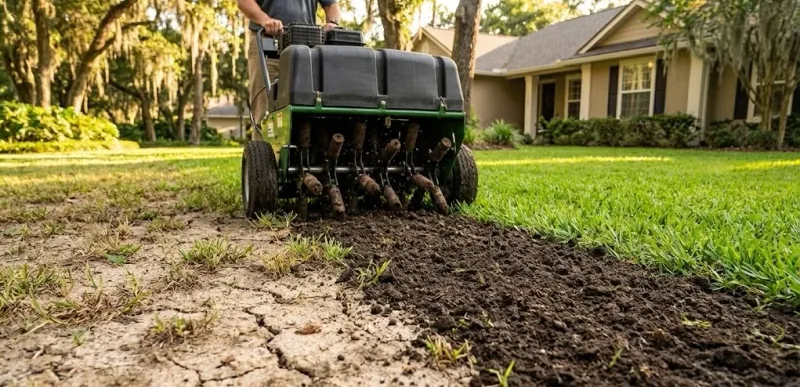
Soil conditions below the surface can cause browning that looks identical to drought or pest damage from above. Compacted soil limits root penetration, reduces the flow of water and oxygen to roots, and can leave grass unable to access moisture even when it is present.
Poor drainage concentrates water in low spots and can promote root diseases, while tree roots actively compete with turf for water and nutrients and can also interfere with shallow irrigation lines.
Core aeration can help lawns with significant compaction, but timing is important: aerating a warm-season lawn during the wrong season or during drought stress can add injury rather than relieve it. Colorado State University Extension’s basic turf-management resource recommends aerating when the grass is actively growing and conditions allow recovery, not during peak heat or drought.
Check for Chinch Bugs and White Grubs
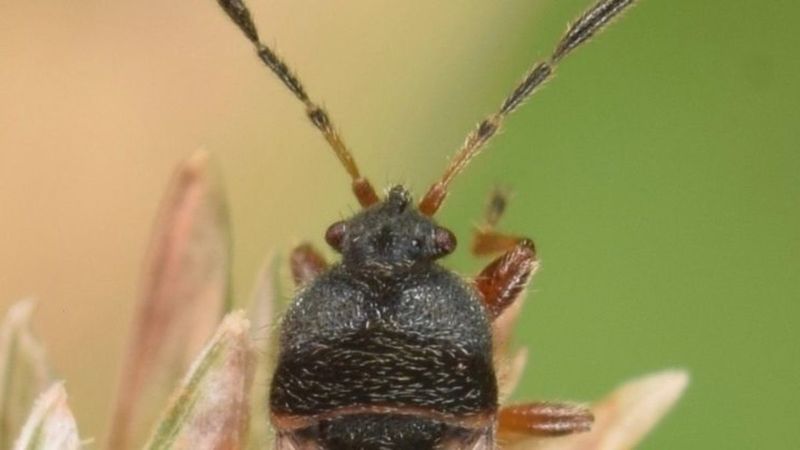
Not every expanding brown patch in a Southern lawn is caused by drought. Two insects that regularly fool homeowners into blaming heat or lack of water are southern chinch bugs and white grubs, and both can cause serious damage before most people think to look for them.
Southern chinch bugs target St. Augustinegrass and are a persistent problem across Florida and Texas. Their feeding damage typically starts as irregular, yellowing patches that expand outward and eventually turn brown, closely mimicking drought stress or disease.
The key difference is that the browning often spreads even when the lawn is being watered. Texas A&M AgriLife’s chinch bug guide for St. Augustine lawns describes a flotation test using a coffee can or similar open-ended container pressed into the soil at the edge of the damaged area; fill it with water and count the insects that float to the surface.
The St. Augustinegrass Lawn Management guide from Texas A&M gives a treatment threshold of 25 chinch bugs per square foot using this sampling method – a figure specific to southern chinch bugs, this grass, and this approach, not a general benchmark for every lawn pest.
White grubs feed underground on grass roots and can produce weakened, brown patches where the turf lifts or rolls back easily, like a loose carpet. Animals digging into the lawn are often a tip-off.
Inspect several one-square-foot sections at the edge of the damage rather than assuming grubs from symptoms alone.
Before reaching for any pesticide, confirm the pest is present and consider whether the population meets an action threshold. EPA integrated pest-management principles call for identifying the pest, monitoring its numbers, and applying treatment only when a threshold is reached – not simply because brown patches exist.
Separate Disease Clues from Pet and Site Injury
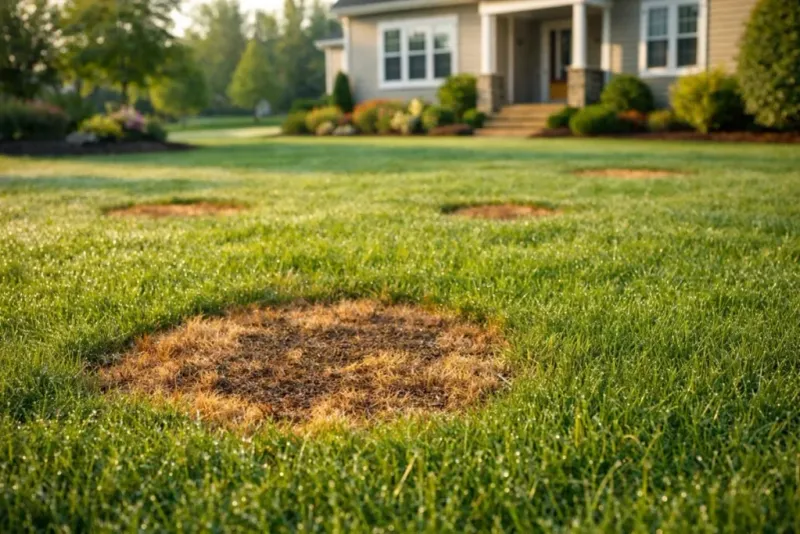
Circular or ringed patches that seem to appear overnight, especially after stretches of warm, humid weather, are worth examining for fungal disease rather than treating with extra water. Spraying or soaking a disease-affected lawn can make conditions worse, not better.
Penn State Extension’s brown patch resource explains that this disease is favored by warm temperatures, wet foliage, and lush turf that has received heavy nitrogen fertilizer. The patches are often circular or irregular, sometimes with a darker ring at the outer edge.
Summer patch, covered in Penn State’s summer patch guide, can look similar to heat or drought stress and is most common on Kentucky bluegrass and fine fescues. In Southern warm-season lawns, large patch is more often associated with spring and fall conditions than the hottest weeks of summer, though timing varies by grass and location, as described in Mississippi State Extension’s large brown patch guide.
Color alone cannot identify a fungal disease. Brown patch, summer patch, drought injury, insect damage, and irrigation failure can produce nearly identical symptoms.
UF/IFAS guidance on fungicide use specifically notes that correct disease diagnosis is necessary because fungicide choices and timing differ by pathogen, and visual diagnosis alone is often unreliable. Applying a fungicide without a confirmed diagnosis wastes money and does nothing for dead roots, broken sprinklers, or insect injury.
A small, isolated dead spot in the exact place where a dog reliably goes to the bathroom is most likely urine injury. Concentrated nitrogen compounds and salts in dog urine can scorch turf quickly.
Colorado State University Extension’s dog urine damage guide specifically rejects baking soda, gypsum, dish soap, and urine-acidifying pet supplements as cures, noting that some can worsen turf damage or harm the animal. The most reliable response is diluting the area with water immediately after the dog uses it.
Choose a Recovery Step Only After You Identify the Evidence
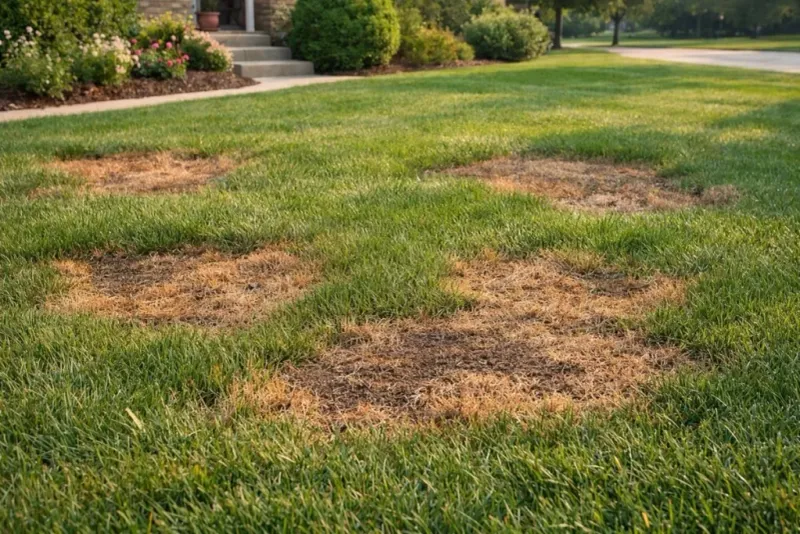
Before spending money on fertilizer, fungicide, insecticide, or extra irrigation, run through a short diagnostic sequence. Start by identifying the grass species, because warm-season and cool-season grasses differ in dormancy behavior, drought tolerance, mowing needs, and disease risk.
Then map the browning pattern: is it uniform across the lawn or concentrated in specific, irregular patches?
Run an irrigation audit if patchy browning points to possible uneven coverage. Check the soil moisture a few inches down and look for drought-stress signals – folded blades, blue-gray color, footprints that stay visible – before adding water.
Inspect for insects at the edge of damaged areas and confirm pest identity and population before treating. University of Minnesota Extension’s turf-browning diagnostic tool and your local cooperative extension office are practical resources when symptoms are ambiguous or overlapping.
Dormant grass may recover on its own once cooler conditions and adequate moisture return. Dead or severely injured turf – where crowns or roots are damaged – will not revive from irrigation alone, and overwatering it risks promoting disease or runoff without improving the grass.
Fertilizing stressed turf without knowing the cause can intensify disease pressure, particularly for brown patch in humid conditions.
Any pesticide you apply must be used according to its label, which is a legal requirement and the clearest safety guide available. EPA guidance on reading pesticide labels covers environmental precautions, pollinator protection, runoff risk, and re-entry intervals.
Local water restrictions also govern when and how much you can irrigate. A brown lawn is a symptom, not a sentence – reading it carefully before acting is the step most likely to produce a green one.