
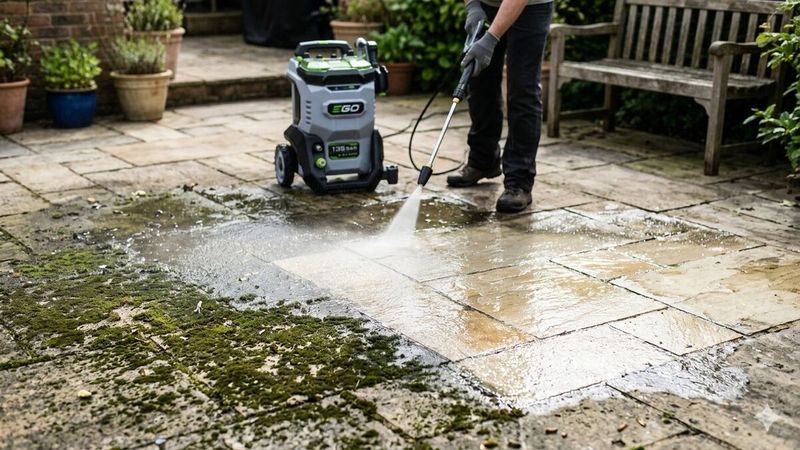
That slick green film spreading across your patio or porch is more than an eyesore. Moss and algae-like growth thrive in warm, damp conditions, and the South gives them plenty of both.
Left alone, the buildup can make outdoor surfaces slippery and harder to clean over time. Household bleach is one low-cost option that may help on some surfaces, but using it safely and correctly takes a few steps most people skip.
That green film may be moss, algae, or something similar
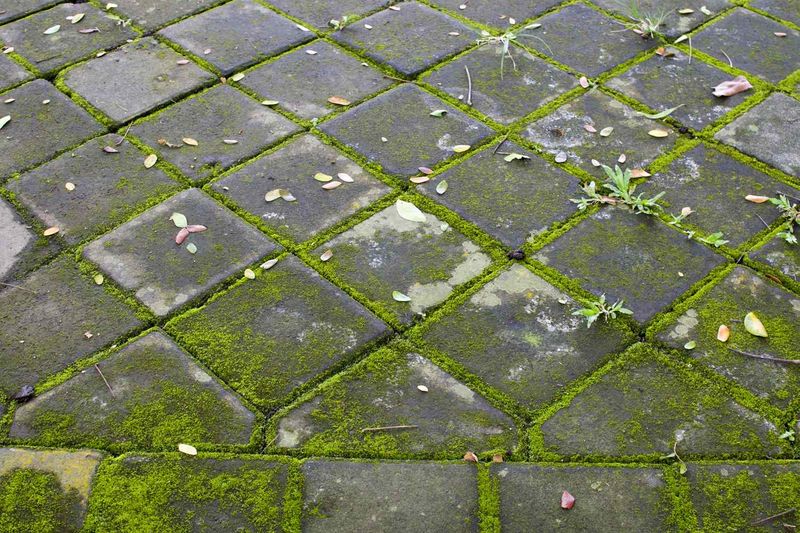
Moss and algae are not the same thing, even though they often show up together on outdoor surfaces. UGA Cooperative Extension describes moss as a small mat-forming plant and algae as threadlike green scum, and both tend to colonize surfaces that stay consistently wet.
The practical problem on a patio or porch is that either one can make walking surfaces dangerously slick.
Appearance alone is not always enough to confirm what you are dealing with. Lichens, mold, mildew, and cyanobacteria can produce green, black, or grayish films that look a lot like moss or algae at first glance.
Because the cleaning approach and surface compatibility can vary depending on the actual growth, this article uses the term “moss and algae-like growth” throughout rather than assuming a specific identification.
Seattle Public Utilities integrated pest management guidance specifically warns that slippery algae on decks or patios can make walking hazardous. That slip risk is the most pressing reason to address the growth on any outdoor hard surface where people walk regularly.
Knowing roughly what you are dealing with helps you choose the right treatment and avoid making the surface worse.
Check the surface and the product before cleaning
Not every cleaning approach works on every outdoor surface. Unfinished concrete and masonry are the surfaces most commonly described in pavement-cleaning guidance, but painted, sealed, or stained concrete, natural stone, composite decking, and wood all have different tolerances for chemical cleaners.
An EPA-registered moss and algae control product label cautions that the product may damage newly painted surfaces, which is a clear reminder that pavement guidance does not automatically transfer to every finish. Before applying any treatment, read the specific product label and look for a list of approved surfaces.
If the label recommends testing an inconspicuous area first, do that before treating the whole patio.
Surface type matters, but so do the site conditions that let growth get established in the first place. UGA Cooperative Extension identifies wet and humid conditions as key contributors to moss and algae establishment, and a cleaner alone will not fix a surface that stays perpetually damp.
Moisture, shade, poor drainage, and irrigation overspray all create the environment that growth needs to return, so note those conditions before you start cleaning.
Sweep away debris before applying anything
Before reaching for any cleaning product, grab a stiff broom and clear the surface. OSU Extension’s pavement guidance recommends sweeping away leaves, soil, and loose debris as the first step in the process.
Skipping this puts your cleaner in contact with a layer of organic material instead of the growth itself, which wastes product and reduces effectiveness.
A good sweep also exposes the full extent of the moss and algae-like growth so you can see exactly where treatment is needed. Thicker patches, edges along borders, and spots near downspouts or shaded corners often hold the most buildup.
Knowing where the problem concentrates helps you apply treatment more deliberately rather than guessing.
Keep this preparation step separate in your mind from the mechanical removal that comes after treatment. Sweeping before application clears the way for the cleaner to reach the growth.
Brushing, scraping, and rinsing after treatment removes the dead or loosened material that remains. Both steps matter, and doing one does not substitute for the other.
Bleach may help on suitable pavement and hard surfaces
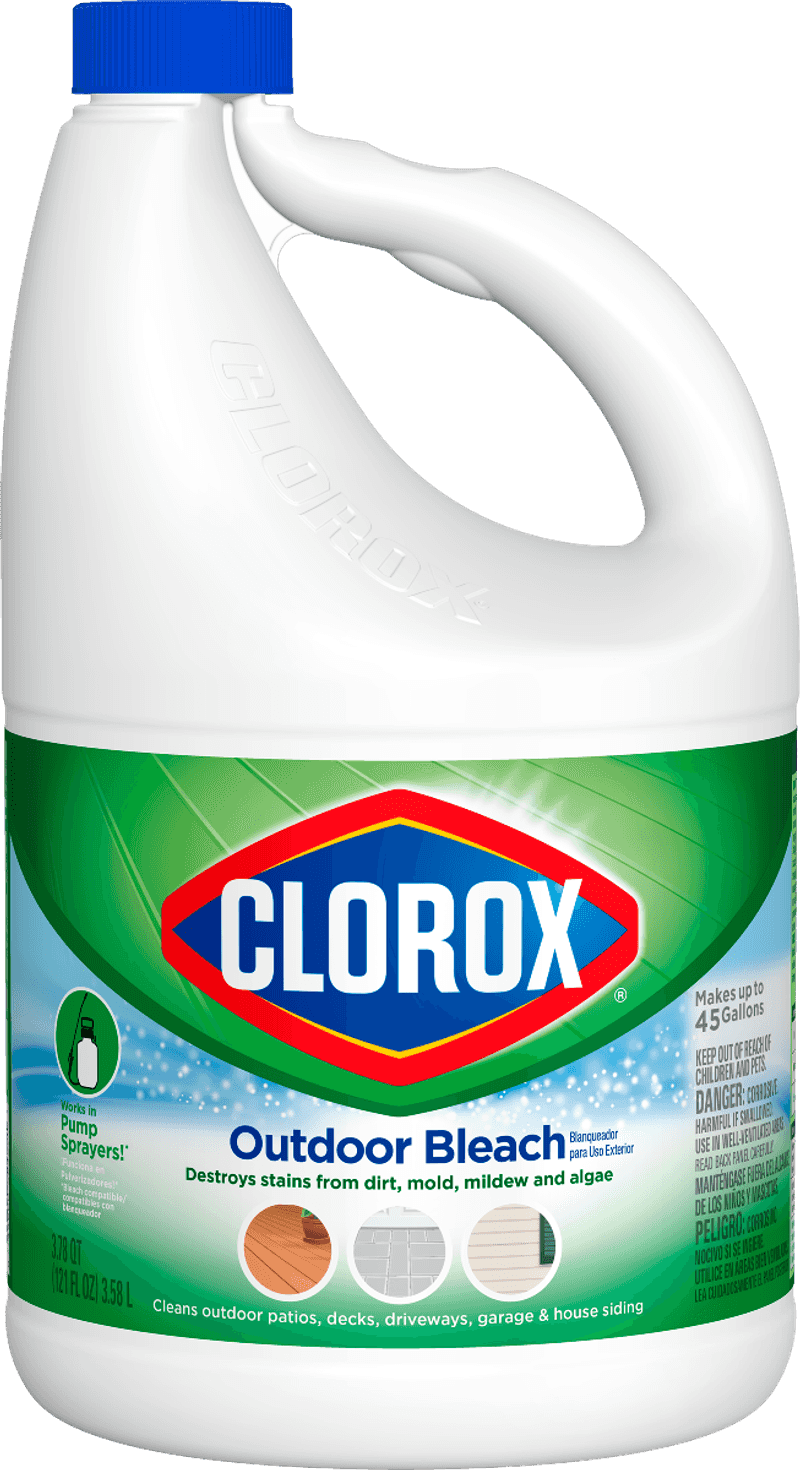
OSU Extension’s guidance on moss and pavement describes bleach as a treatment option that can kill or loosen moss and algae on suitable outdoor surfaces before mechanical removal. That is the foundation of the “cheap fix” premise: regular household bleach is widely available and costs very little.
On compatible surfaces, it may do useful work as one step in a broader cleaning process.
The word “may” carries real weight here. Bleach is not a guaranteed one-step solution, and it is not a permanent cure.
Product concentrations and formulations vary considerably, so there is no single bleach-to-water ratio that applies to every bottle on the shelf. CDC guidance on bleach use advises choosing regular, unscented bleach when appropriate and following the exact directions on the bottle, including any instructions about protective equipment and ventilation.
Scented, color-safe, splashless, and detergent-added bleach products are not interchangeable with regular unscented bleach.
Check whether the specific product you plan to use actually lists outdoor moss or algae treatment as an approved use. An EPA-registered sodium hypochlorite label is product-specific evidence, not a blanket authorization for every household bleach formulation.
Use only a product whose label fits your intended surface and application, and follow that label exactly rather than relying on a recipe found online.
Protect plants, people, and waterways

Bleach can damage nearby plants even in diluted form, so cover any vegetation close to the treatment area before you start. OSU Extension specifically recommends covering nearby plants as a precaution before applying bleach to pavement.
Plastic sheeting or old tarps work well for this. Do not assume that the runoff from rinsing will be dilute enough to be harmless to vegetation once it reaches garden beds or lawn edges.
Runoff control matters beyond the garden border. Keep bleach-containing treatment water and rinse water out of storm drains, ponds, streams, fish habitats, and other waterways.
The EPA label for a concentrated sodium hypochlorite product warns that the product can harm aquatic organisms. That warning is product-specific, but the practical precaution applies broadly: bleach-containing water should not drain into any waterway or storm-drain system.
The most important safety rule has no exceptions. Never mix bleach with vinegar, ammonia, acids, detergents, or any other cleaner.
CDC guidance on bleach states clearly that mixing bleach with other cleaners can release dangerous vapors, and a CDC MMWR report specifically identifies bleach-and-vinegar and bleach-and-ammonia combinations as capable of generating chlorine or chloramine gases. Even if a separate cleaning tip suggests combining bleach with dish soap, do not do it.
Use bleach only as directed on its own label and keep it away from every other product.
Brush and rinse away the loosened growth
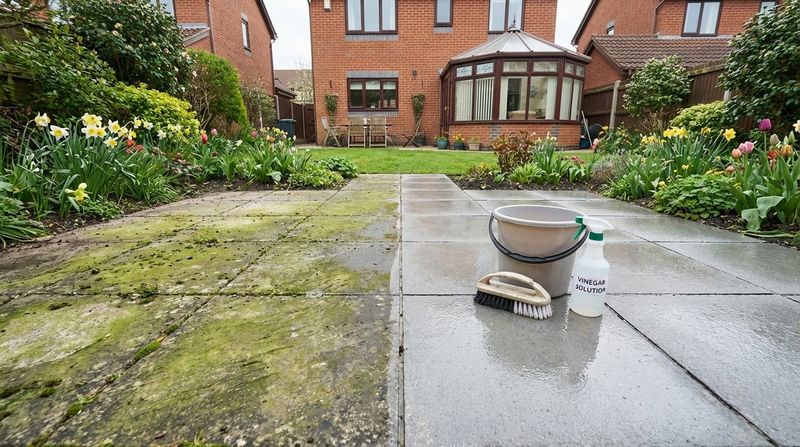
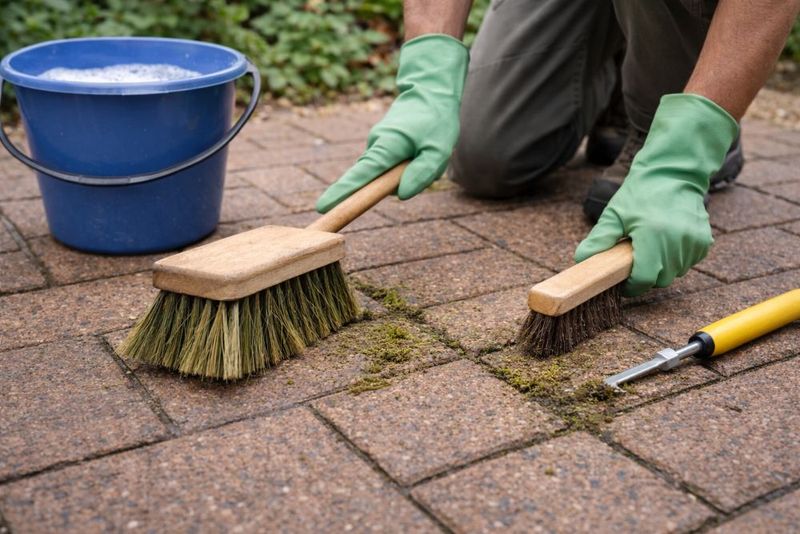
Killing or weakening moss and algae-like growth and actually removing it from the surface are two separate jobs. OSU Extension’s pavement guidance explicitly includes mechanical removal after treatment, recommending a hose, stiff brush, or flat scraper to clear away dead or loosened material.
Waiting for the treatment to work and then skipping the scrubbing step leaves visible residue behind and does little to address the slip hazard.
Work methodically across the treated area with your brush or scraper, then rinse thoroughly with a hose. Direct the rinse water away from storm drains, garden beds, and any nearby waterway.
Complete removal of the slippery buildup may reduce the slip hazard the growth created, but the surface condition, residual moisture, and any remaining organic film also affect traction. Bleach does not chemically improve grip on a surface.
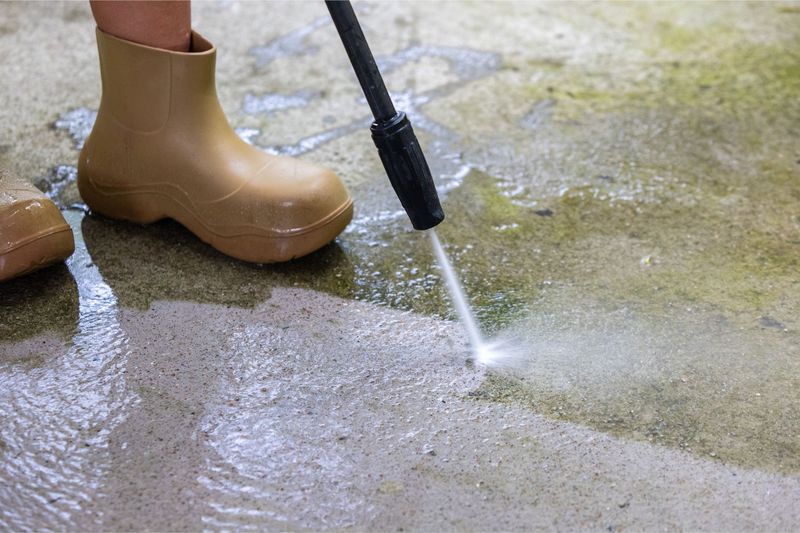
Pressure washing is sometimes suggested as a faster alternative, but faster does not mean better. American Concrete Institute guidance on cleaning methods notes that pressure washing must be matched to surface conditions, and excessive pressure or poor technique can mark or damage some concrete finishes.
If you use a pressure washer, start at a lower setting and keep the nozzle moving to avoid concentrating force in one spot. Control the runoff the same way you would with any other rinse water.
Fix the damp conditions that bring growth back
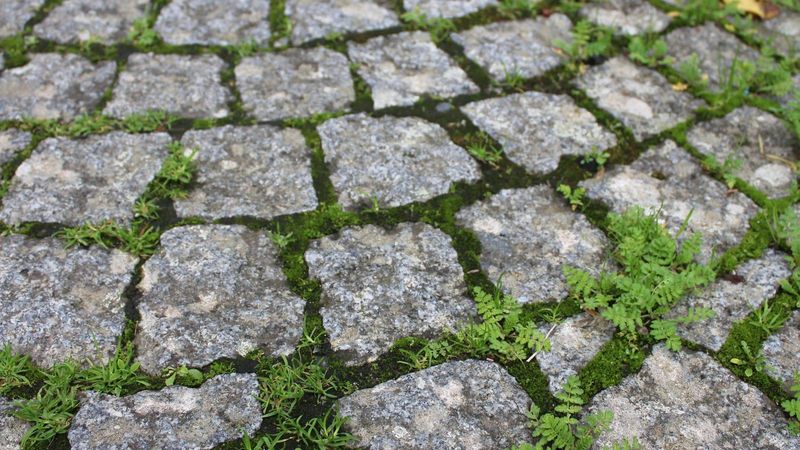
Chemical treatment buys time, but it does not solve the underlying problem. UGA Cooperative Extension notes that wet, humid conditions are key contributors to moss and algae establishment and that chemical suppression remains temporary when those conditions persist.
If the surface stays damp, shaded, and poorly drained, the growth will return regardless of how thoroughly you cleaned it.
Several practical corrections can reduce how quickly growth comes back. OSU Extension recommends redirecting sprinklers so irrigation does not wet the pavement, improving drainage so water does not pool or linger, and increasing available sunlight where it is feasible to do so by trimming overhanging branches or nearby shrubs.
Avoiding repeated unnecessary wetting along the patio or porch edge also helps slow regrowth.
For homeowners in Florida and Texas, warm, rainy, overcast, or humid stretches of weather can create favorable conditions for moss and algae-like growth on outdoor surfaces. Texas A&M AgriLife Extension notes that extended rainy, overcast, and warm weather encourages algal scum.
Those conditions are common across much of the South, but they vary by location and by the specific layout of your yard. A shaded north-facing porch with slow drainage will almost always see faster regrowth than an open, sunny slab with good slope.
Use this process as temporary control, not a miracle cure
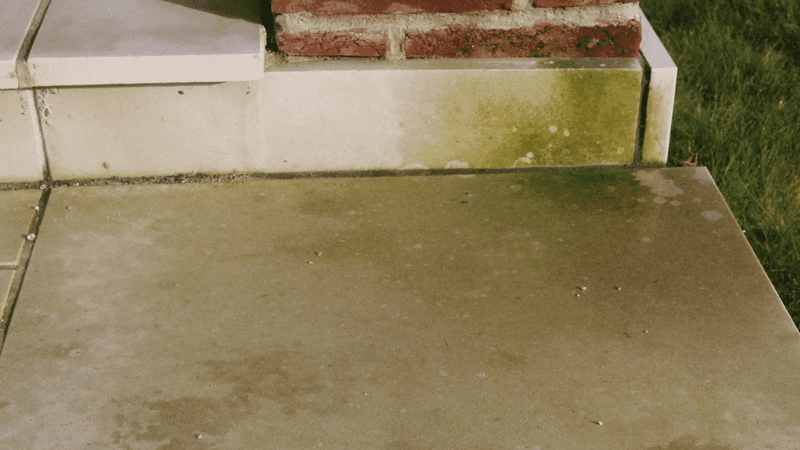
Pulling this process together in order makes it more effective and safer. Identify the growth and confirm your surface type, sweep the area clear of debris, check that your specific product and its label permit the intended use and surface, apply bleach following the label exactly, protect nearby plants before you start, and never mix bleach with any other cleaner.
After the treatment has had time to work, brush or scrape away the loosened material, rinse thoroughly, and keep the runoff out of drains and waterways.
Effective removal of slippery buildup may reduce the hazard that growth creates, but bleach does not chemically improve surface traction. OSU Extension and UGA Cooperative Extension both make clear that regrowth is likely when moisture and shade conditions remain unchanged, so correcting the site is part of the job.
Cracking, spalling, settlement, or other structural concrete damage is a separate maintenance issue that cleaning will not address, and patio surface treatment should never be confused with lawn moss control, which involves different products, soil conditions, and plant concerns.
A clean, dry patio is always a moving target in a warm, humid climate. The process works best when you treat it as seasonal maintenance rather than a one-time fix.