
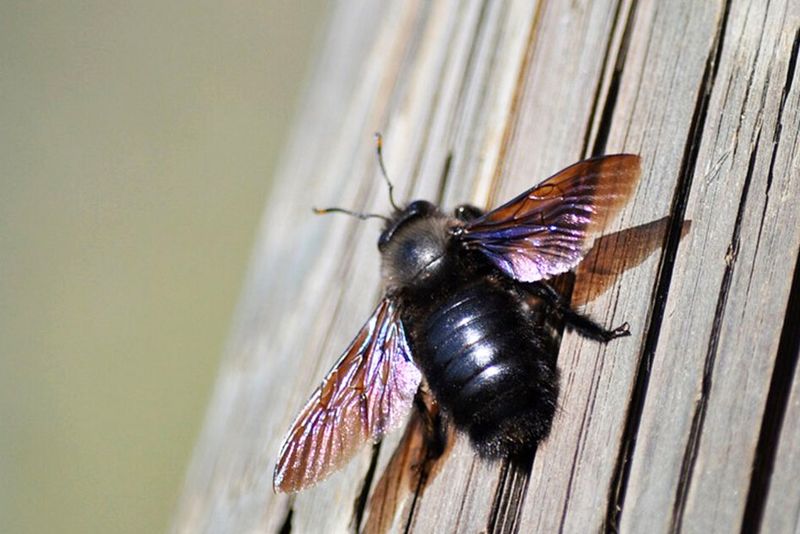
Every spring, North Carolina homeowners spot large, shiny black bees hovering around the same porch rail or eave they damaged last year, and the year before that. The bees are not coming back out of spite or memory.
The wood itself is what keeps drawing them. Understanding why the same spots get drilled again and again is the first step toward protecting your home without declaring war on a native pollinator.
Identify the Large Carpenter Bee Before You Treat the Wood
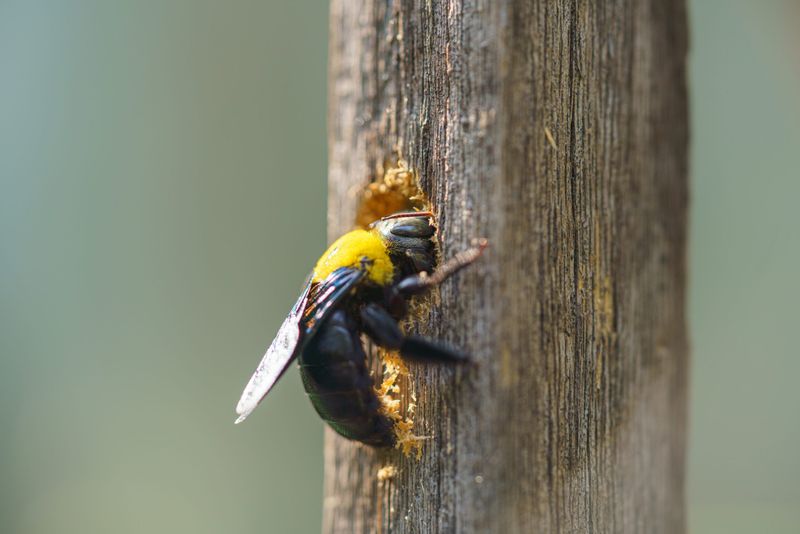
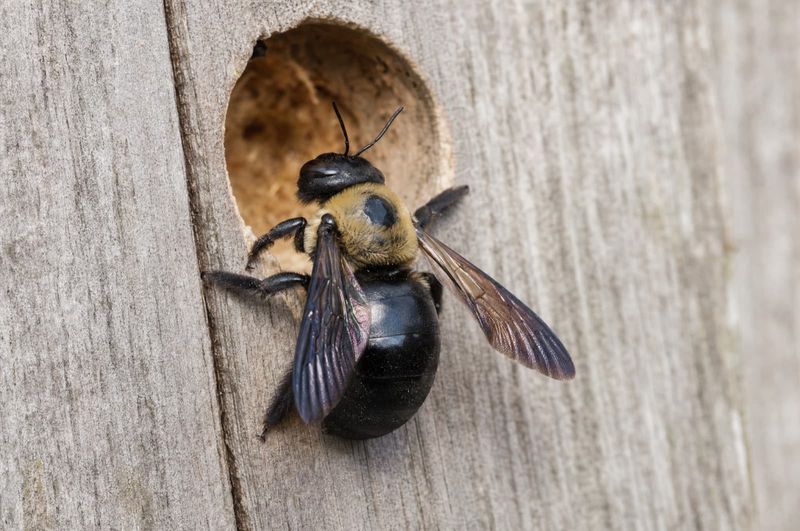
Before reaching for any product or calling anyone, make sure you know what you are actually dealing with. The bee doing structural damage to North Carolina porches, eaves, fascia boards, and deck rails is almost certainly a large carpenter bee, most often the eastern carpenter bee (Xylocopa virginica).
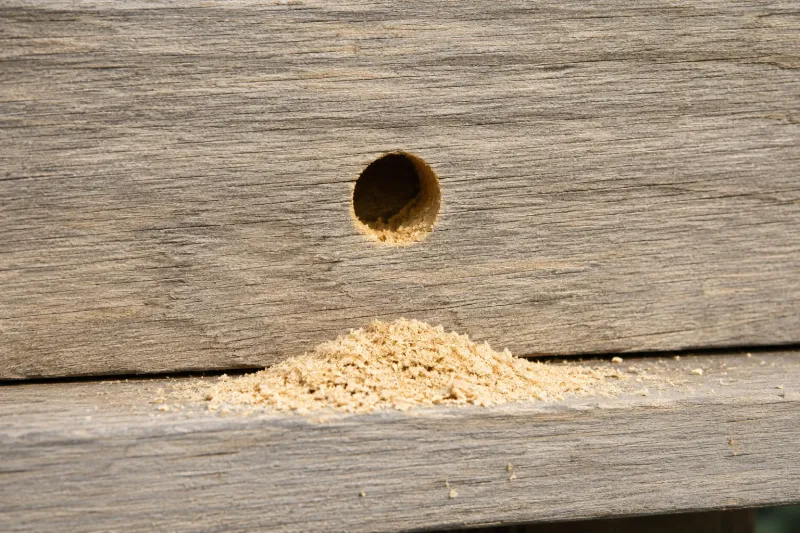
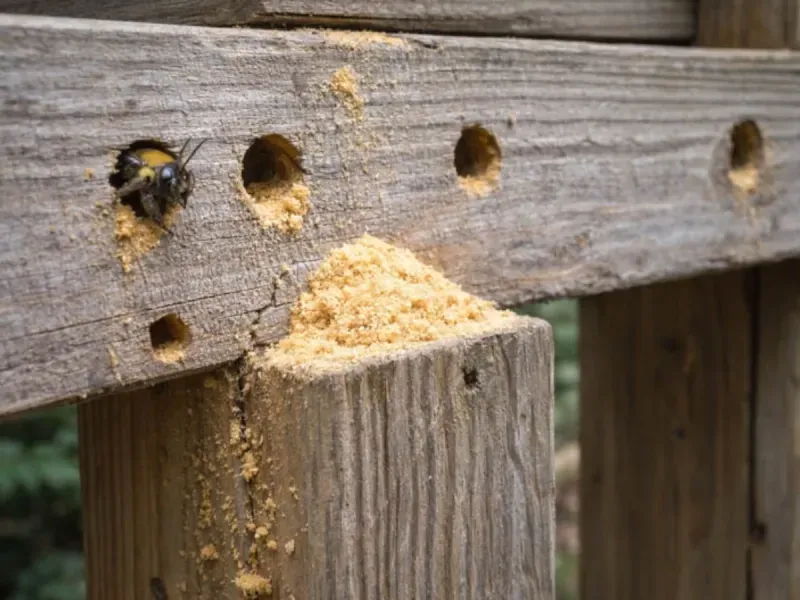
These are robust, roughly bumblebee-sized insects, but unlike bumblebees, the top of their abdomen is shiny and mostly bare rather than fuzzy. NC State Extension’s guide to non-honeybee stinging insects notes that the nearly circular entrance hole is about one-half inch in diameter, and you will often see fresh sawdust or a yellowish-brown stain on the wood surface directly below an active entrance.
Not every large black bee hovering near your porch is boring into the structure. Male carpenter bees are territorial and will dart and hover aggressively around nest areas, but they cannot sting.
Females can sting, though they are generally defensive rather than actively aggressive and are most likely to sting if handled or directly threatened. A bee patrolling the air near a railing may simply be guarding a territory or foraging nearby, not necessarily excavating fresh wood.
Large carpenter bees are also not the same as the small carpenter bees in the genus Ceratina that are common across North Carolina. NC State’s resource on small carpenter bees explains that these much smaller bees nest in pithy or damaged plant stems, such as rose canes, blackberry, sumac, or elderberry, and do not create the large entrance holes associated with structural damage.
If you are seeing tiny bees near cut stems in the garden, that is a separate situation entirely.
In North Carolina, large carpenter bees typically emerge and begin nesting activity in April and May, though some activity can continue later in the season depending on location and conditions. That spring window is when the familiar hovering and fresh sawdust are most noticeable, but confirming an active hole before taking any action will save you time and keep the response proportionate.
Established Galleries Make the Same Spot Available Again
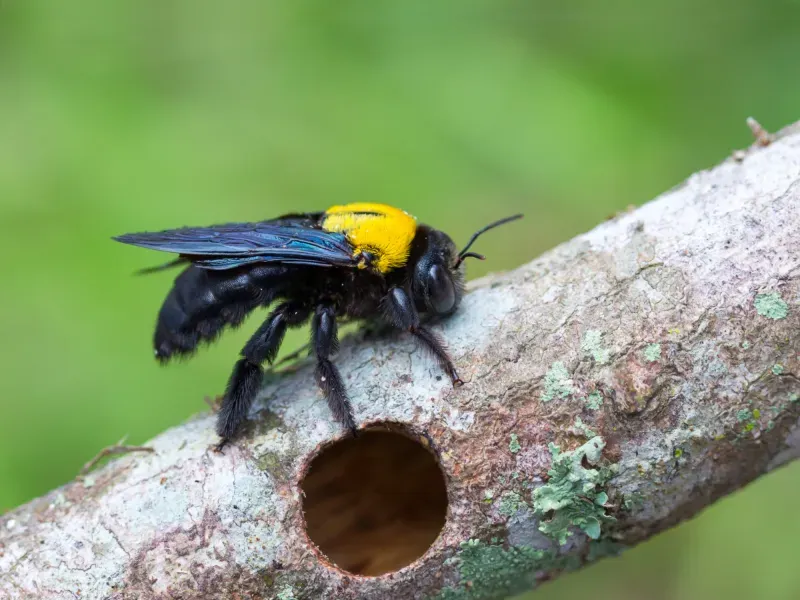
The reason the same rail or fascia board gets drilled spring after spring is not random. University of Maryland Extension’s carpenter bee resource explains that adult carpenter bees commonly overwinter inside existing tunnels, and females may return to or reuse the gallery where they developed.
Later generations can enlarge those same passages, extending them deeper into the wood over successive seasons.
Building a new gallery from scratch takes real work. A female must chew through solid wood to create an entrance shaft and then turn to excavate a horizontal tunnel where she will provision and seal individual egg cells.
An established gallery eliminates much of that labor, making an old tunnel a genuinely attractive option compared to starting over in fresh wood. This is the core reason the same spot keeps showing damage: the wood is already prepared and ready to use.
Penn State Extension’s profile of the eastern carpenter bee reinforces that repeated use of the same gallery by multiple bees across multiple seasons is normal behavior, not a sign that bees are unusually drawn to one particular house for some other reason.
The damage risk from this pattern is real but gradual. A single tunnel in a sound, thick piece of wood is unlikely to cause a structural emergency.
The concern grows when many bees reuse the same wood over several years, particularly in thin siding, fascia boards, porch ceiling planks, or other components where the wood is not especially thick or load-bearing. Serious structural compromise generally requires long-term, repeated infestation rather than a season or two of activity, so the appropriate response is steady maintenance rather than alarm.
Exposed Wood May Add Nesting Opportunities Near the House
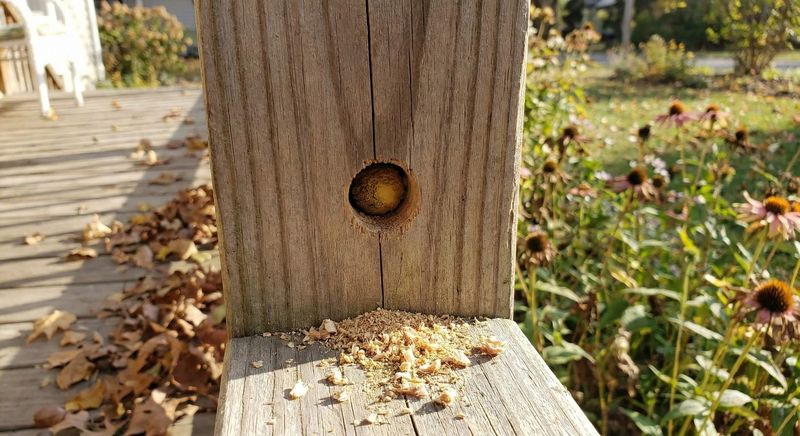
Here is the reframe that changes how most homeowners think about this problem. The yard itself may be quietly supplying nesting opportunities, and the most relevant yard habit is not what you plant but what wood you leave exposed near the house.
Raw, weathered, unfinished, cracked, splintered, softened, or dead wood can all provide suitable conditions for large carpenter bees looking for a place to nest.
That includes more than just the house. Old fence rails, untreated pine or cedar garden structures, wooden pergolas, decorative log borders, stumps, snags, brush piles, and aging outdoor furniture can all offer nesting habitat close to a home.
NC State Extension and Penn State Extension both identify exposed and weathered wood as the primary nesting attractant, not the flowers or plants growing nearby. Carpenter bees excavate wood for nesting; they do not eat it.
Flowers do matter to carpenter bees, but in a different way. Blooms provide pollen and nectar, and a garden full of flowering plants may support more foraging activity in the general area.
What the reviewed evidence does not establish is that a particular flowering plant causes carpenter bees to select a specific porch rail, fascia board, or deck component as a nest site. Food habitat and nesting habitat are two separate things, and conflating them leads to responses that miss the actual problem.
A wildlife-aware yard can absolutely keep dead wood, logs, and snags for native insects and other wildlife. The practical adjustment is separation.
University of Maryland Extension suggests that the relationship between exposed wood and carpenter bee activity is about available nesting conditions rather than a single definitive cause. Moving natural dead-wood habitat away from the house and keeping structural wood maintained reduces the overlap between what bees need and what the home is inadvertently offering.
The yard may be supplying nesting wood without the homeowner ever realizing it.
Inspect the Wood That Offers the Easiest Access
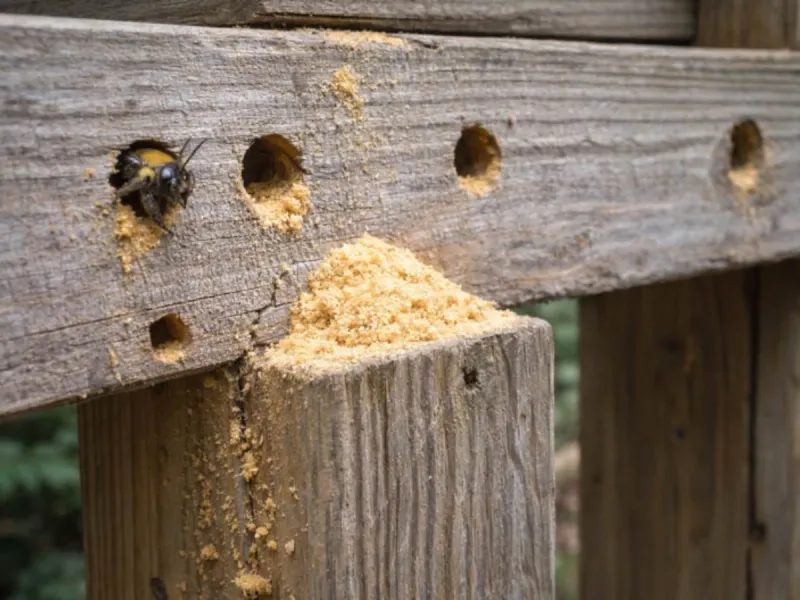
Walking the perimeter of your home with fresh eyes and a good flashlight can reveal more than you might expect. Start at the top: eaves, soffits, fascia boards, and porch ceilings are among the most common targets because they often go unpainted on their undersides and are sheltered from rain, which accelerates weathering.
Work your way down to railings, siding, deck boards, pergola beams, sheds, fences, and any outdoor wooden furniture that has been sitting in place for more than a season or two.
Look for the diagnostic signs: nearly circular holes about one-half inch across, fresh sawdust directly below an entrance, and yellowish-brown staining on the wood surface. Probe soft spots and splinters with a screwdriver.
University of Maryland Extension recommends paying particular attention to wood that is thin, weight-bearing, or difficult to replace, since repeated tunneling in those components carries more consequence than activity in a decorative piece that can be swapped out easily.
Try to distinguish a likely active entrance from an old, inactive hole. An active entrance typically has fresh sawdust and may show bee traffic during warm parts of the day.
An older hole that has not been used recently will often look weathered around the edges with no fresh debris. This distinction matters because the timing and method of your response depends on whether the nest is currently occupied.
Penn State Extension also notes that any logs, brush piles, snags, or optional nesting boards placed near the house should be relocated away from high-traffic areas and away from structural wood you want to protect. Nearby exposed wood can provide an opportunity for carpenter bees without being the single definitive reason they chose a particular location, so separating habitat from the house is a sensible step regardless of how confident you are about the cause.
Repair and Finish Vulnerable Wood Before the Next Nesting Push
Wood that has been repaired, filled, and finished is a less inviting target than wood that is cracked, splintered, or bare. That basic fact drives the prevention sequence that extension sources consistently recommend.
Start by replacing any wood that is genuinely rotted, soft, or so badly weathered that paint alone cannot restore a sound surface. Patching over compromised wood delays the problem rather than solving it.
Once the surface is structurally sound, fill nail holes, cracks, and other surface openings with exterior-grade caulk or wood filler before painting. University of Maryland Extension and Penn State Extension both note that well-maintained painted or finished surfaces are generally less attractive to carpenter bees than raw or weathered wood.
That said, neither source describes paint as a guarantee. NC State specifically notes that painted and treated wood can still be attacked, so the goal is reducing attractiveness rather than creating an impenetrable barrier.
A coating applied to the outside of a board will not reach or eliminate an established tunnel inside it. If there is already an active gallery, surface treatment is a preventive step for surrounding wood, not a remedy for the existing nest.
Those two jobs require different approaches and different timing.
For routine preventive maintenance, late summer after new adults have emerged is a practical window because the season’s nesting activity has wound down and any treatments or repairs are less likely to trap bees inside. Early spring, before major nest construction begins in April, is another reasonable option.
Neither window eliminates all risk, but both are better than working on wood while a nest is actively in use.
Where replacement makes sense, composite, vinyl, aluminum, or other non-wood materials remove the nesting substrate entirely rather than just making it less appealing. For porch ceilings, fascia, deck components, or railings that have needed repeated repair, a non-wood replacement may be the most durable long-term answer.
Handle Active Holes More Carefully Than an Immediate Plug
Reaching for a tube of caulk the moment you spot a carpenter bee hole is a natural impulse, but it can work against you if the nest is still active. Penn State Extension and University of Maryland Extension both caution that holes should remain open after treatment if the selected control method depends on bees entering the tunnel and contacting a product inside.
Sealing the entrance before that contact happens can prevent the treatment from working and may trap bees inside the wood, where they can chew new exit holes or die and create a secondary problem.
The sequence that makes more sense for an active nest is to apply a product that is specifically labeled for carpenter bees and for the application site, allow time for foraging and returning bees to contact it, and then seal the entrance after activity has stopped. After the hole is confirmed inactive, fill it with wood putty, exterior caulk, or a wooden dowel cut to fit, and finish the surface with paint or stain.
Replacing the affected section of wood entirely is a non-chemical option that removes the established gallery and the surface simultaneously.
Pesticide use around carpenter bee nests requires care on several fronts. Any product must be registered for carpenter bees and for the specific site where you plan to use it.
Follow the label precisely, including any requirements for protective equipment and any restrictions on use near children, pets, ponds, blooming plants, and other pollinator habitat. NC State Extension’s pesticide safety guidance and EPA pollinator protection guidance both emphasize minimizing drift and avoiding applications near blooming plants or water.
Spraying bees that are flying or hovering near the porch is not a useful strategy and is not what any label is designed for.
Some locations simply call for professional help. High eaves, soffits reached only by extension ladders, structurally important beams, or situations where a dust formulation needs to be applied inside a tunnel are jobs where a licensed pest-control professional has the right equipment and training to work safely.
The cost of a professional visit is almost always less than the cost of a fall or an improperly applied pesticide.
Protect the House Without Treating Every Bee as the Enemy
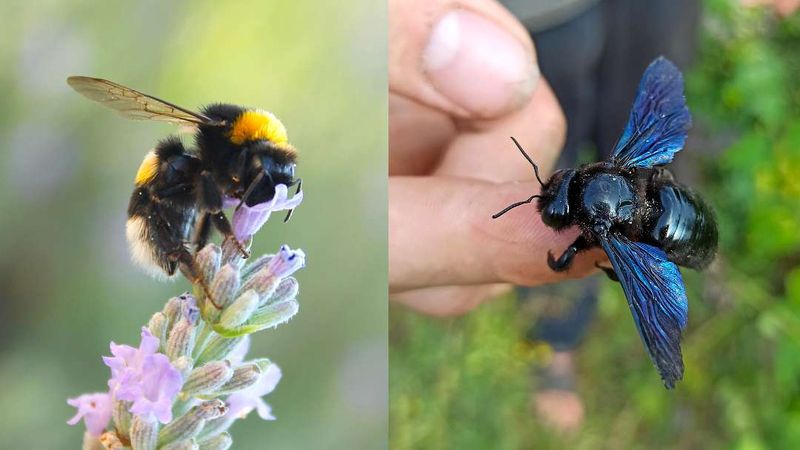
Carpenter bees are native pollinators with a legitimate role in North Carolina’s landscape. They are effective pollinators of open-faced flowers and buzz-pollinate plants that honey bees cannot, including some vegetables and native wildflowers.
When they are using a fallen log or a worn fence post that does not matter structurally, the most reasonable response is often to leave them alone or redirect them rather than eliminate them.
Penn State Extension suggests that placing an untreated pine or cedar board away from the house may redirect some nesting activity, and this is worth trying as a coexistence experiment. Position the board away from high-traffic areas and well away from structural wood you want to protect.
Keep realistic expectations: this is an optional strategy that may reduce conflict in some situations, but it can also simply add nesting habitat, and it is not a substitute for repairing or finishing the vulnerable wood on the house itself.
Carpenter bee traps are available and occasionally mentioned as a management option. Extension sources describe their effectiveness as inconsistent, and some guidance notes that traps may disproportionately catch males, which cannot sting and are not the ones excavating wood.
Traps should not replace wood repair or a professional assessment of an established nest.
There are situations where protecting the home takes clear priority over coexistence. Repeated tunneling in thin fascia boards, porch ceiling planks, weight-bearing components, or wood in a location that creates a safety or access problem warrants a more direct response.
Extensive activity across multiple seasons in the same structural wood, or a nest that cannot be safely reached for repair, are also reasonable reasons to bring in professional help. The goal is a calibrated response: protect what needs protecting, and extend reasonable tolerance where the stakes are low.
Start With the Nesting Wood, While Keeping Flowers in Their Proper Role
Pulling the whole picture together comes down to one practical priority: the wood. NC State Extension and Penn State Extension both point to exposed, weathered, and unfinished wood as the primary condition that makes a structure attractive for nesting.
Start by confirming that the large eastern carpenter bee is what you are dealing with, then inspect the wood it may be reusing. Move any optional dead-wood habitat, logs, or brush piles away from the house and away from structures you want to protect.
Repair and finish vulnerable surfaces at an appropriate time, and get professional help before attempting to treat a difficult active nest yourself.
Flowers are worth keeping in their proper role. A yard with native blooms supports carpenter bee foraging and benefits the broader pollinator community, but planting or removing flowers is not what determines whether bees select a specific fascia board or porch rail as a nest site.
University of Maryland Extension is clear that nesting location is driven by suitable wood, not by what is blooming nearby. You can support native pollinators in the garden and protect your home’s wood at the same time.
The two goals point in the same direction: manage the nesting habitat thoughtfully, and let the flowers do what flowers do.